Guest Column: Decriminalization A Step In The Wrong Direction by Representative Mary J Fitzgerald, District 31

Decriminalization A Step In The Wrong Direction
by Representative Mary J Fitzgerald, District 31

Effective July 1, 2025, Senate Bill 83 will decriminalize the use of controlled substances like fentanyl, fentanyl mixed with xylazine-the so-called zombie drug, heroin, cocaine, methamphetamine, PCP, and all other dangerous drugs. This is why I voted against the bill. It is not good for our children, and it is not good for South Dakota.

Effective July 1, the new law reduces the penalty from a felony to a misdemeanor for those convicted of ingesting dangerous drugs. This approach may encourage some offenders to swallow dangerous drugs when they are encountered by law enforcement to avoid a felony possession charge and significantly increase the risk of overdose. The change in this law in South Dakota will have negative consequences and will not deter this crime.

More significantly, individuals can be convicted for using dangerous drugs a number of times before the crime is a felony conviction and even then, it’s a probationary offense. First and second offenses will be a misdemeanor charge. Third and fourth offenses are felony charges but under our law the offender is still eligible for a deferred imposition of sentence, and/or a suspended imposition of sentence. Under a deferred imposition of sentence, if the offender completes probation for one year without violation the charge is reduced to a misdemeanor. Under a suspended imposition of sentence if the probationer is successful on probation the charges are dismissed, the file sealed, and the felony conviction is erased.

Potentially, by the time it becomes a fifth offense, the offender will be become a convicted felon. But the crime is then reduced from a Class 5 felony to a Class 6 felony, the lowest grade felony in South Dakota. Under our law, a Class 6 felon is still entitled to a presumption of probation and offenders will not serve time in prison but will receive probation. Decriminalizing drugs does little to deter drug use and it does nothing to stop offenders from using drugs.

Addictive drugs and substances that are outlawed are outlawed for good reasons because there is a link between drug use, health problems and crime. Crimes like theft, forgery, robberies and burglaries are linked to drug abuse. The new more powerful methamphetamine produced by the cartels is linked to psychosis and can result in schizophrenia. The use of fentanyl-xylazine combination is linked to severe wounds including necrosis that may lead to amputations. Fentanyl and heroin overdoses and deaths continue to rise.

A quick look at other states, such as Oregon, proves that the decriminalization approach is not effective. Oregon was the first state in the nation to decriminalize small possession amounts of dangerous drugs. But Oregon reversed its decision in September 2024, after noting increases in crime, homelessness and the deterioration of families. Oregon now serves as an example that decriminalizing is not the way to reduce drug abuse.

Senate Bill 83 undermines the work at the border. We are trying to stop drugs from entering the United States. U.S. Attorney General Pam Bondi and FBI Director Kash Patel, under the direction of President Trump, are working tirelessly to stop the flow of illegal drugs into the United States. The FBI reports that fentanyl and other illegal narcotics are killing an American citizen every seven minutes. Now is not the time to decriminalize drugs.

Reducing this crime from a felony to a misdemeanor is a ploy. It was sold to the legislature as a way to reduce prison population. But it will do little to reduce incarceration rates. There is nothing wrong with our current law. We already have two forms of leniency in place—a suspended imposition of sentence and a deferred imposition of sentence. A felony conviction is only handed down after multiple, deliberate violations of the law and probation violations. This ensures that individuals have ample opportunity to change their behavior before facing a felony conviction.

.

Gov Rhoden signs bill to improve funding for Tech Schools

From Twitter:

Attorney General Jackley, AG Coalition Asks Trump Administration To Close Loophole Used For Fentanyl Shipments

Attorney General Jackley, AG Coalition Asks Trump Administration To Close Loophole Used For Fentanyl Shipments

 PIERRE, S.D. – South Dakota Attorney General Marty Jackley has joined 25 other Attorneys General in asking the Trump Administration to close a loophole used by drug traffickers to ship Fentanyl into the United States.

South Dakota law enforcement at all levels seized 18.2 pounds of Fentanyl in 2024, enough to cause the death of every South Dakotan four or five times over,” said Attorney General Jackley. “We need the Trump Administration’s help to stop Fentanyl from coming across our borders and into our states.”

In a letter to U.S. Secretary of Homeland Security (DHS) Kristi Noem and Acting Commissioner of U.S. Customs and Border Protection (CBP) Pete Flores, the Attorneys General call for greater scrutiny of an import pilot program called Entry Type 86, which allows small packages to enter the U.S. with minimal customs screening. The Attorneys General are concerned that the program is being used to ship Fentanyl into the United States.

Kentucky Attorney General Russell Coleman sent the letter along with Attorneys General from the states of Alabama, Arkansas, Florida, Georgia, Indiana, Iowa, Kansas, Louisiana, Mississippi, Missouri, Montana, Nebraska, New Hampshire, North Dakota, Ohio, Oklahoma, Pennsylvania, South Carolina, Tennessee, Texas, Utah, West Virginia and Wyoming.

The letter can be found here:

-30-

Project Prison Reset to Hold First Meeting

Project Prison Reset to Hold First Meeting

PIERRE, S.D. – This Wednesday and Thursday will mark the first meeting of Project Prison Reset. You can find the full agenda for the meeting here.

Media outlets are encouraged to attend the sessions on Thursday, April 3, 2025, beginning at 8:00 am CT/7:00 am MT at the South Dakota Military Heritage Alliance, Inc., 1600 W Russell St, Sioux Falls, SD 57104.

Project Prison Reset will be chaired by Lt. Governor Tony Venhuizen, who will be available for media interviews upon request following the Thursday sessions. The task force was announced by Governor Larry Rhoden in February.

Following this week’s meeting, upcoming Project Prison Reset meetings will take place as follows:

  • Tuesday, April 29, 2025, in Springfield;
  • Tuesday, June 3, 2025, in Pierre; and
  • Tuesday, July 8, 2025, in Sioux Falls.

WHAT: Project Prison Reset to Hold First Meeting
WHEN: Thursday, April 3, 2025, at 8:00 am CT/7:00 am MT
WHERE: South Dakota Military Heritage Alliance, Inc., 1600 W Russell St, Sioux Falls, SD 57104
LIVESTREAM: sd.net

###

In case you were wondering who is behind South Dakota Voices, here’s what I’m hearing.

A few people have asked me in prior months “Who is writing the South Dakota Voices website.”  It’s a substack with what seems to be a lot of AI generated nonsense purporting to be commentary on South Dakota.  I get asked, because of their goofy takes on political issues, such as advocating for all farm subsidies to be eliminated:

Many of the problems appear to be from agricultural runoff and waste. In addition, farming communities are facing all kinds of stresses as consolidation occurs and there are fewer people on the farms, in schools, and on main street.

Is there something the state can do to make the farming business more profitable and more accessible to younger people? Is removing the subsidies and allowing the market to work one of the solutions?

Read that here.

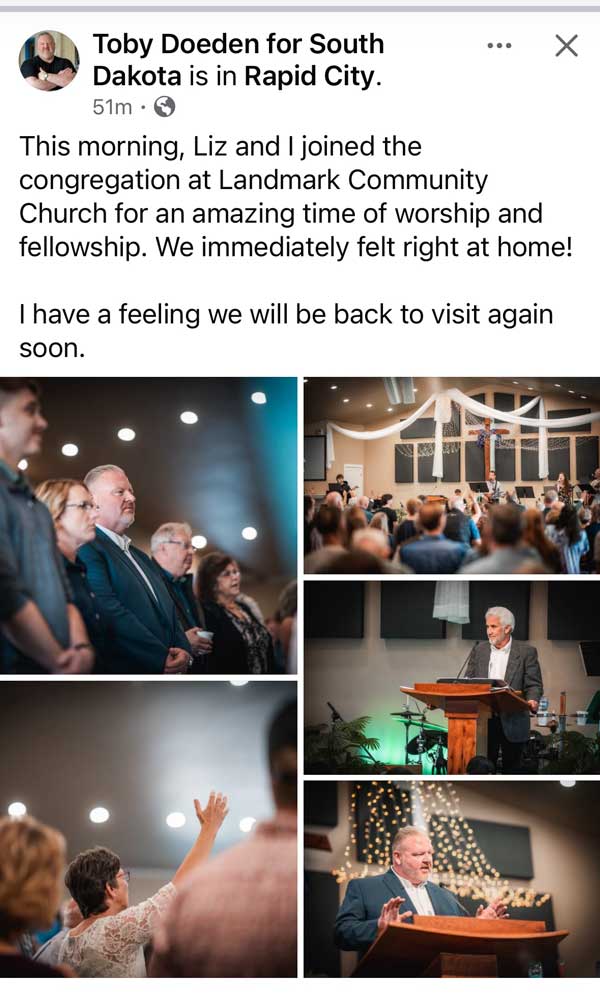
So, this last weekend, at the Doeden-fest event this last weekend in Spearfish, where citizens for liberty types came to an event to be talked at by Doeden.. and which humorously seemed to be taken over by Mary Fitzgerald and Sam Kephart, I’m told there was a live video at the event where participant Katie Hoffman pointed out that Juliann Talkington is the author of South Dakota Voices.

Have you heard that name before? Of course you have.  Talkington was the person who didn’t know how to send out e-mail for the 2024 No on Amendment H group:

If you recall, on behalf of No on H, Talkington was the one who sent an e-mail out to every person on the SDGOP’s mailing list of over 400 Republican County Officials, Donors, and Convention attendees out to the world and then CC’d them all, so everyone who received it received a copy of the SDGOP’s e-mail list.  At the time, she released the SDGOP’s mailing list to the wild.

Now if what I’m hearing is correct, she’s in the clickbait business with such gems as:

Even though there was really appears to be no reason for concern, the measles vaccine was introduced in 1962.

Since that time, a lot of other vaccines have been introduced. Is the data similar? Is the real point to inject people so they become sick with other illnesses? Something else? Why did Congress limit liability for vaccine makers?

Read that nonsense here.

From releasing SDGOP resources to the wild to clickbaiting with goofy AI generated nonsense. This is what passes for South Dakota political leadership these days.

Advertise your business, campaign, or cause at South Dakota War College.

With the end of the legislative session, a number of advertisers have completed their run, so SDWC has advertising opportunities for reaching South Dakota’s opinion leaders based on a first-come, first-serve basis for available positions. South Dakota War College just celebrated our incredible 20th anniversary of keeping an eye on political leaders, and offering commentary from a conservative Republican point of view. With politics continuing to be controversial and directly affecting people’s day to day lives – they’re watching what happens more than ever! Advertisers – I have a number of spots open, and questions on ad prices, ad positions, and ad commitments may be directed to the webmaster by clicking here. Lots of open space available at the moment, such as the #1 spot on the left available, as well as spots #2, 3 on the right, and spots on both sides lower on the page. Ads run in their position through the site, meaning they are not rotated.  Advertising is available on a first-come first-served basis, and discounts are provided for extended commitments.

Please also take a moment to visit our long-time advertisers such as our friend and Senate Majority Leader South Dakota Senator John Thune,  Congressman Dusty Johnson, Republican United States Senator Mike Rounds and Summit Carbon Solutions.

Of course, at Dakota Campaign Store, down on the right, you’ll find me getting ready for the elections with yard signs, postcards, and all the things a professional campaign needs to make an impression.

Thank you to our advertisers for your support, and please reach out if you’d like to join them!

Senator Thune profiled by New Yorker Magazine in his new role as Senate Majority Leader. Thune a “Straight Shooter”

New Yorker Magazine has a fairly long article on Senator Thune in his new role as US Senate Majority Leader, as he threads the needle between leading the US Senate Republicans, and being the liason between that group and President Trump.

Regardless of the fact that it’s a somewhat left-leaning publication, they do talk quite a bit about what many South Dakotans know – that despite the trappings of office, how John at his most basic is just a good guy:

Thune, a fourth-term senator from South Dakota, is an awkward leader for Trump’s ruthless Republican Party, in part because even Democrats invariably describe him as amiable and honest. A senior Democratic aide told me that Thune is “incapable of lying.” Kevin Woster, a former reporter for the Sioux Falls Argus Leader who covered Thune for decades, told me that the senator used to hold weekly conference calls with South Dakota journalists. When Thune tried to sell Republican talking points about the perfidy of whatever Democrats were doing, Woster recalled, “I’d ask him, ‘But, John, Republicans really did the same thing, didn’t they?,’ and he’d say, ‘Yeah, we’re really at fault, too. That’s true.’ Who does that?” Before Thune became the Party leader, journalists would crowd the hallway outside his Capitol office. Unlike Mitch McConnell, the taciturn and cunning leader at the time, Thune genuinely tried to answer questions. He was seldom cutting or caustic, and rarely tossed off a memorable line that might begin or end a newspaper article. As a veteran congressional reporter told me, Thune could be counted on for a reliable “middle quote.” A Republican aide who knows Thune described him to me as hypercompetitive but also “Midwestern nice.” (“Southern nice”—like Mike Johnson, the Louisiana Republican who is the Speaker of the House—can be double-edged, as in “Bless your heart!”) Lamar Alexander, a former Republican senator from Tennessee and a friend of Thune’s, noted a contrast between him and the two most recent Majority Leaders, McConnell and the Democratic senator Chuck Schumer: those men are renowned for their guile, and “you don’t think of guile when you think of John Thune.”

and..

In a city aptly described as Hollywood for ugly people, Thune could pass for an actual movie star, with pale-blue eyes, a square jaw, and Mt. Rushmore cheekbones. Now sixty-four, he has salt-and-pepper hair that is still thick enough to part neatly on the side, and the broad shoulders, thick arms, and narrow waist of a basketball player. His morning workouts at the Senate gym are legendary. Until a recent knee injury, Thune held the informal title of the fastest man in Congress. (He has likened that honor to “the best surfer in Kansas.”) The phrases “looks the part” and “central casting” come up in nearly every conversation about him. John McCain, a two-time Presidential contender, used to joke that he would have won the White House had he looked like Thune. The South Carolina senator Lindsey Graham, who liked to respond that McCain’s wife, Cindy, “would be happier, too,” told me that Thune “is a guy you really want to hate—so tall, good-looking, beautiful wife—but you can’t, because he is so genuinely nice.” Some journalists who cover the Capitol have given Thune the nickname Hot Grandpa.

and..

Thune is in some ways a throwback. At a time when cable-news coverage and online donations reward the noisiest partisans, he has built a reputation for quietly working in good faith with Democrats on the committees he has sat on, among them Agriculture and Commerce. Chris Lewis, the chief executive of Public Knowledge, a left-leaning advocacy group, told me that Thune opposed its positions on most issues, but called him “a straight shooter” who looked for “common ground” on such issues as rural broadband access.

Read the entire article here.

Arizona school voucher program triggered hundreds of millions in budget cuts to keep pace with cost

I hadn’t noticed this article during session, otherwise I would have pointed it out.

But well worth tagging it for reading, since there will be legislators coming back for another attempt next year to strip insane amounts of money from school budgets to fund school vouchers without much thought how that’s going to break the back of local school budgets:

…Arizona’s voucher experiment has since precipitated a budget meltdown. The state this year faced a $1.4 billion budget shortfallmuch of which was a result of the new voucher spending, according to the Grand Canyon Institute, a local nonpartisan fiscal and economic policy think tank. Last fiscal year alone, the price tag of universal vouchers in Arizona skyrocketed from an original official estimate of just under $65 million to roughly $332 million, the Grand Canyon analysis found; another $429 million in costs is expected this year.

and..

Advocates for Arizona’s universal voucher initiative had originally said that it wouldn’t cost the public — and might even save taxpayers money. The Goldwater Institute, a conservative think tank that helped craft the state’s 2022 voucher bill, claimed in its promotional materials at the time that the vouchers would “save taxpayers thousands per student, millions statewide.” Families that received the new cash, the institute said, would be educating their kids “for less than it would cost taxpayers if they were in the public school system.”

But as it turns out, the parents most likely to apply for these vouchers are the ones who were already sending their kids to private school or homeschooling. They use the dollars to subsidize what they were already paying for.

The result is new money coming out of the state budget. After all, the public wasn’t paying for private school kids’ tuition before.

Read the entire story here.

Food for thought.

Thune: Senate Committed to Delivering on President Trump’s Agenda

Thune: Senate Committed to Delivering on President Trump’s Agenda

 “I’m looking forward to taking up our budget resolution in the very near future, so that we can deliver permanent tax relief for Americans, provide certainty to the economy, and make a transformational investment in border, energy, and national security.” 

WASHINGTON — U.S. Senate Majority Leader John Thune (R-S.D.) today delivered the following remarks on the Senate floor:

Click here to watch the video.