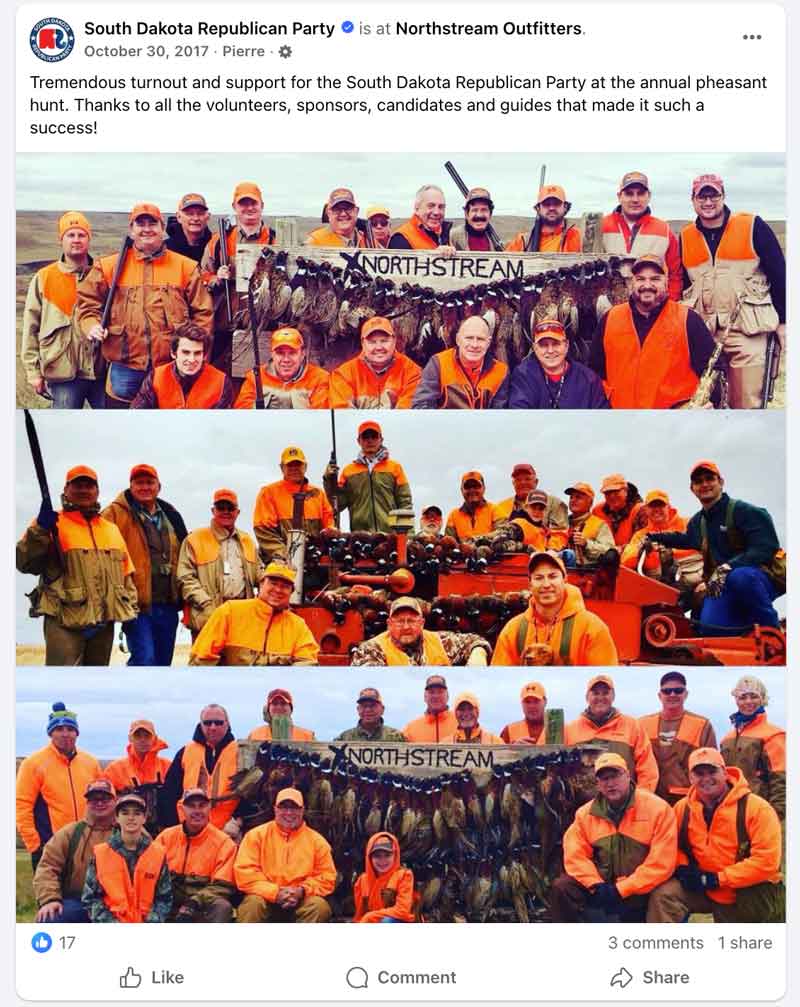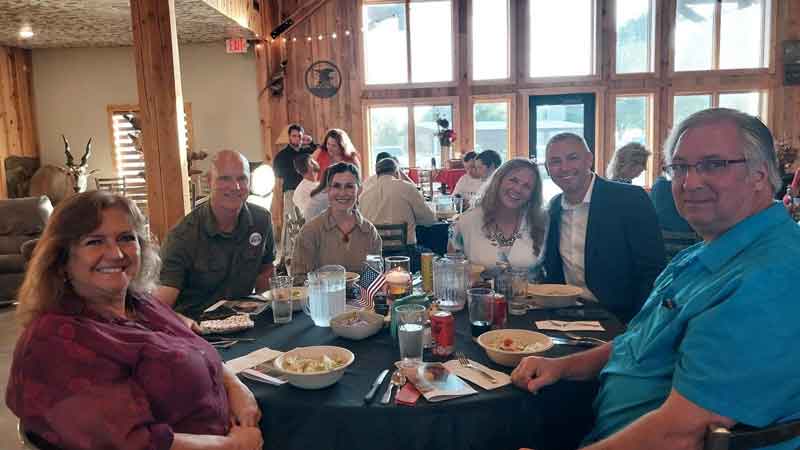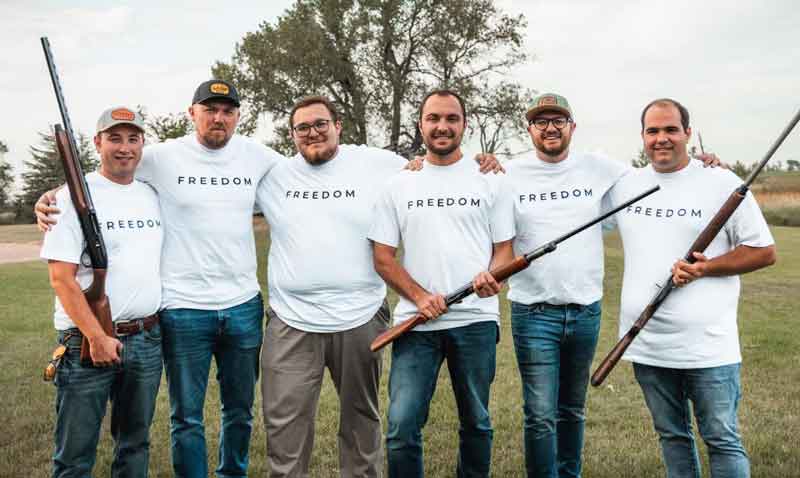
Things getting contentious on the far-right, as 4% Doeden supporters demand 2% Hansen drop out of race

I’m continuing to unpack what went on in politics this last week while I was at my biennial work conference for my day job.

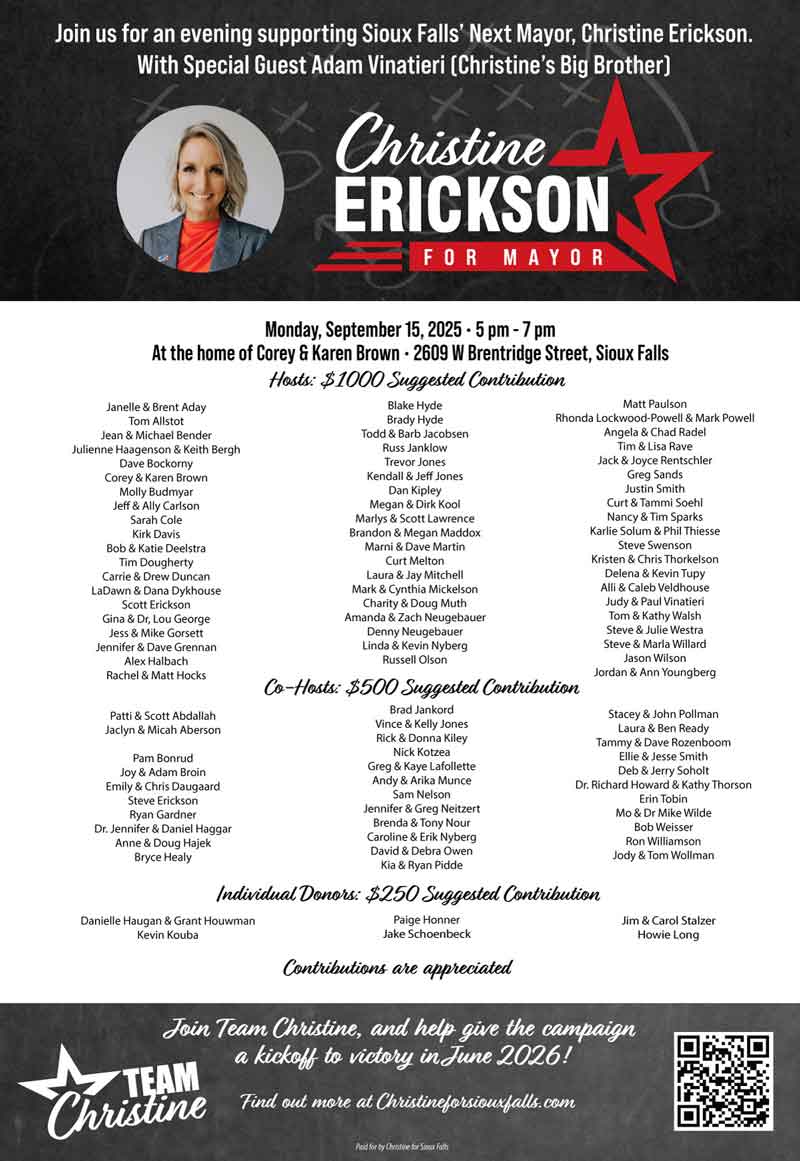
The big news of the week was the announcement that Christine Erickson is running to be the next Mayor of Sioux Falls.

But one of the more quiet, yet interesting developments is that supporters of the candidate who last polled at 4% in the gubernatorial race, Toby Doeden, such as State Rep. & awful human being Phil Jensen and Mike “13 just violates the age of consent” Zitterich, are calling for opposing candidate Jon Hansen to drop out of the race, because they believe Hansen will deny Doeden a win.

Of course, this raised the ire of 4% Hansen supporters, such as Neal “I’m only a terrorist attack away from winning congress” Tapio..

Watch for the bombs to continue to be thrown between the camps in the far right, as the battle over whether Jon Hansen should drop out is just starting between the two.

Northern Plains News: Backers Push $1.50 Flat Tax to Replace S.D.’s Local Property Taxes

Backers Push $1.50 Flat Tax to Replace S.D.’s Local Property Taxes
By Scott Sundberg, Hub City Radio, and Todd Epp, Northern Plains News

ABERDEEN, S.D. (Hub City Radio/NPN) — A group wants to kill property taxes in South Dakota.

They’ve filed a proposed constitutional amendment with the state Attorney General’s Office.

Former State Senator Julie Frye-Mueller, one of the measure’s backers, said the proposal would fund county governments through a flat transaction tax applied to most goods and services.

“We’re not trying to take money away from schools or counties,” Frye-Mueller said. “We’re offering an alternative that doesn’t punish property owners.”

Her husband, Mike Mueller, argued the transaction tax would be more equitable and less invasive than property assessments.

“This tax follows your choice to spend, not your right to own,” Mueller said.

Under the plan, South Dakota’s $1.8 billion in property tax revenue would be replaced with a $1.50 charge on most retail transactions. Not a percentage—a flat fee. Buy a candy bar, pay $1.50. Buy a car, same thing.

Matt Smith, a podcaster helping with the campaign, says that makes the system simple and predictable.

“People will know exactly what they’re paying,” Smith said. “It keeps legislators from playing shell games with property values.”

Critics say it does the opposite: it makes taxes less fair and more erratic. A $1.50 charge hits poor people harder than rich ones. And it doesn’t scale with what you buy.

The amendment allows lawmakers to raise the fee—up to $5—if the budget demands it.

“We added that language so they don’t try to open it later and turn it into something worse,” Frye-Mueller said.

The state doesn’t collect property taxes. That’s done by counties, schools, and other local governments. Supporters claim the new tax will cover those costs. They haven’t shown how, at least yet.

Mueller says the details will come later.

“Who’s going to pay for the schools? This will,” he said. “Who’s going to pay for the counties? This will.”

Frye-Mueller says the Legislature could put the measure on the ballot, but she doesn’t trust them to do it.

She was censured by the South Dakota Senate in 2023 for harassing a legislative staffer. That hasn’t stopped her from making the rounds at Republican events.

The state GOP isn’t backing the plan.

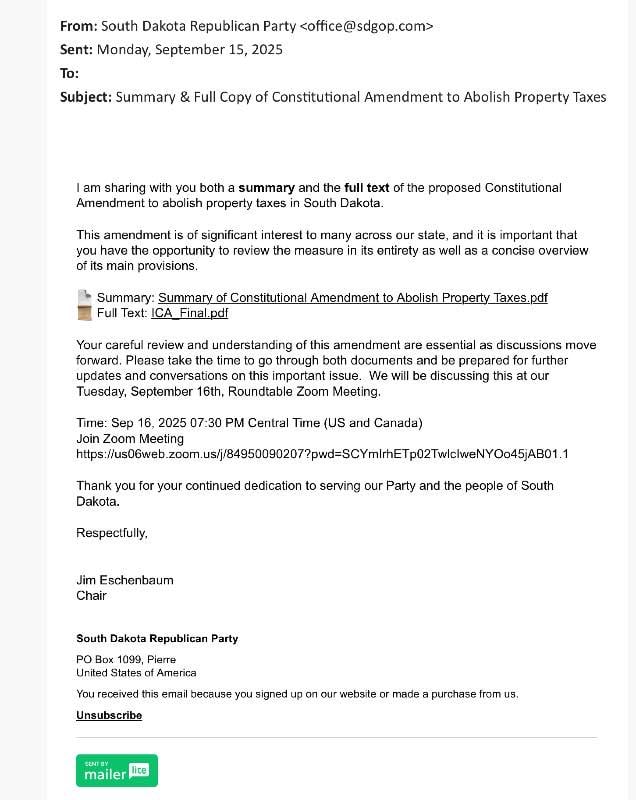
“We’re just giving them a venue,” said party chair Jim Eschenbaum. “We’re not taking any official position.”

The group’s website is www.abolishpropertytaxessd.com.

A state property tax task force will meet in Aberdeen on Wednesday, August 13. Time and place are still TBD.

What the Amendment Proposes

The amendment would scrap South Dakota’s $1.8 billion property tax system and replace it with a flat $1.50 fee on most purchases. Backers call it fair and simple. Critics say it hits low-income buyers hardest and hasn’t been tested. The plan allows lawmakers to raise the fee to $5 if future budgets require it.

The Doeden campaign’s late night text blast. Who does that?

Had a reader send this over..  what idiot is sending out a political text blast at 12:13 AM? 

That would be the Doeden campaign.

Seriously? That’s a complete and definite no no.  When people get a text message at 12:13 AM, they’re wondering if someone is in the hospital or if a relative died – not getting a political message from a grumpy looking politician.

Already, it’s a long campaign.

Legislators opposing Liberty (land) because they want to give the land back… to someone?

State Reps. Scott Odenbach and (Hillary Clinton donor) Liz May seem to have something against economic development as Scott reprints a Liz May column alluding to how he thinks land needs to be undeveloped..

TELLING IT LIKE IT IS

The following written by Rep. Liz May:  This Isn’t Growth—It’s a Slow Displacement

Every time I drive into Rapid City or head out to Spearfish, Box Elder, or Summerset, I feel like I’ve taken a wrong turn.

The hills are still there—but the open sky, the sense of peace, the small‑town rhythm—it’s being swallowed by endless housing tracts, towering apartments, and polished master‑planned developments. Downtown feels more engineered than earned. Communities like Spearfish—once anchored in tight‑knit culture—are now overrun by developers chasing future profits.

and..

This isn’t sustainable. If it continues, Rapid City won’t feel like Rapid City. Spearfish won’t feel like Spearfish. And the Black Hills will no longer feel like the Black Hills—it’ll feel like Denver feels to Colorado.

It’s time to face the truth: this isn’t growth—it’s displacement. And it’s time for South Dakota to restore accountability, respect property rights, and reclaim community before it disappears under someone else’s blueprint.

Read that here.

And this is accompanied by a link to a KOTA story as if they are opposing economic development in the form of Liberty (land).

Is this a new caucus in the House forming – Republicans against Development? Why do I get the impression that this sounds like they’re saying land should not be developed as if they think it should be treated as if it should belong to someone else?

Kind of odd coming from people who claim to follow the Republican platform.

Rep. Schaefbauer plans to bring legislation to use tax dollars to set up a COVID victim Fund in 2026

From Facebook, as opposed to serving the people of Aberdeen, in 2026 Rep. Brandei Schaefbaur plans to (again) use her legislative seat to promote conspiracy theories and goofiness regarding COVID:

So are we to gather that she’s going to encourage lawsuits against doctors, hospitals, the gubmint, and anyone else she can think of over COVID and vaccinating against it?  And to set up a taxpayer paid victims fund?

I’m sure this will go well.

Guest Column: In Defense of Secretary Kellie Wasko by Eric Gednalske

Guest Column: In Defense of Secretary Kellie Wasko
by Eric Gednalske

Kellie Wasko is the most effective Secretary the South Dakota Department of Corrections has had in decades. Her tenure has been marked by a firm commitment to reform, transparency, and modern corrections leadership. Yet, calls for her removal are mounting. Why? Because “inmate deaths are higher than usual.” That’s the argument. Let’s unpack it.

More than half of this year’s inmate deaths are attributed to natural causes—age, illness, or chronic health conditions. These are unfortunate, yes, but hardly an indictment of administrative failure. If anything, they reflect the aging population within our prisons, a trend not unique to South Dakota.

Then there are suicides. These are tragic and deserving of attention. But let’s be honest: no correctional system, no matter how well-funded or staffed, can completely eliminate self-harm. The mental health crisis in prisons is a national issue. It’s not unique to this Secretary, and to frame these tragedies as policy failures ignores the complex human realities involved.

Finally, we come to drug overdoses—the one category that does demand action. And action is precisely what Secretary Wasko has taken. Immediately following this year’s spike in overdose deaths, the Department transitioned visitations to non-contact, a move designed to sever one of the primary pathways for contraband. It’s not a popular decision, but it’s a responsible one. Leadership sometimes means doing the hard, unpopular thing to protect lives.

So, I ask again: what exactly are we blaming Secretary Wasko for? Implementing swift, preventative policy? Taking ownership where others would deflect? Showing transparency in a system historically resistant to it?

Critics need to bring more than headlines and raw numbers to the table. Reforming a correctional system is hard work. Secretary Wasko is doing it—and doing it well. Before we talk about replacing her, let’s have a real conversation about what we expect from leadership in corrections, and whether our outrage is truly justified—or merely convenient.

Your shot boys.

Eric Gednalske is currently a student at the Knudson School of Law at USD and a Political Science graduate of SDSU. Eric grew up in Pierre and served as an Infantryman in the Army before starting college.

It’s Time to Act on South Dakota’s New State Penitentiary by Lt. Governor Tony Venhuizen

It’s Time to Act on South Dakota’s New State Penitentiary
By Lt. Governor Tony Venhuizen
July 25, 2025

For years, South Dakota has grappled with the fact that its 144-year-old State Penitentiary in Sioux Falls needs replacement, yet consensus on where and how to build it has remained elusive.

Governor Larry Rhoden created the Project Prison Reset task force earlier this year to achieve consensus to solve this problem. Governor Rhoden challenged us with a straightforward mission of answering three questions: 1) Determine if we need a new penitentiary; 2) Decide what kind of facility we should build; and 3) Recommend where it should be located.

The task force included legislators, law enforcement, and other stakeholders. Over the course of four public meetings, we toured facilities, studied data, heard more than eight hours of public testimony, and reviewed hundreds of written comments. Our work was conducted openly, and every voice, whether supportive or skeptical, was heard.

Our open and transparent process worked. Task force members who began on opposite sides came together to unanimously recommend a plan that South Dakota can and should support. In fact, we voted unanimously in our answers to each of Governor Rhoden’s three questions.

The task force unanimously recommended that the aging penitentiary be replaced with a 1500-bed facility, built to last 100 years, at a cost not to exceed $650 million. Our contractors are confident they can sharpen their pencils and reach this target.

This design includes a modern intake for new inmates. It also enhances rehabilitation by including the same programming spaces as the proposed Lincoln County design, including increased space for education, treatment, medical services, and re-entry programming. It is a massive improvement over the existing facility and will allow us to do a better job preparing inmates to reenter society, so they do not re-offend and return to incarceration.

More than a dozen potential sites were evaluated, and two locations in northeast Sioux Falls emerged as the best options. Both offer ready access to utilities and emergency services, an easy transition for staffing, and a location in the city and county that has already been home to the state penitentiary for more than a century. They rate just as well as the previously proposed Lincoln County site. Although there will be some transition costs in changing locations, the Sioux Falls sites also save us approximately $18 million due to ready access to existing utility infrastructure.

South Dakota is fortunate that Governor Noem and legislators set aside the funds to pay for a new prison. We also do not need to cut corners. We have seen other states, in weaker financial positions, make difficult decisions to build cheaper, shorter-life structures, and to exclude programming spaces. Our strong financial position means we don’t have to take those shortcuts. We can build high-quality facility now and avoid even higher costs in the future. And we will also avoid having to bond for this facility, which will save South Dakota taxpayers over a half-billion dollars in the long-term.

The task force’s recommendation was unanimous. It represents a hard-won compromise by people who began with very different views. We listened, we adjusted, and we found common ground. Now, we must act.

Every month we delay, costs go up – due to inflation, rising material costs, and ongoing maintenance of our aging facility. South Dakota has the money to do this. We can pay for this project without new taxes or debt. It’s time to move forward, put this issue behind us, and build the penitentiary our state needs for the next century. Let’s get this done – for public safety, for fiscal responsibility, and for the future of South Dakota.

Tony Venhuizen serves as the 40th Lieutenant Governor of South Dakota. At Governor Larry Rhoden’s direction, he served as Chairman of the Project Prison Reset task force.

###

Congressman Dusty Johnson’s Weekly Update: Undoing Biden’s Border Disaster

Undoing Biden’s Border Disaster
By Rep. Dusty Johnson
July 25, 2025

BIG Update

Congressional Republicans and President Trump have made historic progress in securing the southern border. Border crossings of illegal immigrants are at a record low, and the One Big Beautiful Bill provided funds to finish the border wall and hire thousands more immigration enforcement officials.

The United States can never let the border return to the state of crisis seen under the Biden Administration. I introduced the Furthering American Security by Tempering Environmental Regulations (FASTER) Act to require future administrations to act swiftly to maintain a secure southern border. This legislation will require the administration to evaluate border security infrastructure and technology on a regular basis and address any issues in a timely manner, securing the border for generations.

Johnson joined Fox News Radio to discuss his legislation. You can listen here or by clicking the image above.

BIG Idea

Sanctuary cities that allow anti-ICE rioters to destroy transportation infrastructure often turn around and ask the federal government to foot the bill for the repairs. This behavior is beyond the pale.

Under the Biden Administration, sanctuary cities like Boston housed migrants in our airports. A city official in Los Angeles has even gone so far as to call for violence against U.S. Immigration and Customs Enforcement (ICE) agents. Political violence can never be tolerated.

I introduced a bill to prohibit any U.S. Department of Transportation funds from going to sanctuary cities who don’t comply with federal immigration law. My bill sends a message to state and local governments – if they want the federal government’s help, they must play by the rules.

Johnson speaks with Transportation Secretary Sean Duffy, who expressed support for Johnson’s bill to prohibit DOT funds from going to sanctuary cities.

BIG News

In March, a woman was convicted for her part in methamphetamine distribution as part of a Mexican cartel operation on the Pine Ridge Reservation. This led to the deportation of two cartel members, who had already been deported numerous times.

This week, the House Committee on Natural Resources held a hearing on the impact of cartels and drug trafficking in Indian country. I encouraged the FBI to prioritize enforcement efforts on South Dakota reservations. These cartels do not care about the safety of Pine Ridge or the rest of South Dakota. The federal government should work with tribes to allocate resources to combat these bad actors.

Click here or the image above for Johnson’s remarks.

###

US Senator John Thune’s Weekly Column: Republicans Put Families First

Republicans Put Families First
By Sen. John Thune

Strong families make America stronger. That’s why Republicans put families first in crafting the One Big Beautiful Bill Act. We set out to make a law that supports parents and families and creates a brighter future for the next generation. I’m proud to say we’ve delivered a number of pro-family wins in this bill.

That begins with giving families some breathing room in their budgets. In 2017, Republicans’ Tax Cuts and Jobs Act lowered taxes for working families, but that tax relief was set to expire this year, meaning South Dakota families faced a $2,500 tax hike next year. We were determined not to let that happen. So the One Big Beautiful Bill Act locks in lower tax rates permanently, meaning families won’t have to worry about a bigger tax bill – not next year and not ever.

We went further than just making lower rates permanent. We made additional reforms that support working families, like increasing the child tax credit to $2,200 and linking it to inflation, which means it will increase over time. We strengthened measures that encourage employers to offer paid family leave and child care. And we created new investment accounts for newborns – with an initial $1,000 deposit – that can be used down the road for education, to start a business, or buy a first home and get a running start on the American Dream.

Raising a family is stressful (and expensive) enough, and this bill ensures that parents can keep more of their hard-earned money to spend, invest, and save how they see fit. Alongside lower taxes, this bill will also help generate growth in our economy, which will create jobs, expand opportunity, and lead to bigger paychecks. One estimate suggests a typical family will see take-home pay increase by as much as $10,900 in the next four years. That will make a big difference for working families across America.

I’m proud that along with pro-family policies in this bill, we’ve also achieved a significant pro-life victory. With the signing of this bill, and beginning on July 4, 2025, the biggest abortion providers in the country will not receive federal Medicaid funding for an entire year. Many Americans don’t want to see their tax dollars funding abortion, and this bill ensures they won’t. This is the first pro-life legislation to be signed into law in a number of years, and we’ll continue working on additional legislation to uphold the dignity of every human life.

This was a consequential bill, and I’m proud of what we accomplished to protect life, strengthen families, and create a brighter future for our children. The One Big Beautiful Bill Act is about stronger families, promoting a culture of life, and restoring the American Dream for our children. We have more work to do, and we’re going to keep our focus on these priorities.

###


UNET Announces Drug Seizure and Arrests Made in Pennington County

UNET Announces Drug Seizure and Arrests Made in Pennington County

PIERRE, S.D. – The Unified Narcotic Enforcement Team (UNET) announces the arrest of two individuals on Wednesday, July 23, 2025, following an ongoing investigation into illegal drug trafficking in Western South Dakota. The arrests resulted in the seizure of significant quantities of cocaine, fentanyl and MDMA.

Terrell Arthur Wilkins, 41, and Leannah Raine Vitalis, 27, both of Rapid City, were taken into custody and face multiple felony and misdemeanor charges. Each has been charged with:

  • One felony count of Distribution/Manufacturing of Controlled Substance Schedule II (Fentanyl)
  • One felony count of Distribution/Manufacturing of Controlled Substance Schedule II (Cocaine)
  • One felony count of Distribution/Manufacturing of Controlled Substance Schedule II (MDMA)
  • One felony count of Possession of Controlled Drug/Substance Schedule II (Fentanyl)
  • One felony count of Possession of Controlled Drug/Substance Schedule II (Cocaine)
  • One felony count of Possession of Controlled Drug/Substance Schedule II (MDMA)
  • One felony count of Possession of Controlled Drug/Substance Schedule I (Hashish)
  • One misdemeanor count of Possession of Marijuana (2 ounces or less)
  • One misdemeanor count of Possession or Use of Drug Paraphernalia

Additionally, Leannah Vitalis, was charged with:

  • One Felony count of Possession of Controlled Drug/Substance Schedule II (Oxycodone)

The arrests stem from an investigation led by UNET, which determined that fentanyl and cocaine were being transported into Rapid City from Colorado.

A traffic stop conducted by a South Dakota Highway Patrol Trooper in Pennington County led to the apprehension of both suspects. During the stop, law enforcement seized approximately:

  • 126.9 grams of cocaine
  • Approximately 100 counterfeit oxycodone pills containing fentanyl
  • 6.6 grams of MDMA
  • 0.3 ounce of marijuana

Both individuals are currently being held at the Pennington County Jail. They are presumed innocent until proven guilty in a court of law.

UNET is a task force led by the South Dakota Attorney General’s South Dakota Division of Criminal Investigation and includes personnel from the Pennington County Sheriff’s Office, Rapid City Police Department, South Dakota Highway Patrol, and the Division of Criminal Investigation. UNET partners closely with federal agencies such as the Drug Enforcement Administration, Federal Bureau of Investigation, Bureau of Alcohol, Tobacco, Firearms and Explosives, Homeland Security Investigations, U.S. Postal Service, U.S. Army National Guard, and the U.S. Attorney’s Office.

-30-