The property tax plan that was passed by the South Dakota Legislature to reallocate some existing sales taxes, and to create new sales tax revenue to offset property tax is apparently not popular in the state. As in wildly unpopular by half or more, depending on your subgroup according to SD News Watch, via the Argus Leader:
The survey of 500 registered voters across party affiliation conducted April 7-9 by Mason-Dixon Polling and Strategy, found 49% of respondents opposed the swapping of lower property taxes in exchange for higher sales taxes, while 33% approved and 17% were undecided. The margin of error is plus-or-minus 4.5%.
and..
Republicans were close to evenly split, with 45% opposing the new legislation, 42% supporting the measure and 13% undecided.
A majority of Democrats and Independents disapproved of the new laws, at 56% and 51%, respectively.
In the Governor’s race, that’s probably not good news for Governor Rhoden and Rep. Jon Hansen, who both have been touting the sales tax shift plan, while Dusty Johnson has been critical of it.
(Toby Doeden is still clinging to the claim he’s going to eliminate property taxes without having any plan besides magic tax-eliminating fairy dust.)
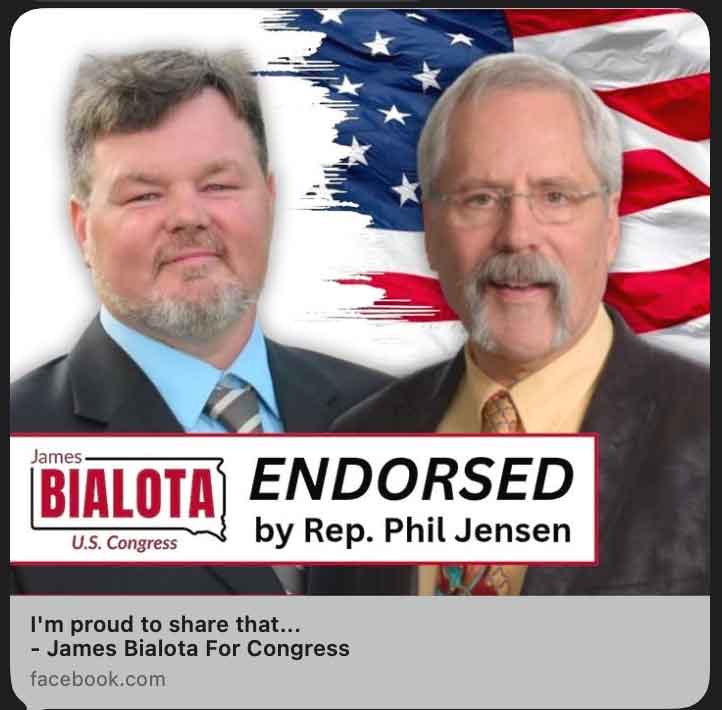
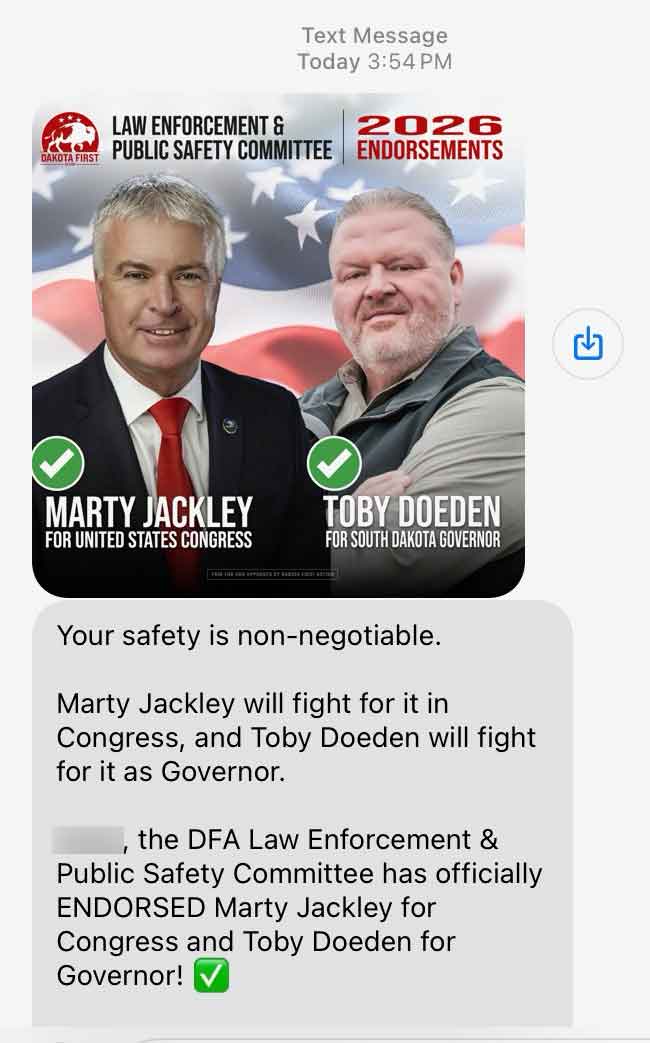
Noting the unrequested endorsement(s) from Doeden PAC, it can always be worse. Like that that other endorsement for Congress, from all around awful person Phil Jensen:
Now, I don’t think there’s any need to give Marty static, because this is kind of modus operandi for Doeden’s PAC, where they will go in and endorse someone who nether wants it, nor asked for it. Like in Brookings last election when Doeden’s toxic PAC jumped in – uninvited and unwanted – and the PAC attention caused them to lose. But they try to tie themselves to people they believe might win.
Except this time.
Because Doeden’s PAC has come in and endorsed Doeden. Which, if you’re coming in with your own PAC, and endorsing yourself.. well, that’s a new and novel kind of self-love.
Keeping Taxpayers Top of Mind By: Gov. Larry Rhoden April 24, 2026
Every taxpayer dollar belongs to the people. It’s our job as elected leaders to spend the people’s money as efficiently as possible to keep South Dakota strong, safe, and free. In recent years, South Dakotans made one thing very clear that they wanted property tax cuts – and this session, we delivered the largest property tax cuts in South Dakota history.
Since session ended, though, there’s been a lot of misinformation about those property tax cuts. Recently, I celebrated Administrative Professionals Day by having some of my team over for breakfast. They answer countless phone calls, letters, and questions from South Dakotans. And they mentioned a recent uptick in questions about taxes. A lot of the calls were driven by misinformation that the Legislature raised sales taxes this session. So, I’m here to clear up the facts.
This session, most legislators agreed with me that South Dakotans deserve real, meaningful property tax relief. But there was a lot of division – about 50 different bills to address property taxes. So, we put the work in, and by the end of session we accomplished the largest property tax cut in South Dakota history. It wasn’t easy. It took grit, hard work, and good ‘ol fashioned negotiating. Here are the facts behind that tax cut:
Next year, the sales tax holiday is due to expire, meaning the state sales tax is set to go up by 0.3% next July. The Legislature tried to make that tax cut permanent and wasn’t successful, and some legislators were chomping at the bit to spend those new tax dollars. So instead, we redirected that into a statewide property tax cut for homeowners. And you’ll see that tax cut next year on taxes payable in 2027. That’s not a new sales tax increase – the tax was already going up, and we’re reinvesting it in a statewide property tax cut.
On top of that, we passed my bill to give the people in each county the option to cut property taxes further. Each county will have the option to replace some or all of their homeowner property taxes with a local half-cent sales tax. It’s not a mandate – it’s a choice. Local leaders and local voters will decide whether it’s the right opportunity for their community – and I’m a big fan of local control!
There was one other bill that promotes local control: HB 1245. I received countless messages of support on this bill from mayors, city councilors, and business leaders from all over the state. They wanted their communities to be able to avoid bonding for projects (and avoid future property tax increases) by instead passing a penny sales tax for up to five years – and only if 60% of the people in their community were supportive.
I was initially skeptical of this idea, but I studied the bill and all of its safeguards. I recognized that it could be a good tool to keep our communities Open for Opportunity. As Mayor TenHaken points out, if Sioux Falls had this local option years ago, the city could have saved over $50 million on the construction of the Denny Sanford Premier Center.
We do a lot of things right in South Dakota. We have the 2nd lowest taxes in America because we always keep taxpayers top of mind. So, if you’ve called our office or stopped in and asked questions, thank you. It is important for me to understand your concerns and your questions. I hope I have answered some of them for you.
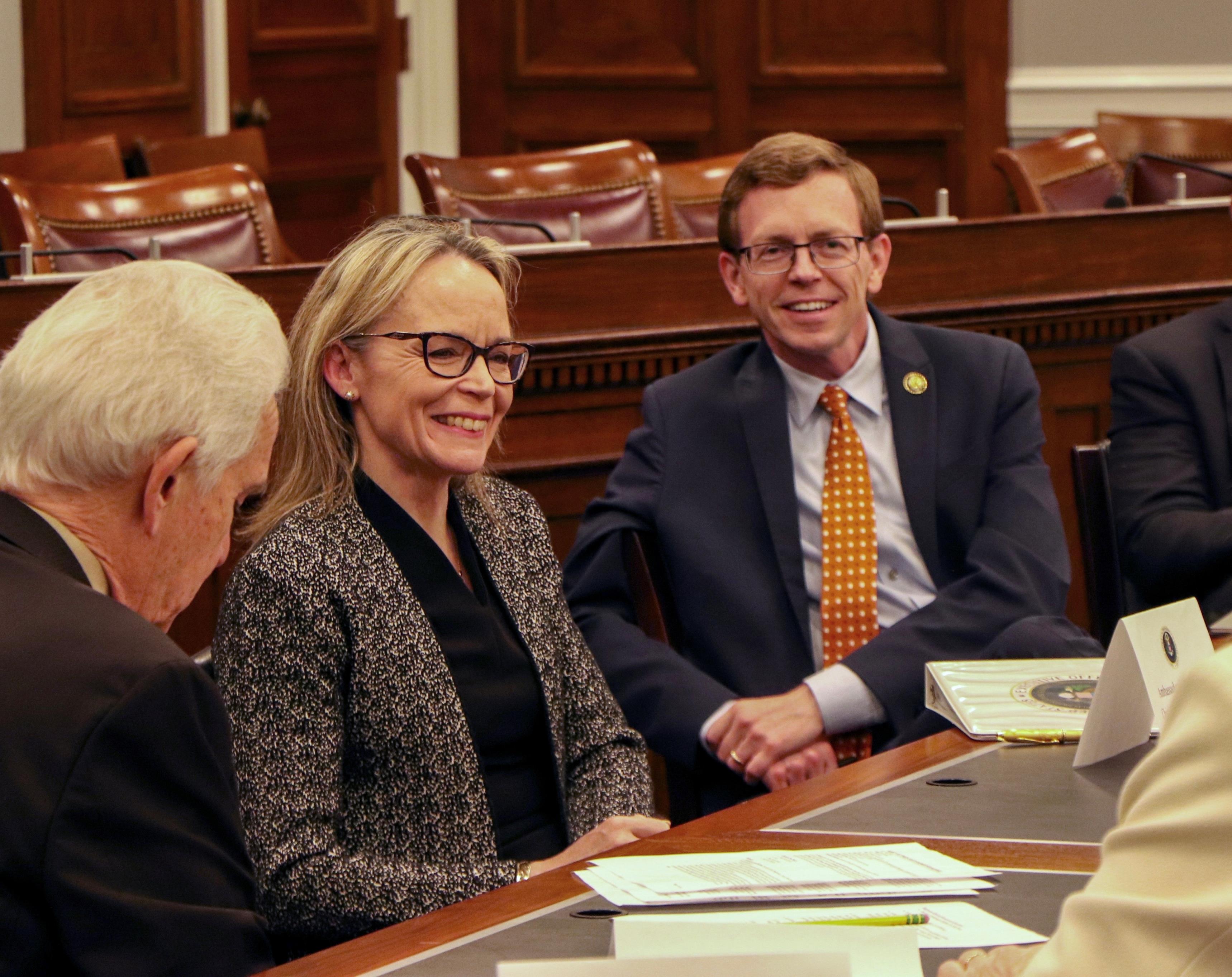
Dr. Julie Callahan, the Chief Agriculture Negotiator in the Office of the U.S. Trade Representative (USTR), joined me and my colleagues for a discussion on how strong agriculture trade is vital to our country.
We all spoke about the need to continue developing strong trade agreements and our desire to keep USMCA strong. Together, the USMCA and NAFTA trade agreements are the most successful of all time. As our countries evaluate USMCA in hopes to renew the agreement, we hope to improve U.S. dairy producers’ access to Canadian markets and increase Mexico’s purchases of U.S. grain.
Dr. Callahan is also focused on ensuring American producers don’t face unfair trade practices by foreign countries for using terms like parmesan, chateau, and bologna on their products. I’m leading the SAFETY Act, which is included in the Farm Bill, to make sure American ag products have fair access in global markets.
Johnson meets with Dr. Julie Callahan
BIG Idea
South Dakota Auto Dealers Association held their annual convention this week in Sioux Falls. It was an honor to join to talk about our shared values in the automotive and transportation industries. We agree – the free market should decide what types of cars are sold – not the federal government. That’s why I worked to eliminate Biden-era rules that would have mandated all new vehicles to be electric by 2032.
I’m also leading an effort to allow states to use funds from unused federal electric vehicle programs for other highway and infrastructure projects like improving roads and bridges. South Dakota has $29 million that cannot be spent on other priority infrastructure needs. My bill would ensure states can use these funds for their most important projects, instead of fulfilling a political agenda.
BIG News
This week, I cosponsored an amendment that will allow E15 to be sold year-round. This is something corn growers have been wanting for years, which will give them a larger market for their grain. Year-round E15 will also boost domestic energy production and energy supply, helping drive down gas prices for consumers.
I’ve been working to get this policy signed into law for some time and I’m hopeful this amendment will be added to the Farm Bill, which the House plans to vote on next week.
Cultivating Opportunity in the Trades By Sen. John Thune
During National Apprenticeship Week, we celebrate the people who work in the trades and on factory floors as well as the next generation coming up to do this important work. To my knowledge, there’s no artificial intelligence that can lay a foundation for a house or chatbot that can fix a toilet. Skilled jobs are in-demand jobs, and they will continue to be in-demand for a long time to come. So we need to invest in these careers and support the next generation of workers going into the trades, manufacturing, and other skilled professions.
That’s exactly what Republicans did last year as part of our Working Families Tax Cuts bill. In addition to delivering significant tax relief for American workers, we made substantial investments in America’s skilled workforce – investments that will grow our skilled workforce, create jobs, and help strengthen our economy by strengthening American workers.
The new Workforce Pell program, which will begin this year, will provide a hand-up to individuals participating in shorter-term training programs for in-demand jobs in fields such as construction, manufacturing, and health care. Workforce Pell grants will also be available to workers who already have undergraduate degrees, providing an option for people to learn additional skills or switch careers as well as for those getting started after high school.
The Working Families Tax Cuts also expanded 529 education savings plans and allows them to be used for vocational training, among other things. And it doubled the annual withdrawal cap to $20,000 to provide even greater flexibility for South Dakotans to use their money to pursue the education that works for them.
Alongside investments in training, the Working Families Tax Cuts also included a number of pro-worker and pro-growth tax policies. No tax on overtime will allow those working in manufacturing and in the trades, among others, to keep more of the money they earn when they work extra hours. Pro-growth policies like full expensing for new factories and factory improvements will help manufacturers grow, innovate, and importantly, create good-paying jobs. And by making the 20 percent small business deduction permanent, this bill helps Main Street businesses grow by investing in their operations and employees.
Republicans are focused on creating new opportunities for Americans to get ahead, and education is a part of that. Ensuring American workers have the opportunity and support to pursue the education that fits their dreams for the future is just one part of those efforts. The opportunities exist, and we need to support Americans pursuing them. That’s what we’ve done with the Working Families Tax Cuts and will continue to do to help more hardworking people pursue and achieve their American Dream.
Governor Dennis Daugaard did something today that he is not quick to do, and you rarely ever see.
He called out a fellow politician for being awful. And it was his own district’s State Senator, Tom Pischke:
“He’s supported weakening our vaccination laws, he also supported … legislation that would weaken his child support responsibilities. I think that’s self-interested and inappropriate and I think he’s disrespectful,” he said, also referencing Pischke’s involvement in high-profile legislative disruptions, such as in 2024 when he faced discipline for placing a bottle of syrup on a colleague’s desk who’d helped block a resolution expressing disapproval of the discontinuation of the Aunt Jemima syrup brand.
and..
“The day Carley went missing, he asked the Senate president for permission to go to the bathroom,” he said. “He demeans the seriousness of the position he holds.”
The main reason for the story is because former State Senator Bryan Breitling has filed to run as an independent against Pischke, and people from across the political spectrum in the district have all come together to clean house. (Actually, clean up their senate seat, but you get the point.)
“If there was other leadership here in District 25, I wouldn’t worry about it,” Breitling said. “When I moved from Miller to Dell Rapids, I had put my political life in the rearview mirror.”
When a former Republican governor who is synonymous with kindness and class comes together with a former Republican legislative leader, a leader from the other party, as well as cats and dogs and everyone to be rid of someone who is literally a stain on the process, that certainly has to get people motivated in District 25 to go to work for Bryan Breitling.
Stay tuned. There will be more to come. We get to see this one all the way through to November.
Senator Mike Rounds’ WEEKLY ROUND[S] UP: April 13-19, 2026
Welcome back to another edition of the Weekly Round[s] Up. I spent our Easter in-state work period back in South Dakota traveling around the state and meeting with constituents. I traveled to Huron for an event organized by American Bank & Trust to meet with local bank presidents, business leaders and ag bankers. I also made a trip to Box Elder for the Defense and Industry Symposium and stopped in Selby to attend the WEB Water Development Association and the Water Investment in Northern South Dakota (WINS) Treatment Plant dedication. I wrapped up the recess in Humboldt, where I met with more than 40 South Dakota farmers to discuss the issues impacting agriculture across the state and the future of the Farm Bill.
This past week, I was back in Washington, D.C. as fly-in season continues and South Dakotans make their way to our nation’s capital. One day last week, I think I set a record for the year with 21 meetings and events in a single day. We will see how long that record lasts! They keep us busy in D.C. with our regularly scheduled votes, hearings and briefings, but I fill the rest of my time by meeting with as many South Dakotans as possible. This past week was a great example of that, and I appreciate all of the South Dakotans who make the trip out to visit with us.
More on these events and the rest of my week in the Weekly Round[s] Up.
South Dakota groups I visited with: South Dakota American Water Works Association; South Dakota Society of Professional Land Surveyors; South Dakotans with the American Clean Power Association; Brandon Maddox, CEO and Founder of Silencer Central based in Sioux Falls with the Firearm Industry Trade Association; South Dakota Biotech; South Dakotans from the U.S. Travel Association; AARP South Dakota; South Dakota college students with the Fraternal Government Relations Coalition; South Dakota Pork Producers Council; students from Marty Indian School; Robb Peterson, CEO of Glacial Lakes Rubber and Plastics; South Dakota Military Officers Association of America; South Dakotans with American College of Gastroenterology; South Dakotans with Growth Energy; and South Dakota pharmacists with National Community Pharmacists Association.
I also had the opportunity to speak at the Mortgage Bankers Association National Advocacy Conference and visit with Lorre Buhler, President of South Dakota’s Association for Mortgage Professionals; Securities Industry and Financial Markets Association Board of Directors; and Dan Scearbo, President, Vibram USA.
Met with South Dakotans from: Bath, Black Hawk, Brookings, Centerville, Ethan, Fort Pierre, Huron, Marty, Pierre, Rapid City, Sioux Falls, Tea, Utica, Vermillion, Watertown and Yankton.
Other meetings: David Mercer, CEO and Caroline Pham, Chief Legal Officer of Moonpay; Brad Boehler, President of Manitou North America; Javier Perez-Tasso, CEO of SWIFT; a classified meeting with the Cyber, Space and Intelligence Association; and the Securities Industry and Financial Markets Association Board of Directors.
This past week I joined Administrator Zeldin and gave remarks at an event hosted by the EPA announcing the Water Resue Action Plan 2.
I also attended an appropriations legislative branch subcommittee meeting as we kick off our appropriations process for FY27. I asked the Acting Comptroller General of the Government Accountability Office a question related to the problems we are experiencing in South Dakota with the postal service. You can watch my questioning here.
Hearings and Briefings: This past week, I attended two classified Senate Select Committee on Intelligence hearings and two classified Senate Armed Services Committee briefings.
Votes taken: 11 – This past week I voted for John Thomas Shepherd to be U.S. District Judge for the Western District of Arkansas and Christopher R. Wolfe and Andrew B. Davis, of Texas, to be United States District Judges for the Western District of Texas.
I once again voted against a resolution that would require the removal of U.S. Armed Forces from hostilities involving Iran. I also voted against a resolution that would block a proposed defense sale to Israel.
Lastly I voted in favor of a resolution to overturn a Bureau of Land Management rule that restricted mining and mineral development on certain federal lands in Minnesota.
Steps taken: 61,366 steps or 28.09 miles.
My Staff in South Dakota Visited: Aberdeen, Colton, Deadwood, Spearfish and Watertown.
Video of the Week: Click here to watch my remarks and the full event with the EPA.
Pierre, SD – Today, the Rhoden for Governor campaign announced the RhodenResults.com page to highlight Governor Rhoden’s accomplishments in his 15 months as Governor.
“Governor Rhoden has a proven track record of results in just a short time as the 34th Governor of South Dakota,” said Ian Fury, Campaign Manager at Rhoden for Governor. “We’ve got a great Governor who is doing a good, steady job to keep South Dakota strong, safe, and free. The other candidates may have plans, but Governor Rhoden is a strong leader with a track record of delivering results.”
The RhodenResults page includes a long list of accomplishments and is also broken down into how Governor Rhoden is keeping South Dakota strong, safe, and free.
Results for how he is keeping South Dakota strong are broken down by:
Taxes;
Economy;
Healthcare; and
Education.
Results for how he is keeping South Dakota safe are broken down by:
Crime;
National Security; and
Immigration.
Results for how he is keeping South Dakota free are broken down by:
Had a note from District 25 House Candidate Carrie Sanderson, who will be one of the next legislators to represent the District:
I am running for the South Dakota House of Representatives in District 25. We are hosting a Meet and Greet on May 7th, from 5:30 PM to 7 PM at LaDelle and Fourth Coffeehouse in Dell Rapids, SD. All are welcome – I hope you can join us!
You can learn more about me and the campaign or donate online at: www.SandersonforSD.com.
Check out the event, and if you’re in the area, Join Carrie Sanderson on May 7 in Dell Rapids.



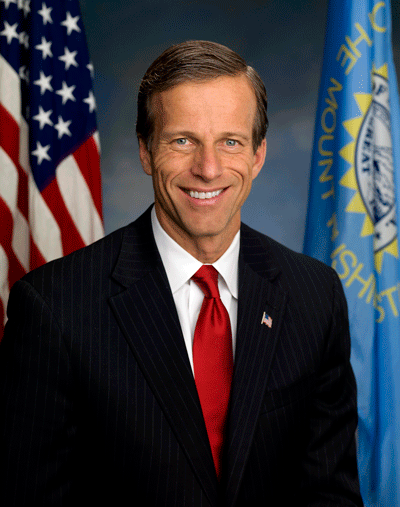 During National Apprenticeship Week, we celebrate the people who work in the trades and on factory floors as well as the next generation coming up to do this important work. To my knowledge, there’s no artificial intelligence that can lay a foundation for a house or chatbot that can fix a toilet. Skilled jobs are in-demand jobs, and they will continue to be in-demand for a long time to come. So we need to invest in these careers and support the next generation of workers going into the trades, manufacturing, and other skilled professions.
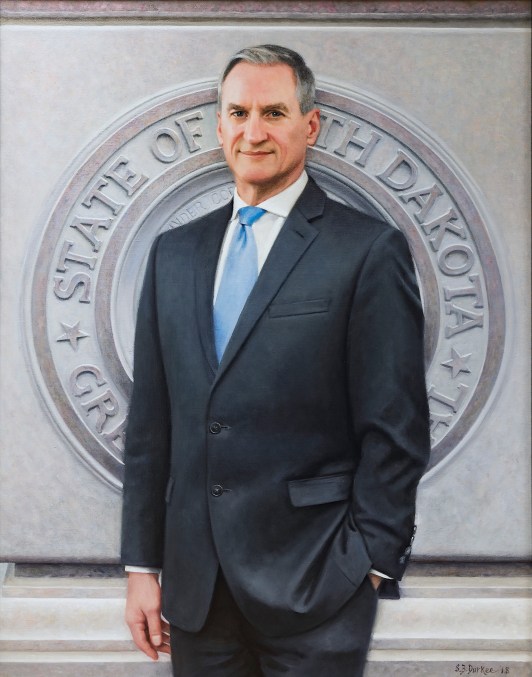 “He’s supported weakening our vaccination laws, he also supported … legislation that would weaken his child support responsibilities. I think that’s self-interested and inappropriate and I think he’s disrespectful,” he said, also referencing Pischke’s involvement in high-profile legislative disruptions, such as in 2024 when he faced discipline for placing a bottle of syrup on a colleague’s desk who’d helped block a resolution expressing disapproval of the discontinuation of the Aunt Jemima syrup brand.