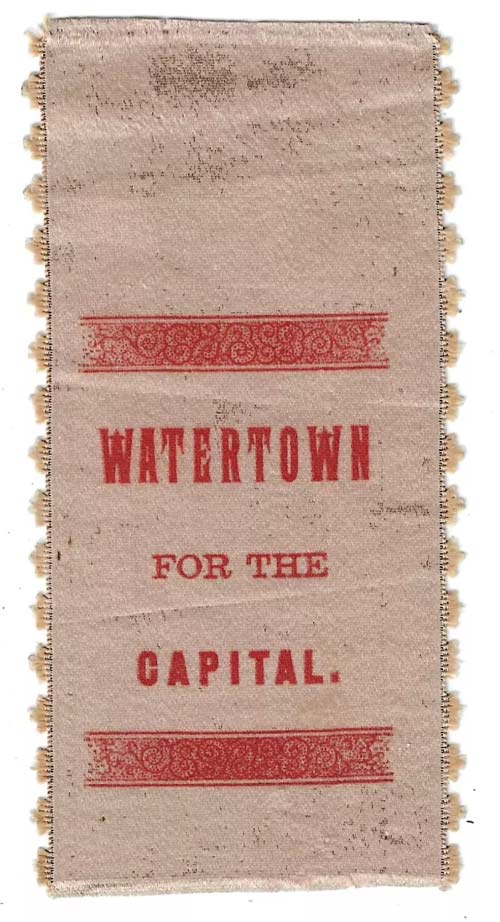
Just an occasional reminder to readers that I’m always on the hunt for South Dakota political ribbons, and in particular South Dakota State Capital fight items, such as this Watertown for the Capital ribbon in my collection.
If you’ve got something you think might be up my alley, I do have some duplicates, or otherwise items that don’t fit in my collection that I have available for trade, such as a couple of SDGOP 1906 convention ribbons, a very, very early SDDP convention ribbon, a 1900 NDGOP ribbon, as well as a 1899 SD Sportsmen’s Association Tournament ribbon among other items I’ve got hanging around.
Christine Erickson Certified for Sioux Falls Mayoral Ballot
Sioux Falls, SD – Mayoral candidate Christine Erickson officially filed her nominating petitions and has been certified to appear on the ballot for the upcoming Sioux Falls mayoral election in June 2, 2026. With 96 days remaining until Election Day, Erickson says her campaign is energized and focused on continuing conversations with residents across the city.
Erickson and her supporters spent the past several weeks gathering signatures throughout Sioux Falls, connecting with community members in neighborhoods, at local businesses,
and at community events.
“I’m incredibly grateful for the hundreds of conversations we’ve had while collecting signatures,” said Erickson. “This process wasn’t just about earning a place on the ballot — it was about listening. I heard from families, small business owners, retirees, and young professionals who care deeply about the future of Sioux Falls. The encouragement, ideas, and support we received have been inspiring and reaffirm why I’m running.”
Erickson emphasized that the momentum built during the petition process is only the beginning. Her campaign will continue meeting residents in every part of the city to discuss priorities, including public safety, responsible growth, infrastructure, and maintaining the high quality of life Sioux Falls is known for.
“Our campaign is rooted in connection,” Erickson said. “Over the next 96 days, we’ll continue showing up, listening, and working to earn the trust and support of voters throughout Sioux Falls.”
More information about Christine Erickson’s campaign, upcoming events, and opportunities to get involved will be announced in the coming weeks.
PIERRE, S.D. – Today, Governor Larry Rhoden unveiled a county map that shows how much South Dakotans save under his plan to cut property taxes, SB 96. You can find that map here.
“South Dakotans deserve a real property tax cut – and that is exactly what my plan delivers,” said Governor Larry Rhoden. “This new interactive map allows South Dakotans to see firsthand how much they can save under my plan. It puts numbers behind our promise to deliver relief for homeowners across our state.”
Governor Rhoden previously introduced his plan to cut property taxes, which gives counties the option to replace their share of property taxes with a half-cent sales tax. County commissions could implement this tax cut, or it could be referrable to a vote of the people, or the people could also initiate it for a vote in their local community. The proposal would also help counties draw more revenues from tourists and out-of-state visitors.
You can find more information about Governor Rhoden’s plan to cut property taxes here.
###
Editor’s note.. Here’s a few samples from the map:
Thune Joins Larry Kudlow on Fox Business, The Guy Benson Radio Show
“You saw the president’s vision for the future of this country, and then you saw the open borders, sanctuary cities … defund law enforcement, raise your taxes, reduce American energy independence Democrats sitting there on their hands at virtually every opportunity when they should have been up cheering … it’s unfortunate.”
WASHINGTON — U.S. Senate Majority Leader John Thune (R-S.D.) today joined Larry Kudlow on Fox Business and the Guy Benson radio show.
On President Trump’s State of the Union address:
“[President Trump] crushed it … both in tone and substance … And I thought it was optimistic, it was hopeful … reflecting on America’s greatness and those who have come before us. Having a couple of those 100-year-old veterans in the audience … having the American … hockey team … congratulations to both the men and the women for their gold medals.
“But it was really the kind of message and speech that I think most people should find inspiring and aspirational and all that – except the Democrats in the chamber. So I thought what you also saw last night was kind of the two Americas. You saw the president’s vision for the future of this country, and then you saw the open borders, sanctuary cities … defund law enforcement, raise your taxes, reduce American energy independence Democrats sitting there on their hands at virtually every opportunity when they should have been up cheering … it’s unfortunate.”
[…]
“The president laid out a bold vision. And some of the things he talked about last night – on top of the things … that we got done in this last year through the first reconciliation bill – but … a housing bill, talking about something on additional energy development, permitting reform, AI. I think there’s some real areas that we can be working on and working with the White House, and hopefully in a bipartisan way … to get some solutions for the American people. But those are all things that kind of strike at the heart of this question of affordability. I think the president has zeroed in on that.
“What we believe are the answers as we look to the future … are safer streets, which the president has been dialed in and zeroed in on since he came to office and before; obviously more money in the American people’s pockets, and we have done that, and you’re going to see more of that … as the year wears on; and then obviously new opportunities to get ahead for working families, and there are so many areas in which the president has delivered on that.
“There’s more to do, but you look at just as an example, the Trump newborn accounts … [T]hat is a wonderful idea for the future and to get people saving for their kids. And I think that’s something that is going to serve the American people and working families well, well into the future.”
On the SAVE America Act:
“[W]e will vote on the SAVE America Act in one way, form, or another. And if the Democrats block it, I think it’s a great contrast to draw going into these fall elections. Do you want to be the people who are voting against actually requiring people to be American citizens to vote in American elections? I think that’s a fairly straightforward issue, but if the Democrats want to … stand in the way of that, then we’re obviously happy to litigate that in the fall elections.”
On the Democrats’ DHS shutdown:
“The president and his team have been … operating in good faith in terms of trying to get a solution here … We have now had [three] votes in the Senate … on the very bill the Democrats negotiated on the Department of Homeland Security, on that appropriations bill, and then subsequently walked away from and voted against it as recently as last night. And we’ll give them more opportunities to vote on that.
“[Republicans are] not going to do anything that jeopardizes or puts at risk law enforcement officials who are out doing their jobs. They have a right to be able to do their jobs, to do them in a safe way. And these sanctuary cities, which create these hostile environments where, puts not only … these law enforcement officials at risk, but also their families, that’s just crazy … There are a whole range of issues I think the White House has been willing to deal on, and the Democrats haven’t been there, because I think they see this as a political issue, and it’s really unfortunate, because nobody wins in a shutdown.”
From my mailbox, State Representative David Kull has thrown his name in the ring to run for District 2 State Senate:
Last year I made an announcement that I was not going to run for a third term in the South Dakota House. At that time I also had no intention for running for the Senate as Senator Steve Kolbeck had indicated that he was going to run to retain his seat. He has since made the decision that he was not going to pursue reelection.
In the ensuing months, I have had internal debates, followed by conversations with my wife, colleagues and friends and have arrived at the decision to announce my candidacy for District 2 Senate.
It has been an honor to represent the people of District 2 for the past four years and hope I can garner enough support to continue to do so in a slightly different role.
Gov. Rhoden Appoints Kevin Nyberg and Chuck Spring to GFP Commission
PIERRE, S.D. – Today, Governor Larry Rhoden appointed Kevin Nyberg and Charles “Chuck” Spring to the Game, Fish & Parks (GFP) Commission.
“There are few things I appreciate more than enjoying God’s creation – and I know many South Dakotans share that same sentiment. That is why we need people like Kevin and Chuck to preserve it for future generations,” said Governor Larry Rhoden. “Kevin and Chuck are servant leaders and avid outdoorsmen. I trust they will bring a fresh perspective to the GFP Commission and strengthen our great outdoors for years to come.”
Kevin Nyberg is the President and CEO of Nyberg’s ACE Corporation and has served on several boards, including the Augustana University Board of Trustees, the South Dakota GFP Foundation, and the Sioux Falls Chamber of Commerce Board of Directors. Nyberg is passionate about the outdoors, holding patron member status with Pheasants Forever and being a lifetime member of the Rocky Mountain Elk Foundation.
“South Dakota offers some of the finest outdoor recreation opportunities in the country. Whether camping, hunting, or fishing, South Dakota’s outdoors have provided numerous memorable experiences with family and friends,” said Kevin Nyberg. “Thank you to Governor Rhoden for giving me the opportunity to help guide South Dakota’s outdoor resources for future generations to enjoy.”
Kevin Nyberg lives in Sioux Falls with his wife, Linda. They have four children and five grandchildren. You can find a photo of Kevin Nyberg here.
Chuck Spring has strong roots across western South Dakota, having spent his lifetime ranching near Union Center. He has extensive experience with GFP’s West River Deer Task Force and Depredation Committee, and he formerly served as a GFP Commissioner from 2020 to 2024.
“I would like to thank Governor Larry Rhoden for the opportunity to serve as a GFP Commissioner,” said Chuck Spring. “Hunting has always been an important part of my life, so one of my goals is to work with the Department to help find solutions to bring back the big game numbers to what they used to be in certain areas of the state.”
Chuck Spring has been married to his wife, Claireen, for 51 years. They have three sons who also help run their ranch. You can find a photo of Chuck Spring here.
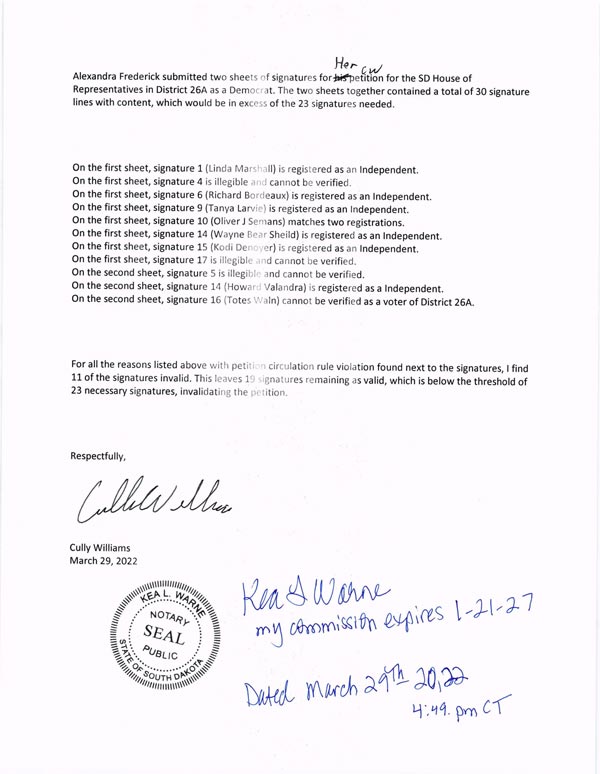
Just had this sent over to me. Democrat activist Cully Williams now living in Spink County has announced that he’s running for the South Dakota legislature:
It’s curious, as just a short time ago, he was filing to bump other Democrats off the ballot..



 Sioux Falls, SD – Mayoral candidate Christine Erickson officially filed her nominating petitions and has been certified to appear on the ballot for the upcoming Sioux Falls mayoral election in June 2, 2026. With 96 days remaining until Election Day, Erickson says her campaign is energized and focused on continuing conversations with residents across the city.