
Had this sent to me a short time back. Articles of Incorporation were filed in the fall of last year for a new group – a domestic non-profit – called American Land & Legacy which is fronted by Amanda Radtke, a self-styled social media influencer who is always pushing her narrative du jour in conservative Republican facebook groups.
Has Radtke filed an LLC to potentially monetize her facebook outrage? I’d say “who cares,” but it’s more of who she’s bringing along for the ride. And what kind of rabbit-hole it represents. The two related entities organized last October are as follows:
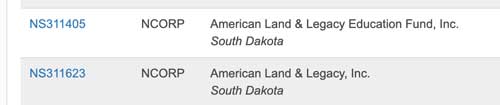
For our purposes, we’re looking at NS311623. (You can look at it yourself, these are very public filings). And looking at the filing, there’s a couple of items that drew my attention:
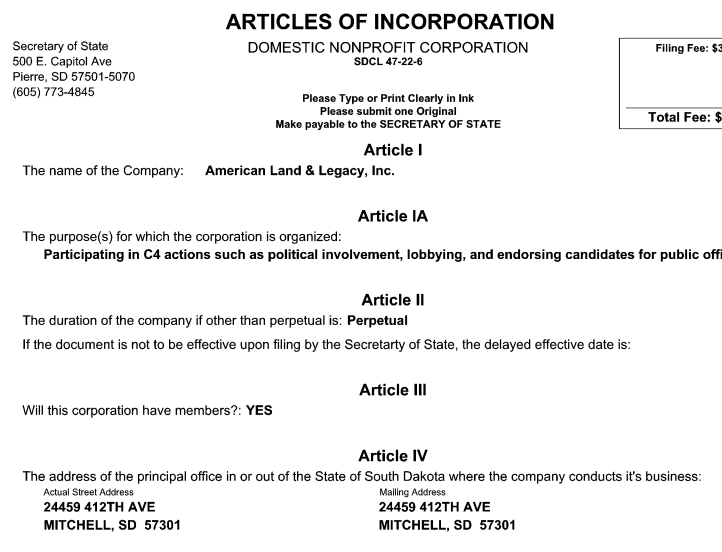
First off is that this group has organized itself, indicating that the purpose for that organization is “Participating in C4 actions such as political involvement, lobbying, and endorsing candidates for public office.” So – their words – they came together for lobbying and endorsing candidates.
Who is the “they?” Here’s where it gets more curious.
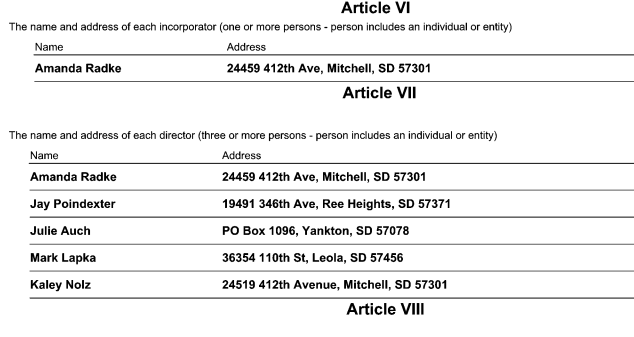
Included on the initial board of directors for this lobbying organization were State Rep. Julie Auch, State Senator Mark Lapka, and State Rep. Kayley Nolz. So hang on.. 3 legislators are directors of an organization that stated that they will have political involvement such as lobbying and endorsing candidates for public office? And they will be raising money for this purpose, or taking money from parties unknown for this purpose?
Why does that make me ask what’s going on here, and wonder what conflicts might arise from being a director in this corporation? There’s no IRS 990 filing available yet as it was just formed, so we know little of what they seem to describe as a 501 (c)(4) group. But with elected officials involved, it makes you wonder how the money flows, and who it flows to, and what it’s being used for?
Since this initial filing in October, on November 3, State Rep. Julie Auch was replaced on the board with a non-legislator. And on January 1, Radtke signed paperwork to remove her sister Rep. Kayley Nolz. Which leaves Senator Mark Lapka on the board of directors of an organization which was formed to be involved politically and “lobbying, and endorsing candidates for public office.”
Here’s the thing about 501c4 organizations – and I learned this long ago when one was involved in a ballot measure 20 years back – They can get away with not disclosing how they raised and spent their money for a long, long time, if at all. In fact, they have a term for groups like this – political Dark Money. If you’re looking at how some people view dark money… From the Campaign Legal Center:
“Dark money” groups are political organizations that masquerade as “social welfare nonprofits” under section 501(c)(4) of federal tax law, allowing them to avoid having to disclose where any of their money came from. Wealthy special interests use these groups to pour cash into elections and influence legislation in their favor, while keeping their involvement totally secret.
…. Federal campaign finance laws provide that any group with a “major purpose” of engaging in federal campaign activity must disclose its contributors, and federal tax laws provide that political activity cannot be a 501(c)(4) nonprofit group’s “primary activity.”
If a group wants to work primarily on politics, it must register as a political committee and disclose its donors.
Dark money groups get away with breaking the law because the two federal agencies charged with overseeing political activity and nonprofits, the Federal Election Commission (FEC) and the Internal Revenue Service (IRS), are doing practically nothing to stop them.
Now, that’s how they are said to operate on the federal level. At the state level, there have been attempts to rein in this kind of activity, but I’d have to consult someone to get the current state of regulation.
The bottom line is why did these legislators think they needed to organize a 501(c)(4) federal dark money group to “lobby” and “endorse candidates for public office?” Clearly, a couple of them got out of it right away. But the whole organization is there, still with a State Senator on the Board of Directors according to the latest amendment.
In what might be the biggest election year in a generation, it brings up many questions. Unanswered questions as to why they’re using an unusual tool in South Dakota politics to make it challenging to follow the money.
I think someone should look at their ties to China
Auch is quick on the trigger
The thing is that Legislators have to disclose those entities they control more than 10% of the capital or stock on their conflict of interest statement. Would they have to disclose they are a director of this dark money group? Mmmaaybe…
American Land & Legacy Education Fund? Education? Vouchers?
Scholarship Granting Organization? SGO. I believe an SGO needs to be in place as “pass-through” as part of Governor Rhoden opting into Trumps Education piece of the BBB for the tax write off.
I live when these people stand on their soapboxes and decry these things in public, then try to sneak around quietly and do the very things they are screeching about. I’ve always felt radke was a self serving grifter. Another hypocrite being drug into the light. Maybe she can write a kids book about it.
Fear her wrath
All about protecting their rights while most in this group take away the rights of others.
Pat,
Is it legal for a South Dakota legislator to vote on bills while serving on a nonprofit that raises money to lobby for those same bills?
SDCL § 2‑12‑9 makes it a misdemeanor to offer money or inducements to influence legislation, and the state constitution bars financial interests in actions legislators vote on.
These legislators are cashing in on the bills they vote on, and it’s hard to call that anything but shady. Time for South Dakota Attorney General Marty Jackley to look into these potential violations and hold them accountable. Hypocrisy shouldn’t come with a paycheck.
In October of 2023, Gov. Kristi Noem requested an advisory opinion from the South Dakota Supreme Court to clarify when legislators are barred from holding state contracts, and the court’s February 2024 opinion significantly narrowed what counts as a conflict of interest. The ruling allowed Noem to move forward with filling two vacant legislative seats after months of uncertainty.
What the Advisory Opinion Said
The court examined Article III, Section 12 of the South Dakota Constitution, which restricts legislators from having “direct or indirect” interests in state contracts.
The justices concluded that not all contracts between legislators and the state are prohibited.
The key distinction:
General appropriations bills (the annual budget) do not count as “laws” that authorize specific contracts.
Separate legislation that creates programs or projects does authorize contracts — and legislators cannot enter into those contracts during their term or for one year after.
This reversed decades of broader interpretations and marked a major shift in how conflicts of interest are understood. Personally, I preferred the old definition.
Any time Radke or her followers are involved its shady! She is nothing more than a self serving liar. Look at her Facebook pages, she quotes herself and decides what her title is by that days audiance…is she a farmer…a rancher…a speaker…a mom…
Her & her husband both work away from home yet Ranch…Farm & homeschooling their kids????
She is padding her pockets with a lot of foolish people’s money while telling them she’s saving the Prairie.
Any one she endorses is no one we should be voting for!! Lapka & Nolz both need to be kicked out…Nolz got there thru her sister’s backroom shadiness in the first place.