Hey – I know that guy…

As seen at tonight’s Jacks game. It’s like you can’t get away from Josh Haeder!

As seen at tonight’s Jacks game. It’s like you can’t get away from Josh Haeder!
 Dusty Johnson Legislation Removes Statute of Limitations for Murder on Federal Lands
Washington, D.C. – Today, U.S. Representative Dusty Johnson (R-S.D.) introduced Kamisha’s Law to remove the statute of limitations for non-capital homicide crimes on federal and tribal lands. Kamisha’s Law honors Kamisha Nyvold, a toddler who was murdered in Sisseton, S.D., in 1992. Thirty years after the crime, new information led to the prosecution of the murderer, however, the five-year statute of limitations had passed. Prosecutors were unable to charge the defendant with second-degree murder. U.S. Senator Mike Rounds (R-S.D.) introduced identical legislation in the Senate.
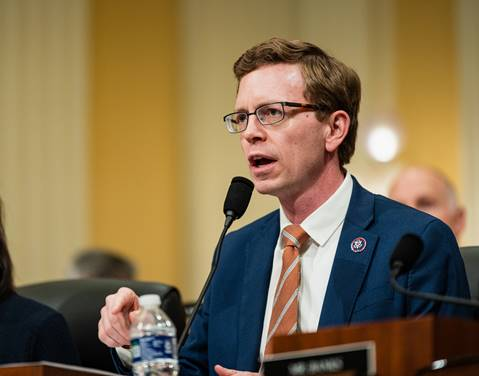 “This is a much overdue reform for families like Kamisha’s,” said Johnson. “It’s unfortunate that Kamisha’s killer will only spend ten years behind bars. I’m grateful for Senator Rounds’ leadership on this issue to ensure justice for victims and for the advocacy of Kamisha’s mother, Christine Irwin, and her husband Roger.”
“Prosecution for murder should not have an expiration date,” said Rounds. “In the case of Jay Adams Jr., new evidence was not brought forward until over three decades after Kamisha was murdered. While he was prosecuted under a plea deal, this legislation rights a wrong by eliminating the statute of limitations for second-degree murder on federal lands. I appreciate Kamisha’s mother Christine and her husband Roger for working with my team on this legislation, and I appreciate Representative Johnson agreeing to carry companion legislation in the House. I look forward to working with my colleagues to honor Kamisha’s memory and get it across the finish line.”
“Kamisha’s Law is about accountability, protection, and making sure no other family has to endure the pain we live with every day,” said Christine and Roger Irwin. “Our daughter, Kamisha, is more than a name attached to legislation. She is deeply loved, and her life mattered. This law honors her by turning loss into action and grief into meaningful change. Kamisha’s Law represents a commitment to doing better—to closing gaps that allow harm to continue. No family should have to fight for justice only after the unthinkable has already happened. We call on lawmakers from both parties to come together and pass Kamisha’s Law without delay. Protecting families by ensuring offenders receive appropriate sentences must rise above politics. Bipartisan support sends a clear message that human life, safety, and accountability are shared values. We are grateful to the leaders who have listened, who have shown compassion, and who have chosen to act. Kamisha’s legacy will be one of impact, awareness, and protection for others. We urge Congress to stand united, pass Kamisha’s Law, and ensure that Kamisha’s life leads to lasting change.”
Background:
Kamisha Nyvold was a toddler who was murdered in Sisseton, S.D. in 1992. Thirty years after the crime, new information led to the prosecution of the murderer. However, the five-year statute of limitations had passed. Prosecutors were unable to charge the defendant with second-degree murder.
Prosecutors were forced to strike a deal with Kamisha’s killer, who then had to waive his statute of limitations and plea to manslaughter, resulting in a maximum 10-year sentence in federal prison.
Kamisha’s Law will eliminate the statute of limitations for non-capital homicide offenses on federal and tribal lands for the following crimes:
Click here for bill text.
###
From my personal e-mail, just got this note from the Brookings School District:
BSD Families,
The South Dakota Department of Health has informed the district that a spectator who attended Saturday’s Les Tlustos Wrestling Invitational has since tested positive for measles. The Department of Health does not plan to conduct contact tracing related to this event and has not provide additional information.
Families with questions or concerns are encouraged to contact the South Dakota Department of Health directly.
That’s just great.
Had this discussion with my wife a couple of days ago where people mistakenly don’t think measles is a big deal. And in many cases, it isn’t. But in some, it’s more than bad. And why we get vaccinated.
Measles gives some people a runny nose, high fever, etc. And with some measles causes health complications like pneumonia and encephalitis, and kills some people.
Wonder why we used to have a school for the deaf and it seemed there used to be more hearing impaired children? That’s one reason. Measles infection during pregnancy, particularly close to delivery, can affect the development of the fetus’s auditory system, leading to permanent, profound deafness, among other disabilities. Or miscarriage, premature birth, or (again) brain damage.
That’s why we vaccinate kids with the MMR vaccine. And why we don’t need the goofy anti-vaxxers trying to dictate public policy to remove these requirements in our schools.
KELOland is reporting that a legislative committee voted to send projects that would bring jobs and revenue that could help alleviate tax burden in our state to North Dakota and Nebraska. Again.
Am I talking about CO2 pipelines? No, silly. We killed the revenues and investment that such a project was going to bring to the South Dakota economy last year, and they’ve already left for greener pastures. Today, House State Affairs voted against providing tax incentives to kill more investment in our communities – the mega-million dollar data centers that want to come here.
The same types of tax incentives all of our neighbors are offering. But South Dakota apparently won’t:
The prime sponsor, Republican Rep. Kent Roe of Hayti, said the incentive would attract large data centers to South Dakota. Roe said data centers would pay substantial amounts of property taxes at a time when many people are complaining their property taxes are too high. He noted that 40 states offer sales-tax breaks to data centers, including South Dakota’s six neighboring states.
and..
Voting yes to kill the bill were Republicans Jessica Bahmuller of Alexandria, Spencer Gosch of Glenham, Hansen, Leslie Heinemann of Flandreau, Karla Lems of Canton, Schaefbauer, Overweg and Scott Odenbach of Spearfish, and Democrat Erin Healy of Sioux Falls. Voting no were Emery, Jamison and Republican Tim Reisch of Howard.
And people wonder why their taxes keep going up, and their kids keep moving away? Because when projects want to come here and pay sales tax on the power they’re going to buy, property taxes on the buildings they put up, payroll taxes on the people they hire to build and staff the places, plus much of the same for the people they bring into the community, people won’t cut them a tax break on computer equipment to go in the buildings?
With the anti-development attitude the NIMBY’s and BANANA’s leading the legislature have, instead of calling South Dakota the Land of Infinite Variety, we should change the slogan to South Dakota. No.

Thune: Female Athletes Deserve a Level Playing Field
“Thanks to this administration’s actions, Title IX is being enforced and upheld, and women and girls playing sports at federally funded educational institutions are protected.”
WASHINGTON — U.S. Senate Majority Leader John Thune (R-S.D.) today delivered the following remarks on the Senate floor:
Click here to watch the video.
This goofy data center nonsense “Notice of Maladministration” material was apparently put on desks in the House chamber by Representative Dylan Jordan this morning.

(Seriously, I don’t look for this goofy stuff). If they ignore or fail to deliver this notice, they agree to pay $30,000.
Does this mean that legislators are supposed to defer to all the goofy nonsense material sent to them, or is it just Rep. Dylan Jordan?
Attorney General Jackley Presents Public Integrity Report to Legislative Committee
PIERRE, S.D. – South Dakota Attorney General Marty Jackley has released his Public Integrity Report to the Government Operations & Audit Committee. The report details the work of the Public Integrity Unit in 2025, which reviewed 47 unique reports of misconduct by state government employees, resulting in 14 criminal investigations and four state employees being criminally charged. All four cases are still pending.
“South Dakotans deserve a government that is transparent, accountable, and free from corruption,” said Attorney General Jackley. “I am committed to ensuring South Dakota remains the most honest and ethical state government in the nation.”
The Public Integrity Unit was established through Senate Bill 62, proposed by Attorney General Jackley, passed by the 2025 Legislature, and signed by Gov. Larry Rhoden. The legislation created mandatory reporting requirements for state employee misconduct and provided protections for employees who make good-faith reports to authorities.
Housed within the Attorney General’s Office, the Public Integrity Unit investigates cases of state employee misconduct. It includes an Assistant Attorney General serving as prosecutor and a Division of Criminal Investigation (DCI) Supervisory Special Agent serving as investigator.
Gov Rhoden said: “In several states across our country, corruption and fraudulent practices are going unchecked — and in South Dakota, we stood up against it. Our people deserve transparency and accountability, now more than ever. I am proud to work with the Attorney General on instituting and implementing this law.”
“The more than 14,000 South Dakota state employees are hardworking, law-abiding public servants who dedicate themselves to serving the state,’ said Attorney General Jackley. “We will not allow a few to tarnish the sterling reputation of the majority.”
-30-
Before Attorney Jackley Marty Jackley bowed out of the gubernatorial contest that was anticipated, and pivoted towards Congress, money had not been flowing to him because they didn’t seem to know where he was going to land.
That’s not a problem now, and someone has opened up the money spigot.
Jackley EOY FEC Report 2025 by Pat Powers
Marty Jackley put up a fundraising quarter for Congress that’s on pace with any good fundraising quarter we see from our federal delegation. Marty reported $490,326.61 in donations, with another 10k transferred in to total $500,628.24 raised.
Expenditures were only $81,680.97, leaving Jackley a little under 1 million dollars cash on hand, at $922,326.34, to move towards the primary election.
Crabtree for Congress posted their end of year FEC Report for 2025 in the race for Congress, showing where Casey in in the sprint for the primary election.
Crabtree for Congress December FEC Report by Pat Powers
In the holiday portion of the cycle, the Crabtree operation was not as heavy on fundraising, where they only took in $30,202.48, against expenses of $77,250, leaving the campaign with $133,868.91 cash on hand.
He may have a little more to put into the kitty from a State PAC, and his legislative campaign account, but Casey needs a fundraising push in the contest against a well-heeled Marty Jackley. There’s time yet to go in the race, but cash needs to be king from now through early voting.
House Bill 1181, a bill to ban weather modification activities was withdrawn yesterday by the sponsors of the legislation.
If you recall, I had noted earlier that legislators seem to have broken their pledge to shoot down planes, and just ended up asking for more government. Such pledges like these below…
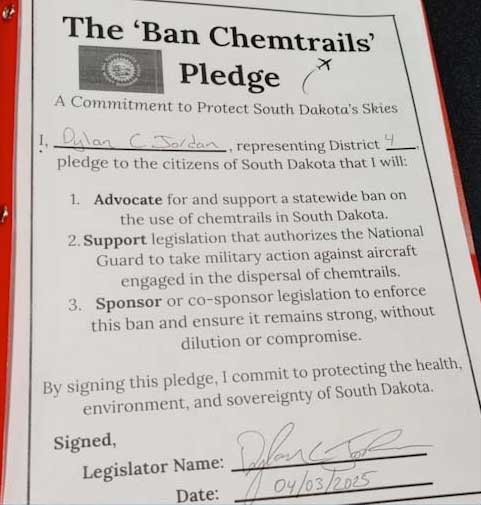
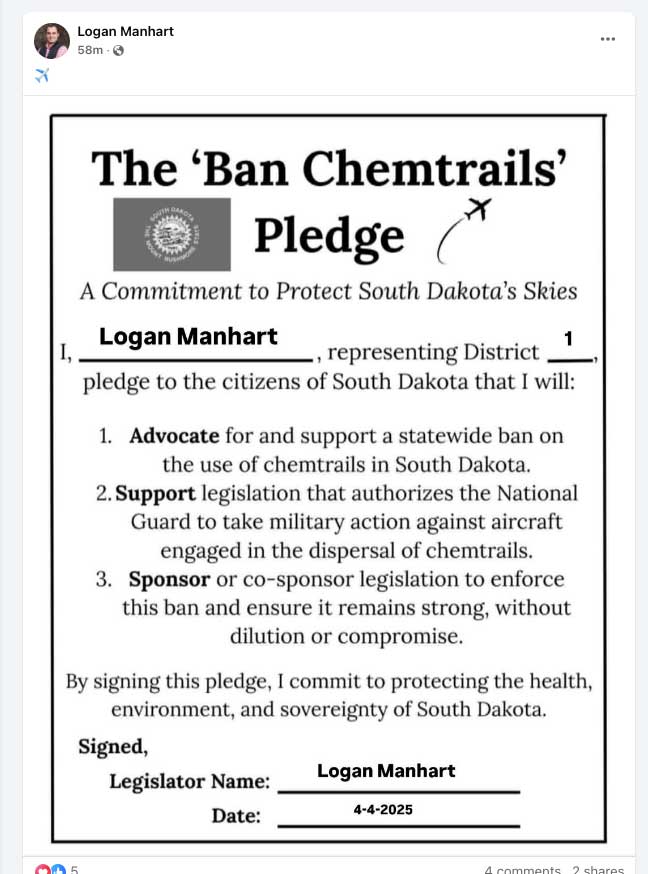
Those look pretty definitive on how they were going to “stay strong without dilution or compromise.”
If you look at the new legislation that was just dropped in the hopper, House Bill 1271 “Act to prohibit weather and climate modification activities and provide a penalty therefor,” all I have to say is that dilution and compromise, you have found a home, because the fierce opponents against chemtrails who promised military action are – as before – going to administer those planes.
They are going to administer and promulgate against those made-up villains and evil-doers for things they read about on the Internet, and they are going to establish criteria.
That’s those legislators just showing them how when they pledge military action, …they will do the exact opposite and run away.