I was somewhat neutral on Governor Rhoden’s State of the State address as I’m listening to it until a couple of passages in his speech.
First, as I’m sitting listening to it, the Governor had a call against currently public information remaining in the public domain:
To address this, my office is bringing forward two bills to protect the personal information of law enforcement, judges, legislators, and statewide officials by removing it from public voter files. We will also add doxxing to the crime of stalking and increase penalties when it targets law enforcement and public officials. South Dakota will not tolerate threats against those who uphold the law and serve the public.
Read that here.
As Arch Beal would say, “Whoa, whoa, whoa.” Governor Rhoden announces that he intends to bring a measure against open government? How exactly do they plan on wording this measure? And more importantly, how exactly do they intend to curb legitimate news gathering endeavors in the interest of “protecting personal information?”
I have a particular interest in how they they intend to implement this. In case you’ve forgotten, there have been instances – very recent instances – of legislators claiming residency at one location, yet clearly living at another, as I’ve gone into depth on:
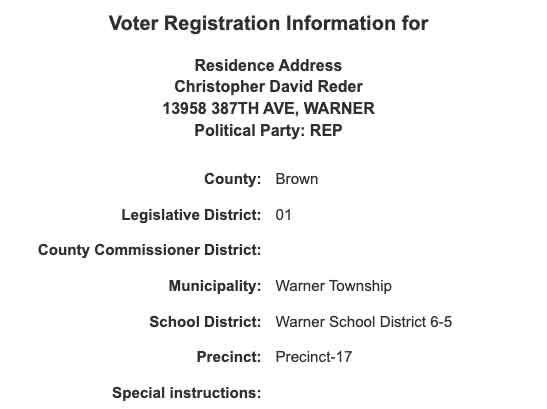
First off, looking at Rep. Reder’s voter registration, the live data as of today indicates that he’s supposedly registered to vote at an address in Warner, SD:
Establishing where he claims to vote and supposedly legislates from is 13958 387th Ave, Warner, SD 57479, What else can we find out about that location?
and..
Reder’s foundation that had been at that farm address that he also uses as his legislative address? Interestingly, in filings with the Secretary of State, that Foundation seems to have changed Reder’s address in the corporate filings:
DTOM Foundation Paperwork B0345-5410 by Pat Powers on Scribd
Bagley, Minnesota. Not Warner, South Dakota.
On January 19, 2025 when this document was filed, this document shows Christopher D Reder as hanging his hat in Bagley, Minnesota, or at least where his business is located. Reder would have been seated in the Legislature on about January 14th.
Read that entire story here.
Shortly thereafter, Representative Reder resigned in part because he faced a cloud of questions about his residency, including the fact he was claiming an owner occupied tax exemption for property in Minnesota.
Was revealing what he claimed as his home address done so with nefarious intent that wished him harm? No, it was not. Was it a legitimate and germane question from the public as to his qualifications for serving in office? Absolutely. They can’t – or at least should not – have residency qualifications for office if they pass laws declaring that information as unlawful to publicize or hold as secret. It’s against the public interest, as well as that of a free press.
But depending on how this law is worded, will questioning the residency of a legislator, and presenting evidence of one’s thesis become a crime, punishable by law in the State of South Dakota? I’m sure there are some legislators affected who would like it to be that way. But this public information needs to remain in the public domain. Unless we’re now creating a separate class of citizenship for elected officials now.
Maybe I’m a little excited over nothing. But this is a question that the Governor and legislators need to carefully navigate if they choose to claim it a safety measure as opposed to censoring criticism that they don’t like coming from a free press.
—
Also as it relates to the State of the State speech.. I had a call from one of my readers asking me “did Governor Rhoden really talk about women being chaste? I had to look it up, and it means exactly what I thought it did.”
Err.. sorry. Yes, Yes he did.
We are able to enjoy our Black Hills today, in part, because of the foresight of one of South Dakota’s greatest leaders, our ninth governor, Peter Norbeck. As I close today, I would like to read the conclusion to his State of the State Address from 1919..
..I believe in her government, and in her institutions of home and church and school; I believe in the sturdy, intelligent manhood of her sons, and the chaste womanhood of her daughters..
Chaste womanhood. So you don’t have to look it up yourself.
chaste. [cheyst]/ tʃeɪst /
-
refraining from sexual intercourse that is regarded as contrary to morality or religion; virtuous. 2. virgin. 3. not engaging in sexual relations; celibate.
Read that here at Dictionary.com.
Yes, That was the Governor in 2026 quoting the Governor in 1919 (as part of his state of the state) believing in the virginity of South Dakota’s daughters.
In 2026, you might also believe that quoting speeches like that will elicit eye-rolling over the patriarchal statement by the daughters of South Dakota. Because in 2026, those women may have the attitude that their chastity is not the Governor’s business.
I have the feeling I’m going to have a lot to write about this legislative session. (In addition to funding for K-12 education not being mentioned in the speech today).

 Mitchell, SD– State Representative Jeff Bathke announces his re-election campaign, representing District 20 and the great State of South Dakota. District 20 includes the communities and citizens of Jerauld, Sanborn, Miner and Davison Counties.