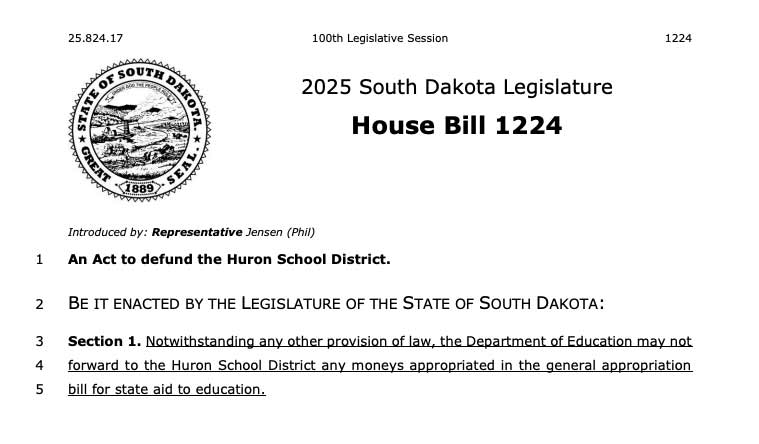
The controversy regarding Phil Jensen’s sponsorship of a bill to strip the Huron School District of funds is supposedly rising to the level where House Leadership may address it.
What I’m hearing is that something is going on, as this has the potential to really bite the caucus in the tail.
Aside from the fact it’s a ridiculous act, I’m being told various reasons as to why the bill was brought, none of which have been confirmed by the author yet.
One source is saying it’s a shared transgender bathroom issue that Phil was trying to use the power of the purse to go after the district, others are saying that it might be because of multiculturalism at the school that he doesn’t like. But again, that’s all rumor and conjecture and not confirmed.
I do note that the District is one of – if not the most culturally diverse school district in the state…
The question is what is House Leadership going to say, and more importantly, what are they going to do? Are they going to slap him on the wrist and say “bad Phil,” or are they going to censure him? They should remove him from office, but I doubt the House has the intestinal fortitude to do that, since there is at least 1 member of leadership who was at the Doeden rally featuring alleged Black Nazi Mark Robinson.
Interesting post from our former Governor, and very timely, as there was a recent show from Co2 idiot/’shock jock in a cowboy hat’ Trent Loos, that I don’t even want to post here, as he flat out referred to our former Governor using a term that no media professional would use and most women would find offensive.
I think if someone has an issue with Kristi they just cheapen themselves by trying to make it about her hair, wardrobe or being a woman. If you disagree with her, disagree with her actions, but trying to belittle her because of her gender says you’ve already lost the argument.
Hearing chatter that Rep. Phil Jensen was a bit in and out of House Education today. There seems to be something going on (related to his Huron School District funding ban) perhaps?
Washington, D.C. – Today, U.S. Representative Dusty Johnson (R-S.D.) was named to the Select Committee of Strategic Competition Between the United States and Chinese Communist Party, more commonly referred to as the “Select Committee on China.” Johnson was a member of the Select Committee last Congress.
“China poses many unique threats to America’s food security and national security,” said Johnson. “Their attempts to influence America and grow their presence around the world should be a growing concern to many. I’m grateful for the opportunity to continue this important work with the Select Committee to get tough on China.”
Johnson has been actively opposed to China’s influence in America. He leads legislation to protect U.S. infrastructure from China, make it harder for China to buy American farmland, crack down on the China-caused fentanyl crisis, safeguard ocean shipping from Chinese malpractice, and more.
“The Chinese Communist Party (CCP) represents the most significant national and economic security threat of our time, and I am proud to continue leading the Select Committee as we build on the essential bipartisan work of the 118th Congress,” said Chairman John Moolenaar (R-MI). “With the appointment of this exceptional group of members, we are strengthening our efforts to combat the CCP’s growing influence around the world and protect our freedom and way of life. I am grateful to Speaker Johnson for his support and partnership, and I am confident that, together, we will advance policies that keep the United States strong and secure as we confront China’s increasing challenges to our national security.”
Background:
The House Select Committee on Strategic Competition Between the United States and the Chinese Communist Party is responsible for assessing the threats to the economy and national security posed by the government of China and proposing plans to ensure a strong American future.
State Representative Rebecca Reimer has a bill in the system this year that’s actually a good idea.
House Bill 1094 allows school buses to have video recorders on board – if the district or bus company chooses – which can be used in evidence of people who don’t follow the law in stopping when the STOP arm is extended and the flashing red lights are going, removing any doubt whether someone is violating that very important safety rule that schools are faced with daily as they transport kids. Here’s the meat and ‘taters of the act:
Section 2. That a NEW SECTION be added to chapter 32-32:
If any school bus, as defined in § 32-32-1, is transporting students enrolled in a school district in this state and is equipped with an external video system capable of recording traffic activity around the bus, any recording from that video system is discoverable and may be entered into evidence in any civil or criminal action.
No district or bus company is required to install an external video system under this Act.
In my mind, this is not just reasonable legislation, but very necessary. Why? Because I witnessed it almost daily with my own daughter. I have a special needs daughter who was transported by bus to her program with the Brookings School District daily, to and from my house on a fairly busy street – 2 schools up the street, and the street is a major artery in town, and everyone tends to be a little lead footed. And honestly, people are terrible about stopping.
Several times I week I would witness people just sailing by on the opposite side of the street when the red lights were flashing and the stop sign extended, whether because they were inattentive, ignorant, or just didn’t care. The school bus would honk at them, and that was about all they could do, because the police can’t be everywhere.
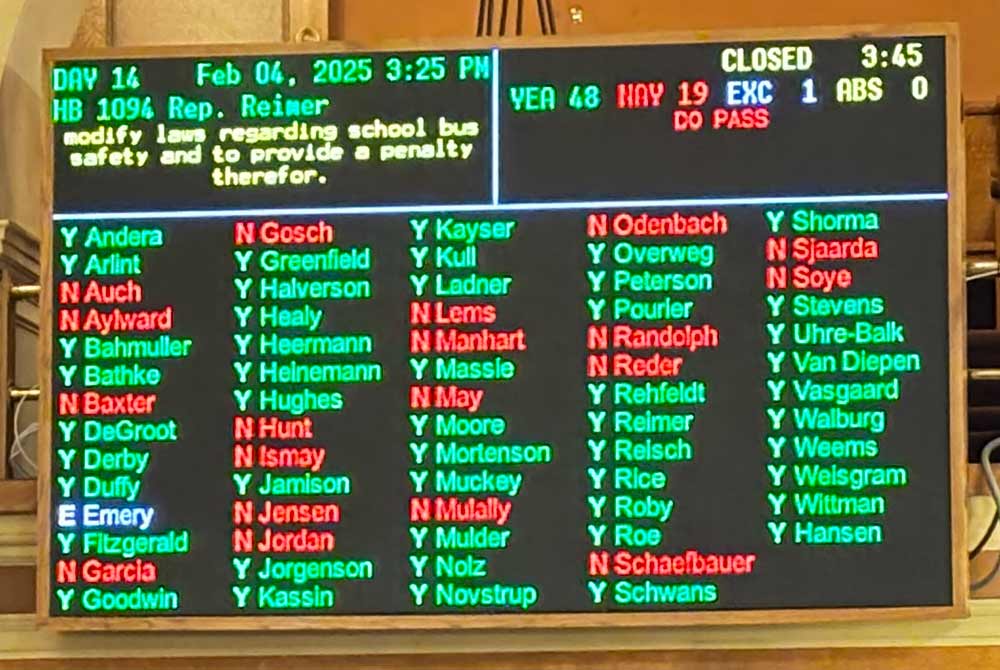
This bill actually allows the buses to document the violation, and for schools to present evidence to the state’s attorney for a prosecution decision so people possibly get the hint to not put kids in danger. It’s actually useful. And here’s how the vote went yesterday:
After passing unanimously in House Judiciary, 19 House members voted against protecting school kids from getting ran over by idiots.
Voted to Run over kids (Nays): Auch, Aylward, Baxter, Garcia, Gosch, Hunt, Ismay, Jensen (Phil), Jordan, Lems, Manhart, May, Mulally, Odenbach, Randolph, Reder, Schaefbauer, Sjaarda, and Soye. 19 legislators actually voted against protecting kids who are just trying to get on the darn bus to go to school.
Isn’t protecting the fragile little minds of our kids equally important with them not being crushed under the wheels of a vehicle while getting on or off of the school bus?
I’ll leave you with a couple of videos:
Nationally, it happens more than 90,000 times a day. Putting a camera on a bus to capture when it happens for a local prosecutor to act is not an unreasonable thing.
I found out something new today – aside from it being the anniversary of this website’s founding, it is also the birthday of South Dakota’s chief executive Governor Larry Rhoden!
Governor Rhoden celebrates his 66th birthday today, his first in the office of Governor.
Congratulations Larry on another successful trip around the sun!
It sounds as if the person who was arrested for threatening Governor Larry Rhoden is (was) a middle school teacher in Rapid City.
Officials say they were able to track the phone number to 28-year-old Hudson Wheeler, a teacher at South Middle School in Rapid City. Court documents say in the calls, Wheeler could be heard saying, “Rhoden, I know you’re not in charge of it all, but hey, you’re sticking your neck out too much man” and “Good luck Kristi, I’m coming for you. I’m *expletive* coming for you.”
In another call, Wheeler is accused of saying, “I will kill everyone who has government official if you come to Rapid City.”
The affidavit says Wheeler admitted he drank about 10 but less than 18 beers, left approximately six to 10 voice mails to multiple government officials, and stated he was angry at what is going on in the world right now and was ranting.
You know, little known factoid, I’m a terrible insomniac. I’ve made it a point, and have gone out of my way to avoid alcohol over the last decade because it messes with my sleep cycle so badly – it’s rarely worth it having a social beer or two at 7 or 8pm, and not being able to sleep past 2:30 in the morning.
Maybe it’s just me, but calling government officials and making threats to kill them … that would be a much bigger reason to never ever touch alcohol again. Although, I’m guessing he won’t get any choice in that matter, because his drunk calling is not going to reflect well on the renewal of his teaching contract. Or his teacher certification. Or in not going to jail.
Summit Carbon Solutions and Infinium Partner to Advance eFuels Production and Energy Independence in the Midwest
Ames, Iowa and Sacramento, Calif. [February 5, 2024]– Summit Carbon Solutions (Summit) and Infinium, a leading electrofuels (eFuels) producer, have entered an arrangement for the supply of up to 670,000 metric tons of carbon dioxide (CO2) annually at a proposed eFuels facility in North Dakota or South Dakota.
By leveraging Summit’s pipeline network, Infinium would have access to a consistent supply of CO2 — important to the production of ultra-low carbon eFuels. These fuels, made by combining captured CO2 with renewable power-derived green hydrogen, are used in the aviation, shipping, and heavy transport sectors, increasing domestic energy production and the supply of high demand eFuels to US and international markets.
“This partnership demonstrates how CO2 infrastructure drives energy independence and enables new markets for ethanol producers, farmers, and rural communities,” said Lee Blank, CEO of Summit Carbon Solutions. “CO2 is a commodity with growing value, and Infinium’s eFuels technology is an important piece of the puzzle. By providing a reliable CO2 supply, we’re helping unlock opportunities that support domestic energy production and economic growth.”
Construction and operation of an Infinium eFuels facility in the Midwestern US would promote significant investment in state and local economies, create high-paying, skilled jobs, and support hundreds of additional positions. At the same time, it would open additional market opportunities for US ethanol producers and farmers in Americas Heartland.
“As demand for eFuels continues to rise, it is essential to secure reliable and scalable CO2 sources,” said Robert Schuetzle, CEO of Infinium. “Summit’s infrastructure would supply the CO2 needed to scale production and advance eFuels as a key part of America’s energy future.”
About Infinium:
Infinium is a leading provider of gas conversion solutions and developer of eFuels projects. Its offerings include ultra-low carbon synthetic eFuels, technology enabling monetization of flare gas and RNG, and patented technology designed to support the rapidly evolving energy industry. Infinium is a company of “firsts”—the first to produce commercial volumes of power-to-liquid clean eFuels; the first to develop and deploy modular gas conversion technology; and the only clean fuels innovator offering end-to-end solutions to customers at every step in their energy journey. Industry leaders including Amazon, American Airlines, Borealis and IAG are customers of Infinium. Learn more at www.infiniumco.com.
About Summit Carbon Solutions:
Summit Carbon Solutions is driving the future of agriculture by expanding economic opportunities for ethanol producers, strengthening the marketplace for Midwest-based farmers, and creating jobs. In developing the largest carbon capture and storage project in the world, the company seeks to connect industrial facilities via strategic infrastructure to store carbon dioxide safely and permanently in the Midwest United States. For more information, visit www.SummitCarbonSolutions.com.
The countdown is over and I’m sitting here at my desk in what I call “the corner of cold,” where I work by day on insurance claims and over lunch and during the night. And today my 8th child, South Dakota War College, a.k.a. dakotawarcollege.com – shockingly – celebrates the 20th anniversary of my first post, on February 5th, 2005.
20 years ago I might have predicted (with hope) that I’d still be around in twenty years, but I never would have predicted that the little website I set up via blogspot would not just still be going, but would be actively thriving and remaining at the center of the South Dakota political discussion.
I tell the story that way back in 2005, I read the blogs that changed how politics were discussed and considered in South Dakota – South Dakota Politics, Daschle V. Thune, Sibby online were writing the insider details, they’d have the scoops that you didn’t see in the mainstream media on KELO or reading in the Argus, and they helped provide a lot of the background that you didn’t get otherwise.
Months after the election, South Dakota Politics was still active, and other blogs and websites – mainly on the left – joined them. SD Watch with Todd Epp. Clean Cut Kid with Chad Schuldt, Ben Hanten at South Dakota 123, and there were a number of others. But I really wasn’t getting what I craved, because I cut my teeth at the state level, in particular in the state legislative races. After having been involved in South Dakota politics for 17 years at that time, my focus had been less about national level, and more what’s happening locally.
Since I wasn’t finding what I wanted to read, I decided to write about it myself. And when I sat down and got serious about updating it regularly, I was pleasantly surprised to find that others found it enjoyable. And they started commenting. Now, 20 years later you’re still commenting.
I have to laugh as I’ve had kids who have grown up alongside SDWC, and I know at least one of them rolls her eyes when she has new friends and colleagues realize that it’s her dad who writes this, so she gets to hear how much they enjoy the website, and they pump her for insider info. Which I think elicits an eyeroll from her more than anything. And that’s a good segue into insider information about Dakotawarcollege.com itself.
Why South Dakota War College? Well, in a way you can blame State Representative Tim Reisch.
At the time I created it in 2005, I was trying to come up for a name for the blog and I had caught a press release that went out from State Government for Tim, who at the time was going to be attending the Army War College to become a better officer in the National Guard. And since I wanted to write about South Dakota politics and how to make campaigns better, I went with it.
It was distinct and nobody else was using it, and 5 or ten years after the fact was not the time to be changing the name of the website to something that might work better in search engines. And here we are 20 years later.
Thank you for your patronage over the last two decades.
Who knows. Maybe both the website and I will still be kicking around in 20 more!
I find myself replying to texts all evening, so “Yes, I’ve seen the bill.”
And given that the bill’s sponsor is State Representative Phil Jensen, arguably the worst human being in the South Dakota State Legislature, I can hope that the reason behind the bill isn’t going to come with national condemnation. But given the source, and the rumors I’m hearing behind the scenes… I’m preparing.