It’s the quiet time of the 2022 election season. But there are still things bubbling under the surface.

While many look at the long stretch of months between the last legislative session and the end of 2021 as the doldrums of politics when little to nothing is happening, it’s actually an important planning period for those behind the scenes.

For potential candidates, it’s a time to float trial balloons about running.  Because next year, they have to actually produce, and get go collect signatures. Which is more complicated than just saying that you’re running.

Even more importantly, for serious candidates it’s a long uninterrupted stretch for fundraising, which is why you see those engaged in the process beginning their efforts. It takes a long time to gather the amounts necessary to sustain a statewide candidacy. This is the marathon part before next years’ sprint to the finish.

Same goes for political parties. This is the time when they build their machines to try to follow through to a successful next years’ election.

Now that we’re in the build-up for 2022, what are the parties doing?

South Dakota Democrats currently find themselves with two field directors, but still searching for the organization’s third executive director in so many years during financially and electorally rocky years.

Former State Senator Pam Cole had lasted approximately one year after historic losses by the party.  Before her, Stacey Burnette managed to last from early August to late October in 2019. (Before she and party Chair Paula Hawks abandoned ship because of disastrous party financial issues.) Before that Sam Parkinson lasted slightly longer as Executive Director from June 2017-April 2019, when state Democrats showed a few signs of life, but still lost the presidential race in the state by 30 points and were crushed in the state legislature.

While Democrats are claiming in recent interviews that they’re searching for an executive director, why is there is no job advertisement on their website anymore?  The job closed at the end of January, and remains unfilled.

They also made an announcement that the national party may dump some money into the state. This is nothing new, as National Democrats dumping money into the state on a monthly basis has been their life support. Literally, it is one of the only things that have kept their doors open over the course of the last three years. So, this will not be a big change in routine.

Comparatively, the electoral process for South Dakota Republicans has provided far more success than their Democrat counterparts have experienced with far fewer staff.

South Dakota GOP Chairman Dan Lederman is currently in the midst of his third two-year term of office, beginning in February of 2017. Favoring a more hands-on managerial style, he has been running a lean shop with a number of functions outsourced on an as needed basis.

In the previous two cycles, Lederman had been able to successfully coordinate party efforts, improving on them every time as he’s fostered an environment conducive for the GOP to expand their hold on the number of Republican voters in the state, which currently give an advantage of 144,000 more Republicans than Democrats.

Unlike Democrats who seem to be distracted with ballot measures, and many things which are not the function of a political party, Republicans under Lederman have managed to strengthen already historic highs of the number of Republican elected officials.

What I’m hearing is that Republicans don’t have any significant revisions planned, and according to their chairman are going to be doing many of the same things that have brought them good fortune in the past several cycles. Chairman Lederman recently commented to me that “Candidate recruitment is key to success,” indicative that the party is already in that part of the planning cycle.

With the Sioux Falls area having had more attention from the GOP last cycle, I’d watch for efforts to continue along that vein.

There’s likely more brewing, but that seems to be the undercurrent of discussion at the moment on the GOP side.

While it continues to be quiet on the surface, we’ll continue to keep an eye on things as bubbles of activity begin to form.
Release:  Public Invited to Discuss Strategies to Expand Homeownership in Sioux Falls 

 Public Invited to Discuss Strategies to Expand Homeownership in Sioux Falls 

Sioux Falls, SD: Councilors Alex Jensen and Christine Erickson will hear from citizens on how the city can make homeownership more accessible in Sioux Falls. Ideas gained from this outreach effort could be used for future legislative efforts intended to tackle the lack of homeownership opportunities. 

When: Thursday, May 20th 

Where: HyVee at 37th and Minnesota 

Time: 7:30am to 9:00am 

Visit https://www.siouxfalls.org/council for more information on the city council. 

# # # 

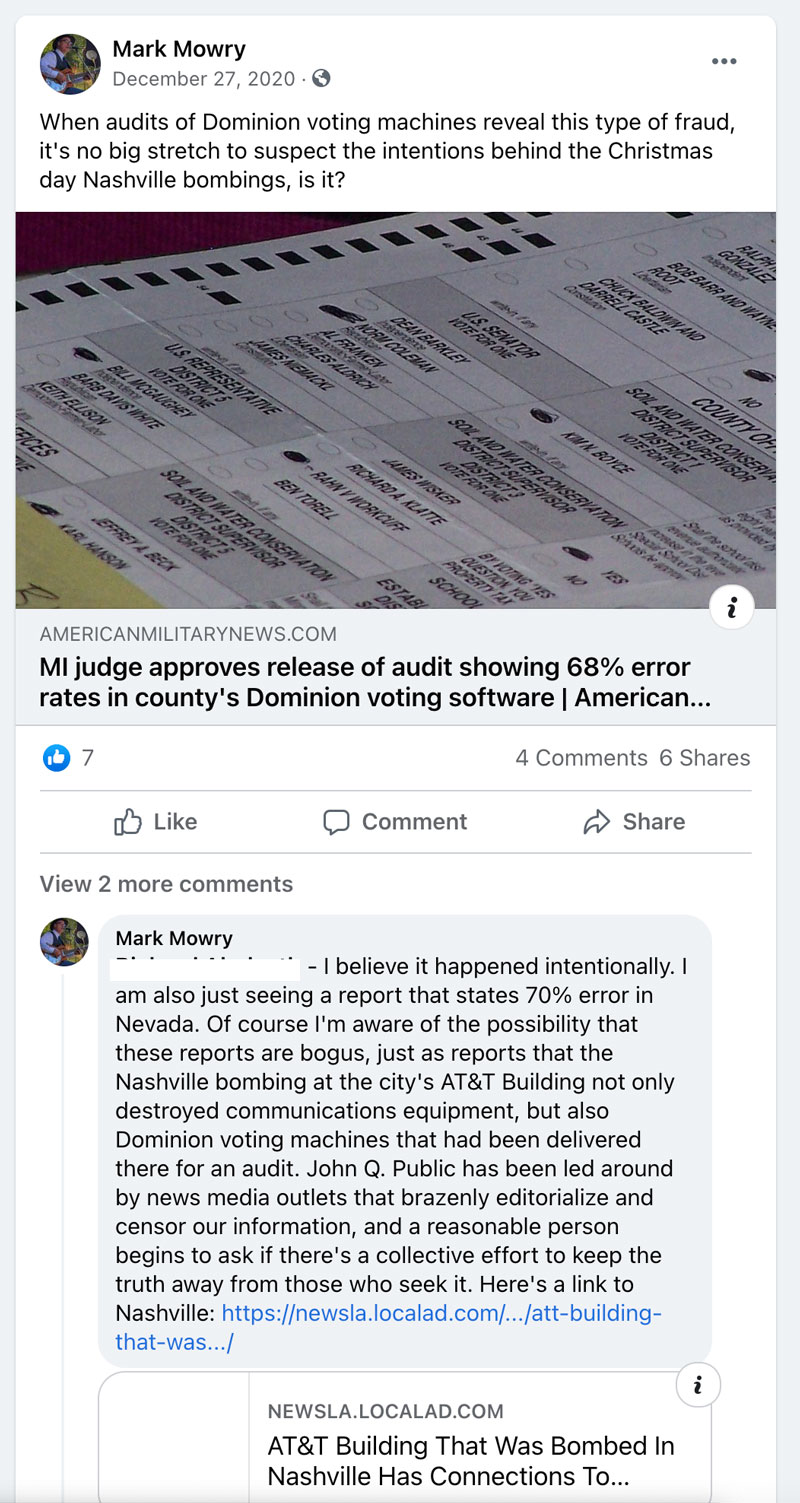
US Senate candidate claims Nashville bombing was intentional part of dominion voting machine conspiracy

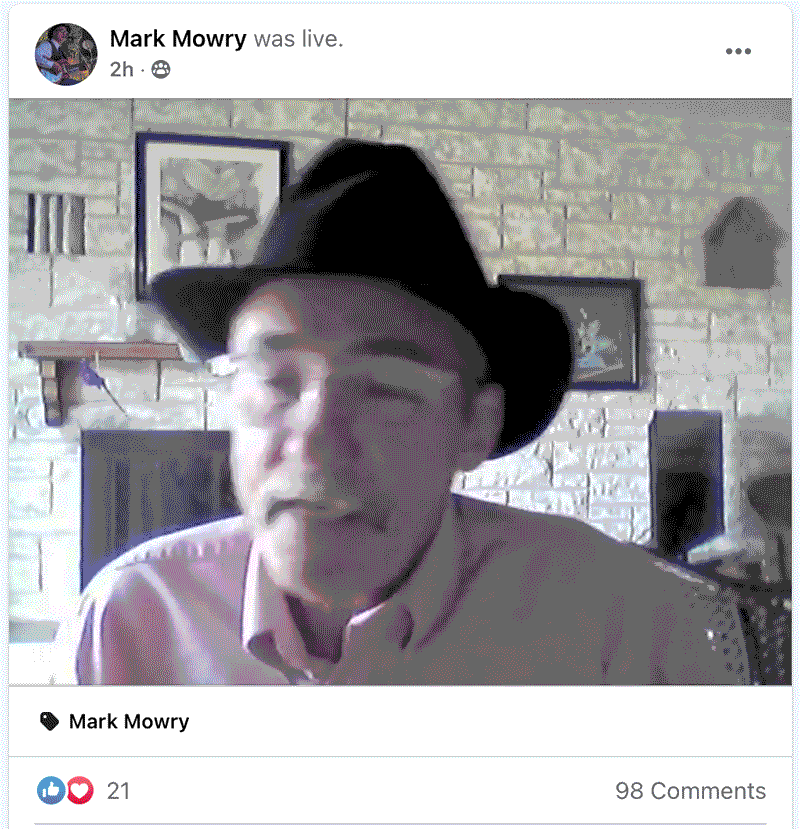
If you start digging into the social media for US Senate Candidate Mark Mowry (who announced his candidacy in the mainstream media today after becoming a Republican) you quickly see that my offhand derision that he’s the QAnon candidate might not be too far off the mark.

Because if it walks like a duck, and sounds like a duck.. well…

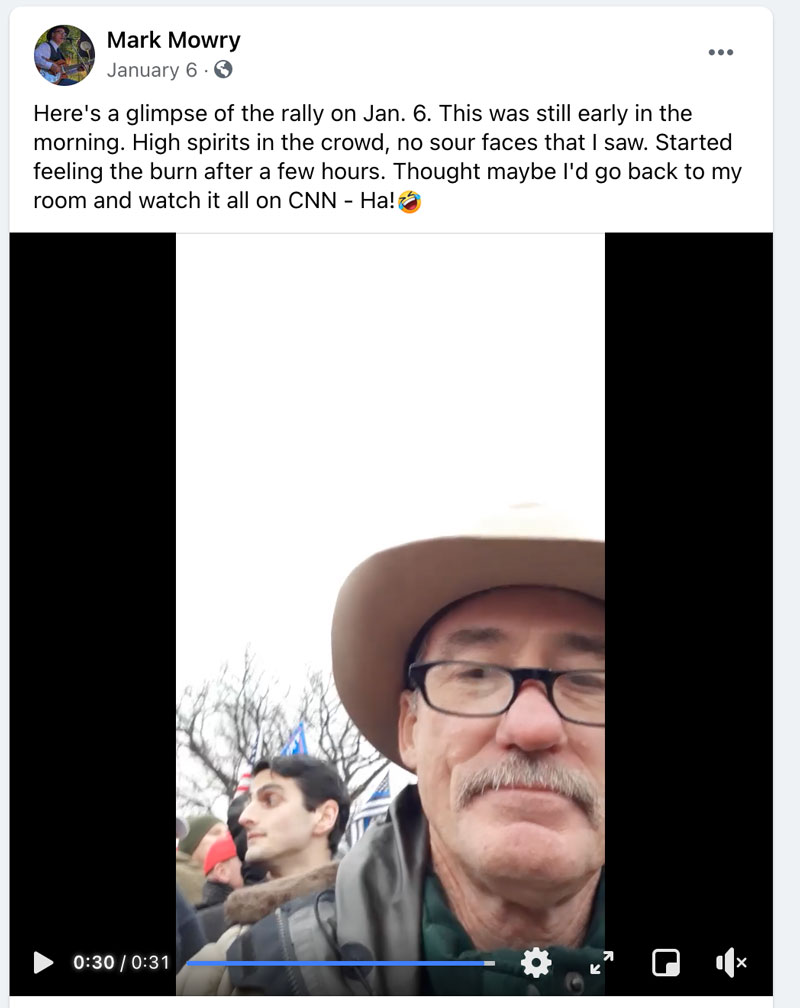
For starters, Mowry noted that he was in attendance at a certain US Capitol Rally earlier this year. One that eventually went a bit… sideways.

Of course, aside from his attendance, we also have him promoting claims that the Nashville bombing was done to hide fraud with Dominion voting machines.

Repeating the conspiracy claim was bad enough, but then we have Mowry explicitly stating that he believes the bombing “happened intentionally?”

(Of course, it didn’t exactly happen as Mowry speculated.)

If you like Marjorie Taylor Greene in Congress, I suppose that Mowry might be to your liking.

But for the rest of us, I prefer our US Senators not promote crazy facebook conspiracies.

Fox News reporting on more Kristi Noem for President speculation

From Fox News comes more chatter that everyone wants South Dakota Governor Kristi Noem on their speaker list, and she’s hitting some visible and notable events that you might see presidential hopefuls speaking at:

The influential Iowa based social conservative group The FAMiLY Leader on Wednesday announced that Noem will headline their 10th annual Leadership Summit on July 16th in Des Moines.


For a half century Iowa’s caucuses have kicked off the presidential nominating calendar, and any stop in the Hawkeye State by possible White House hopefuls generates more 2024 buzz.

Read it all here.

Spearfish resident changes party to Republican. Notifies press he’s running against Thune 2 weeks later. Still a fringe candidate.

Mark Mowry, the Q-Anon candidate of choice has finally gotten around to changing his political party to Republican, and has announced his candidacy against US Senator John Thune in the media:

Mark Mowry has announced his intent to run for U.S. Senate, the office currently held by Minority Whip John Thune, in the June 2022 Republican primary.

“Our conservative leaders have talked loudly and forcefully, but then they enter the battle with tin swords and soon come retreating back to their constituencies with a feeble ‘I tried.’ South Dakotans love their freedom and independence, and they expect and deserve more from their leaders,” Mowry said in a press release.

Read that here.

In checking today, it appears that he finally got around to becoming a Republican, despite not being one as recently as the end of April. (Believe me, I checked).

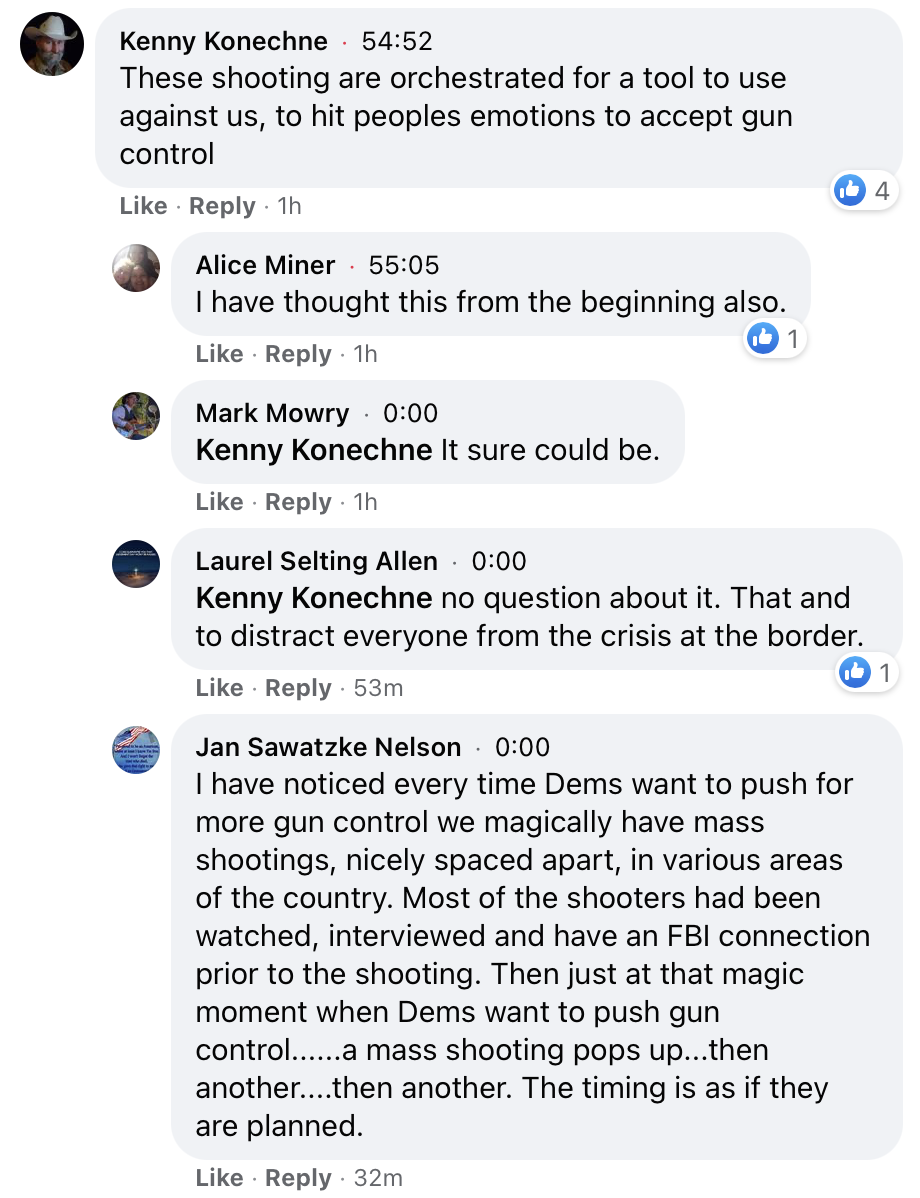
But, being a Republican for 2-weeks does not solve some of his other problems, as I noted regarding his recent facebook chat he gave to the “Primary John Thune Group in 2022” group:


Read my prior story on it here.

I really don’t think that South Dakota Republicans are interested in nominating a candidate who believes that mass shootings “sure could be” orchestrated to get people to accept gun control.

Moving on.

Thune, Johnson Lead Colleagues in Urging Department of Justice to Continue Investigation into Beef Industry

Thune, Johnson Lead Colleagues in Urging Department of Justice to Continue Investigation into Beef Industry

“We urge the DOJ Antitrust Division to continue vigilance and where possible, provide updates of findings.”

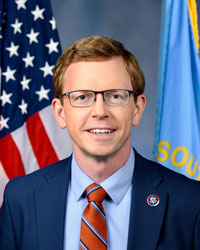
WASHINGTON — U.S. Sen. John Thune (R-S.D.) and U.S. Rep. Dusty Johnson (R-S.D) today led several of their colleagues in urging Attorney General Merrick Garland to continue the U.S. Department of Justice (DOJ) investigation into the nation’s four biggest meatpackers. Thune and Johnson’s bicameral letter also requested that DOJ provide Congress with updates on its investigation and encouraged ongoing vigilance on this issue.

“It is critically important that producers have fair and transparent markets for the commodities they produce,” the members of Congress wrote. “We urge the DOJ Antitrust Division to continue vigilance and where possible, provide updates of findings.”

The letter was also signed by Sens. John Barrasso (R-Wyo.), Kevin Cramer (R-N.D.), Steve Daines (R-Mont.), Joni Ernst (R-Iowa), Deb Fischer (R-Neb.), Chuck Grassley (R-Iowa), John Hoeven (R-N.D.), and Cynthia Lummis (R-Wyo.) and Reps. Kelly Armstrong (R-N.D.), Liz Cheney, (R-Wyo.), Randy Feenstra (R-Iowa), Ashley Hinson (R-Iowa), Mariannette Miller-Meeks (R-Iowa), and Matt Rosendale (R-Mont.).

Full text of the letter below:

The Honorable Merrick Garland
Attorney General
U.S. Department of Justice
950 Pennsylvania Avenue, NW
Washington, DC 20250

Dear Attorney General Garland:

We want to bring to your attention our concerns with potential instances of improper and anticompetitive activities in the live cattle and beef industry. Nearly a year ago, on May 22, 2020, the U.S. Department of Justice (DOJ) Antitrust Division sent civil investigative demands (CIDs) to the nation’s four biggest meatpackers. Since that time, the American people have seen no public results from the investigation. In fact, there is no information to even suggest whether the investigation has concluded or is still ongoing. Due to the change in leadership at DOJ since these CIDs were issued and the new allegations of anticompetitive activities since that time, we encourage the Antitrust Division to continue its civil investigation of these entities. Additionally, to the extent allowed by statute, we request that DOJ provide Congress updates on any investigations or ongoing vigilance.
Cattle producers have faced significant challenges over the last few years. In 2019, a fire at a single beef plant in Kansas, a facility that accounted for approximately 6 percent of our nation’s beef processing capacity at the time, created significant market disruptions.  In 2020, the COVID-19 pandemic-related plant closures led to additional processing capacity shortfalls and supply chain disruptions throughout the country. It appears plant labor shortfalls remain an issue today. While black swan events do not always prove wrongdoing, additional attention can reinforce confidence in the system.

Cattle producers, especially small feeders, are again experiencing difficult conditions that are threatening their ability to stay in business. With a tight supply chain, any changes in processing capacity can have a dramatic impact on cattle prices, preventing producers from capturing margin from boxed beef rallies.

It is critically important that producers have fair and transparent markets for the commodities they produce. We urge the DOJ Antitrust Division to continue vigilance and where possible, provide updates of findings.

Thank you for your prompt attention to this request.

Sincerely 

###

Guest Column: Let the Scorecards Begin by State Rep. Trish Ladner

Let the Scorecards Begin
by State Rep. Trish Ladner

As a freshman legislator, it has been a very interesting year. I have met new colleagues and have made some amazing new friends. It was refreshing to learn that they are just like you and me. Serving in the legislative session is a small, bracketed amount of time for all of us and after session we go back home to our farms, ranches, families, businesses, or jobs. During session, we are approached by lobbyists who are paid to be either proponents or opponents on certain issues. One morning I arrived in chambers to find 10 lobbyists lined up at my desk to give me their pitch about one bill out of 10+ that were on the docket for the day for us to vote on. As a new legislator, I have made a point of listening to both sides of the argument, did my own research, and spoke to select constituents in District 30 who had knowledge about specific issues related to agriculture, education, commerce and more. Then I’d decided my stance on the issue based on what I believed was best for the people of District 30 and our state. As some of you may know, I am for less government and in some cases I had to ask the question, “should this be a law, a protocol or remain a local issue?”

At the end of each session most lobbyist organizations come out with what is called a scorecard ranking legislator’s voting performance from 0% to 100%. They take the issues they were advocating for, or against, and rate the representative or senator based on how they voted for their special interests bills. Call me naive, but I believe that I was elected to go to Pierre to represent you the people, not special interest groups or causes. One local group gave me a score of 73% because I voted against three of the sixteen bills they supported and were advocating for. I looked over the three bills I voted against and quite frankly, I would vote the same way today as I did during session. For example, one of the bills I voted against was SB96 – to revise certain provisions regarding the use of telehealth technologies. At first blush, you think that would be okay. It worked well throughout the pandemic. When this bill came to the floor for a vote, I specifically asked the Representative carrying the bill if the expansion of telehealth technologies extended to the prescription of controlled substances (i.e., medications that can cause physical and mental dependence). When the answer was yes, I knew that I could not vote in favor of the bill. Having come from a background in the behavioral mental health arena, I know that none of the doctors I have worked with would prescribe or renew a prescription for a controlled substance (ie., narcotics), without seeing the patient in person and evaluating all aspects of their physical and mental wellbeing.

After reviewing some of the scorecards generated by special interest groups, I’ve decided that I wouldn’t put much credence in them. No disrespect to these organizations, but when all is said and done, I can live with a 73% score knowing that I have worked hard for you in Pierre to protect and defend our common sense, down to earth values and I will continue to do so.

Next session, we will inevitably face new challenges for our nation and this great state of ours. Challenges, that we will address one at a time as they present themselves. In the meantime, this is such beautiful time of year in the Black Hills. I’d like to encourage you to take the time to get out and enjoy the fresh, clean air and the natural scenic beauty that is South Dakota!

Under God, the people rule!

Rep. Trish Ladner, District 30
trish.ladner@sdlegislature.gov

Governor Kristi Noem supporting NRA, appearing in video challenging Biden to pry her guns from her cold, dead hands.

Starting yesterday, South Dakota Governor Kristi Noem is appearing in a new web video for the National Rifle Association Institute for Legislative Action, which is popping up on social media via Twitter and Facebook:

In the video, Governor Noem echoes former NRA President Charlton Heston, and challenges President Biden by noting that she’ll give him her gun when he “pries them from my cold, dead hands.”

US Senator John Thune’s Weekly Column: Let’s Get America Back to Work

Let’s Get America Back to Work
By Sen. John Thune

The April jobs report was less than stellar. Far less, in fact. With the rollout of the vaccine and millions of Americans ready to get back to work, economists predicted the U.S. economy would add around 1 million new jobs. The reality: only a quarter of the predicted new jobs came to fruition. Just 266,000. For employers who are looking to beef-up their staffs ahead of what’s expected to be a busy summer season, it’s quite a disappointment. On top of that, the Bureau of Labor Statistics recently reported that there were 8.1 million job openings at the end of March, making the dismal addition of just 266,000 new jobs all the worse.

If there are 8.1 million job openings (open jobs that employers are looking to fill) and only 266,000 jobs that have been filled (workers who’ve been hired), what’s going on? I believe it’s a direct result of Democrats’ completely misguided policies, especially their decision to create a disincentive for unemployed workers to rejoin the workforce.

It is no secret that South Dakota is a great place to live, work, and raise a family. Our high quality of life, low cost of living, and strong respect for freedom and personal responsibility is what attracts so many people to our state, and people quickly learn that we understand the value of hard work.

Before the pandemic, South Dakota had an extremely low unemployment rate of 3.3 percent. And now, nearly a year and a half into the pandemic, it’s even lower: 2.9 percent and falling. To compare, the national unemployment rate is more than twice as high as South Dakota’s at 6.1 percent. A low unemployment rate is good because it means those who want to work are working. On the other hand, though, it can be tricky for employers when there aren’t enough available bodies to fill empty job openings. It’s a challenge that’s facing many businesses in South Dakota.

At the beginning of the pandemic, millions of Americans, including many in South Dakota, were suddenly out of work. At the time, it was important for the federal government to take action to help ensure that workers who were affected by the pandemic at no fault of their own had the means necessary to pay their bills and put food on the table.

Republicans and Democrats agreed that we needed to temporarily adjust unemployment benefits to meet those needs. However, as more jobs have become available and more Americans have received the vaccine, I believe we need to incentivize individuals to get back to work. The additional $300 per week plus-up to the unemployment benefit is doing just the opposite, though. In some cases, because of the plus-up, some people are actually making more money without a job than if they got their old job back – even if it was available. That is why this week I cosponsored Sen. Roger Marshall’s (R-Kan.) Get Americans Back to Work Act, which would phase out the plus-up by the end of June rather than allowing it to remain in place through the first week of September, which is current law.

As we negotiated different COVID relief bills, I worked hard to ensure that individuals who are not eligible to receive unemployment benefits aren’t unfairly receiving these taxpayer-funded benefits. Specifically, my bill to improve the integrity of the Pandemic Unemployment Assistance (PUA) Program, which Congress created to temporarily provide unemployment benefits to individuals not traditionally eligible for unemployment compensation (i.e., independent contractors and the self-employed), was included in the COVID relief bill that became law late last year.

Earlier this year, I introduced the PUA Eligibility Clarification Act, which would incentivize unemployment beneficiaries to return to the workforce by directing the Department of Labor to rescind guidance allowing individuals receiving traditional unemployment benefits to become eligible for PUA if they refuse a suitable offer to return to work and self-certify that the workplace was unsafe due to COVID.  By rescinding this guidance, the bill would ensure that unemployment beneficiaries return to work if they are offered a job, yet allow state workforce agencies to continue to provide PUA compensation to those individuals who truly require the assistance.

I believe most of the folks accepting these unemployment benefits are hardworking people who are eager to find a job and get back to work. However, it is difficult for many people to justify going back to work to make only a little more than what they are currently receiving on unemployment – or, in some cases, less. South Dakota made the right call by ending the Democrats’ boost to unemployment benefits by the end of June. This will greatly help the many businesses in our state that are looking to grow and attract the workers they need to do so.

As we continue to return to normal and hopefully toward the strong pre-pandemic economy, I will continue to fight for the pro-growth Republican policies that helped build it. Doing so will help get our country back on track.

###