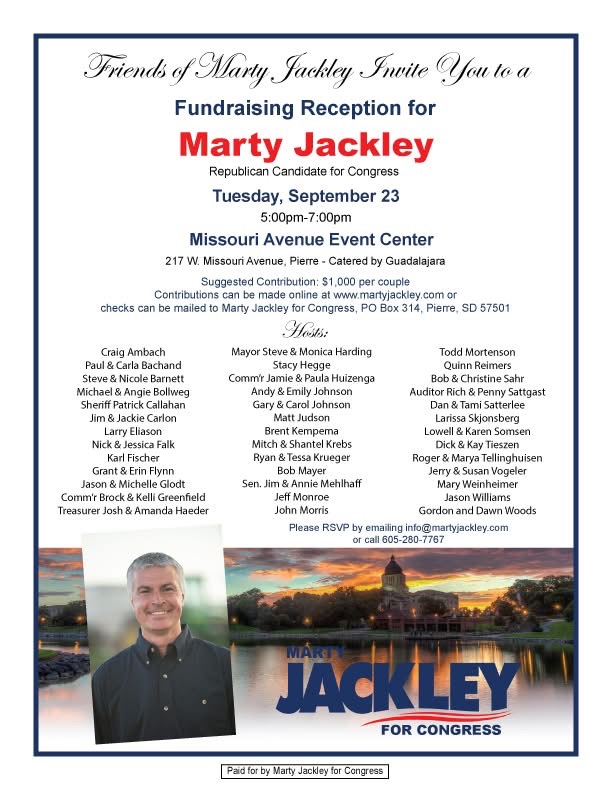
Just had a co-worker gift these to me after I noticed them – a joint Gov Kristi Noem/Kid Rock button/bumper sticker set from the Buffalo Chip last year that I did not know existed.
Joint events with musicians and politicians have a bit more cross appeal and value, and this was obviously a low-number run of pins. The most famous example is the McGovern for President Pin with Carole King, James Taylor and Barbara Streisand. Otherwise, I’m not sure there is another South Dakota based example to cite!
Very glad to add it to my South Dakota collection.
Kristi Golden is a communications professional with experience in media, public service and community engagement. She served as communications director for U.S. Senator Larry Pressler.
“What’s past is prologue.” That timeless phrase from Shakespeare reminds us that history doesn’t just repeat itself—it sets the stage for what comes next. In politics, as in life, the lessons we ignore are often the ones we most need to revisit.
Today, the South Dakota Republican Party finds itself at a critical juncture. We can either learn from the past and build a stronger, more unifying future, or repeat the mistakes that fracture coalitions and squander majorities.
The Republican Party rose to power by championing economic freedom, personal responsibility, and strong communities. Yet some regressive voices are now replicating the very mistakes that undo successful movements by reacting to the far left’s overreach not with steady leadership, but with reactionary politics that abandon the very foundations of our party’s past success.
Progressive identity politics pushed too far on issues such as radical gender ideology, open borders, and calls to defund the police. Many Americans were rightly outraged. But in that anger, a regressive faction within the Republican Party has broadened its backlash beyond those issues. Now, it’s not just radical policies under fire—it’s anything labeled “establishment,” including the conservative institutions and strategies that built our current majority.
This isn’t just bad politics. It’s self-sabotage.
In the rush to purge experience and elevate outrage, problem-solving is replaced with performative politics. Identity politics reemerges in a different jersey, and the party slips into a trap it once avoided.
They mistakenly believe they are emulating the leadership styles of President Donald Trump, who tapped into working-class frustration in a way only he could, using his platform to reach voters who felt ignored and disrespected. He turned that into a winning message, but his ability to do that successfully is rare.
What the regressives don’t seem to understand is that history has demonstrated movements built solely on grievance may win headlines, but they don’t govern. They burn hot and burn out.
Here in South Dakota, we’ve been successful because we’ve focused on issues that matter: strong communities, limited government, individual responsibility, and economic opportunity. But those core themes are now being drowned out by tribalism. When the state party is more focused on blacklists than ballot wins, we lose sight of who we’re supposed to be serving.
On the national level, we are seeing the fracturing of identity politics play out on the left. In New York, the election of Zohran Mamdani, a democratic socialist, has alarmed moderate Democrats. His platform, built around rent freezes, higher taxes, and pro-Palestinian rhetoric, may excite a niche base but threatens to alienate working families.
On the right, we’re seeing similar fractures emerge. In South Dakota, a fixation on purity has led to damaging infighting. Our state party has attacked a sitting Republican U.S. Senator. It has remained silent on hate speech. It has branded long-serving conservatives as RINOs. Blacklists are circulated. Loyalty tests are given more weight than legislative success. The result? Donors are backing away. Campaigns are struggling to organize. And volunteers don’t rally around circular firing squads.
This is not a strategy. We are witnessing the breakdown of a once-great party.
The road to a majority is not paved with exclusion. It requires building coalitions, not burning bridges. Ronald Reagan knew this well. His 1984 reelection was one of the most dominant in American history, not because he demanded total agreement, but because he offered a vision that brought people together. He united working-class Democrats, limited-government libertarians, and traditional conservatives around shared values and principles. Reagan once said, “The person who agrees with you 80 percent of the time is a friend and an ally, not a 20 percent traitor.” That principle is in direct contrast to today’s purity politics.
We should not lose sight of the values that have made South Dakota strong. Economic freedom. Individual empowerment. Opportunity for all. That’s not how we meet the needs of South Dakotans who are worried about wages, affordable housing, property taxes, childcare, and opportunity.
Reagan believed a rising tide lifts all boats. The far left wants to decide which boats are allowed to rise. The regressive right wants to decide who’s allowed in the boat. But real conservatives lift everyone.
But we won’t win by mimicking the left’s worst instincts. We can’t afford to fall into the same echo chambers, the same lazy tribalism, the same rejection of critical thought.
Anger can spark action, but leadership turns action into lasting progress.
If Republicans want to maintain and expand our majority, we need to stop confusing outrage with strategy and start governing with vision, purpose, and principle. That’s how we win. And more importantly, that’s how we serve.
Sharing with you a note I received from State Representative Greg Jamison announcing a forum (open to the public) being held tomorrow:
I’m putting together a Safer Sioux Falls Forum on July 22nd, 10:00 am at the Pavilion in the Belbas Theater.
All local law enforcement agencies, DOC Parole Manager, UJS, Minnehaha County States Attorney, Assistant Attorney General, city council leadership and council members, mayor, police chief Minnehaha and Lincoln County sheriffs are all participating. All Sioux Falls legislators have been invited and many are attending.
The intent of the Safer Sioux Falls forum is to address issues that have been raised about having a prison in our city.
The first question is to the mayor/police chief about what impacts they feel from having a prison here.
If potential positive outcomes/funding… can be found that we support, my hope is that we could bring them to our special session and have them considered as part of the action we take.
The 22nd was chosen because it works with the mayor/police chief and sheriff first, but also because the 22nd was set aside for our special session.
We should be done by 11:30 am.
Jamison is viewed as a potential candidate for mayor of Sioux Falls, and has been participating as part of the Prison Reset task force.
Democrats reported $79,326.04 raised, against $95,589.00 spent, leaving $57,914.10 cash on hand. I would venture that this is as generated in part by their recent state dinner.
You know, I’m not sure what to say about the fundraising disparity. Except the SDGOP should have fessed up at the Central Committee meeting, because that report didn’t appear out of thin air early this AM.
The South Dakota Republican Party held out until the very last day, today, to file their July federal elections commission monthly report. And for good reason.
The Republican Party Central committee met yesterday in Pierre, and this is information that they very likely did not want to discuss. The amount they are reporting as having raised in June to the FEC? A whopping $85.
That’s not $85,000. Or even $8500. $85. Less than most people‘s trip to a grocery store.
That’s even worse than last month, when the states majority political party raised an embarrassing $700.
Added to their $85 of effort, another $270 came in for refunds from the post office. Against this fundraising total, the SDGOP managed to spend $6079.
Apparently, X-senator Julie Fry Mueller’s husband is running for the open seat on the South Dakota Republican Party executive board vacated by Ezra Hays recently.
Mueller, if you recall, was part of his wife’s ’breastfeeding scandal,’ and was in the closed room as all of it was going on with the legislative employee:
The unnamed staff member said in written testimony that Frye-Mueller and her husband, Mike Mueller, came into her office last week to discuss a bill. The senator asked the staff member about her child and if she had vaccinated her child. When she said ‘yes,’ Frye-Mueller pointed her finger at the staff “aggressively” and told her “it would cause issues,” according to the testimony.
Frye-Mueller then asked the staff member if she was breastfeeding, the staff member said. When the staff member said she was using formula, Frye-Mueller began describing how she could breastfeed.
“She proceeded to provide hand gestures to her chest area and motion to her husband to see if he agreed,” the staff member said in her testimony. “He smiled and nodded.”
Do we have someone to serve on the state Republican Party Executive Board who hasn’t been in the middle of a legislative scandal telling an employee how to breast-feed?
The Julian Beaudion for US Senate campaign has launched, and according to the first FEC report that has been filed, the fledgeling Democrat Senate campaign is doing marginally better than the Brian Bengs (I) campaign for the same race.
Beaudion raised a total of $85,413.40 in his first quarter (Compared to Bengs’ $77,542.44). I make this comparison, as both the Democrat and the Independent are raising money through ActBlue, the Democrat fundraising platform.
Beaudion had a lower burn rate than Bengs, only spending $41,688.46, leaving him $43,724.94 cash on hand, compared to Bengs ending up with $16k after spending $60k.
The question is whose approach is better? Spending more to get geared up for the campaign, or banking as much as possible? Beaudion will have access to Democrat campaign money from the national level is he can get a credible campaign pulled together by the end of the year… And he may have access to it anyway, “just because” Democrats want to throw rocks at Republican in the majority leader’s own state.
Keep on watching as things develop in the months to come.
Gov. Rhoden Announces Prison Special Session on September 23
PIERRE, S.D. – Today, Governor Larry Rhoden announced the date of the special session to consider and pass legislation for a new prison. The special session will be on Tuesday, September 23, 2025, at 9:00 am CT. Governor Rhoden signed an Executive Proclamation formally announcing the special session. You can read his letter to the legislature, which includes the Executive Proclamation, here.
“When we started this process, we knew that we needed to build consensus on a plan that a supermajority of the legislature can agree on, and I believe that we are in good shape to achieve that,” wrote Governor Larry Rhoden. “The purpose of this session shall be to consider and pass legislation to authorize the Department of Corrections to do everything necessary to move forward with this project.”
Lt. Governor Tony Venhuizen, who chaired the prison task force, also wrote a letter to Governor Rhoden on the task force’s findings. You can find that letter here.
“We understood that compromise was necessary to reach a recommendation that can win [the Governor’s] support and the support of the legislature,” wrote Lt. Governor Tony Venhuizen. “The task force’s unanimous vote for its recommendation demonstrates that we have found a good site f0r a new penitentiary and a strong path forward.”
The prison task force was announced by Governor Larry Rhoden in February. They were tasked with answering three questions:
Do we need a new prison?
How big should it be?
Where should it go?
The prison task force came to unanimous agreement on all three of these questions.
The special session is called pursuant to Article IV, Section 3 of the South Dakota Constitution.
Johnson Votes to Protect Americans’ Financial Privacy
Washington, D.C. – U.S. Representative Dusty Johnson (R-S.D.) voted to pass the Anti-CBDC Surveillance State Act to prohibit a central bank digital currency (CBDC) and protect the financial privacy of all Americans.
“A central bank digital currency allows governments to track purchases of its users – this is wholly un-American,” said Johnson. “Countries like China utilize a central bank digital currency to punish and reward their citizens – we should not be taking any tips from the Chinese Communist Party’s playbook. I’m glad the House passed the Anti-CBDC Surveillance State Act to protect the financial privacy and freedoms of Americans.”
Background:
Unlike decentralized digital assets, CBDCs are digital forms of sovereign currency issued and controlled by the federal government, with transactions occurring on a government-managed ledger. In short, a CBDC is government-controlled programmable money that, if not designed to mimic cash, could provide the federal government with detailed transaction data on individual users and the ability to program the CBDC to suppress politically unpopular activities.
In March 2022, then-President Biden issued an executive order urging for CBDC research and development. The corresponding report made it clear that the Biden Administration was not only wanting to create a CBDC, but they are willing to trade Americans’ right to financial privacy for a surveillance-style CBDC.
President Trump issued an executive order prohibiting federal agencies from pursuing a CBDC. The Anti-CBDC Surveillance State Act codifies President Trump’s executive order, permanently banning their development, so future administrations cannot weaponize this technology against Americans.
Specifically, the Anti-CBDC Surveillance State Act:
Prohibits the Federal Reserve from issuing a CBDC directly to individuals, ensuring the Federal Reserve can’t mobilize itself into a retail bank with the ability to collect personal financial data on Americans.
Prohibits the Federal Reserve from indirectly issuing a CBDC to individuals through an intermediary or third party.
Prohibits the Federal Reserve from using a CBDC as a tool to implement monetary policy.
Requires authorizing legislation from Congress for the issuance of any CBDC.
Protects innovation that reflects American values.
From the Argus Leader, a group fighting the Sioux Falls School District opt-out might need some remedial math after they turned in about half of the signatures needed to bring the action to a public vote:
District community relations coordinator DeeAnn Konrad said the group submitted 2,302 unverified signatures by the 5 p.m. deadline on July 17, well short of the required amount of 5,490 signatures, or of the group’s initial goal of 6,500 signatures.
and..
The leader of the petition effort, Misty Furness, didn’t immediately respond to the Argus Leader’s request for an interview at the time of publication.
Furness did speak with conservative political group Patriot Ripple Effect’s members in a meeting publicized in her opt-out Facebook group and on the conservative group’s Facebook page, but reporters from the Argus Leader and Sioux Falls Live were barred from attending this meeting.