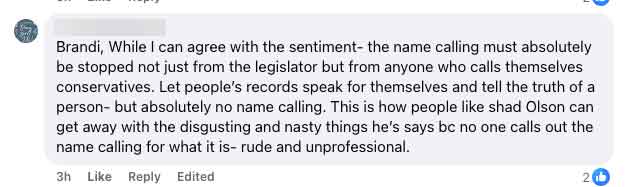
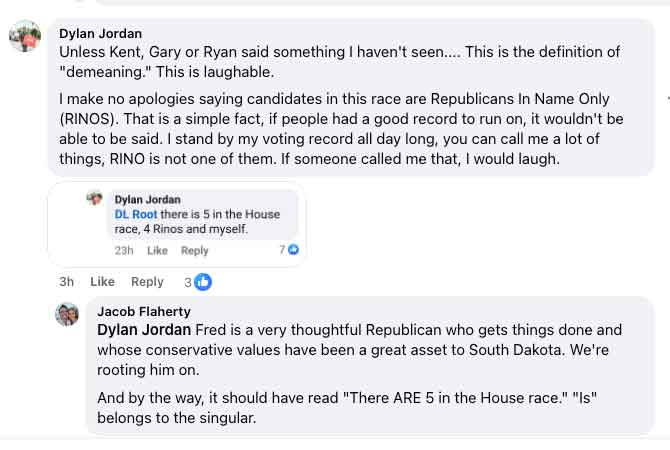
Because there’s a debate raging on former State Representative Fred Deutsch’s facebook page as two legislators who have done little more than embarass the Republican party try to justify why it’s ok for them to call people RINO’s. Despite the fact they represent a lot of people who probably don’t even understand the meaning of the term.
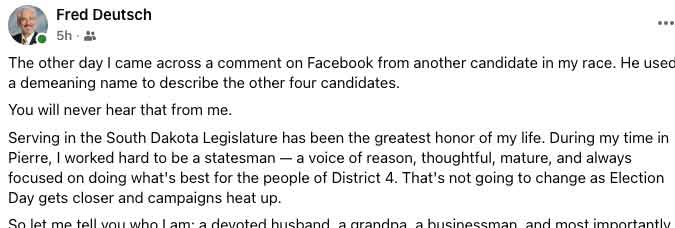
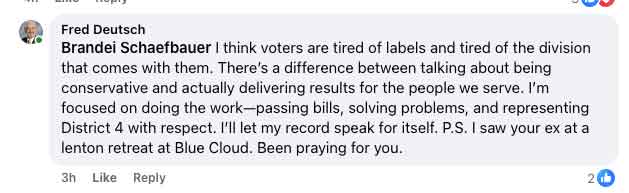
The set up is that Fred notes that he’s not into the name calling that one of his opponents is doing in referring to his opponents with a demeaning name…
And thus, we begin the trip down the rabbit hole..
.. what does “voting with the constitution” have to do with whether someone is considered a RINO, a.k.a, Republican In Name Only? Especially when whether someone is considered one or not is subjective based on the name-caller? As for “voting with the constitution,” that’s pretty subjective as well. I suspect people on the other side of the aisle believe they’re doing so as well.
“There’s a difference between talking about being conservative and actually delivering results.” Burn.
“This is how people like Shad Olson can get away with the disgusting and nasty things he says.” And that’s just what “his hacker says” to Brandei!
Of course, the originator of the whole name calling affair had to chirp in himself.
Dylan Jordan: “If people had a good record to run on, it wouldn’t be able to be said.”
Trump Administration Approves Gov. Rhoden’s Request for Year-Round E15
PIERRE, S.D. – The Trump administration announced they have approved a request made by Governor Rhoden and six other Governors for a nationwide waiver under the Clean Air Act to allow the year-round sale of E15.
“Allowing year-round E15 supports our farmers, boosts American energy independence, and keeps fuel affordable for our families,” said Governor Larry Rhoden. “I appreciate President Trump and Administrator Zeldin’s quick action on our request so that E15 can be sold this summer, and I urge Congress to pass a permanent solution.”
On March 6th, 2026, Governor Rhoden and six other Governors sent a letter to EPA Administrator Zeldin, asking for a waiver so that E15 could be sold year-round. A copy of the letter can be found here.
This decision by the Trump administration to approve the Governor’s request will increase the sale of higher blends of ethanol, directly helping South Dakotan and American farmers.
The National Corn Growers Association praised the decision in a release, which can be found here.
Gov. Rhoden Signs Election Integrity Bills into Law
PIERRE, S.D. – Today, Governor Larry Rhoden signed six election integrity bills, including the South Dakota SAVE Act, Senate Bill 175, which requires that an individual provides proof of citizenship when registering to vote.
“In South Dakota, we do things right, especially when running our state elections,” said Governor Larry Rhoden. “This bill ensures only citizens vote in state elections, keeping our elections safe and secure.”
Senate Bill 175 only applies to state elections and only impacts new registrants. If a South Dakota resident is already registered to vote, there is nothing for that individual to do to maintain their registration. If a South Dakota resident is already registered to vote and needs to change their name, address, or other information, no proof of citizenship is necessary.
Senate Bill 175 has an “emergency clause,” which means it took effect immediately upon the Governor’s signature. Since it passed both legislative chambers a few weeks ago, the Governor’s Office, the Secretary of State’s Office, and the five state agencies required to assist with voter registration have been working to implement these new legal requirements. In South Dakota, state agencies already verify citizenship for different programs, so implementation of this citizenship verification requirement was a smooth process.
To check your voter registration status, navigate to the “Voter Information Portal” on the Secretary of State’s website here.
Governor Rhoden also signed the following five bills:
SB 142 amends the requirements for filing certain campaign finance disclosure statements;
SB 151 requires the publication of the results of an election for precinct committeeman or committeewoman and declares an emergency;
SB 171amends provisions pertaining to the processing of absentee ballots and declares an emergency;
SB 214amends provisions pertaining to the publication of the statewide voter registration file; and
HB 1095modifies provisions pertaining to the submission of a nominating petition.
Governor Rhoden has signed 228 bills into law and vetoed two this legislative session.
The Dakota Scout has a story this morning noting that free airplane flights that were provided to Governor Rhoden for purposes of traveling around the state at the time of a campaign tour in 2025 were not included in his campaign report filed earlier this year:
The Rhoden campaign characterized the omission as inadvertent and said it became aware of it only after The Scout’s inquiry.
“They have not sent us the invoice for the flight, though we requested it at the time. It will be reflected on our report when we receive it,” Rhoden for Governor Campaign Manager Ian Fury told The Scout.
And..
“We have campaign finance laws for a reason,” Johnson campaign spokeswoman Courtney Heitkamp told The Scout when informed of the omission. “It’s not appropriate for the governor to hide his use of a private plane, and he needs to amend his finance report.”
The other campaigns also responded; the Hansen campaign can’t afford to send a parcel second day air, much less fly. And Toby Doeden filed with the FAA to block any mention of his name and airplanes in the same sentence. (Those were jokes, btw)
The whole airplane thing just seems to be a hot topic for all governors. Which is why it is always surprising when they don’t remember it – because it continues to come up
California Carley took some more roasting today for skipping out of session, and generally not having a clue about South Dakota. Today, South Dakota Democrats pointed out how he doesn’t show up for work in the legislature, doesn’t have a clue about South Dakota, and is generally the utterly worst State Senator since Julie Frye Mueller:
Senator Mike Rounds’ WEEKLY ROUND[S] UP: March 16-22, 2026
Welcome back to another Weekly Round[s] Up.
We had a long week here in DC. During this past week, I met with several South Dakotans, attended multiple briefings, voted eight times, introduced two pieces of legislation and participated in several interviews.
Normally on the weekends I travel back to South Dakota to visit with folks from around the state. However, votes on the SAVE America Act and Senator Mullin’s confirmation kept us in D.C. this weekend. On Saturday, I spoke on the Senate floor in support of the SAVE America Act which I have cosponsored. During my remarks, I discussed the double standards when it comes to showing identification in everyday life in America. For example, you need a photo ID when you open a bank account, rent a car or board a plane. This winter you even had to show two forms of identification to shovel snow in New York. American elections should be for American citizens only and the SAVE America Act takes steps to secure our elections. You can watch my full floor speech here.
Additionally, the Department of Homeland Security (DHS) remains unfunded. Despite Democrats having 14 opportunities to fund the department, they continue to play politics with the safety and security of the American people. Now more than ever we need a fully funded DHS; airports are in chaos, families are going without pay and the potential for terrorist attacks goes up each day the department is unfunded. Funding DHS is not optional.
More on this and the rest of my week in the Weekly Round[s] Up:
South Dakota groups I visited with: South Dakotans with Breakthrough T1D; Impact Schools of South Dakota; Rapid City Youth City Council; Carrie Heberlee, National Association of Postal Supervisors; South Dakotans with American Coalition for Ethanol; Dr. Brian Tande, President and Ralph Davis, Vice President for Research at South Dakota School of Mines and Technology; American Council of Engineering Companies of South Dakota; Sheila Gestring, President of University of South Dakota and Chris Kassin, Senior Executive University of South Dakota Foundation; and Lee Strubinger, Research & Reporting Director, John T. Vucurevich Foundation.
Met with South Dakotans from: Baltic, Brookings, Dell Rapids, Garretson, Pierre, Rapid City, Sioux Falls, Vermillion and Wentworth.
Other meetings: Rwanda DNSC; Patrick Collison, CEO of Stripe; Darren Guccione, CEO and Co-Founder of Keeper Security; Steve Vintz, CEO of Tenable; General Frank Donovan, Commander, U.S. Southern Command; Kristen Davies, Chief Information Officer, Department of War; and General Anderson, Commander, U.S. Africa Command.
I also attended our weekly Senate Bible Study on Tuesday. On Wednesday, Senator Mullin (soon to be Secretary Mullin) spoke at our weekly Senate Prayer Breakfast.
Legislation Introduced: This past week, I introduced the Investments in Rural Transit Act, legislation that would help rural transit providers improve their services. You can read the press release on this piece here. I also introduced the Small Business Investor Capital Access Act which would increase access to capital for small businesses and entrepreneurs by modernizing outdated securities regulations. You can read about that here.
Hearings: This past week, I attended a Senate Armed Services Committee hearing and a Senate Select Committee on Intelligence hearing titled Worldwide Threats. This one one of our only Intelligence hearings that is not classified! You can watch my questions to CIA Director Ratcliffe here.
Briefings: I attended one classified briefing with the Senate Armed Services Subcommittee on Airland.
Votes taken: 8 – As noted earlier, we spent much of this past week debating and voting on the SAVE America Act. As a cosponsor of this legislation, I fully support this bill. Additionally, I voted in support of an amendment to this legislation that protects women and girls in athletics by banning biological men from women’s sports.
I also voted on a procedural motion related to Senator Mullin’s nomination to serve as Secretary of the Department of Homeland Security. We hope to confirm him this week.
This past week, I voted to fund DHS once again, and once again it failed due to opposition from Senate Democrats. There have now been 14 opportunities to fully fund DHS, but Senate Democrats continue to block fully funding this department.
There was also a vote to remove United States Armed Forces from Iran via a War Powers Resolution, which I voted against. Iran has been rebuilding their offensive capabilities in order to harm the United States and our allies. We take any military actions seriously, especially boots on the ground in the Middle East. However, this threat from Iran is not going away and we must make certain that we’re in a position to defend our nation from those who wish us harm.
Lastly, I voted to confirm Anna St. John as United States District Judge for the Eastern District of Louisiana.
Steps taken: 61,438 steps or 29.61 miles.
Video of the Week: On Wednesday I joined Fox Business to talk about the conflict in Iran, click here to watch.
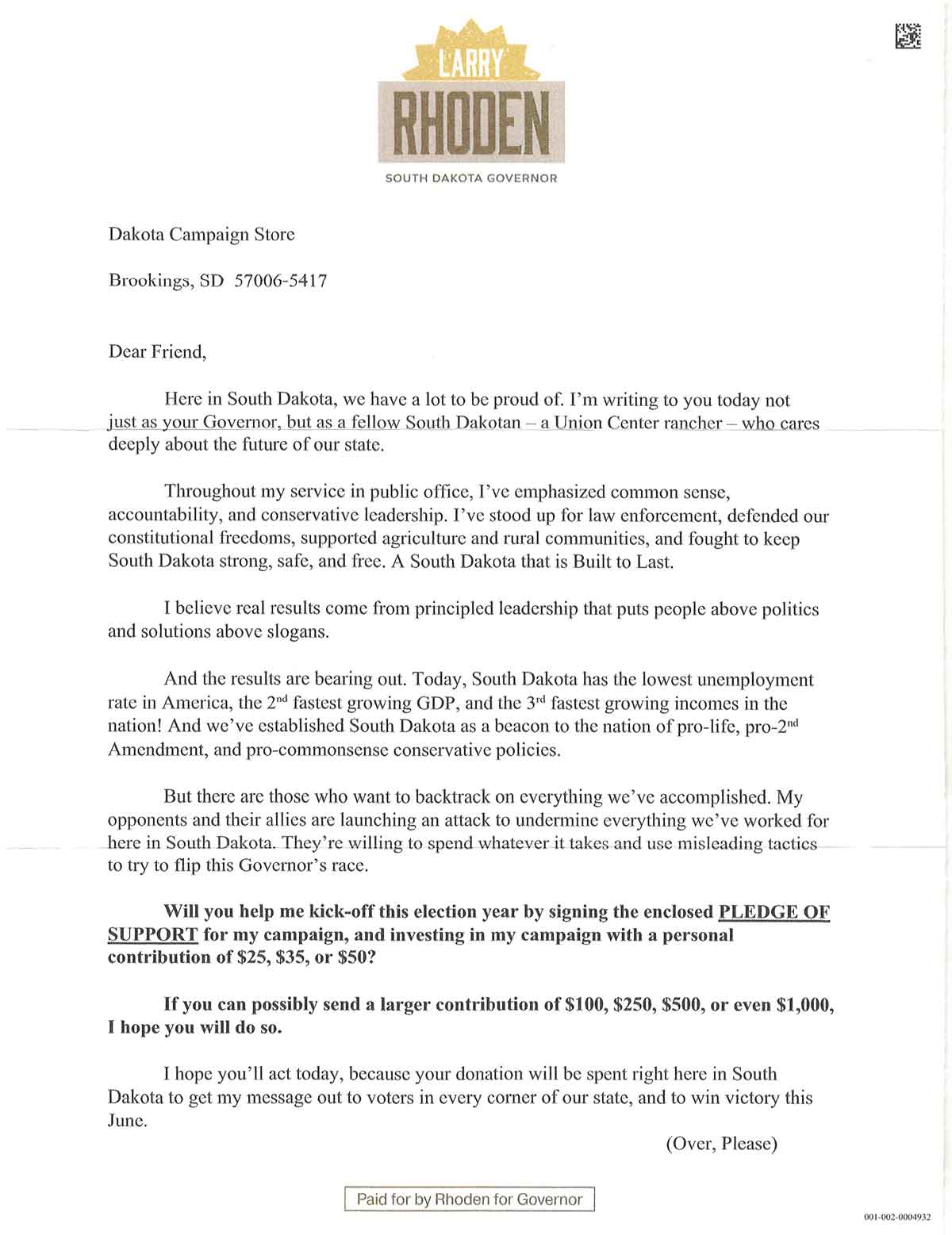
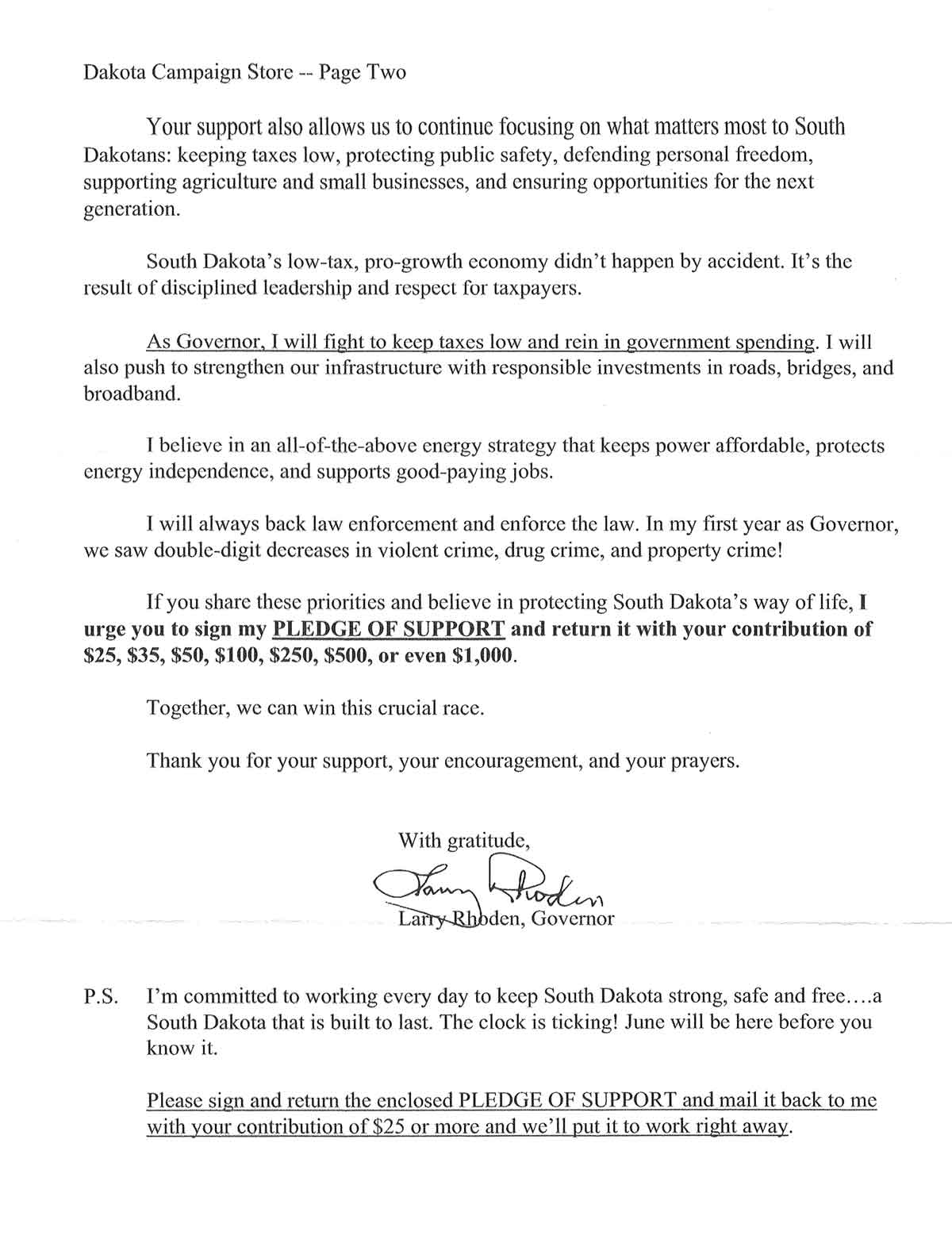
I received, or at least my business received, a fundraising letter from Governor Rhoden today. In the letter he promises to protect energy independence, and claims he will fight to keep taxes low.
Dear Friend.. well, certainly I am friend to many people, including the Governor, and my house pets. Maybe one or two others. (But it’s a short list.)
Of course, the Governor makes the ask contending that his “opponents and their allies are launching an attack to undermine everything we’ve worked for here in South Dakota. They’re willing to spend whatever it takes and use misleading tactics to try to flip this Governor’s race.”
As I always recommend to candidates, you have to show the need, which he does. It’s not a hard push against his opponents, but he’s pushing. And he follows it by making the ask after that to send him money.
But then we flip to page two and he kind of loses me.
You know, I like Larry. He’s a good guy. But some of these claims seem to have slipped under the surface of some murky river water for those who are paying attention.
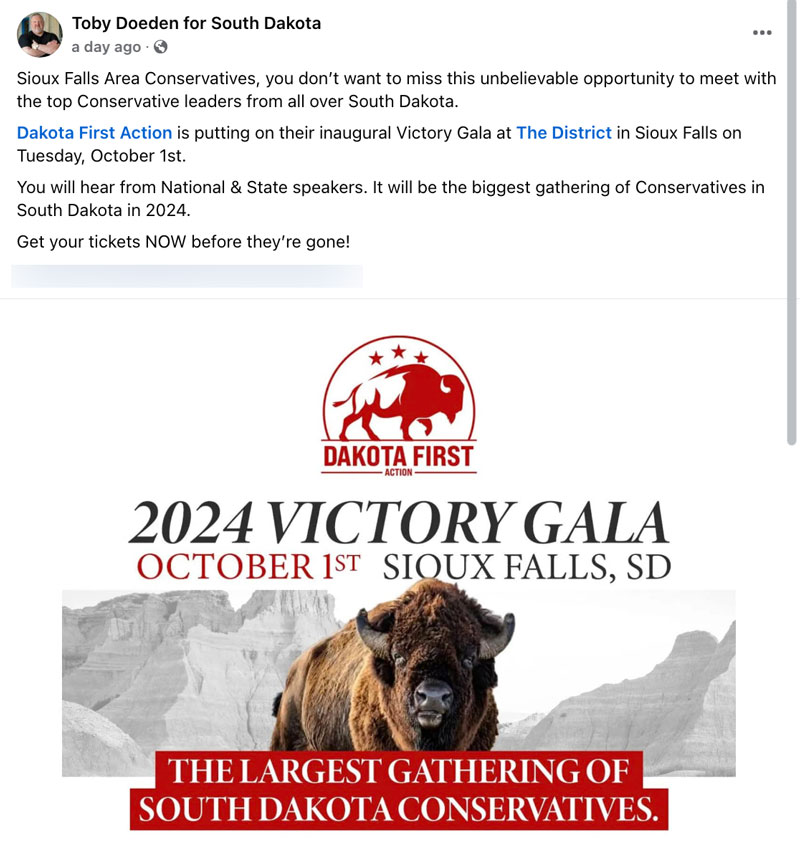
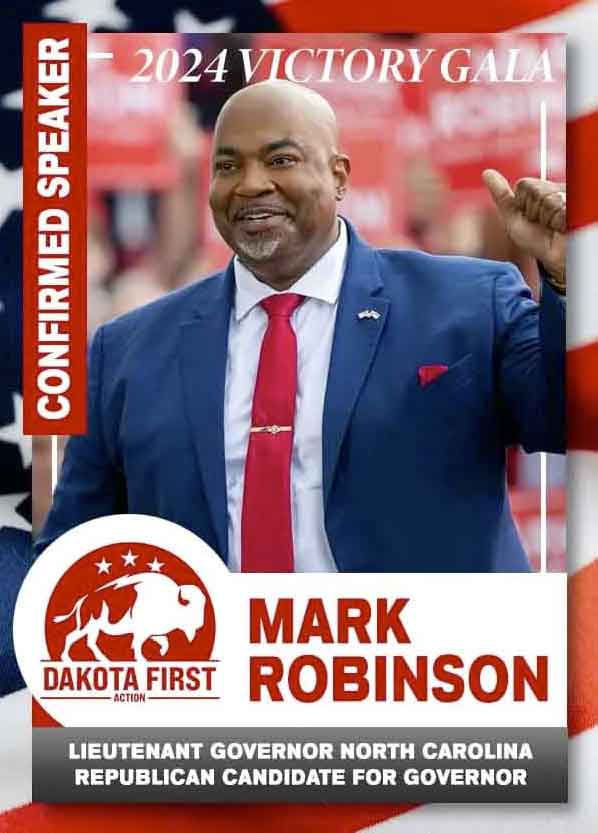
Remember Toby Doeden’s disastrous event in Sioux Falls where he was bringing North Carolina Gubernatorial Candidate Mark Robinson to Sioux Falls? And before he could appear, Robinson was accused of declaring on porn websites that he was ‘a black nazi.’ (And that was one of the tamer things he said.)
If you look back, Doeden had deep connections which allowed him access to Robinson and used them, as his PAC treasurer’s wife is married to the person managing Robinson’s campaign Matt Hurley. The same Matt Hurley who after the Robinson debacle, was brought on to manage Doeden’s campaign for Governor.
CNN recently reported that Robinson made racist and sexually explicit remarks more than a decade ago on a pornographic website’s message board. The report said Robinson, who has a recent history of anti-transgender rhetoric, said he enjoyed watching transgender pornography, referred to himself as a “black Nazi,” expressed support for reinstating slavery and praised Adolf Hitler.
Robinson’s video speech occurred during the Dakota First Action political action committee’s Victory Gala.
Toby Doeden, an Aberdeen businessman and founder of Dakota First Action, said his fellow Republicans who are condemning Robinson are hurting the party.
“CNN has no substantive proof,” Doeden said. “Republicans will eat their own. If he were on the left, not a single Democrat would have called for him to step down.”
And I also recall Toby spoke to the Argus Leader about it.
But Doeden doubled down on the controversial figure’s innocence. The Aberdeen man said there is “absolutely, positively no proof” that Robinson posted on Nude Africa. He also claimed the posts highlighted in the CNN story were fabricated.
“We have one of the most prominent conservatives in the country fighting to be governor of North Carolina, and the most left wing, liberal mainstream media outlet shows screenshots that they allegedly found just recently that have been out there for 16 years. You don’t think it’s possible that these are fake?” Doeden said. “Of course, they’re fake. It’s ridiculous.”
This is the point where we’re supposed to hear the cock crow, as it did after Peter’s denial of knowing Judas. Because in the latest out of North Carolina:
Former North Carolina Lt. Gov. Mark Robinson has admitted to having an obsession with sex and pornography from a young age, but lied about it during his failed 2024 gubernatorial election in order to protect the people around him, including President Donald Trump, he said Thursday. And if given the opportunity to go back and do it over, he would lie again, he said.
“I don’t know where it came from: an obsession with pornography, an obsession with sex,” Robinson told pastor Josh Hall on an online podcast called “After the Call.” Robinson’s admission came on the first episode of the show, which was released at 5 p.m. Thursday. The show from Real Truth Media promises, “One guest. One room. No script.
and..
Among his writings he called himself a “Black Nazi,” endorsed slavery, used slurs against the LGBTQ+ and Jewish communities, admitted to watching women shower and enjoying gay porn.
What? Toby Doeden’s fervent denial of the claims against his featured speaker were complete and utter bullsh*t? I’m shocked, I tell you. Just shocked.
By the way, here’s where this gets even better, with additional connections between Gubernatorial wannabe Toby Doeden and Mark Robinson. Notice the links highlighted in Red above?
Matt Hurley took over as Mark Robinson’s political consultant during his 2024 gubernatorial election after the series of reports about Robinson’s porn habits led most his staff to quit.
Matt Hurley’s wife has long been Doeden’s PAC treasurer.
Matt Hurley has been managing Gubernatorial Candidate Toby Doeden’s campaign for Governor.
On a podcast owned by Matt Hurley – Robinson admits to his porn habit, that he lied, and would do so again.
And Toby Doeden’s denials of the Robinson porn claims are proven – with the assistance of his own campaign manager – to be completely false nonsense.
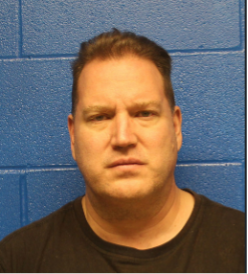
It looks like justice will be postponed once again, as the hearing that was supposed to take place this morning in the matter of former newsreader Shad Olson (Criminal docket #46CRI24-000097). and his initial appearance on a probation violation has been postponed.
According to UJS Court records, a continuance has been requested by the defendant and granted by the court, so the can of destiny has been kicked down the road to April 23, 2026.
This marks the 5th continuance requested in the case by the defendant throughout the extended lifespan of his criminal matter. So if there are any complaints by Shad that this case is never ending, he needs only to look in the mirror for the cause.
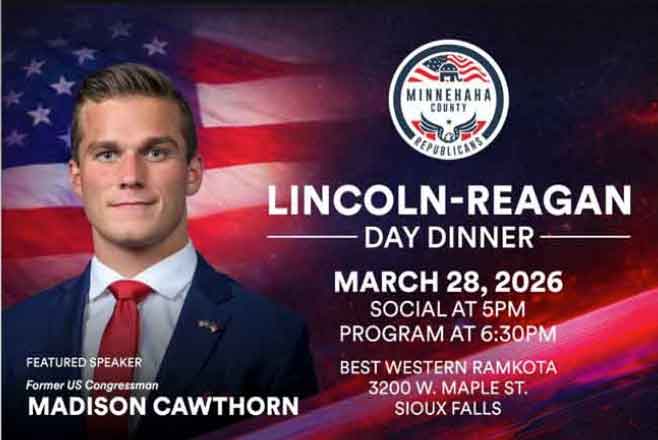
Thanks to the generosity of our donors and sponsors, the Minnehaha County Republicans are proud to offer a limited number of complimentary tickets to our upcoming Lincoln-Reagan Day Dinner for veterans and current active-duty service members, plus one guest.
These tickets are available on a first-come, first-served basis and are expected to go quickly.
This annual event brings together community leaders, elected officials, and engaged supporters for an evening of connection and inspiration. This year’s event will feature keynote remarks from former U.S. Congressman Madison Cawthorn.
Please note: valid military ID will be required at check-in.
Thank you for your service and sacrifice. We look forward to seeing you there.
Best Regards,
Minnehaha County Republicans
—-
The question I received from the person who sent it to me was “What is the type of military ID required for veterans? It’s not like vets get an id card.” (I suggested he present his DD214. Let the desk person argue with that. )



 But Doeden doubled down on the controversial figure’s innocence.
  It looks like justice will be postponed once again, as the hearing that was supposed to take place this morning in the matter of former newsreader Shad Olson (Criminal docket #