Logan Manhart Bitcoin bill is back, asking for South Dakota to dump money into it.

Logan Manhart’s Bitcoin investment bill is back from 2025, where it was killed in committee on a 9-3 vote.
I’m sure it will fare just as well.

Logan Manhart’s Bitcoin investment bill is back from 2025, where it was killed in committee on a 9-3 vote.
I’m sure it will fare just as well.
While I was watching Senator Mykala Voita’s state-sponsored “Ramadan in July” resolution pass the Senate (22-11), at least one of the chambers had some sense today.
State Representative Dylan “DJ Jazzy” Jordan’s anti-development resolution – HCR 6007 – which tried to send a signal that we don’t like jobs and development in South Dakota – was shot down on a vote of 29-37. On nearly a straight-line pro-jobs economic development versus the anti-development group in the chamber. (Rep. Goodwin – what are you doing? You’re killing me.)

This marks the third Rep. Jordan measure to go down in flames. 3 4 down, 3 2 remaining to be heard (maybe less.. I didn’t catch what happened to HB 1071 in House Transportation this AM. *Correction. 1071 was killed 9-1)

Former Republican State Sen. Dave Johnson files for District 33 Senate
The petitions are in! And David Johnson’s re-election campaign is officially underway for State Senate, District 33.
Dave is an effective, rational, and tenacious conservative, and ready to get to work for South Dakota.
“Let’s roll!”
The Senate Agenda for today has been posted, and the very first on the list is District 21 State Senator Mykayla Voita’s Senate Concurrent Resolution 604 is first on the list.

In case you had forgotten, I mentioned it earlier..
Senator Voita and her end-time army resolution by Pat Powers
Voita has introduced a 4 page resolution requesting everyone pray and fast in July, “depriving ourselves of those temporary physical comforts.” (What about fireworks? Is her version of jesus-government still going to allow us to do fireworks in July?).
And for the “the Paraclete to move within the halls of government, classrooms, businesses…,” etc.
Under that post, in the comments, a reader had picked up on a big item I hadn’t even considered:

The learned senator, in effect, wants to culturally appropriate Islam’s holy month, which is the ninth month of their calendar, move it to the seventh month, and sanction it–by the State–as a Christian practice of worship. I doubt whether a concurrent resolution has ever had a fiscal note. But this one deserves a fiscal note. South Dakota sales tax revenues rely on the taxation of food, both at the grocery store and in the restaurant. Those two industries, hopefully, will oppose this measure, or in the future there could be layoffs during the month.
Um.. well looking at the resolution..
BE IT FURTHER RESOLVED, that we call upon all those who are physically able and spiritually inclined to join us annually during the month of July, for a time of prayer and fasting, depriving ourselves of those temporary physical comforts so that we may be awakened to our need and hunger for God, humbling ourselves before Him, prayerfully seeking His face, asking for His forgiveness, forsaking all wickedness, and begging Him to bestow His healing, blessing, grace, and mercy upon us, so that we, our communities, our state, and our nation will be transformed into a people fit to be His own.
and comparing it to an explanation of what Ramadan is to non-practitioners..
Ramadan is the ninth month of the Islamic calendar. It is observed by Muslims worldwide as a month of fasting (sawm), communal prayer (salah), reflection, and community. It is also the month in which the Quran is believed to have been revealed to the Islamic prophet Muhammad. The annual observance of Ramadan is regarded as one of the five pillars of Islam and lasts twenty-nine to thirty days, from one sighting of the crescent moon to the next.
I find myself challenged to disagree with the commenter’s thesis that Senator Voita is trying to create a funky Christian appropriation of Ramadan in July in South Dakota, as sponsored by the state. Because that’s what she’s proposing.
I think Christians and Muslims should be free to worship in the way they choose. But first and foremost, we can follow the US Constitution, keep church and state separate, and we don’t need Voita’s “Ramadan in July” resolution or any other Christian, Muslim, Buddist, etc. religious resolutions being promoted by the state legislature.
To each their own. Let’s all get along without the legislative coercion.
Governor Requests Presidential Disaster Declaration Following Windstorm
PIERRE, S.D. – Today, Governor Larry Rhoden has formally requested a presidential major disaster declaration for South Dakota in response to a historic, record-breaking winter windstorm that caused widespread damage across Custer, Fall River, and Pennington counties on December 17 and 18, 2025.
“Our communities faced extraordinary conditions during this storm with severe impacts, especially in rural and frontier areas,” said Governor Larry Rhoden. “This support will help local communities, reduce the financial burden on electric ratepayers, and ensure essential services can be restored and strengthened for the future.”
The storm produced sustained high winds and extreme gusts exceeding 90 mph in parts of western South Dakota, downing trees and power lines, damaging public infrastructure, and leaving thousands of residents without power for days. The Black Hills region was particularly impacted. Difficult terrain and extensive forest damage significantly delayed power restoration efforts and access for emergency responders.
Governor Rhoden previously signed an emergency declaration on January 7, 2026, which started the disaster process by requesting technical assistance for a preliminary damage assessment by FEMA. Those preliminary damage assessments conducted from January 20 to 22 confirmed more than $4.6 million in public infrastructure damage across the three counties, exceeding federal thresholds for disaster assistance. Damage included roads, power systems, parks, recreation areas, trails, and public facilities, with Custer County experiencing particularly devastating per-capita impacts.
If approved, the Presidential declaration would provide Public Assistance funding for Custer, Fall River, and Pennington counties for repairs at a cost share of 75% federal, 10% state, and 15% local. In addition, it would make Hazard Mitigation Grant Program funding available in the future.
###
Had this sent to me a short time back. Articles of Incorporation were filed in the fall of last year for a new group – a domestic non-profit – called American Land & Legacy which is fronted by Amanda Radtke, a self-styled social media influencer who is always pushing her narrative du jour in conservative Republican facebook groups.
Has Radtke filed an LLC to potentially monetize her facebook outrage? I’d say “who cares,” but it’s more of who she’s bringing along for the ride. And what kind of rabbit-hole it represents. The two related entities organized last October are as follows:
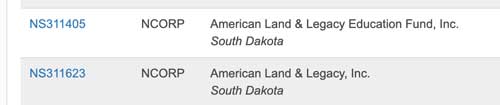
For our purposes, we’re looking at NS311623. (You can look at it yourself, these are very public filings). And looking at the filing, there’s a couple of items that drew my attention:
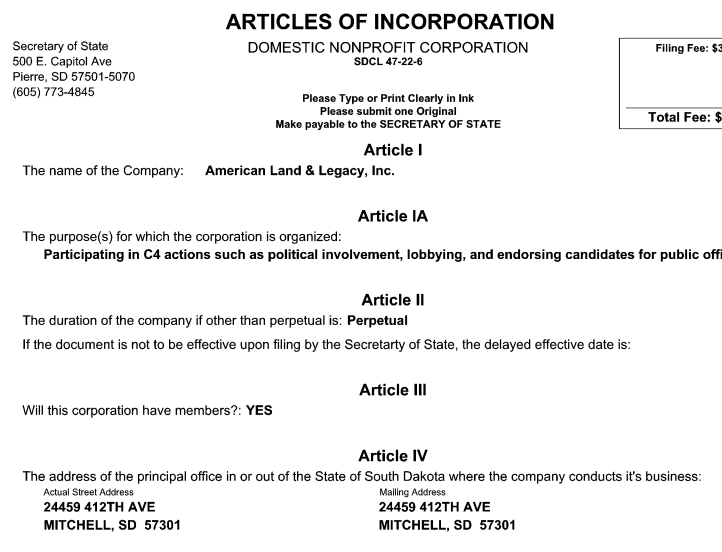
First off is that this group has organized itself, indicating that the purpose for that organization is “Participating in C4 actions such as political involvement, lobbying, and endorsing candidates for public office.” So – their words – they came together for lobbying and endorsing candidates.
Who is the “they?” Here’s where it gets more curious.
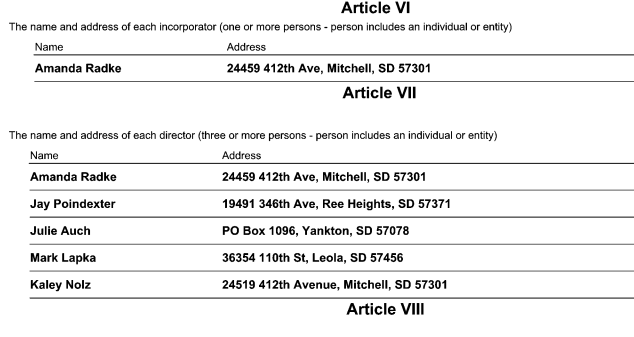
Included on the initial board of directors for this lobbying organization were State Rep. Julie Auch, State Senator Mark Lapka, and State Rep. Kayley Nolz. So hang on.. 3 legislators are directors of an organization that stated that they will have political involvement such as lobbying and endorsing candidates for public office? And they will be raising money for this purpose, or taking money from parties unknown for this purpose?
Why does that make me ask what’s going on here, and wonder what conflicts might arise from being a director in this corporation? There’s no IRS 990 filing available yet as it was just formed, so we know little of what they seem to describe as a 501 (c)(4) group. But with elected officials involved, it makes you wonder how the money flows, and who it flows to, and what it’s being used for?
Since this initial filing in October, on November 3, State Rep. Julie Auch was replaced on the board with a non-legislator. And on January 1, Radtke signed paperwork to remove her sister Rep. Kayley Nolz. Which leaves Senator Mark Lapka on the board of directors of an organization which was formed to be involved politically and “lobbying, and endorsing candidates for public office.”
Here’s the thing about 501c4 organizations – and I learned this long ago when one was involved in a ballot measure 20 years back – They can get away with not disclosing how they raised and spent their money for a long, long time, if at all. In fact, they have a term for groups like this – political Dark Money. If you’re looking at how some people view dark money… From the Campaign Legal Center:
“Dark money” groups are political organizations that masquerade as “social welfare nonprofits” under section 501(c)(4) of federal tax law, allowing them to avoid having to disclose where any of their money came from. Wealthy special interests use these groups to pour cash into elections and influence legislation in their favor, while keeping their involvement totally secret.
…. Federal campaign finance laws provide that any group with a “major purpose” of engaging in federal campaign activity must disclose its contributors, and federal tax laws provide that political activity cannot be a 501(c)(4) nonprofit group’s “primary activity.”
If a group wants to work primarily on politics, it must register as a political committee and disclose its donors.
Dark money groups get away with breaking the law because the two federal agencies charged with overseeing political activity and nonprofits, the Federal Election Commission (FEC) and the Internal Revenue Service (IRS), are doing practically nothing to stop them.
Now, that’s how they are said to operate on the federal level. At the state level, there have been attempts to rein in this kind of activity, but I’d have to consult someone to get the current state of regulation.
The bottom line is why did these legislators think they needed to organize a 501(c)(4) federal dark money group to “lobby” and “endorse candidates for public office?” Clearly, a couple of them got out of it right away. But the whole organization is there, still with a State Senator on the Board of Directors according to the latest amendment.
In what might be the biggest election year in a generation, it brings up many questions. Unanswered questions as to why they’re using an unusual tool in South Dakota politics to make it challenging to follow the money.
Yes, it’s a bit of hyperbole, but when I note “House passes ACLU funding bill out of State Affairs committee” today, I’m referring to House State Affairs’ passage of a bill that we will absolute lose in court on. That would be Rep. Ismay’s bill to ban paid petition circulators.
They say that insanity is doing the same thing over and over and getting the same result. Well, that would be House State Affairs, because here we go again with House Bill 1087:
The bill passed with a 9-4 vote, which means it will go to the full House of Representatives.
Opponents said the bill would trigger a legal challenge if enacted and cost thousands of taxpayer dollars to defend. Opponents included the American Civil Liberties Union of South Dakota, South Dakota Advocacy Network for Women, and the South Dakota Education Association.
Rep. Tim Reisch, R-Howard, echoed their concerns.
“We’re not going to give our teachers a pay raise, we’re out of money, and we’re going to pass a bill that we know is going to cost the taxpayers millions of dollars,” Reisch said. “I’m going to be a ‘no’ on this.”
Unless there’s a new US Supreme Court decision, or the bench changes significantly in the 8th District.. we already know this dog just isn’t going to hunt. It’s not new law, and we’ve tested it more than once. Legislators should move on and not waste the state’s money in a year we don’t have any.
Representative Kent Roe has had enough of the anti-economic development election year politics from gubernatorial candidate, Jon Hansen.
Tonight, Roe took to Facebook to call him out by name for Hansen‘s promotion of NIMBY and BANANA-ism to the detriment of South Dakota:
This type of legislation sends shock waves into all of the United States. It sends a clear message: GET OFF MY LAWN! Straight out of the Bernie Sanders anti-AI and anti-America playbook. It also reveals what a Hansen administration would likely look like. The sponsors loosely say it’s ok now for GOED to operate, but “wait until I get my hands on that program too!
Kent is such a gentleman – but clearly, he’s got some fight to bring jobs and development for his District!
I’m sure we’re going to hear more about this and Hansen’s “Bernie Sanders anti-AI and anti-America playbook” soon!
From State Senator Amber Hulse comes legislation to help preserve the freedom of speech when it takes the form of “protected public expression.” The laws are becoming more and more common across the country, which is commonly referred to as anti-SLAPP Legislation. Referring to the definition as provided by the Reporters Committee for Freedom of the Press:
Short for strategic lawsuits against public participation, SLAPPs have become an all-too-common tool for intimidating and silencing criticism through expensive, baseless legal proceedings.
Anti-SLAPP laws are meant to provide a remedy to SLAPP suits. Anti-SLAPP laws are intended to prevent people from using courts, and potential threats of a lawsuit, to intimidate people who are exercising their First Amendment rights. In terms of reporting, news organizations and individual journalists can use anti-SLAPP statutes to protect themselves from the financial threat of a groundless defamation case brought by a subject of an enterprise or investigative story.
Under most anti-SLAPP statutes, the person sued makes a motion to strike the case because it involves speech on a matter of public concern. The plaintiff then has the burden of showing a probability that they will prevail in the suit — meaning they must show that they have evidence that could result in a favorable verdict. If the plaintiff cannot meet this burden and the suit is dismissed through anti-SLAPP proceedings, many statutes allow defendants to collect attorney’s fees from the plaintiff.
Hulse’s Senate Bill 137 proposes protective measures for those who are exercising their freedom of speech or the press on matters of public concern, which puts a heavier burden on someone who is attempting to use threats of a lawsuit and it’s expense in defending it as a way to silence their opponents:
Senate Bill 137
Introduced by: Senator HulseAn Act to establish procedures for anti-SLAPP actions to protect the exercise of a person’s constitutional rights, including freedom of speech.
Be it enacted by the Legislature of the State of South Dakota:
Section 1. That a NEW SECTION be added to a NEW CHAPTER in title 15:
Except as otherwise provided in section 2 of this Act, the provisions of this chapter apply to a cause of action against a person based on the person’s protected public expression. For purposes of this chapter, “protected public expression” includes:
(1) Communication in a legislative, executive, judicial, administrative, or other governmental proceeding;
(2) Communication on an issue under consideration or review in a legislative, executive, judicial, administrative, or other governmental proceeding; or
(3) Exercise of the person’s right of freedom of speech or of the press, the right to assemble or petition, or the right of association, as guaranteed by the United States Constitution or South Dakota Constitution, on a matter of public concern.
In a year where there’s a lot of goofiness up in Pierre, I think we should support legislators when they bring legislation to protect the public’s rights, especially our rights to speak truth to power in times where people are abusing the courts to squelch opposition.
If you care about the first amendment, you should encourage your legislator to sign on.
Kudos to Amber, and stay tuned!
Funny coincidence. House Bills 1083 and 1084, which I’ve written about at length over the last few days, had Lobbyists from the Unified Judicial System in committee testifying in favor of those bills this morning that were shot down/heavily modified. Why is that coincidental? Because I’m hearing where they weren’t was on the House floor where opponents had the opportunity to share the problems with House Bill 1015.
And it ends up that the bill didn’t fare so well..
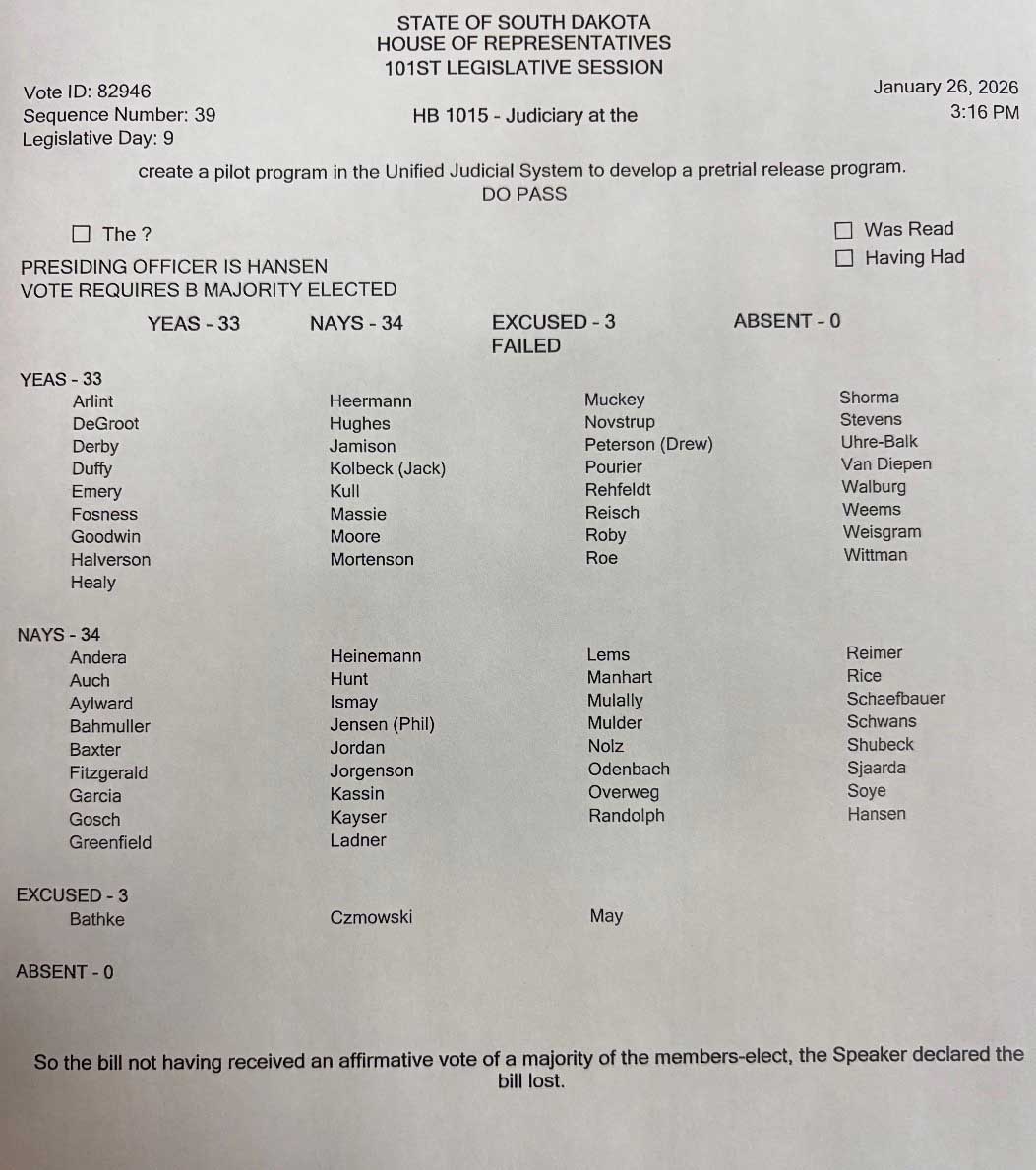
It failed 33-34. But I’m told it will be up for reconsideration. And when that happens, my thought it that it’s in a good spot where it ended up today – defeated on the House Floor. And there’s no need for a do-over.
As I noted several days ago, the White House is dead-set against cashless bail, and has issued executive orders against the practice, threatening federal funds. And that’s just the start of the problems. In Pennington County where the project had been piloted, since it began, the jail population has expanded and as I’m told, the racial disparity it hoped to combat has increased.
That might be anecdotal, but as I spoke with one State’s Attorney today, he brought up this bill, and expressed that South Dakota’s Court Service Officers have a hefty caseload already. And a cashless bail program that places a higher workload on them is not a good thing.
It’s an experiment that was tried in one county, but doesn’t seem to have delivered as promised.. and now UJS is looking for a statewide pilot?’
But don’t listen to me. What do I know? I write about things.
Instead, reach out to the people who try to keep communities safe. I think anyone and everyone who voted in favor of this measure should reach out to their county state’s attorney and ask them what they think of the proposal of a cashless bail program, what it will do to the caseload of themselves as well as court service officers, and how it will affect the safety of their community.