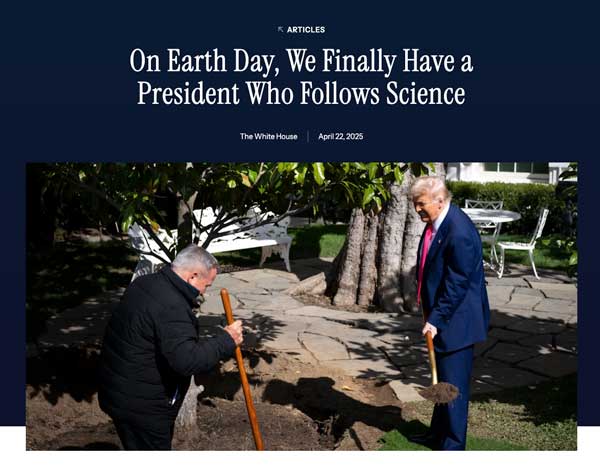
Attorney General checking out the equipment to make sure it works right
From X.com, sometimes it’s good to be the boss:

From X.com, sometimes it’s good to be the boss:
South Dakota Stands At A Crossroads: Save Our Facilities From Medicaid Ruin
by Billijean Moerman
As proud South Dakotans, we understand the obligation of prioritizing care for others above all else; for our families, our neighbors, and all those in need. Having access to quality healthcare when needed is a standard necessity of this care that we expect for one another. For this reason, it is imperative that I draw attention to our devastatingly overtaxed, primary funding source of Medicaid.
For many years, Prairie Estates Care Center stood as a beacon of love for our elderly in the small farming community of Elk Point. Some of the most gracious and hard-working individuals called Prairie Estates their home and I was the proud administrator who served them. As with most all facilities, Prairie Estates relied on Medicaid funding to reimburse our gracious owners for the care that we provided. For years, our owners fought and went into debt to keep Prairie Estates open. In January 2023, this battle was lost as Medicaid reimbursement rates barely covered a fraction of the costs.
Our state lost the most caring, loving, close-knit facility I have ever seen in my 24 years in long term care. There was nothing more heartbreaking than to hold my residents as they cried for their home, as we were forced to separate them and move them hundreds of miles away. Many of our residents went to school together and knew one another for much of their lives. They deserved to spend their golden years surrounded by their community and loved ones. Instead, they were forced to go to the only facilities that had room for them. Sadly, Prairie Estates Care Center is just one of over a dozen nursing homes and long-term care centers forced to close in recent years across our state. Over the past five years alone, 10 percent of licensed nursing home facilities in South Dakota have closed due to Medicaid underfunding. According to the South Dakota Department of Social Services, 54 percent of nursing home residents across our state depend on Medicaid for care. At the time when our facility was forced to close in 2023, Medicaid reimbursements in our state totaled $62.5 million. It is highly concerning to see lawmakers in Washington consider proposals that would drastically cut our overly overburdened Medicaid budget. Major new cuts to the program, on top of existing underpayments and inflation, would be devastating.
Medicaid is a program built for families. It serves South Dakotans of all ages, including pregnant mothers and 40 percent of the children born in our state. Patients and families who are the most vulnerable— including those with mental health and substance abuse problems, live in rural counties or have developmental disabilities— rely on Medicaid for care. Organizations and centers established to care for these patients often utilize Medicaid funding. A recent analysis from Georgetown University demonstrated that Medicaid is especially important in small towns and rural areas. One fifth of the country lives in these areas, including a large population of our state.
I, like many red-blooded Americans, admire the efforts of President Trump for championing the voiceless and repeatedly stating he will not cut Medicaid. I support our government in finding greater efficiencies and thank the President and Congress for preserving essential programs like Medicaid as part of this initiative. Trust me when I say that nursing facilities need every penny they make, and Medicaid is crucial in this regard.
So please, don’t wait until your small-town nursing home closes. Don’t wait until you need a compassionate caring environment for your mom or dad and find that they no longer exist. I am speaking for thousands of elderly, but our voices are not strong enough.
Attorney General Jackley Announces Settlement In NCAA Lawsuit
PIERRE, S.D. – South Dakota Attorney General Marty Jackley announces that the State has reached a settlement of its lawsuit against the NCAA that reduces the amount of money that Division I schools, including South Dakota State University and the University of South Dakota, will have to pay toward the NCAA’s proposed $2.8 billion settlement of federal class action lawsuits brought by student athletes in California.
“This settlement is for and about our student athletes. It provides approximately 33% relief to South Dakota’s universities and all other Division I schools, as well as a foundation for financial equity for female athletes,” said Attorney General Jackley. “This settlement also provides the Attorney General an opportunity to work with the NCAA on future reductions and stipulates that funding of the newly created Women’s Basketball Performance Fund remain intact with no reductions.”
Also, as part of the settlement and South Dakota’s past success in hosting NCAA tournaments, the NCAA has committed to meet with the hosts of past NCAA tournaments and events in South Dakota to discuss holding future events in the State. “Last year’s Summit League men’s and women’s basketball tournaments brought roughly $10 million into South Dakota,” Attorney General Jackley said. “We look forward to hosting future NCAA events in South Dakota.”
Attorney General Jackley and the South Dakota Board of Regents, on behalf of South Dakota State University and the University of South Dakota, had filed a lawsuit in September 2024 against the NCAA alleging that smaller Division I schools were being overcharged for the cost of the $2.8 billion settlement. South Dakota’s lawsuit sought to relieve the financial burden on South Dakota’s universities and other smaller Division I schools and to financially protect female athletes.
The student athletes had sued the NCAA to recover back payment for their participation in college athletics during the term of the settlement. A federal judge in California is now deciding whether to give final approval to the NCAA’s settlement.
In consultation with the South Dakota Attorney General, the NCAA is directing a budget surplus of $55 million to reduce the amount of money Division I conferences would have had to pay for the first year of that settlement.
The settlement reduces by approximately $2 million the amount of money that the Summit League and the Missouri Valley Conference, which include the two South Dakota schools as members, will have to pay in the first year of the settlement.
The State has agreed to dismiss its lawsuit against NCAA. A hearing had been scheduled for Thursday in Brookings County Circuit Court.
-30-
KELOland has a story on the impending Jon Hansen/Karla Lems announcement tomorrow:
Rep. Jon Hansen and Rep. Karla Lems would be the first to officially enter the race. Hansen and Lems have placed an identical post on their Facebook pages, with a “Stronger Together” slogan, inviting the public to a 6 p.m. event at the Military Heritage Alliance building in Sioux Falls.
Hansen is a Dell Rapids lawyer. During his 10 years in the South Dakota House of Representatives, here’s what he has focused on:
- Restricting abortion.
- Opposing surrogate pregnancies.
- Blocking carbon dioxide pipelines.
- Steering state funds to non-public K-12 education.
- And changing state election laws.
Hansen was prime sponsor of a Republican-led effort by the Legislature in 2022 to make it more difficult for voters to amend the South Dakota Constitution, as well as to pass or stop state laws, if the proposal sought to raise taxes or impose a new tax. Republican lawmakers supported his proposal that sought to raise the threshold to 60%. It also would have required 60% of the proposal obligated state government to appropriate $10 million or more in any of the first five fiscal years.
Opponents criticized Hansen’s effort as an attempt to give the Legislature more power. He wrote the pro-side on the ballot-measure pamphlet. Voters however overwhelmingly rejected the proposed change.
I guess we know what they’ll be talking about the entire campaign – abortion, carbon pipelines, robbing funds from schools, and preventing people from helping the infertile.
It’s going to be a long campaign.
And as an aside, should we refer to the followers of Hansen/Lems as Hansen/Lemmings for shorthand?
Stay tuned.
Gov. Rhoden Announces Bill Even as Commissioner of the Governor’s Office of Economic Development
PIERRE, S.D. – Today, Governor Larry Rhoden announced that Bill Even will serve as the next Commissioner of the Governor’s Office of Economic Development (GOED). He will assume this position on May 2, 2025. You can find a picture of Bill Even here.
“South Dakota has built the strongest economy and the freest state in America, and GOED has been instrumental to those accomplishments,” said Governor Larry Rhoden. “Bill Even is the right leader to continue driving our economy forward. Bill has as rich history of advocating for South Dakota’s economy, including for ag, our most important industry. I trust that Bill’s servant leadership will help us keep South Dakota Open for Opportunity.”
Joe Fiala will continue to lead in the Governor’s Office of Economic Development, embracing a new role as the Deputy Commissioner.
“I am grateful for Joe’s continued service. He has been so crucial to GOED for years, and he will be an important partner to Bill in the future,” continued Governor Rhoden. “Together, Bill and Joe will help lead our economy towards even greater success.”
Bill Even has a long history of public service, having served as Secretary of Agriculture, Deputy Secretary of Tourism and State Development, Director of the Governor’s Office of Economic Development, State Energy Policy Director, and Policy Advisor and Executive branch lobbyist for Former Governor Mike Rounds.
Bill holds an A.S. in Agricultural Production from Lake Area Technical Institute, a B.S. in Agricultural Business from South Dakota State University; and a Juris Doctorate from Drake University Law School. He currently serves as the Chief Executive Officer for the National Pork Board based in Des Moines, IA. Prior to his employment with the National Pork Board, Bill served as the Global Industry Relations Lead and Commercial Unit Lead for DuPont Pioneer.
“I want to thank Governor Rhoden for the opportunity to serve as Commissioner of the Governor’s Office of Economic Development,” said Bill Even. “My great-grandfather homesteaded our family farm at Humboldt in Dakota Territory in 1884. He and his young wife came here seeking new opportunities, room to grow and to raise a family. I believe that pioneering spirit still exists in America and in South Dakota. I look forward to working with people who share that optimistic mindset and vision of making a life and a living in our great state.”
Bill and his wife, Janell, have three children and live in Tea, SD.
###
So this announcement came out yesterday in the afternoon:
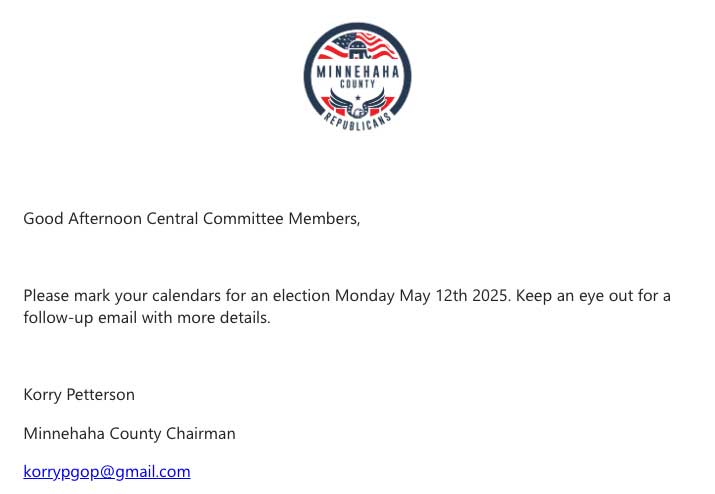
An election for the Minnehaha County GOP already? What’s going on there? While the message is not specific, I would venture that it’s all related to the Minnehaha County GOP Tom Pischke censure fight.
That’s part 1. Part 2 of this post is even weirder. Recently, you might have caught the Minnehaha County GOP had announced a “Joint Legislative Wrap-Up” with the Lincoln County GOP, with the location as “The Alliance Center,” with the notation that “Map and details will be sent to those who register.”
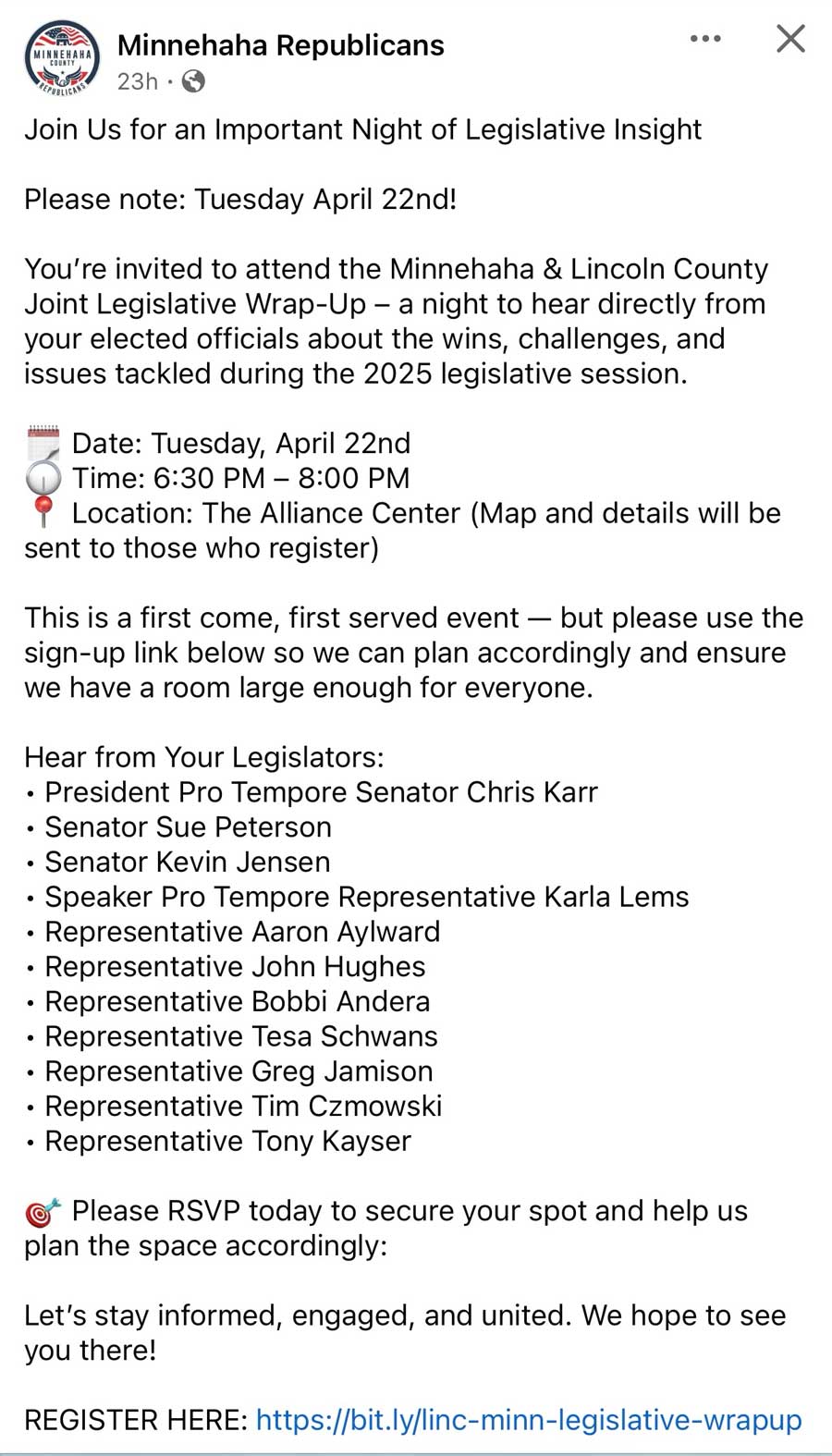
The invite said that registrants get to hear from their legislators… with the list. Except it’s missing some people. Several in fact. In fact, the list of legislators seems to be almost exclusive to those who voted to lock-up librarians, and to vote similarly in lock-step on issues. So much so, that I reached out to one of the legislators who wasn’t on the list.
I asked if the event is a “come hear from the people they wanted to invite” type of event? I was told “they sent us an email asking us if dates would work for us. Then they never told us when the actual date would be.” Nice.
But then we got to the eve of the event, and my texts started blowing up.
I had a reader tell me that for this legislative forum, “They hid the address from people until they registered,” sending this sign up link:

So, the facebook link said it was being held at “the alliance.” This sign-up link said it was being held at the “South Dakota Military Alliance.” The problem? As my correspondent related to me:
The person I know registered but never got the address so she went to the Alliance building and the women there said, “you aren’t the first person coming here to find that meeting but we don’t know where it’s at but it might be at a place called the Triple A.” So basically, they announced and advertised it as being at the Alliance but actually had it at a different location.
What? So, they advertise it being held at one place… and it does not appear that happened, despite the fact they advertised it was being held at the Military Alliance?
The Lincoln County GOP did have a facebook post on it with some pictures.. and I don’t think that’s the SD Military Alliance, unless they were set up for a funeral or something:

Regardless, this is just kind of weird. You have the groups setting up a secret meeting with only some of the legislators, deceptively using an incorrect location, and seemingly trying to shut out some legislators even those Republicans who might only be more causally interested to attend. And coming at a time when the Minnehaha GOP leadership is busy trying to either kick people out, or are experiencing an exodus of leadership. All at the start of the 2026 election election cycle.
As I find myself saying all too often – I’m sure this will go well.
With Tina Mulally as Treasurer, It took the SDGOP less than a week to have to re-file their last FEC report, as it appears they under-reported their expenditures by over $20,000, greatly reducing what little cash on hand they had. Here’s the updated report that just came across to the Federal Elections Commission today:
Sdgop2025 Aprilfec Do Over by Pat Powers on Scribd
Where the old report had $28,084.25 claimed in receipts, $8,492.97 expenditures and $68,841.29 cash on hand, the corrected report says the SDGOP ACTUALLY has $28,084.25 in receipts, a 4-fold increase of $36,572.17 in expenditures, and they’re only left with $40,762.09 cash on hand!
If that burn rate remains in place, they’re going to start to be in trouble next month!
Attorney General, Departments of Health, Social Services and Emily’s Hope To Announce Partnership Friday in Sioux Falls
PIERRE, S.D. – A joint partnership between state government offices and a local organization to distribute naloxone kits throughout South Dakota will be announced at a news conference Friday, April 25, in Sioux Falls.
Those attending the news conference will be South Dakota Attorney General Marty Jackley, State Social Services Secretary Matt Althoff, State Health Secretary Melissa Magstadt, and Emily’s Hope founder Angela Kennecke.
Friday’s news conference starts at 11 a.m. in the media conference room of the Sioux Fall Law Enforcement Center at 320 W. Fourth St.
For more information, contact Tony Mangan of the South Dakota Attorney General’s Office at 605-773-6878.
-30-
Attorney General Jackley Praises U.S. Attorney General Bondi’s Creation of Second Amendment Enforcement Task Force
PIERRE, S.D. – South Dakota Attorney General Marty Jackley joins 25 other Attorneys General in praising U.S. Attorney General Pam Bondi’s creation of a Second Amendment Enforcement Task Force.
“The right to keep and bear arms is a Constitutional right that has been threatened by Washington,” said Attorney General Jackley. “The Attorney General’s task force will ensure that the Second Amendment is protected now and in the future.”
In their letter to the U.S. Attorney General Bondi, the Attorneys General promised to support the Trump Administration in Second Amendment litigation and provide resources as needed.
Other Attorneys General joining the letter are from Alabama, Alaska, Arkansas, Florida, Georgia, Idaho, Indiana, Iowa, Kansas, Kentucky, Louisiana, Mississippi, Missouri, Montana, Nebraska, New Hampshire, North Dakota, Ohio, Oklahoma, South Carolina, Tennessee, Texas, Utah, West Virginia, and Wyoming.
More on the Task Force can be found here:
Yesterday, as quickly as GOP Gubernatorial Jon Hansen could tap it out, the SDGOP was re-posting his attack on the Summit Carbon Pipeline and carbon sequestration in general.
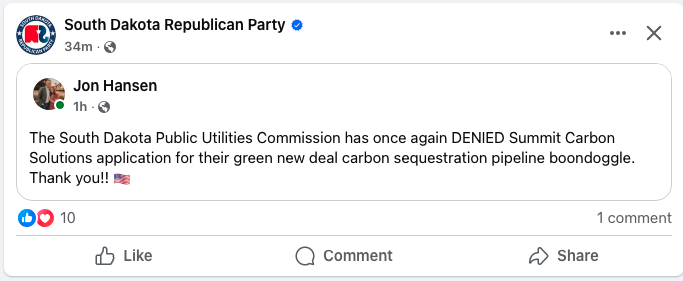
While it might play to a very narrow group of individuals, neither seem to care that their cheerleading is a direct attack on President Trump’s energy innovation agenda:
Under President Donald J. Trump, America is back — leveraging environmental policies rooted in reality to promote economic growth while maintaining the standards that have afforded Americans the cleanest air and water in the world for generations.
Unlike the previous administration, which wasted billions of taxpayer dollars on virtue signaling and ineffective grifts, the Trump Administration’s policies are rooted in the belief that Americans are the best stewards of our vast natural resources — no “Green New Scam” required.
Here are key actions President Trump is taking on the environment:
President Trump is promoting energy innovation for a healthier future.
By supporting cutting-edge technologies like carbon capture and storage, nuclear energy, and next-generation geothermal, the Trump Administration is ensuring America leads in both energy production and environmental innovation — producing the cleanest energy in the world. Moreover, by ending the Biden-era pause on liquefied natural gas export approvals, the U.S. is sharing cleaner energy with allies, reducing global emissions, and creating American jobs — building on President Trump’s first-term successes, where the U.S. led the world in greenhouse gas emission reductions.
SDGOP Chair Jim Eschenbaum – an Obama voter & 32 year Democrat – and Jon Hansen should read President Trump’s Energy Innovation Agenda here.
Big questions that Republicans should ask about party leadership and those who think they can sit in the big chair on the second floor – are they following President Trump’s agenda? Or are they anti-Trumpers who are going to be attacking the president and trying to stop his energy innovation agenda in South Dakota?
Another reminder that Republican faithful in the state really need to take a look at the people they’re putting in charge of the Republican Party.