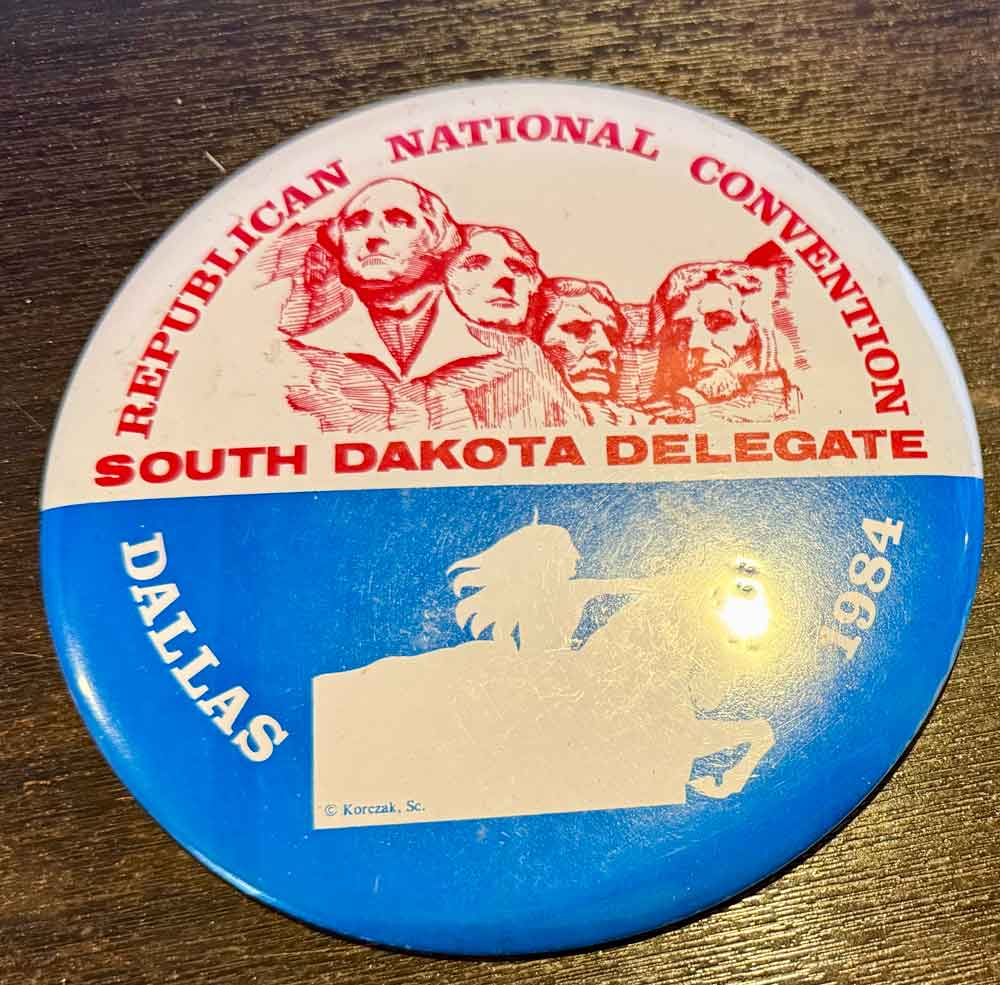
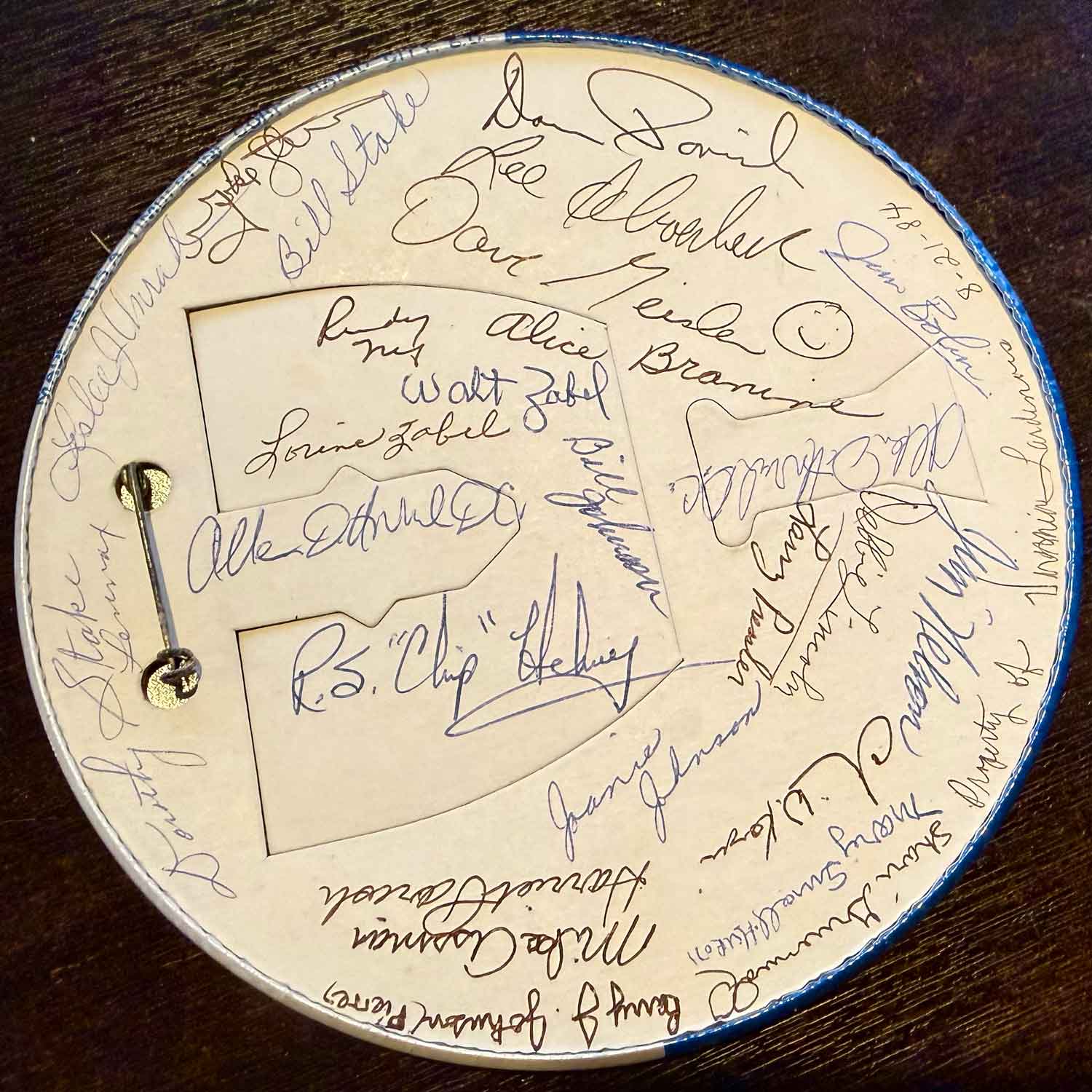
I bought this giant 6 inch pin for the South Dakota Delegation for the 1984 GOP National Convention the other day, not because I needed it (I already have one or two running around), but when I saw it on eBay, it was #1, cheap, and #2 the only one I’ve ever seen that was signed by many of the delegates. And I needed that early Lee Schoenbeck signature.
The signatures are a snapshot of the delegates attending who nominated Ronald Reagan to be our candidate, and there are a lot of names you might recognize.
A number of other names I recognize, including long time carriers of water for the elephant Joanie Johnson & Bill Johnson. If you’re not familiar, you’ve probably heard of their grandson.
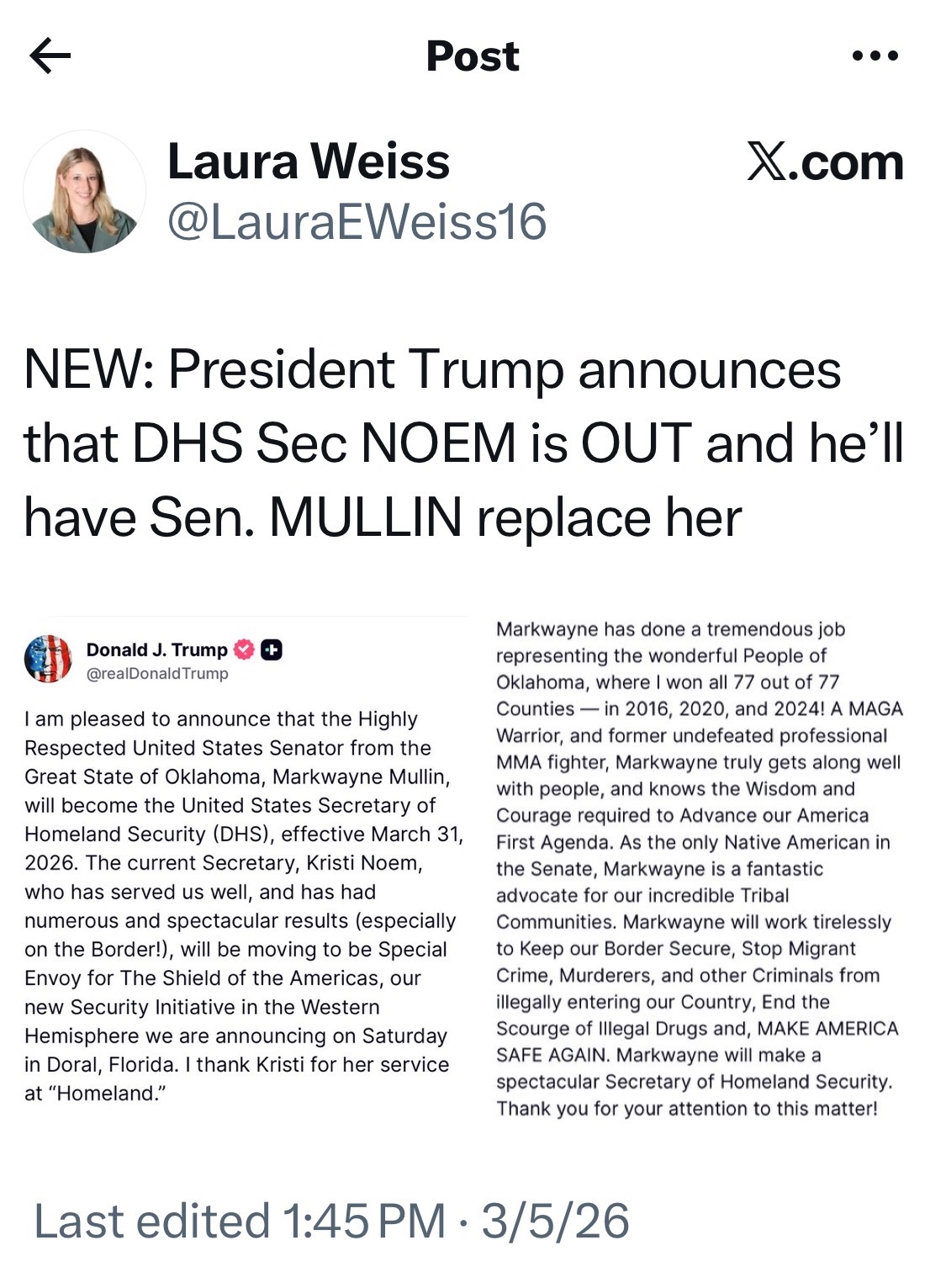
Thank you @POTUS Trump for appointing me as the Special Envoy for the Shield of the Americas. @SecRubio and @SecWar are incredible leaders and I look forward to working with them closely to dismantle cartels that have poured drugs into our nation and killed our children and…
Thank you @POTUS Trump for appointing me as the Special Envoy for the Shield of the Americas. @SecRubio and @SecWar are incredible leaders and I look forward to working with them closely to dismantle cartels that have poured drugs into our nation and killed our children and grandchildren.
The Western Hemisphere is absolutely critical for U.S. security. In this new role, I will be able to build on the partnerships and national security expertise, I forged over the last 13 months as Secretary of Homeland Security.
We have made historic accomplishments at the Department of Homeland Security to make America safe again: we delivered the MOST secure border in American history, 3 million illegal aliens have left the U.S., we have located 145,000 children, FEMA delivered disaster relief at a 100% faster rate, we ushered in the golden age of travel, saved the American taxpayer $13 billion and revitalized the U.S. Coast Guard.
From KELOland News, the former 32-year Democrat in charge of the SDGOP, Jim Eschenbaum, has managed to insert himself into the conversation around former Governor Noem’s departure from the Department of Homeland Security:
South Dakota GOP Chairman Jim Eschenbaum sent KELOLAND News a statement.
“I really don’t know for sure why President Trump removed Secretary Noem, but I fully trust his judgment. I’m sure President Trump will tell her where to go next,” Eschenbaum said in an email to KELOLAND News.
Kristi is a dear friend and the toughest person I know. When she shut down the border in record time, others were shocked, but I wasn’t — I knew what she was capable of. She’ll deliver in her next role just as capably. I thank her for everything she’s done to keep South Dakota —…
— Governor Larry Rhoden (@GovLarryRhoden) March 5, 2026
Farm Bill Passes Ag Committee with Johnson’s Support
Washington, D.C. – Today, the House Agriculture Committee passed the Farm, Food, and National Security Act, also known as the Farm Bill, with a bipartisan 34-17 vote. U.S. Representative Dusty Johnson (R-S.D.) voted to pass the Farm Bill which contains dozens of Johnson’s priorities that support farmers and ranchers in South Dakota and across America.
“I’ve met with ag producers across South Dakota and they all agree – we need a Farm Bill. I agree, and that’s why I’m proud to have worked with Chairman Thompson to finalize this legislation,” said Johnson. “This Farm Bill invests in rural America and provides needed certainty for producers by building on the work completed in the Working Families Tax Cuts. These investments in American agriculture strengthen communities, secure our food supply chains, and put our producers first.”
Click here or the image above for Johnson’s opening remarks
Johnson’s bills included in the Farm Bill:
The SAFETY Act to safeguard American exports from unfair trade practices.
The Butcher Block Act to assist with new and expanding livestock and meat processors.
The Healthy Dog Importation Act to ensure dogs imported into the U.S. are in good health and have received proper vaccines and medical treatment.
The A-Plus Act to increase investments in small meat packers.
The ACES Act to add agricultural cooperatives with fewer than 2,500 employees as qualified entities under the Rural Energy for America Program.
The Increased TSP (Technical Service Providers) Access Actto improve and expand the certification and participation process for Technical Service Providers under United States Department of Agriculture (USDA) conservation programs.
Transfer Food for Peace from United States Agency for International Development (USAID) to USDA, as seen in H.R. 1207.
The CAREERS Act to strengthen workforce development and career education programs.
The Save Our Bacon Act to block California’s Proposition 12 requirements on producers.
Johnson’s crop and conservation priorities included in the Farm Bill:
Provides long-term investments in working lands conservation programs, such as the Environmental Quality Incentives Program (EQIP) and Conservation Stewardship Program (CSP).
Johnson’s amendment to clarify that tech-neutral modernization is eligible for fencing repair or replacement under the Emergency Conservation Program (ECP).
Johnson’s rural development priorities included in the Farm Bill:
Updates and modernizes USDA broadband programs, providing faster buildout speeds and strengthening connectivity to rural communities.
Codifies the Circuit Rider Program, which provides technical assistance for rural water systems.
Broadens the Business and Industry Guaranteed Loan Program to support new investments in food infrastructure for a more resilient and diverse U.S. food supply chain.
Reauthorizes the Rural Economic Development Loan and Grant Program and permits awardees to provide other forms of collateral to secure loans.
Johnson’s other agricultural priorities included in the Farm Bill:
Johnson’s amendment to strengthen Tribal 1994 Land Grant Institutions by expanding their ability to acquire land, modernize facilities, and invest in equipment to support ag research and extension.
Reauthorizes the New Beginnings for Tribal Students Program and removes the cap on funding each state can receive.
Reauthorizes the Sun Grant Program, expands the scope to include bioproducts, and allows universities to better utilize grant funding.
Reauthorizes the Wood Innovation Grant Program, reduces the non-Federal match, and authorizes grants for hauling materials to locations that can utilize it.
Directs additional resources toward livestock and poultry disease preparedness, including the National Animal Health Laboratory Network, National Animal Disease Preparedness and Response Program, and the National Animal Vaccine and Veterinary Countermeasures Bank.
More than doubles authorization funding for the Market Access Program (MAP) and Foreign Market Development (FMD) Program, enabling better market access and trade promotion.
Reforms reporting requirements under the Agricultural Foreign Investment Disclosure Act to ensure accuracy and transparency of data on farmland owned by foreign persons.
Allows the Secretary to enter into self-determination contracts with Tribes to operate SNAP, consistent with the SNAP Tribal Food Sovereignty Act.
Welcome back to the Weekly Round[s] Up. This past week, I attended President Trump’s State of the Union address. The president gave a great message to the American people. I look forward to working with him and my Senate colleagues to continue providing Americans with real results. Our nation is safer, our economy is stronger and our military is the most powerful in the world. We will continue to build on these successes for an even brighter future for America.
In addition, this past weekend, President Trump took decisive action in Iran following weeks of unproductive conversations surrounding their nuclear program, as well as their short and mid-range ballistic missiles. President Trump has taken the right course of action in beginning to eliminate the Iranian regime’s defensive and offensive capabilities. We should be thankful for our men and women in uniform and their ability to project power that keeps our borders safe. We will do everything we can to make sure they are the best led, the best trained and the best equipped fighting force on earth. Please keep them all in your thoughts and prayers, especially the families of the brave soldiers who have lost their lives in this operation.More on this and the rest of my week in the Weekly Round[s] Up:
South Dakota groups I visited with: Leaders from Heartland Energy; South Dakotans from Northern Plains Joint Venture Partnership; Marty Pennock, Adjutant DAV Department of South Dakota / Disabled American Veterans; South Dakota State Medical Association; South Dakota State University’s National Institutes for Water Resources and Council for Agricultural Research, Extension and Teaching; Michael and Wanda Irwin with M&W Towing; South Dakotans with the Wounded Warrior Project; South Dakota members of Big Brothers Big Sisters of America; the South Dakota Wing of the Civil Air Patrol; and South Dakota Grasslands Initiative.
Met with South Dakotans from: Madison, Pierre, Rapid City, Sioux Falls, Wentworth, and Winner.
Other meetings: Sahrawi Negotiating Team; Mike Gitlin, CEO of Capital Group; Blake Lawit, Chief Global Affairs and Legal Officer at LinkedIn; Michelle Bowman, Vice Chair of Supervision of the Federal Reserve; Doug Worman, CEO of CAN Financial Corporation; Robin Vince, CEO of BNY; and Bruce Van Saun, CEO of Citizens Bank.
Hearings: On Thursday I went to a Senate Armed Services Committee hearing, you can watch that here. I also attended a Senate Banking, Housing, and Urban Affairs hearing which you can watch here.
Briefings: I attended two classified briefings: one with the Senate Select Committee on Intelligence and the other with the Strategic Forces subcommittee.
Votes taken: 5 – This week I voted yea on five items including Ryan McCormack, of Virginia, to be Under Secretary of Transportation for Policy and John DeLeeuw, of Texas, to be a Member of the National Transportation Safety Board for the remainder of the term. As well as the Department of Homeland Security appropriations bill which failed.
My Staff in South Dakota visited: Onida and Platte.
Steps taken: 60,785 steps or 28.38 miles.
Video of the Week: On Sunday afternoon I went on Fox News to discuss the strikes in Iran over the weekend. Click here to watch.
Johnson’s Tribal Homeownership Bill Passes U.S. House
Washington, D.C. – Today, the Tribal Trust Land Homeownership Act, led by U.S. Representative Dusty Johnson (R-S.D.) and U.S. Senator John Thune (R-S.D.) passed the House with a 384-40 vote. Johnson’s bill advocates for homeownership and streamlines the approval process for mortgages on tribal trust land.
The Senate passed the Tribal Trust Land Homeownership Act in December 2025 and the bill passed the House Natural Resources Committee in January 2026. The bill now heads to President Trump’s desk for his signature.
“Government bureaucracy shouldn’t prevent an individual from achieving the American Dream of homeownership,” said Johnson. “Now that our bill has passed the House and Senate, I’m hopeful President Trump will sign it into law soon to make homeownership more accessible on tribal trust land.”
“This legislation will positively impact our Native families pursuing homeownership,” said Sharon Vogel, Chair of the South Dakota Native Homeownership Coalition and Executive Director of the Cheyenne River Housing Authority. “H.R. 2130 will help to eliminate barriers that have historically hindered our homeownership efforts. It also allows us to leverage private sector partnerships that require government processes to keep pace with mortgage industry timelines. We are grateful to Representative Johnson and Senator Thune for their leadership and commitment on this issue and for working with the Coalition to improve housing conditions for our families in South Dakota.”
Click here or the image above for Johnson’s floor remarks
Currently, in order to be finalized, mortgages involving property on tribal trust land must be reviewed and approved by the Bureau of Indian Affairs (BIA). The BIA Mortgage Handbook establishes timelines for BIA offices to process and approve these mortgages. However, these timelines are not always adhered to.
The Tribal Trust Land Homeownership Act would:
Seek to cut through BIA red tape and provide timely processing of mortgages.
Create statutory timelines in which the BIA would be required to process and approve mortgages involving property located on tribal trust land.
Require the BIA to notify lenders upon receipt of such documentation and perform a preliminary review of such documents no later than 10 days after receipt and approve or disapprove of such documents within 20 or 30 days, depending on the type of application.
Require the BIA to notify the lender once the proposed residential leasehold mortgage, business leasehold mortgage, or right-of-way document has been received.
Enhance the ability of certain federal agencies to operate their tribal housing programs and improve communication between the BIA and tribes, tribal members, and lenders through the establishment of a realty ombudsman within the BIA who can communicate with relevant parties.
Gov. Rhoden Signs SNAP Waiver, Urges Congress to Fix Federal Program
PIERRE, S.D. – Today, Governor Larry Rhoden signed HB 1056 and called on Congress to fix the Supplemental Nutrition Assistance Program (SNAP) at the federal level to provide certainty to states. The Governor outlined his decision in a letter, which can be found here.
“I agree with the Legislature’s and the Trump Administration’s goal of encouraging healthier food choices,” wrote Governor Larry Rhoden. “However, I disagree that a state waiver is the right approach. Lasting SNAP reform requires federal action, not a patchwork of state waivers.”
Governor Rhoden pointed out that 90% of the Legislature recognizes that SNAP reform must occur at the federal level, citing the passage of Senate Concurrent Resolution 603. Governor Rhoden went on to argue the following reasons for the necessity of a consistent federal solution:
SNAP’s federal structure means state-level waivers are subject to reversal by future federal administrations; and
State waivers create additional costs for South Dakota taxpayers due to the new state responsibilities.
“I will continue to monitor federal developments and evaluate any future opportunities through the lens of fiscal responsibility, administrative practicality, and real impact for South Dakota families,” continued Governor Larry Rhoden. “If the federal government finally does its job and fixes this problem, this law should be repealed to avoid more costs to South Dakota taxpayers.”
Governor Rhoden has signed 74 bills into law and vetoed one this legislative session.
Before the dust has settled on the rollout of their third commercial, Team Dusty has rolled out a fourth commercial promoting the Gubernatorial candidates’ support and plans for education for South Dakota:
Not a lot of moss growing on the campaign’s advertising effort, as they continue to roll out a full spread of communications.