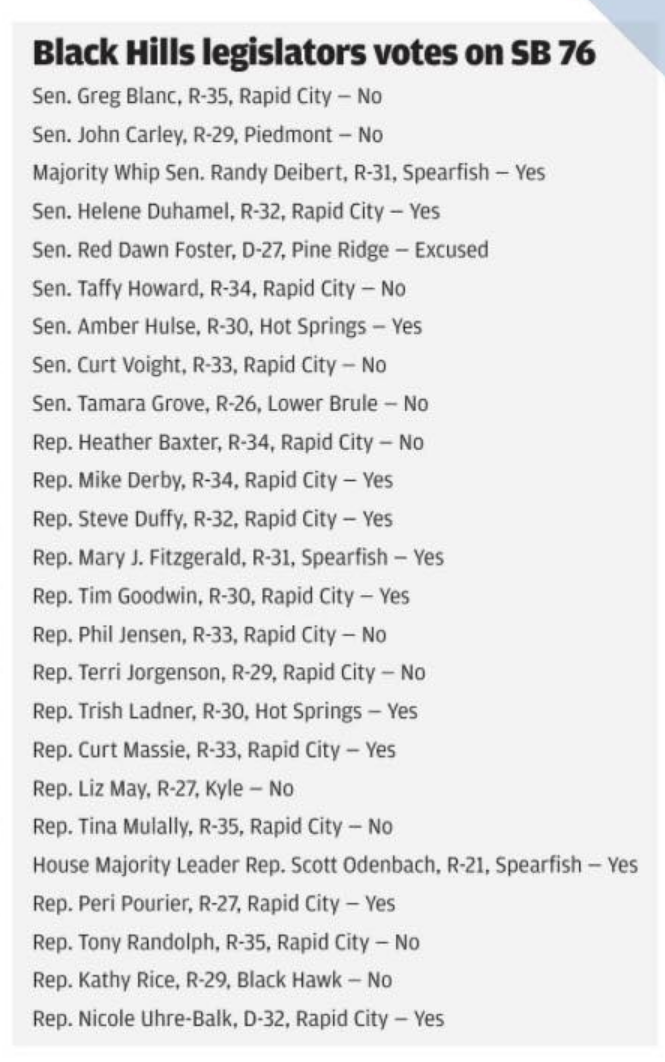
Phil around and find out. Jensen removed from House Education Committee

State Representative Phil Jensen found out from House Leadership today what happens when people grow weary of your antics.  It was announced that he has been removed from House Education Committee.

I would venture that it had as much to do with what he pulled last year – singling out Huron to zero fund their state aid to education – as it did when he joined Rep. Josephine Garcia in generally being a pain in the rear in committee over their seating assignments this last week.

I have no doubt Phil will continue to make a nuisance of himself as the chairman of the South Dakota Freedom Caucus.

Especially since they’ve given him freedom from his House Education Committee assignment.

Update:

Word is that Phil was replaced by Liz May. Jensen is noted by LRC as currently serving on House Taxation and Local Government.

Bit of a fall from being House Education vice chair last year.

Guest Column: What Federal Cannabis Rescheduling Means and Why South Dakota’s Medical Cannabis Law Remains Essential for Patients and Public Safety By Emmett Reistroffer

What Federal Cannabis Rescheduling Means and Why South Dakota’s Medical Cannabis Law Remains Essential for Patients and Public Safety
By Emmett Reistroffer

Emmett Reistroffer is the Director of Government Relations for Genesis Farms, based in Box Elder, SD and is a Republican candidate for the South Dakota House of Representatives, District 35

President Trump’s recent executive order directing the rescheduling of marijuana from Schedule I to Schedule III under the Controlled Substances Act is a significant and historic step toward potential federal reform. But it is only that—a first step. Any actual change will unfold through a lengthy, uncertain process that could take years before it produces meaningful, on-the-ground effects.

Still, the announcement has understandably sparked (pun intended) widespread interest and confusion, particularly among the more than 18,000 South Dakotans who currently rely on our state’s voter-approved medical cannabis program for safe and lawful access. Questions are fair. Misinformation is not.

As someone who has spent years advocating for safe medical cannabis access—and who now works daily with patients, caregivers, regulators, local governments, and licensed operators across South Dakota—I believe it is important to set the record straight. Patients, providers, and community leaders deserve clarity. Unfortunately, some politicians appear eager to exploit uncertainty as an opportunity to undo progress backed by an overwhelming majority of voters.

South Dakota’s medical cannabis law — now SDCL 34-20G — was built deliberately, carefully, and democratically. It provides patient protections, oversight by physicians and other medical providers, controlled licensing, product testing, and strict regulatory enforcement. It is not a loophole, a commercialization scheme, the wild west, or a policy accident. It is a medical framework supported by veterans, chronic-pain patients, cancer survivors, families, and healthcare professionals who support a safer alternative to opioids and criminalization.

The claim that federal rescheduling somehow makes South Dakota’s voter-approved medical cannabis program unnecessary misunderstands both what rescheduling is and what it actually changes in practice.

First – Why Did President Trump Take Action?

The opening section of President Trump’s executive order clearly states the policy rationale behind directing federal agencies to reconsider marijuana’s classification.

“Chronic pain affects nearly 1 in 4 United States adults and more than 1 in 3 United States seniors, and 6 in 10 people who use medical marijuana report doing so to manage pain.  Forty States plus the District of Columbia have State- or locally-sanctioned, regulated medical marijuana programs.  Yet decades of Federal drug control policy have neglected marijuana’s medical uses.  That oversight has limited the ability of scientists and manufacturers to complete the necessary research on safety and efficacy to inform doctors and patients.”

In short, the executive order recognizes a reality that patients, physicians, and states have already confronted: federal policy has failed to keep pace with medical evidence and real-human experience.

This action reflects Donald Trump’s populist governing approach—addressing issues directly, grounding policy in observable facts, and prioritizing the lived experiences of Americans over outdated assumptions. It does not legalize marijuana, nor does it dismantle state authority. Instead, it acknowledges medical use, encourages research, and begins correcting a long-standing federal and state conflict.

That context matters—because the executive order was not issued to replace state medical cannabis programs like South Dakota’s, but to begin aligning federal policy with what the American people want and what most U.S. states have worked on for decades.

What Federal Rescheduling Really Means — and What It Doesn’t

The shift toward moving marijuana from Schedule I to Schedule III is meaningful — but it is not federal legalization, and it is not a replacement for state medical cannabis programs. It’s also not a guarantee that anything will change – it simply allows a pathway to change.

Rescheduling happens through formal DEA rulemaking process that includes scientific review, public comment, and final rule publication. The process is further affected by other agency involvement and input and even Congressional action. This will take, at least, several months — but more likely, years — and potentially longer if litigation occurs. Until rescheduling is final, cannabis remains Schedule I under federal law.

Even if rescheduling is finalized, marijuana will still be a controlled substance under the Controlled Substances Act. It will not become broadly available as a federally prescribed medication unless and until there is full FDA approval to be dispensed in pharmacies.

Physicians in South Dakota issue medical certifications, not federal prescriptions — and rescheduling does not convert our program into a federal prescription system.

In practical terms, rescheduling does three important things:

  1. It formally acknowledges legitimate medical use
  2. It reduces research barriers to legitimate scientific research
  3. It allows relief from the punitive IRS 280E tax restriction on state-licensed medical cannabis businesses

Those are positive steps — and a long list of various organizations and the vast majority of Americans, including Veterans, patients, medical providers and researchers support rescheduling because it strengthens and stabilizes state medical cannabis programs — not because it replaces them.

What Rescheduling Does Not Fix

Rescheduling alone does not resolve the core conflicts between federal and state law.

Congress would still need to act to:

  • harmonize federal criminal statutes with state-regulated systems
  • address interstate transport and commerce rules
  • modernize banking and financial protections
  • establish an appropriate federal framework for medical cannabis access
  • preserve state regulatory authority

South Dakota’s medical cannabis program remains essential until these issues are addressed and safe access for patients is guaranteed.

If South Dakota repealed SDCL 34-20G today, there would be:

  • no federal replacement structure ready
  • no federal prescription access available
  • no legal framework protecting patients
  • no oversight system for quality, safety, or testing

Repeal would not “defer to federal law.”

Ultimately, repeal would simply remove patient protections and re-criminalize sick and dying South Dakotans – whom 70% of voters decided deserve compassion, dignity, safe access and legal protection.

A small group of newly elected lawmakers, led by a vocal anti-marijuana activist, are calling to return South Dakota back to a time when sick and dying patients had to get cannabis from street dealers and risk jail or prison time, just to find relief and manage paint – folks with chronic pain, seizures, or PTSD among many others.

I believe a more reasonable, conservative and compassionate approach is to respect the will of the voters and focus on program improvements instead – working together to ensure safe access to medical cannabis with proper oversight.

South Dakota’s Program Reflects This Approach.

Maintaining the voter-approved medical cannabis program means:

  • regulated rather than chaotic
  • physician-guided rather than street-driven
  • tested and tracked rather than unmonitored
  • accountable to state agencies rather than cartels or illicit suppliers

Our Department of Health, local governments, and licensed operators have invested years and millions of dollars into building a secure, compliant system — one that prioritizes safety, product integrity, and an overall responsible approach to handling medical cannabis.

Repealing the voter-approved law and current program would:

  • destabilize communities
  • endanger patients and create unnecessary risks for them and their families
  • embolden street dealers and make the black market more lucrative
  • and undo the will of South Dakota voters

Federal reform should support and complement South Dakota’s voter-approved and state-regulated medical cannabis program — not erase it.

The Responsible Path Forward

Rescheduling is progress — but it is not a finish line.

The responsible and principled approach is to:

  • maintain the voter-approved medical cannabis law (SDCL 34-20G
  • continue improving the program to ensure every patient who qualifies has the option for safe access to medical cannabis
  • work with regulators and stakeholders to ensure regulations are reasonable and fair
  • align where appropriate with evolving federal policy
  • advocate for Congressional action that respects state sovereignty

South Dakotans support a program rooted in compassion and common-sense oversight. We should not abandon that work — but steward it wisely as federal policy finally begins to catch up. While President Trump’s executive order is a positive step in the right direction, South Dakota is ultimately better positioned to deliver on the needs and desires of our own people and should remain in control of our own medical cannabis policy — rather than rely and wait on Washington bureaucracy.

Emmett Reistroffer is the Director of Government Relations for Genesis Farms, based in Box Elder, SD and is a Republican candidate for the South Dakota House of Representatives, District 35

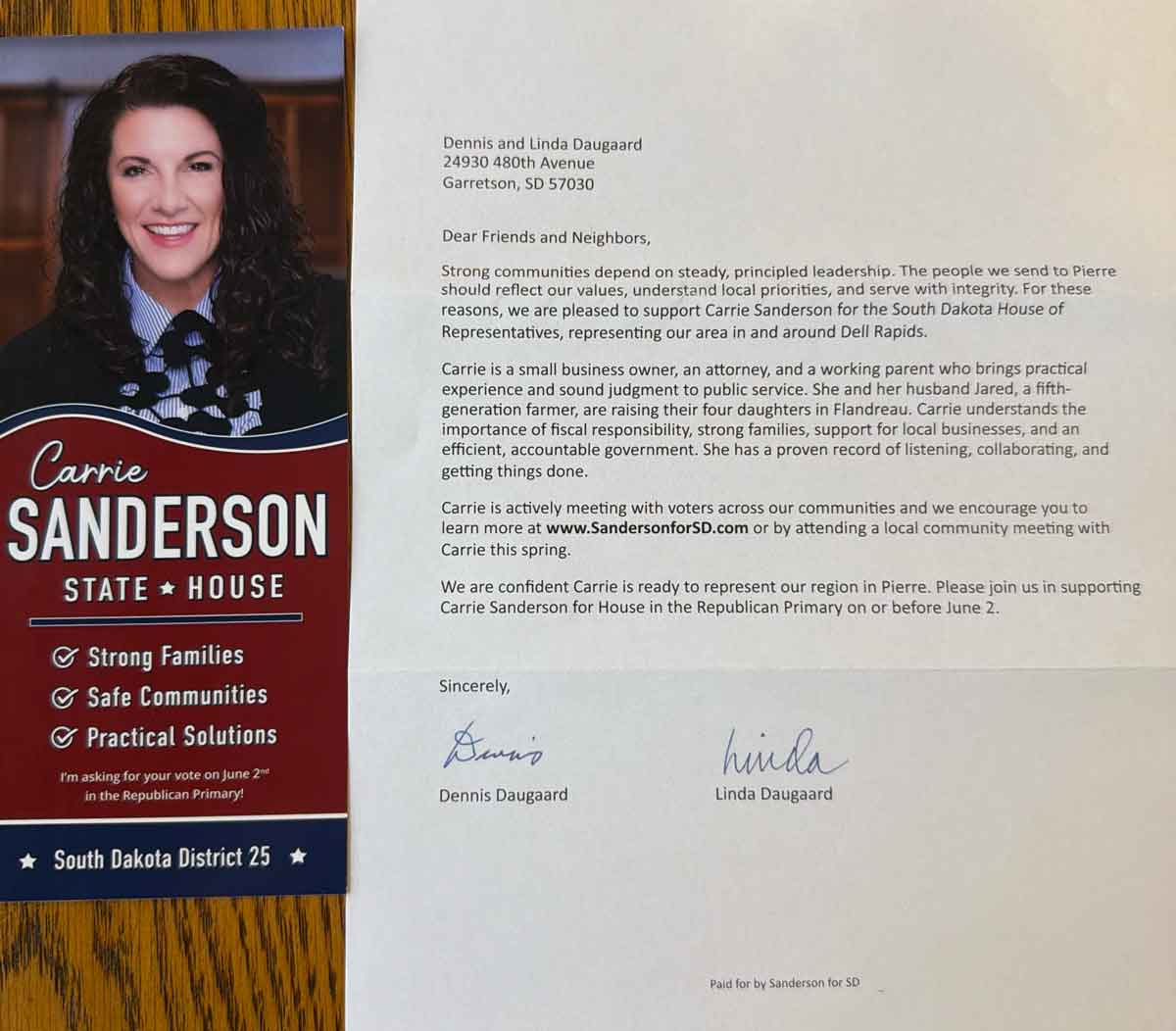
Representative Amber Arlint Announces Reelection Campaign for District 12 House

Representative Amber Arlint Announces Reelection Campaign for District 12 House

Sioux Falls, S.D. – Today, Representative Amber Arlint announced that she is running for re-election to the South Dakota House of Representatives in District 12,  reaffirming her commitment to serving her constituents by improving education, keeping neighborhoods safe, and supporting an economy that rewards hard  work and creates opportunity here at home.

“I am running for re-election because I believe in our community and the future of South Dakota,” said Arlint. “That means protecting taxpayers, strengthening public safety, improving education, and making sure South Dakota remains a place where you can live, work, and raise a family.”

First elected in 2022, Arlint has championed legislation to grow South Dakota’s workforce through technical education, modernize community safety zones to include domestic violence shelters, and strengthen the state’s long-term financial stability. She has also supported public safety measures, including expanding access to forensic medical exam kits, increasing penalties for impaired boating, and strengthening laws to combat human trafficking.

In the Legislature, Arlint serves on influential committees shaping education and transportation policy, where she has consistently defended local decision-making and pushed back against policies that place new requirements on schools and communities without the resources to meet them. She has also led and supported legislation to expand health care training capacity at Southeast Technical College, addressing workforce shortages through targeted, one-time investments.

Arlint is a wife, mother, and small business owner in the Sioux Falls metro area. Together, she and her husband are raising their two children in the community she serves, bringing her family and business experience to her service in the Legislature.

District 12 includes portions of Sioux Falls in Minnehaha and Lincoln counties.

Absentee voting begins April 17, 2026 and the Republican primary election will be held on June 2, 2026.

To learn more about Representative Arlint’s re-election campaign, visit AmberArlintSD.com or follow her on Facebook.

###

Guest Column: Lies Pt. 1 – Citizens Lying to Cops by Thomas E. Simmons

Thomas E. Simmons is a professor at the University of South Dakota Knudson School of Law in Vermillion. His views are his own and not the views of USD, its administrators, or the South Dakota Board of Regents. The opinions expressed above are merely those of private citizen.

Guest Column: Lies Pt. 1 – Citizens Lying to Cops
by Thomas E. Simmons

Not everyone knows a fairly basic fact about what’s illegal: lying to a cop can be a crime. Specifically, lying to law enforcement is a class 1 misdemeanor. (Class 1 misdemeanors are punishable by one year’s imprisonment per South Dakota Codified Law 22-6-2(1).)

This fact was underscored by a recent South Dakota Supreme Court decision, South Dakota v. Biteler (SD 2025), a case which arose out of Lincoln County and was decided in December.

First, let’s look at the statute which criminalizes lying to cops. It a crime whenever someone:

Makes a report or intentionally causes the transmission of a report to law enforcement authorities which furnishes information relating to an offense or other incident within their official concern, knowing that such information is false.

South Dakota Codified Laws section 22-11-9(3).

The statute was initially enacted in 1975, but initially it only penalized the false reporting of a crime. It has since been expanded – as one can see from the text above – to include a false report (1) “relating to an offense” and; (2) to any “other incident within” an officer’s “official concern.” Lies “relating to an offense” would include misleading an officer about the whereabouts of a suspect. Penalizing lies relating to an “incident within” a cop’s “official concern” is broader still.

That’s all well and good, but the word “report” makes it sound like the only thing to avoid is filing some official formal paperwork with the police that contains knowingly false information. What is a “report,” exactly? That was the issue presented to our state supreme court in the Biteler decision.

Amanda Biteler was originally charged with a second-offense DUI a few years ago and sentenced to parole rather than incarceration. As part of her sentence, she was required to submit what is known as “24/7” breath monitoring to check for alcohol consumption. Eventually, she was permitting to submit “remote breath” tests using a portable device with a straw and a camera lens. She was instructed how to use it.

As the court explained, “When a remote breath enrollee submits a breath test, the testing device takes their photograph. One of Biteler’s test photographs was flagged because it did not appear that she was the person who blew into the testing device.” She was charged with making a false report.

The court had to determine whether a breath test and a picture amounted to a “report.” Biteler argued the breath data and photograph didn’t amount to a report because rather than affirmatively communicating to law enforcement, she was simply complying (or rather, failing to comply) with the conditions of her parole. Moreover, there were no words contained within the breath data and photograph.

The statute itself does not define “report.” So, the court turned to ordinary definitions of the word. (Note that the word here is being used as a noun – as in making a report – and not as a verb – for example, reporting something to someone.) The county circuit court had located this definition of report: “a formal oral or written presentation” and it had dismissed the charges against Biteler since the breath test coupled with the photograph didn’t meet that definition.

The South Dakota Supreme Court reversed, adopting a broader definition of “report.” It concluded that a report means “a communication which furnishes information.”  Biteler had falsified her breath test by having someone else blow into the unit while Biteler’s face pointed at the camera. The breath test accompanied by the photograph amounted to a report insofar as they represented a communication which furnished information. False information, it turns out.

Biteler essentially conceded that she had been noncompliant with the conditions of her parole because she had misused the portable unit, but she resisted the prosecutor’s assertion that she had committed a crime. She had been noncompliant, certainly, but had she attempted to deceive law enforcement with a false communication – a false “report?” Indeed, she had, the court concluded.

On that basis, her conviction was reinstated.

Lying to cops is illegal. In fairness, I expect that a lot of lies to law enforcement go uncharged and unpunished. If, for example, back when Amanda Biteler was driving under the influence and stopped, the officer may have asked her if she’d been drinking. If she denied that she had had a few, this would have been a lie. Indeed, it would have been a report (a “communication which furnishes information”).

Better to refuse to answer a question than to answer it falsely. Falsehoods and untruthfulness can get you in trouble. Lying to cops is rightfully categorized as a claim because it impedes the functions of law enforcement.

The foregoing has been “part I” of a 2-part series on lying. Here, in Part I, we considered citizens lying to cops. In Part II, we’ll consider cops lying to citizens.

Thomas E. Simmons
University of South Dakota Knudson School of Law
Vermillion, SD

All of the views and opinions Professor Simmons expresses here on are his as an individual and do not reflect the views of the Board of Regents, the University of South Dakota, its School of Law, their employees, faculty or administrators. The foregoing editorial represents only his views as a private citizen.

Representative Keri Weems Announces Re-Election Campaign for District 11 House

Representative Keri Weems Announces Re-Election Campaign for District 11 House

SIOUX FALLS, S.D. — Today, Representative Keri Weems announced her campaign for re-election to the South Dakota House of Representatives in District 11, citing her commitment to public service, proven legislative experience, and record of delivering for her constituents.

“I’m running for re-election because District 11 deserves experienced leadership that listens, shows up, and delivers,” said Weems. “Our best days are still ahead, and I’m ready to keep working for you.”

Weems previously served three terms in the State House from 2003 to 2008 and brings a strong record of service. Her legislative work has focused on keeping taxes low, making government more efficient, supporting local decision authority, strengthening public education, improving public safety, and investing in infrastructure that keeps communities connected and growing.

Her professional background includes leadership roles in both the private and nonprofit sectors, where she has earned a reputation for integrity, collaboration, and steady leadership in difficult situations. She has worked closely with local organizations, small businesses, and families to strengthen economic opportunity, expand access to essential services, and support initiatives that improve quality of life.

Weems lives in Sioux Falls with her husband, Jay. Together, they have three adult children. As a wife, mother, and grandmother, she remains deeply engaged in her community by volunteering her time and supporting local organizations and causes.

District 11 includes the west side of Sioux Falls, stretching from I-29 nearly to Tea-Ellis Road, and from 57th Street north to 12th Street.

Absentee voting begins on April 17, 2026, and the Republican Primary Election will be held on June 2, 2026.

To learn more about Representative Weems’s re-election campaign, visit KeriWeems.com or follow her on Facebook and X. An official photo of Representative Weems can be found here.

###

State Sen. Casey Crebtree’s Weekly Column – Serious Problems Demand Serious Legislators and Serious Solutions

Column: Week 1 Session Update
“Serious Problems Demand Serious Legislators and Serious Solutions”

The 2026 Legislative session kicked off in Pierre, and improving South Dakota’s economy needs to be the top issue for my colleagues and I, otherwise our economy will fall behind our neighbors, our kids will leave the state, and everyday South Dakotans will hurt. Getting South Dakota back on track requires bold leadership and vision, because the time is now to make an impact.

Moody’s has flagged South Dakota as a state in or near a recession. At home, sales tax revenue fell 0.6% last fiscal year—only the third time in 30 years for South Dakota. Families feel it. Roughly one in five South Dakotans is delinquent on a credit card payment. People are buying fewer groceries and cutting back. When South Dakotans are asked what matters most, inflation and affordability top the list.

That’s the backdrop for every debate in Pierre. Serious problems demand serious legislators and serious solutions.

Driving home through whiteout conditions Friday, I kept thinking about my kids and their future. I don’t want a South Dakota where the next generation has to leave to build a life because they can’t find opportunities here. We like to say we’re “open for opportunity” in South Dakota, but it can’t be just a slogan. It has to be a commitment shared by the governor, the Legislature, local leaders, and every South Dakotan. The status quo won’t keep our towns alive. Closing our doors won’t either.

That’s why I’ve been in the middle of the big fights—housing and infrastructure funding to keep housing costs low, standing up for biofuels so our farm families can compete globally, and pushing for opportunities that make a real impact across our state. I don’t shy away from a fight because it’s hard. I’d rather stand strong with courage on a hill than be found hiding in a bunker in fear.

The big fight of 2026 is economic development and data centers. South Dakota needs to strengthen its economy, and we can do so in a thoughtful way that benefits hard-working South Dakotans and carefully balances concerns. Data centers play a pivotal role in our national security, provide new high-paying jobs, generate a steady stream of property and sales tax revenue, diversify our economy, and give the state and local communities a more reliable, predictable revenue base. This will increase property tax revenue that can fund our schools and roads in the future and keep more money in your pockets. This discussion is taking place at the federal level as well, with President Trump championing these data centers, while folks like Bernie Sanders lead the opposition.

America First means securing our energy, building critical infrastructure here, and competing to win. South Dakota Always means doing it with clear rules, strong oversight, and built-in local benefits—no blank checks, no sweetheart deals, and no cost-shifting onto local families. If we get it right, we bring investment, expand the tax base, and create high-paying jobs for electricians, plumbers, HVAC workers, and cybersecurity grads who can live in places like Agar, Toronto, Sioux Falls, Rapid City, and communities across the entire state.

As I always say: the best solutions aren’t found in Pierre, they come from folks at home that tackle real challenges every day. So, reach out with your ideas and solutions. If you’ll be in Pierre, let me know, I’d love to visit and recognize you on the Senate floor. Thank you. It’s an honor to serve District 8.

###

Has the bill to shoot down planes been filed yet? Don’t forget that we have pledges in place.

Remember last April when there was a pledge and a facebook page enlisting legislators to join them for a call to shoot down planes that people thought were spreading (the mythical) chemtrails?

There were legislators who just couldn’t wait to sign on to “taking military action” after the group’s call to arms against our friendly skies:


Yet here we are a week into session, and we’re just getting crickets. It seems that these legislators might be slow-rolling their call to shoot down planes. I mean, a pledge is a promise, isn’t it?  Even considering the fact that chemtrails are a conspiracy-fueled internet myth, these legislators said they’d be on the front lines for calling out the National Guard for “military action.”

But when the rubber hits the tarmac, I just don’t think we’ve seen their commitment.  All keyboard cowboys, and no tinfoil hat.

Kind of “fair-weather” conspiracy kooks, if you ask me.

Rumored AG wannabe Steve Haugaard being featured at South Dakota Freedom Caucus fundraiser

This disclaimer-less ad started hitting facebook this afternoon.

The South Dakota Freedom Caucus (aka, the free-dumb caucus)  – the group which has to hide many of it’s members – is having an event in early February in Sioux Falls featuring former legislator Steve Haugaard. And if you’ve forgotten, Haugaard has been rumored over the past few months to be possibly seeking the office of Attorney General in the 2026 election:

If Steve Haugaard is Phil Jensen, California Carley, Heather Baxter & Dylan Jordan’s choice for Attorney General, it really becomes a hard pass for a lot of Republicans.