Trump endorses Marty Jackley for Congress

Hot off the press! President Donald Trump has endorsed congressional candidate and Attorney General Marty Jackley to serve as South Dakota’s next congressman.

Hot off the press! President Donald Trump has endorsed congressional candidate and Attorney General Marty Jackley to serve as South Dakota’s next congressman.
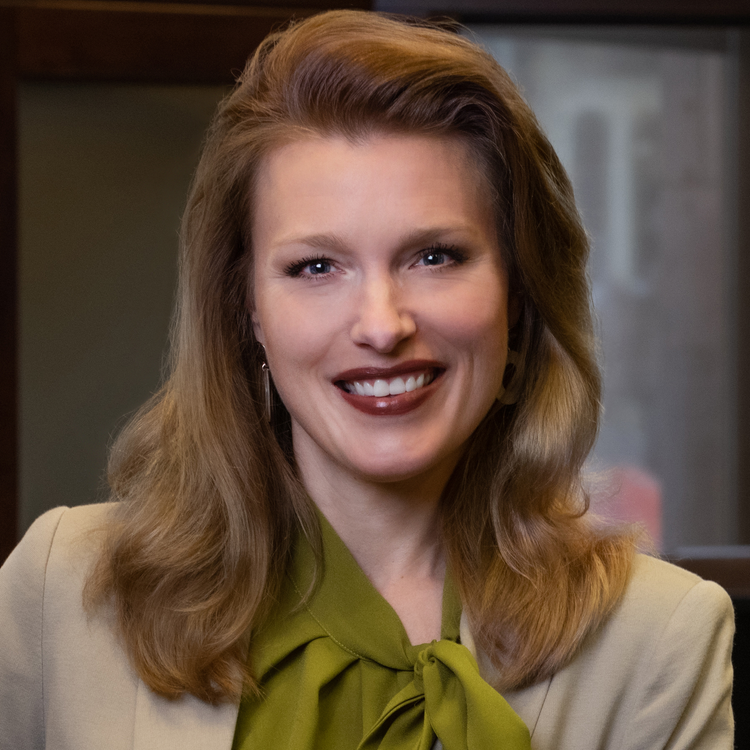 Frankenstein appointed to the U.S. Commission on Civil Rights.
Sara is a trial lawyer at Gunderson, Palmer, Nelson & Ashmore, LLP Law Firm in Rapid City, South Dakota. Sara earned her Bachelor of Arts from the University of South Dakota and her Juris Doctor from the University of South Dakota School of Law. She served as law clerk to the Honorable Richard H. Battey, U.S. District Court, District of South Dakota in 2001 and 2002.
Sara practices in the areas of election law, employment law, civil rights, trust litigation, commercial litigation, insurance defense, and governmental affairs, including county, municipal, school, and administrative law. Sara serves as city attorney and special counsel for cities and counties across South Dakota. She also advises and defends hundreds of cities and counties in litigation and prelitigation. Sara trains and advises all 64 county election administrators in the State of South Dakota through all aspects of state and federal election law and does the same for most of the towns and cities throughout the state and beyond.
Sara has twice testified before Congress on the issue of voting rights. She served as special counsel to the South Dakota House of Representatives for the impeachment of South Dakota’s former Attorney General and advises legislators on election and governmental law. She has successfully argued Voting Rights Act cases before the Ninth Circuit Court of Appeals, the Eighth Circuit Court of Appeals en banc (all 11 judges), and successfully briefed a Voting Rights Act case to the United States Supreme Court on a petition for writ of certiorari.
Sara has been selected as a Super Lawyer from 2016 through 2025 in the areas of Legislative and Governmental Affairs. Sara was appointed as one of five directors to the Center for Election Confidence national board, serving along with four nationally known election lawyers across the country.
Previously, the U.S. Commission on Civil Rights appointed Sara to a four-year term on the South Dakota Advisory Committee, where she was elected Vice Chair. Sara was asked to present the committee’s report to the U.S. Commission on Civil Rights on behalf of the statewide committee.
Sara has twice served as a speaker at the Republican National Lawyers Association Election Law Conference. Sara presented at the 2020 Law Symposium for the University of South Dakota Knudson School of Law on election law, among speakers from throughout the country. Sara frequently presents training to governmental officials regarding election and voting rights law and governmental employment law.
For information about the U.S. Commission on Civil Rights, visit https://www.usccr.gov.
Here’s something that slipped in under the radar last week.
The awful State Representative Josephine Garcia of District 5, who caused a sh*t-show in House Education Committee this session over where she was supposed to sit, is apparently not running for a State House seat. And instead, according to the Secretary of State has filed paperwork to run for the State Senate:
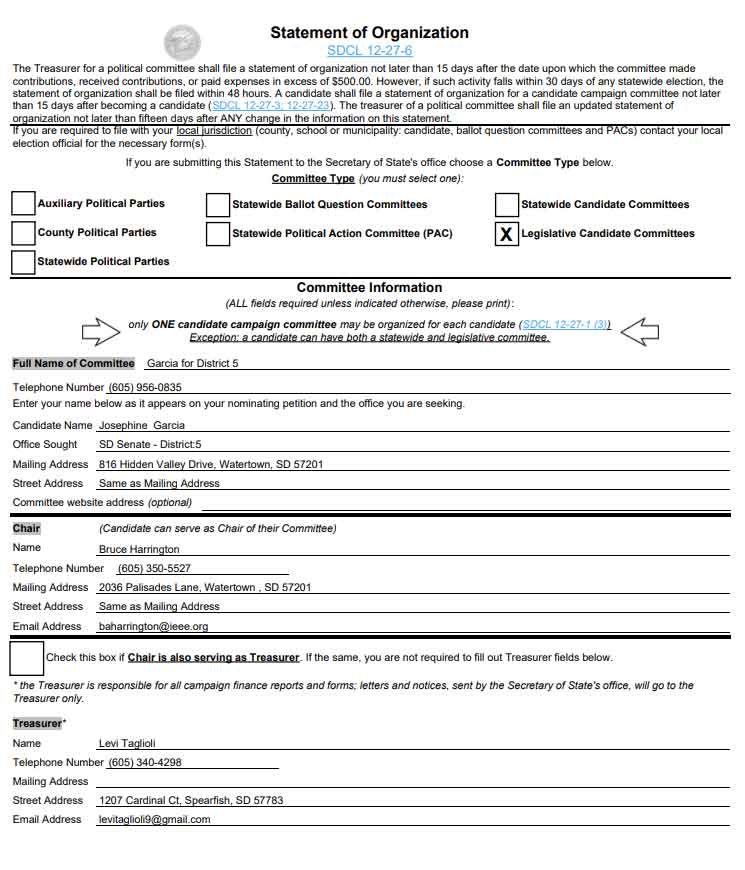
Interesting that Garcia’s campaign treasurer is Levi Taglioli from Spearfish. There’s no one in Watertown who would take that on?
Garcia would be challenging current State Senator – and the good guy in this political theater – Glen Vilhauer for the seat. What’s the answer to the Garcia’s shift in offices? Make your checks out to:
Glen Vilhauer for SD Senate
PO Box 1091
Watertown, SD 57201
Or you can donate online at https://www.glenforsdsenate.com/donate
Emerson College was just in the field conducting polling in the South Dakota Governor’s race this past weekend, and came up with some unexpected results, showing that while Congressman Dusty Johnson maintains the lead in the contest, the down-field candidates are shifting on the board, and it remains anyone’s race:
An Emerson College Polling/Nexstar Media survey released on Wednesday showed Johnson in first place with 28 percent, with businessman Toby Doeden with 18 percent, Gov. Larry Rhoden at 17 percent and state Rep. Jon Hansen (R) at 14 percent. A separate 23 percent said they were undecided.
The poll also found that the economy was seen as the top issue facing the state at 35 percent, followed by threats to democracy and housing affordability at 13 percent each, education at 11 percent and health care at 9 percent.
“Incumbent Governor Larry Rhoden, who came into office after Kristi Noem was appointed to the Trump administration, faces a difficult election campaign as Rep. Dusty Johnson has garnered plurality support ahead of the June primary,” Spencer Kimball, executive director of Emerson College Polling, noted in a press release.
Read the entire story here on The Hill.
This is interesting that voters had shifted that hard away from Governor Rhoden, who while reaping the benefit of being the chief executive during session.. he’s been mired down in Pierre during session. And his legislative initiatives have met with some success, but not complete victories.
In polling in the last 30 days from more politically geared pollsters, there were fewer undecideds, and Rhoden enjoyed a wider lead from Doeden, up to around 8 points. But in this informal touchpoint, they have him within the margin of error from the car salesman from Aberdeen.
Of course, Dusty has led all polls at least 10 points or so up from the next candidate. And in both recent tests, Hansen hovered at the bottom of the spectrum, garnering 10% in the prior poll, and jumping up to 14% in this one.
In this and the other poll I’ve seen, there are big undecideds still in the race. Which means the winds could blow differently at the time of the next test of the waters.
The Dusty Johnson for Governor team is on Facebook in a new ad, advertising for campaign interns to work with the campaign to get hands-on experience on the process of running for office.
If you’re in high school or college, and want to find out the real story on politics, there’s no better experience than working on the campaign trail.
(And speaking as a parent who has had kids volunteer for his campaign team, Team Dusty has always done a good job of making it a positive experience, and watching out for them.)
Reach out to the campaign at dustyjohnson.com if you know of a young person who might be interested.

Thune: Senate Bill Paves the Way to More Affordable Housing
“[T]he 21st Century ROAD to Housing Act takes aim at unnecessary regulation by removing, streamlining, or updating regulations that act as a drag on the supply of affordable housing.”
WASHINGTON — U.S. Senate Majority Leader John Thune (R-S.D.) today delivered the following remarks on the Senate floor:
Click here to watch the video.
Yay! We’re robbing Peter to pay Paul!
At least, that seems to be the cheer coming from the South Dakota House of Representatives as they voted yesterday to take an increase in the state sales tax – because the sunset on the sales tax reduction was never removed, despite many efforts – and to dump it all into property taxes, via Senate Bill 245.
According to an article on the Dakota Scout website:
“This is our shot,” House Speaker Jon Hansen said of Senate Bill 245, of which he sponsored. “This is our shot to answer the call of the people on property taxes.”
and..
The bill returns to the Senate, where it will be debated there.
SB 245 is a companion bill to SB 96, which passed Thursday and went to Gov. Larry Rhoden’s desk. SB 96, which Rhoden proposed last year, would enable the counties to enact a new sales tax of up to a half a percent. The revenues would be required to offset property taxes.
Jon Hansen declares This is our shot? This was not a shot. This was more of a rimshot.
Yes, there are some people unhappy about property taxes, but they weren’t out there demanding “Create a new sales tax! And while you’re at it, raise the regular sales tax, and do nothing to pay for the functions of government!” as the solution. When you start congratulating yourselves because you decided to tax your way out of problems, that’s not a solution. That’s just a re-arrangement of deck chairs.
The same basic problems still exist. You need an expansion of the tax base, and the Republican way to accomplish that used to be growth and a healthy economy. Things that legislators should be paying more attention to. Instead of congratulatory backslapping over moving money around.
“I contend that for a nation to try to tax itself into prosperity is like a man standing in a bucket and trying to lift himself up by the handle.” – Winston Churchill.

Fresh out of my e-mail box is notice of a fundraiser for Marty Jackley for Congress tomorrow night from 5 to 7 pm in Rapid City at the Hotel Alex Johnson. And we’re currently at about 70 Host/Host Couples.
If you’re free, go check it out!
Josh Phillips Submits Petitions, Officially Qualifies for Ballot for Minnehaha County Sheriff
Sioux Falls, S.D. – March 9, 2026 – Josh Phillips announced today that he has officially submitted the required petition signatures to qualify for the ballot in the race for Minnehaha County Sheriff, marking the next step in his campaign to lead the county’s largest law-enforcement agency. (Photo)
Phillips, a Captain with the Minnehaha County Sheriff’s Office, said the milestone reflects strong early support from residents across the county who want experienced leadership focused on public safety and community partnerships.
“Turning in our petitions is an important step in this campaign,” Phillips said. “I’m grateful to the many volunteers and supporters who helped gather signatures and show that Minnehaha County is ready for experienced leadership that will keep our communities safe and strong.”
Phillips has spent his career serving the citizens of Minnehaha County in law enforcement, rising through the ranks to his current position as captain. His campaign focuses on maintaining strong partnerships with local law enforcement agencies, supporting deputies with the training and resources they need, and continuing the tradition of professionalism and integrity within the Sheriff’s Office.
Earlier this year, Phillips launched his campaign for sheriff after receiving the endorsement of outgoing Sheriff Mike Milstead.
“With the petitions now submitted, our campaign will continue meeting with voters throughout Minnehaha County to talk about the future of public safety and how we can build on the strong foundation already in place,” Phillips said.
Phillips said his campaign will emphasize transparency, community engagement, and ensuring that the Sheriff’s Office remains prepared to meet the growing public safety needs of the county.
More information about Josh Phillips and his campaign for sheriff can be found at:
https://phillipsforsheriff.com
###
Senator Mike Rounds’ WEEKLY ROUND[S] UP: March 2-March 8, 2026
Welcome back to the Weekly Round[s] Up. It was another busy week in DC. Lately, I am averaging about 18 events each day, between briefings, hearings and meetings with so many South Dakotans! I appreciate hearing from people across the state on a wide variety of topics affecting South Dakotans. Along with meetings with South Dakota groups, I also stayed busy with hearings, briefings and votes.
One important briefing from this past week to note was the classified briefing for all senators on Iran. Secretary of State Marco Rubio and Secretary of Defense Pete Hegseth gave a satisfactory briefing on the events going on in Iran. While I can’t get into details, know that it is incredible what our military is able to accomplish. We continue to keep our men and women in uniform in our prayers, and our hearts go out to the families of the servicemembers who lost their lives defending our country in this conflict. More on this and the rest of my week in the Weekly Round[s] Up:
South Dakota groups I visited with: Standing Rock Sioux Tribe; South Dakotans representing National Parent Teacher Association; South Dakotans with the Creutzfeldt-Jakob Disease Foundation; Agricultural Retailers Association; South Dakota YMCA leaders; South Dakota surgeons with American College of Surgeons; American Legion Department of South Dakota; South Dakotans with Ducks Unlimited; South Dakota Broadcasters Association; Department of South Dakota VFW; Christina Oey, Executive Director of South Dakota Humanities Council; Rosebud Sioux Tribe Council; Mickelson & Company LLC out of Sioux Falls; Katie Shmid with the National Association of Insurance and Financial Advisors; Feeding South Dakota; Dakota Credit Union Association; South Dakotans with Community Transportation Association of America; and South Dakotans with the National Bleeding Disorders Association.
Met with South Dakotans from: Aberdeen, Black Hills, Blackhawk, Brookings, Ellsworth, Garretson, Gayville, Kimball, Onida, Pierre, Rapid City, Sioux Falls, Spearfish, Warner, Watertown and Willow Lake.
Other meetings: LTG Hartman, Acting Commander at U.S. Cyber Command; Nathan McAuley, CEO of Anchorage; and Pierre Yared, Acting Chairman of the White House Council of Economic Advisers.
I also gave remarks at an Internet Works Middle Tech Mixer where I was recognized as an Inaugural Trailblazer in Innovation.
Hearings: This week I attended two Senate Armed Services Committee hearings; you can watch the first here..
and the second one here.
Briefings: I attended three classified briefings: one with the Senate Select Committee on Intelligence the second with the Cybersecurity subcommittee; and a Senators-only briefing about current events in the Middle East.
Votes taken: 4 – This past week I voted in support of funding the Department of Homeland Security once again. I also voted to advance the 21st Century Road to Housing Act, legislation that we worked on in the Senate Banking Committee. I am pleased to see floor action on this bill as my office helped write over 20% of this major legislation. Final passage vote will occur within the next few days. Lastly, I voted nay on a War Powers resolution directing the removal of United States Armed Forces from Iran.
Bible Study and Prayer Breakfast: This week I attended Senate Bible Study hosted by Senator Steve Daines (R-Mont.). The study we went over was titled Insights on Successfully Persevering in Office. I also went to Senate Prayer Breakfast hosted by Senator Roger Marshall (R-Kan).
My Staff in South Dakota visited: Aberdeen and Onida.
Steps taken: 63,514 steps or 29.26 miles.
Video of the Week: Early Tuesday morning I went on Fox and Friends First to talk about Iran, click here to watch!