Senator Rounds’ statement on the Biden mandate
From Twitter:
My full statement on President Biden’s executive orders on vaccine mandates ⬇️ pic.twitter.com/GYgyRr3wfe
— Senator Mike Rounds (@SenatorRounds) September 10, 2021

From Twitter:
My full statement on President Biden’s executive orders on vaccine mandates ⬇️ pic.twitter.com/GYgyRr3wfe
— Senator Mike Rounds (@SenatorRounds) September 10, 2021
Remember the Anti-Vaxxer legislation from 2020?
House Bill 1235 was the bill where former State Representative Lee Qualm intimated that among other things that vaccinations caused autism, and they were trying to make vaccines for polio, measles, rubella, mumps, etcetera, optional, allowing people to opt-out of them, despite decades and decades of medical evidence?
Well, the people behind it haven’t gone away, but rather, they’ve blurred into the crowd, and are re-emerging as part of the COVID objector movement, declaring that it’s all about Health Freedom. And they’re taking part in an anti-vaccination rally next week:

Mya Olson, founder of “Health Freedom South Dakota” was one of the chief proponents of 2020’s House Bill 1235, and is actively participating in anti-vaccination rallies focused on COVID, such as the above event on Tuesday, as well as another event being promoted for September 18th:

Granted, being in an event with State Rep. Jon Hansen is not as fringe as a rally with Lora Hubbel and a pseudo-science practitioner, but the message is pretty clear.
That across the board that the same anti-vaxxers who were lobbying to let those unvaccinated for measles and polio into school environments are also part of the movement against business owners determining health policies for their own workplace.

Guest Column: Remembering 9/11 as a Congressional Staffer
By Danica Allmer, Rapid City Constituent Service Representative for Congressman Dusty Johnson
September 10, 2021
Tuesday, September 11, 2001. It was like every other day working for then-Congressman John Thune on Capitol Hill. I was a staff assistant at the time and our office, the Longworth House Office Building, was located adjacent to the Capitol.
A few minutes past nine the phone rang – it was our Chief of Staff – he was in South Dakota and the first thing he said was “turn on the TV and get me John.” I could tell right away something was not right. I rushed to the Congressman’s office and turned on the TV – the first tower had been hit. As the staff gathered around the TV, like the rest of the world, we thought it was a pilot that lost his way or had a heart attack mid-air – an accident. Then the second plane hit – this was no coincidence.
There was no game plan for a situation like this. Most of us didn’t have cell phones, and there was no social media. We all assembled in the Congressman’s office and determined we should hunker down at the office. But soon enough, one of the legislative aides came rushing in. Her husband had called her frantically. While waiting at the mechanic he saw a plane hit the Pentagon. “You guys need to evacuate,” he said. At this point it had not made the news that a third plane had hit the Pentagon. Immediately, reality hit home that Washington was under attack and there could be more planes.
We decided as an office we were going to go take shelter at our Deputy Chief of Staff’s home as he lived only a couple blocks from the Capitol. All 9 of us, including Congressman Thune and his wife went outside. We’d only walked a block when we heard a sonic boom – looking to the sky someone yelled “Don’t worry, it is one of ours!” I remember feeling immediate relief knowing our airmen had the skies covered.
The rest of the day was surreal. We hunkered down in one apartment watching the coverage and providing updates to John. He held an impromptu press call with reporters back in the state to let them know what was going on. In the middle of this crisis, he’d found a Bible and was reading it in between getting updates and fielding calls. I was proud to work for a man who in a time of tragedy turned to Jesus for strength.
Phone lines were jammed most of the day – it wasn’t easy to get ahold of family to let them know we were ok. I lived near the Pentagon and took the metro to work – with all public transportation shut down, my coworker graciously drove me home.
Work changed after this, all of Washington drastically changed. The first day back at the office there were concrete barricades everywhere, you could not get within a block of the House office buildings. Police were standing on the corners with weapons. It was a ghost town.
White House tours stopped, Capitol tours stopped, and the way we did business significantly changed. The more information we learned in the days following made us realize how lucky we were – I can never fully express my gratitude for those who sacrificed themselves taking down flight 93 into the Pennsylvania countryside. Experts say it was likely heading towards the Capitol. My day would have been quite different if those brave souls didn’t take on the terrorists.
For a city that is normally divided, Washington was united. Members of Congress spontaneously sung God Bless America on the Capitol steps just hours after the attacks, prayer services were offered and encouraged for any congressional staffers to attend, American flags popped up on homes all over the country. We were Americans. We were united. We thanked God.
###

A South Dakota Summer
By Sen. John Thune
As a South Dakotan, there’s a lot for which I’m thankful. This state is the best place in the country to live, work, and raise a family. It’s my home. It’s my kids’ and grandkids’ home. And it’s a beacon of freedom, opportunity, and personal responsibility that continues to draw people from across the United States to come explore. Are there any downsides? Just one. Snow. I hate shoveling snow.
With the summer season drawing to a close, which unfortunately means we’re getting closer to having to deal with the white stuff, it’s a good time to reflect on what else makes me thankful to be a South Dakotan: its people. It doesn’t matter what town you’re traveling through, it becomes clear that the people of this state are what give it its backbone. They are hardworking, passionate, God-fearing Americans who are always willing to go the extra mile for a friend, neighbor, or family member.
I’m back in South Dakota nearly every day the Senate is not in session to spend time with friends, family, and fellow South Dakotans. It’s where I recharge my batteries after dealing with all of the craziness in Washington, D.C. I’ve spent the last several weeks crisscrossing the state to check in with folks and hear what’s on their minds. As always, it’s been really informative, especially as I prepare to head back to Washington where a little commonsense and South Dakota straight-talk go a long way.
Whether I was in a bigger city or a smaller town, I heard about everything from the chaotic withdrawal from Afghanistan to border security to keeping our communities safe. I heard about economic issues, particularly the workforce shortages that are plaguing businesses throughout the state. Farmers and ranchers told me about the agriculture industry’s seemingly annual struggle with tough weather and market conditions. South Dakotans’ concerns are my concerns, so you can be sure I’ll take these messages with me to Washington.
I’m sure you’ve heard “I’ve Been Everywhere,” the old Johnny Cash classic. Well, it’s been echoing through my head throughout these last few weeks. I’ve been to Parker, Aberdeen, Mitchell, Sioux Falls, Wessington Springs, Miller, Onida, Gettysburg, Faulkton, Redfield, Clark, Harrisburg, Rapid City, Ellsworth Air Force Base, Armour, Wagner, Avon, Parkston, Tyndall, Brookings, Huron, Lemmon, Highmore, Ipswich, Box Elder, and Spearfish. And county fairs – what would summer be without a Tubby Burger? While I haven’t been everywhere, I have tried to travel to as many corners of the state as possible. If we didn’t catch up this summer, I hope to see you soon.
Aside from my usual summer travel, it was also a lot of fun to follow the Sioux Falls Little League team’s run at the Little League World Series. These young athletes were true professionals on and off the field, and they really showed that they can play ball with the best of them. While they came up short in the end, they left it all on the field. A proud state was there to cheer them every step of the way and welcome them home to celebrate their success. You’ll get ‘em next year, guys.
My final reflection this summer is for our men and women in uniform. It’s hard to believe, but it’s been 20 years since the September 11 attacks. From the rubble, America picked itself up and dusted itself off and took the fight to the bad guys to keep it and them from coming back to our shores. The American heroes who carried out these missions served with bravery and honor, and they succeeded. While what we have seen unfold in Afghanistan over the last month is unnecessary, and it is painful for many to see, it bears no reflection on the service and sacrifice of our troops, including those South Dakotans who have stepped up to serve. You are the true heroes.
Ah, South Dakota. There’s no place like home. Summer is ending, but fall is right around the corner. That means South Dakota high school and college sports, pheasant hunting, and so much more. And as for winter, maybe this is the year I buy a snow blower.
###
Flags at Half-Staff in Honor of Patriot Day
PIERRE, S.D. – Governor Kristi Noem has ordered that flags be flown at half-staff statewide from sunrise until sundown on Saturday, September 11, 2021, in honor of Patriot Day. Patriot Day commemorates the people killed in the terrorist attacks on September 11, 2001.
In honor of the 13 American servicemembers killed in the recent attack in Kabul, the State of South Dakota will also be flying an additional 13 American flags in front of the State Capitol.
###
New guest column posted over at the South Dakota Political News from Board of Regents member Tony Venhuizen:
The Department’s proposed standards are an improvement. Compared to the current standards, they increase coverage of U.S. history and government and of South Dakota-specific topics. They emphasize the Constitution and the Bill of Rights, the structure of our federal, state, local, and tribal governments, and key historical events like the Revolution, the Civil War, both World Wars, and the Cold War. As I already described, they greatly increase coverage of Native American topics, including tribal history and government.
Yet, there is always room to improve. The Department will be soliciting feedback in the coming months, in writing and during four in-person hearings, starting this week in Aberdeen. I would encourage you to read each version of the standards for yourself and make your own judgments. We owe it to our young people to get this right.
9/11 anniversary and the lesson every generation must learn
by Governor Kristi Noem
I heard about it on the radio.
The fall morning of Sept. 11, 2001, was a regular day driving in my truck to the family farm. Until it wasn’t. The first reports were coming through my pickup truck’s speakers: an airplane has flown into the World Trade Center in New York City.
When I got to the farm, I rushed into the office to turn on the TV. I watched in horror as the reports I heard on the radio were given a face and a name — terrorism.
What followed that morning was the most devastating terror attack on American soil this country has ever seen. New York. Washington. Were it not for the brave efforts of the passengers on Flight 93, who knows what else could have been a target.
America lost 2,977 innocent lives that day, including 343 firefighters and 23 police officers. These heroes redefined courage. They faced the most harrowing rescue effort in American history and rushed in while others were running out.
The message was clear as I watched the TV screen in disbelief. The world would never be the same.
In the 20 years since the 9/11 attacks, we have sent our best and brightest to combat terrorist organizations in Afghanistan, Iraq, Libya, Syria, and Yemen.
When the attacks happened, I remember thinking I am so glad I live in South Dakota. Sadly, our state has not gone untouched by the War on Terror. South Dakota lost 36 patriots serving overseas. Nearly 7,000 of our bravest Americans died serving their country. So many of South Dakota’s sons and daughters have also served, returned, and built lives here – some will carry the scars from their defense of our freedom for the rest of their lives.
This September 11th, communities across the US will honor the fallen heroes from that infamous day. Veterans and family members will gather to honor the heroes lost in the War on Terror that followed.
In the wake of so many sacrifices, we have sadly come to this 20th anniversary with scenes of chaos and crisis flashing out from our screens again. Afghanistan, the nation that shielded those behind the attacks in 2001, is on the brink of civil war — again. The freedom and opportunities that once gave hope to many Afghans are being torn down by the Taliban and insurgent terrorist factions like ISIS-K. Although US troops are gone, War and terror have not withdrawn from Afghanistan. How we ensure that country does not again become a haven for those who would strike America will be the challenge of our next generation.
In classrooms across our state, this next generation of young Americans is just beginning to experience a world without American troops fighting wars in Iraq or Afghanistan. But we are far from peace. The pain of losing 13 servicemembers in the attack at the airport in Kabul has not even begun to heal.
This 20th anniversary is marked with the same costly lesson that every generation must learn: freedom isn’t free. There are brave men and women who pay the cost. We must never forget their sacrifice, and this year and every year on 9/11, we will always give respect to those who answer the call to serve. America is safer because of their sacrifice.
###
Missed this crazy interview from a month ago where alt-right website “TruNews” featured an interview with South Dakota Senator Julie Frye-Mueller and State Representative Taffy Howard.
Taking place at the Pillow Guy Cyber Symposium, the self-titled “Dynamic duo” (not kidding) spent the interview casting a lot of shade at Governor Kristi Noem, and talked about fellow Republican legislators being “RINO’s” who only put the R behind their name to get elected.

You can watch the video for yourself by clicking here.
Not familiar with the TruNews program featuring Julie and Taffy? Well, it’s not something that many South Dakotans are familiar with. And they probably don’t want to be. You won’t find them on YouTube, as they’ve been permanently banned as of February 2020 for promoting hate speech.
And the founder of TruNews has been quoted as claiming that the Trump Impeachment effort was a “Jew Coup.”
Wikipedia has a much longer list of the program’s controversies, such as TruNews claiming that “the spread of Ebola “could solve America’s problems with atheism, homosexuality, sexual promiscuity, pornography and abortion.” And that “COVID-19 was God’s “death angel” and “plagues are one of the last steps of judgment.”
But, that’s the audience they’re bringing their message of being a “dynamic duo” to.
God help us all.
Governor Kristi Noem and other state leaders are firing back at the federal government for doing that which the Governor has repeatedly fought against – mandates which take control away from business owners
My legal team is standing by ready to file our lawsuit the minute @joebiden files his unconstitutional rule. This gross example of federal intrusion will not stand.
— Kristi Noem (@KristiNoem) September 9, 2021
The president’s action crosses the line. I believe in the vaccine, but I also believe in a limited federal government. Effectively, this is a national vaccine mandate. Our federal government has never done this before, and it should not do so now.
— Rep. Dusty Johnson (@RepDustyJohnson) September 9, 2021
The federal government should NOT be forcing private citizens to get vaccinated. Period. I’m vaccinated. I encourage others to get vaccinated. But President Biden’s vaccine mandate is extreme government overreach that South Dakotans won’t stand for.
— Senator John Thune (@SenJohnThune) September 10, 2021
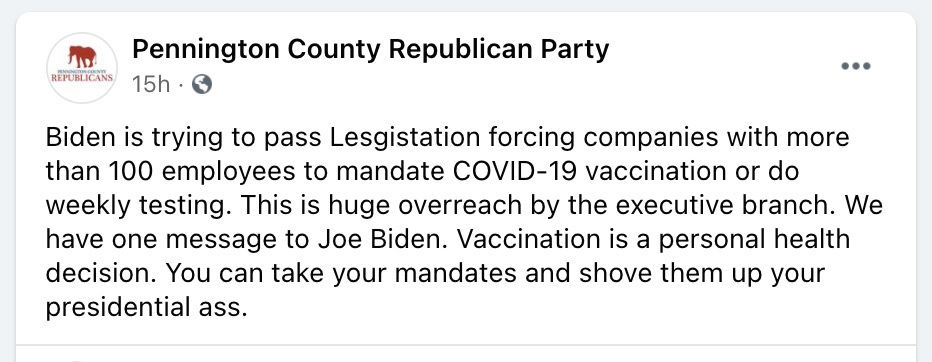
And of course, there are always others out there to keep things classy.
The Argus Leader also more on a story regarding the call for a special session for purposes of impeachment of South Dakota Attorney General Jason Ravnsborg as announced earlier today:
Peterson said he will formally begin petitioning all members of the Legislature beginning next week and will ask them to gavel in for the special session on Nov. 9.
Because the governor is set to deliver her annual budget address the same day, many lawmakers had already planned to be in Pierre. And that will add ease for House leaders to garner the two-thirds support they need, said Senate Pro Tempore Lee Schoenbeck.
The Watertown Republican and highest ranking senator in the chamber in recent months has dismissed talks of a special session to take up topics like marijuana policy or participation of transgender people in sports. But after speaking with House Speaker Gosch earlier in the day, he will not oppose a special session regarding the attorney general, he said.