
I know I’m on the opposite side of this from a number of people whose judgement I trust and are more often in agreement than disagreement.
But, after last week’s passage of Senate bill 96 as part of the package of relief for property tax, I can’t help but give some attention to that troubling little thought in the back of my mind that asks “Is this the part where we’re supposed to start cheering about creating a new tax?
Of all the testimony I caught in the debate, State Representative Will Mortenson said something that added to that doubt:
Republican Rep. Will Mortenson of Pierre called for SB 96’s defeat on Thursday. “Take from the poor, give to the rich,” Mortenson said, summarizing his perspective of what’s going to happen. He argued that people from rural counties would be subsidizing another county’s property-tax relief when they shop in regional centers. He also said that people with the most-expensive homes would see the most relief.
Those in regional hubs will benefit greatly from the new County Sales Tax. And don’t let anyone’s creative word-smithing disavow that it’s anything but a new sales tax where we had none before:
Section 5. That a NEW SECTION be added to a NEW CHAPTER in title 10:
A county may impose a gross receipts tax not to exceed one-half percent on the gross receipts of all sales of tangible personal property, any product transferred electronically, and services, that are taxable pursuant to chapters 10-45 and 10-46 in the county. The tax must conform in all respects to the state sales and use tax, with the exception of the tax rate.
For purposes of this chapter, “gross receipts” have the same meaning as defined and used in chapter 10-45.
5 or 10 years ago, a legislator – most certainly a Republican legislator – would avoid a whisper of a new tax like they’d avoid a plague rat, for fear of being tarred and feathered in mailings over the notion. Doubly so in an election year. But it’s 2026. And many want to be seen doing something about property taxes. So, this is what they came up with.
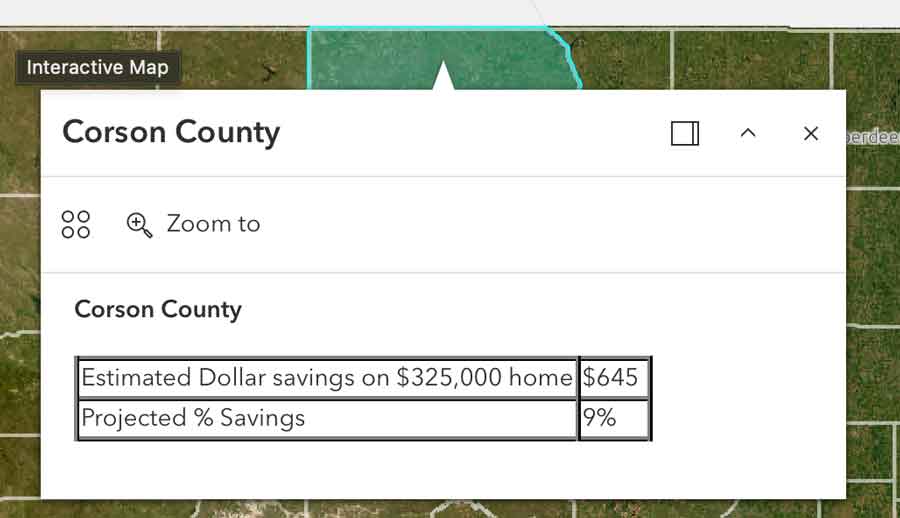
I mean, don’t get me wrong. According to the interactive chart that was going around, while those in Corson County are only seeing a 9% reduction…
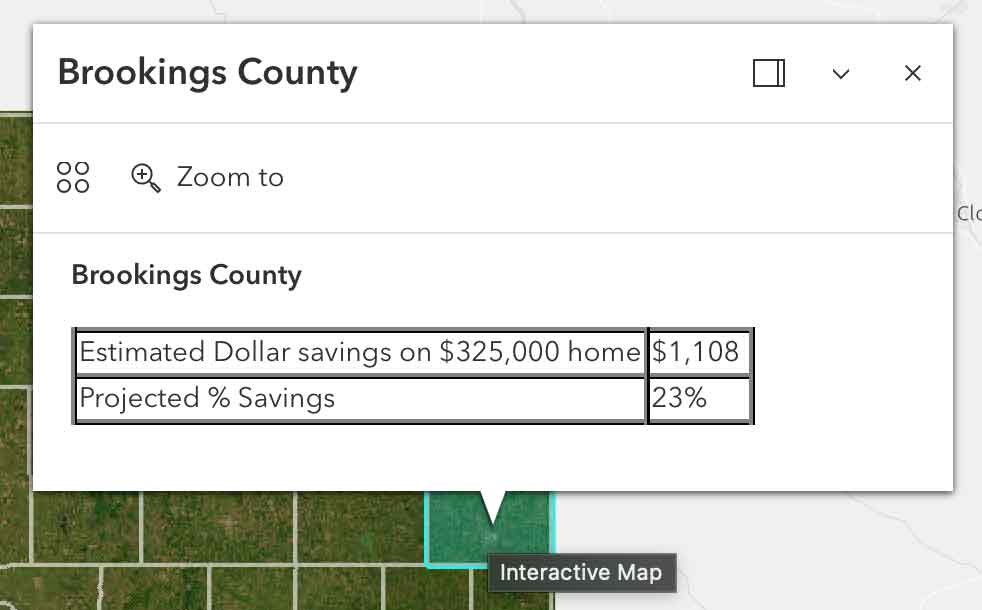
..my residence in a regional hub predicts I could see a 23% reduction in my property tax:
I probably shouldn’t complain that my property taxes are going to be subsidized on the backs of the thousands the SDSU students spending money in the community. But I can’t help but think we shouldn’t strive for a better way.
What is that better way? One that South Dakota Republicans used to embrace. Growth and new jobs. Taking advantage of new opportunities.
It might almost seem like an alien concept with the wave of NIMBY populists that have taken the lead at the moment. At this point, South Dakota has made sure the country knows that we’re closed for business on energy growth, and many in the legislature are doing their damndest to block the wave of growth in technology and data centers from ever darkening our state’s doorsteps. There are even those who have made it their legislative mission to stop local development in it’s tracks through putting up hard roadblocks to tax increment financing.
That’s not a way to grow our economy. It just means that ten years from now when everyone complains that their taxes are back where they used to be (and we still have this new sales tax) that they will look inward again to once again shuffle around the chairs on the deck of the Titanic. That’s not a solution. That’s a coping mechanism to claim to voters that you did something.
If you want natural growth and expansion of the tax base, we need to be creative as a state and have a business environment that makes people want to establish businesses in South Dakota and to invest here. We want these guys and the state NEEDS the investment.
Or not. And we can just wait for the next new sales tax, so we can congratulate ourselves and tell voters that “we solved the problem.”
Two things:
1. Your paragraph text says “6% “ for Corson when the map shows 9%.
2. Ziebach is 20% so some rural counties do great.
Overall, doesn’t economic development now get a double win? New commercial property taxes plus a .5% on the commercial sales tax – both reducing county property taxes. Maybe that will get some of the NIMBY crowd on board for a new business to move to town. 100% on board we need to grow!
It’s a tax shift from the rich to the poor.
The “relief” is a percentage of the county portion of the tax bill. Very expensive homes (doctors, lawyers, bankers, etc) get the highest “relief” whether they want or need it at all; generally not. People with smaller homes who are more impacted by big costs (including property tax) need it most will get the least relief.
Those who need it least get the most and those who need it most get the least. A flat amount would have made the bill less regressive.
But the poorest people most impacted by higher costs and property taxes are typically renters. (They do pay property taxes; when the owners taxes go up, the rent goes up).
The poorest people in the state are required to pay the HIGHER sales tax so that doctors, lawyers, bankers, etc. can get LOWER taxes.
Terrible bill not ready for prime time.
Well I mean that is pretty in line with the GOP MO…
Sounds like something Thune would support – something that grossly and disproportionately hits the poor but he and the GOP will claim it’s something that is best for all South Dakotans. And the lemmings lick it up
what does Thune have to do with this?
Good old tax and spend Republicans!
Secondly any excess tax after the county tax is covered will be applied to reduce city and school levies. Lots of schools and cities overlap counties. If minnehaha enacts it, the county taxpayers will be paying the sales tax increase to lower the city taxes for the city people in Lincoln County.
Likewise for schools that overlap counties.
Just not well thought out. But no real tax policy people developed it.
Any over 100% goes to ag and commercial classes not the school levee. Your comment is not accurate and perhaps unintentionally confused with some of the other ideas that were defeated. (Section 7 of the bill).
Any overage will be applied the the county portion of tax for the other 2 classes of property, ag and commercial.
Actually most small counties will do fairly well. They won’t collect much sales tax, but they also don’t have much owner-occupied value to offset. These would be more likely the counties that see some of that reduced county levy spill into the other classes.
This bill has nothing to do with the school portion of the tax, only the county levy.
Perspective. The average South Dakotan makes 60k/year. (high side). If 30 percent is spent on housing (no sales tax) and another 10 percent is spent on non sales taxable items (donations to non-profits, fees, licensing, insurance, prescriptions, etc), that leaves $36k left over. If someone spent every bit of that $36k on items that require sales tax and and they live in a county where both the 1/2 percent increase was voted in and the .003 percent sunset increases was taken they would pay an additional $288 per year in sales tax. That is any extra 5.53 per week or 79 cents per day in sales tax. And South Dakota would still have one of the lowest sales taxes in the nation at 5%. South Dakota has been so heavily reliant on Property Taxes to cover services that are used by a large percentage of folks who don’t pay a dime, this seems to be leveling the playing field to me?
I don’t disagree with your assessment, but I have to ask who this “large percentage of folks” who use services but don’t pay property tax?
In our area, it is tourists. Our emergency services, Ambulance/Fire/County Fire Administrator is funded 96% by property taxes. A large % of the calls are vehicle accidents/unauthorized camp fires/medical emergencies at hotels/campgrounds involving tourists.
in Sioux Falls, tourists and commuters who get stuck in bad weather pay 4.5% sales tax, a 1.5% tourism tax, a 1% municipal gross receipts tax, a 1% city room occupancy tax, and a Business District Improvement fee of $2 per room per night..
So if a motel room costs $100/night, a tourist is going to pay $10 per night in taxes. I think they pay for the services they use.
2 ways to cut or eliminate property tax. Cut budgets, or find different funding sources.
Every plan has offered a different funding source. Every different funding source has been to add some additional tax on something. Sometimes that added tax is called a fee…same thing.
If we aren’t interested in any additional tax, or fee, that leaves us budget cuts. County, or city, or school expenses increase just like everyone else’s expenses.
So if we are dead set against any new tax, however it might be implemented, then maybe we’re stuck with the status quo.
Mortensen carried the bill last year. Politics at its best.
It was Tony Venhuizen’s bill from last year, that Mortensen carried, correct?
The Anti Economic Development fellows, known as the AEDs, lead by Ms. Taffy, don’t want growth by economic development. They want to shift the chairs around on the Good Ship Lollipop so they pay less in taxes and we pay more.
Ms. Taffy seems to hate economic growth.
Yes, there are trade-offs involved in a tax shift from property tax to sales tax. Almost all public policy questions have trade-offs involved.
The aspect worth cheering here is the pivot to local control on some of these tax questions. County commissioners are uniquely placed to assess the trade-offs across policy issues involving property tax, regional hubs of economic activity that involve their urban and rural residents, and any pros/cons of implementation that use county resources. It may be hard to understand how refreshing this policy approach is when compared to years of unfunded mandates from Pierre with little to no local input.
I would venture a guess that we will learn more from counties wrestling with this tax policy between now and July 1 than we did from years of legislative summer studies. Maybe this isn’t the answer, and maybe counties will choose not to implement it. But I think we will better understand the trade-offs involved and that can better inform future iterations of public policy. Much more discussion to come.
Mr. Kippley is saying the legislature summer studies were a waste of time, and turning this to local control is the answer. grudznick, for one, is not shocked. I also expect magic beans, which grow a massive stalk, will result from the decisions of the County of Pennington, but do not want the leafs from said stalk to throw shade on my lands.
That’s not an unfair statement. I agree counties have had a few revenue sources, which tended to be encroached on by the legislature for unfunded mandates as well as rising expenses.
I agree Pat. Bad idea.
It will create a problem for rural communities who won’t have a voice to impact change.
Excellent post, Pat. Very well stated.
Oil is up 20% tonight. 53% in 5 days. Trump is claiming it is temporary but every expert says this will take years to repair. This president continues to implement insane taxes, this one being just a stupidity tax for all those who bought his lies. Too bad we all have to pay. Thanks Republicans for destroying the economy again.
It’s an option for counties. It should help with the property tax problem. It’s kind of strange that cities get both sales tax and property tax and counties do not.
SB96 is addressing the spike in property taxes. It’s giving money back proportionately to the people who are paying the most in the first place.
If you go to the next county to buy your goods, you’re giving your money to them anyway. Like Goodwin said- shop local or order online if you don’t like it. 1/2% is negligible.
Mortensen just wants to sink Larry’s ship for his puppet master. Dusty’s plan also uses sales tax, but is redistribution of wealth.
800 lb gorilla Need income tax
translated: Dusty is still in no position to win.
dream on.