
The Sioux Falls School Board has posted a public letter on their website in response to the Governor’s Budget address expressing their concern with the zero percent increase in educational funding proposed for the next legislative session, and their belief that the State of South Dakota should be investing in Public Education:
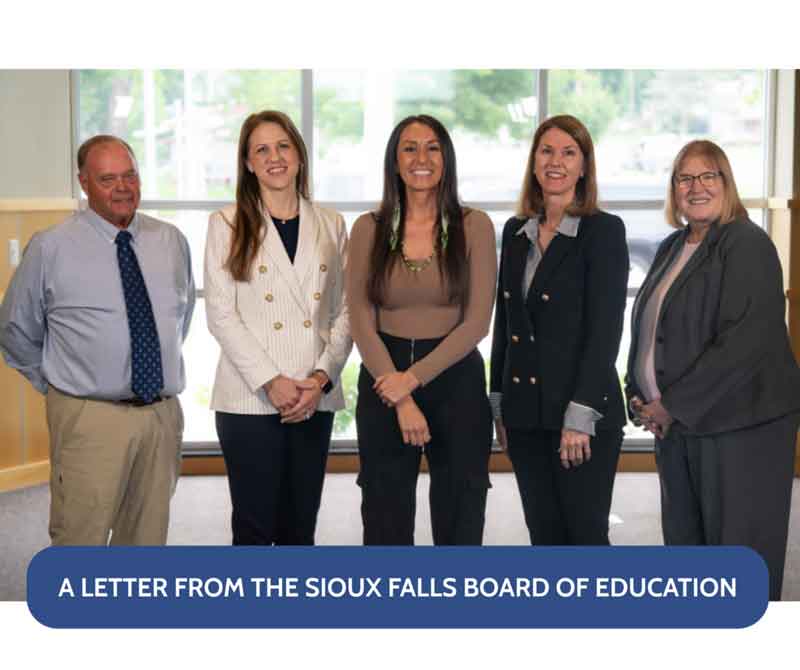
Governor Larry Rhoden offered an encouraging message during his Budget Address on December 2, 2025 when he said cutting education “isn’t the way.” As members of the Sioux Falls School Board, we appreciate his recognition that workforce, safety, and freedom all depend on strong schools. In that same spirit, we want to outline a clear vision for K–12 public education in South Dakota and place our district’s needs within the context of the decisions facing the Legislature this session.
Public education is not a line item in the budget. It is the infrastructure that keeps South Dakota strong, safe, and free. More than ninety percent of South Dakota’s children attend public schools, and those students become the workers, tradespeople, healthcare providers, business owners, and civic leaders who make our state succeed. A high school graduate is more than three times less likely to be incarcerated than someone without a diploma. Education is not just an expense, it is our most effective investment in public safety strategy and the foundation of workforce development.
For those reasons, we appreciate the Governor’s statement that slashing healthcare, education, and public safety is not the path to property tax relief. We support exploring better options. But solutions require clarity about the actual conditions facing public schools. District budgets do not rise and fall neatly with revenue curves. Even in years of flat enrollment, our costs increase with inflation, special education mandates, transportation needs, competitive salaries, insurance, curriculum materials, and school security demands. These obligations do not shrink simply because more children were born ten years ago.
It is important to speak plainly about the narrative surrounding homeschooling growth. The Governor highlighted a 216% increase in homeschooling. That percentage sounds dramatic, but it is mathematically inflated because it begins from a very small base. The truth is simple and steady: public education continues to serve the overwhelming majority of South Dakota’s children and families. More than nine out of ten South Dakotans still attend public schools, and we continue to educate the full spectrum of students, English learners, children with disabilities, students experiencing homelessness, students fleeing trauma, and students whose needs are growing more complex each year.
The real issue is not how much homeschooling has grown; the real issue is where public dollars are going, and whether all schools that receive public dollars are subject to public accountability. Public schools are bound by law to educate every child, without exception. We must report academic outcomes, comply with civil rights laws, follow open meetings and open records requirements, undergo routine audits, administer state assessments, meet accreditation standards, and show the public exactly how every tax dollar is spent. Our classrooms are transparent. Our governance is public. Our results are measurable.
Private schools and homeschool programs receiving public support are not required to meet these standards. They may refuse admittance, limit enrollment, or opt out of serving students with disabilities or English learners. They do not report achievement data, do not follow the same financial transparency rules, and are not accountable to elected boards. When public dollars support institutions that are not required to serve all children and are not required to open their books to taxpayers, we create an uneven system and risk diminishing the stability of the public schools that educate nearly every child in the state.
Public dollars require public accountability. South Dakotans deserve the assurance that every taxpayer-supported educational entity is meeting basic standards of quality, transparency, and fairness. Only public schools currently meet that standard. We also want to clarify an important point regarding school funding statutes. SDCL 13-13-10.1 requires that public schools receive an annual increase of inflation or three percent, whichever is less. The law does not allow the state to average increases across multiple years, nor does it tie public school inflationary adjustments to the funding circumstances of unrelated departments. When the Consumer Price Index is three percent, the law requires three percent. This consistency is essential for districts to meet rising costs and maintain competitive teacher salaries in a highly constrained labor market. When the Legislature provides 1.25% or the 0% the Governor presented, they are not following the law they made. Don’t they need to follow their own laws?
We acknowledge and appreciate the Governor’s investments in technical education, particularly at Southeast Technical College. These one-time and ongoing commitments will strengthen our workforce pipeline. But those investments depend on a strong K–12 foundation. Technical colleges cannot thrive without public schools preparing the students who will later fill those programs. A comprehensive vision for South Dakota’s future workforce must begin with K–12 public education.
There has been discussion about the state’s rainy day fund. South Dakota now holds reserves of 12.5%, significantly above the historic benchmark of 10%. Legislative budget leaders have noted that returning to 10% could free up approximately $70 million without compromising fiscal stability. This is the kind of responsible conversation worth having as we look for pathways to property tax relief that do not undermine long-term educational well-being or violate statutory obligations to schools.
What remains missing from the statewide conversation is a clear vision for K–12 public education. Public schools are more than classrooms; they are economic engines, safety nets, and community anchors. They develop the human capital upon which our entire state economy depends. At a moment when South Dakota is debating significant policy changes affecting school funding, school choice, and property taxes, it is critical that public education be seen and protected as essential statewide infrastructure.
As members of the Sioux Falls Education Board, we respectfully ask the Governor and Legislature to work with us in the following ways:
• Uphold the statutory inflationary increase required by law.
• Ensure any school receiving public dollars meets basic standards of academic reporting and fiscal transparency.
• Protect local control so districts can respond to community needs.
• Avoid policies that penalize districts for responsible budgeting when revenue forecasting remains volatile.
• Treat public K-12 education with the same strategic importance as post-secondary education and public safety.
• Engage public school leaders as partners in budget and tax policy discussions.
We offer this response in a spirit of partnership. Our goals are the same: a strong, safe, prosperous South Dakota built on the promise of opportunity for every child. Public schools are fulfilling that mission every day. We ask the Governor to continue protecting and strengthening the schools that educate the vast majority of South Dakota’s children and that anchor the future of our state.
The Sioux Falls School District is the largest district in the state representing over 25,000 students, with a staff count of about 3275 employees.
Truth. This state has an abysmal education funding scheme. We must be content being so poorly educated.
They cooked with this letter. I’m glad the governor is getting pushback on this budget.
The voters chose Medicaid expansion over school funding. Deal with it.
They didn’t. The legislature decided to slash and burn without any foresight last session and they and the governor are doubling down on bad decisions.
the voters opted for Medicaid expansion without thinking how it would affect the state budget
everybody wants everything but nobody wants to pay for anything
Good news for them. The state does invest in public education. More than half a billion dollars a year.
Big “Are there no poorhouses” vibes coming from Scrooge here. Here’s hoping you get visited bythree ghosts this Christmas to gift you with wisdom and empathy.
They got huge increases for years during Noem. No one feels bad for them.
You must be looking at AFP numbers. K-12 education since 2020 has barely kept up with inflation. A 29 percent increase while inflation has run 23-26 percent. I have zero trust in the LRC anymore or our leadership in the Legislature. The LRC gave the majority leader figures that showed a 39 percent increase vs Governor Rhoden’s reported 29 percent increase at his budget address. Governor Rhoden’s budget address stated that 44 percent of the dollars pay for public education. Majority Leader says 56 percent and now his AFP lackey is posting 65 percent. No one has the data to make any type of informed decision. Folks are just pulling numbers out of there asses to support their narratives.
“Huge increases” lol – incremental and grudgingly given during ongoing fights to rip public school money out and give it to private schools. A zero-increase budget here in the magic fairy dust tariff era is a huge backslide.
Did that money mostly go to Administrators vs. teachers?
is education really the problem everyone in Washington and Pierre is educated with law degrees and Phds and do not know shit They can not figure out what’s wrong They ought to go back a few decades and see how things were done then with a lot less problems
What specific time frame do you believe we should try to imitate? If it’s the 50s, as so many state, marginal tax rates are gonna blow your mind.
If a one-room school house was good enough for Larry, it should be good enough for everyone.
He went to Private School.
No wonder he doesn’t care about public education.
We have all heard it for years, the endless complaining: The teachers are the only people in the state who went to college. They work harder and longer hours than anybody else. Everybody else makes more money than they do. They don’t get no respect. Nobody understands how awful their jobs are.
But when you ask one of them “so why don’t you do something else for a living?” they react like you just told them to un-alive themselves. The thought of changing careers is incomprehensible. They might have to work outdoors, nights, weekends, holidays, summers, doing manual labor? Hell no.
If we paid every teacher $1,000,000/year, they would still be complaining. Once you have figured that out, you stop listening. Many of us stopped listening years ago. Someday they might have complaints worthy of the public’s attention, but we have tuned them out.
Great solution – just quit. That’ll certainly help our education system.
in the real world, the private sector, you quickly find out there is always somebody willing to do your job, and work harder at it, for less money.
In 1871, Lewis Carroll elucidated the problem when he wrote:
“Well, in our country,” said Alice, still panting a little, “you’d generally get to somewhere else, if you ran very fast for a long time, as we have been doing.”
“A slow sort of country!” said the Queen, “now here, you see, it takes all the running you can do, to keep in the same place. If you want to get somewhere else, you must run twice as fast as that.”
The rest of us get it.