One-time PUC candidate appears to have fallen on harder times

Ryan Gaddy, a Republican who unsuccessfully tried to run as Libertarian for PUC in 2014, and unsuccessfully tried to organize a decriminalization effort for marijuana in 2015, has allegedly threatened a legislator out in Idaho according to news reports:

Ryan Gaddy was arrested in the early hours of the morning and booked into Kootenai County Jail for making official and executive threats, pending a $250,000 bond.

And..

“Not sure how many 5 gallon gas cans I can fit in the car, but today could have very explosive results. Jordan Redman…this…is gonna be hilarious!” a post on Gaddy’s facebook said.

Gaddy was arrested in Shoshone County in late 2024 after a standoff with law enforcement according to the Coeur d’Alene Press.

Read the entire story here.

That’s not terribly smart.

Gov. Rhoden Signs Pro-Second Amendment Bill into Law

Gov. Rhoden Signs Pro-Second Amendment Bill into Law

 PIERRE, S.D. –  Today, Governor Larry Rhoden signed SB 81, which prohibits the use of a firearms code for transactions involving firearms, accessories, components, and ammunition and to provide a civil penalty therefor.

“I am proud to protect our Second Amendment rights with the signing of this bill,” said Governor Larry Rhoden. “South Dakota has seen strong growth of our firearm industry, and this bill will help that continue. I am grateful that both the bankers and the firearm industry came together on this issue.”

A private signing ceremony was held this morning and included representatives from South Dakota’s growing firearms industry, South Dakota’s banking industry, the National Rifle Association, and prime sponsors of the bill. You can find a picture of Governor Rhoden signing SB 81 here.

Governor Rhoden has signed 35 bills into law this legislative session.

###

Rounds, Cantwell, Johnson and Schrier Introduce Legislation to Remove Burdensome Regulations for Tribal Health Car

Rounds, Cantwell, Johnson and Schrier Introduce Legislation to Remove Burdensome Regulations for Tribal Health Care 

WASHINGTON – U.S. Senators Mike Rounds (R-S.D.) and Maria Cantwell (D-Wash.), members of the Senate Committee on Indian Affairs, and Representatives Dusty Johnson (R-S.D.) and Kim Schrier (D-Wash.) today reintroduced the Purchased and Referred Care Improvement Act, legislation to require the Indian Health Service (IHS) to reimburse tribal members for care sought outside of IHS in a timely manner.

The PRC program is used to supplement health care resources outside of IHS facilities for eligible tribal members. PRC funds are only available when a patient has no access to direct care at an IHS facility, including emergency care or specialty care. While PRC is a critical resource for tribal communities, many beneficiaries encounter a number of barriers when attempting to access care outside of IHS. This includes strict residency, notification and eligibility rules.

If a PRC claim is approved, IHS is expected to process the claim in a 30-day timeframe. While the Indian Health Care Improvement Act currently requires IHS to pay outside providers for approved PRC claims within 30 days, a previous analysis by the Department of Health and Human Services found that an estimated 32,000 claims over a two year period were not paid within this time frame. As such, payments to outside providers are often delayed, ultimately contributing to wrongfully-charged medical debt for tribal members.

“The Indian Health Service has made a commitment to care for tribal members across the United States, and they need to honor that commitment,” said Rounds. “Because of the strict standards for PRC claims, approved claims are few and far between. It’s crucial that IHS reimburses tribal members for outside care once it’s approved. I’m pleased to reintroduce this legislation, which would hold IHS accountable to make certain they get their work done and follow their mission of providing health care for tribal members.”

“This bill would help put an end to delays in medical cost reimbursements that have created serious financial hardships for Tribal members,” said Cantwell. “I have heard from the Confederated Tribes of the Colville Reservation and many of its Tribal members that receive medical treatment at non-Tribal facilities rely on the Indian Health Service to reimburse for the cost of care — but when that doesn’t happen, Tribal members are then financially harmed to the point of some not wanting to seek care at all to avoid negative credit score impacts. To fix this, Senator Rounds and I are introducing the Purchased and Referred Care Improvement Act so Tribal patients don’t have to worry about being sent to debt collectors or losing points on their credit score while they wait for the federal government to reimburse their provider.”

This legislation is cosponsored in the Senate by Majority Leader John Thune (R-S.D.) and Senator Patty Murray (D-Wash.).

“The Indian Health Service is not upholding the required service to Native American patients in the Purchased and Referred Care program, leaving financial debts to be paid by the patient that they do not owe,” said Johnson. “Our bill will right this wrong and ensure these bills are paid in full by IHS.”

“The damage caused by these unpaid, unprocessed claims can be devastating for members of our tribal communities – the outstanding debt and impact on their credit score are incredibly harmful to their financial future,” said Schrier. “I’m proud to introduce bipartisan legislation to make commonsense, much-needed reforms to ensure tribal citizens can receive the care they need without fear of undue financial burdens.”

“The United States has a solemn obligation to provide healthcare under our Treaties, yet often falls short,” said J. Garret Renville, President of the Coalition of Large Tribes and Chairman of the Sisseton-Wahpeton Oyate. “Some of the most significant and broad scale failures occur with respect to timely and appropriate payment for Purchased and Referred Care. That creates wrongful and very detrimental tribal medical debt. This bill will reduce those burdens and protect tribal citizens’ access to care and our financial stability, consistent with our Treaty rights.”

“Senator Rounds’ bill will help tackle a problem that has plagued tribal health care patients and providers for too long: the timely reimbursement of claims by IHS for services purchased from and referred to providers outside the IHS,” said Frank Star Comes Out, President of the Oglala Sioux Tribe. “We thank Senator Rounds for his thoughtful leadership on this issue and for listening to the concerns of Tribes and tribal health care advocates about the need for IHS reform and oversight on this matter. Under no circumstance should a Native person be paying for approved Purchase and Referred Care. We look forward to working with the Senator to enact this bill this session.”

“For decades, the Colville Tribes and its members have endured severe obstacles to accessing critical health care due to the Indian Health Service’s management of the Purchased/Referred Care program,” said Jarred-Michael Erickson, Chairman of the Confederated Tribes of the Colville Reservation. “On the Colville Reservation, these management deficiencies have resulted in tribal members having their credit negatively impacted because of unpaid medical bills, fewer health providers, and even deaths. The Purchased and Referred Care Improvement Act will strengthen and clarify the Service’s obligations to inform health providers that tribal members should not be pursued for medical bills that the Service is legally obligated to pay.”

Specifically, the Purchased and Referred Care Improvement Act would:

·         Require IHS to develop procedures to reimburse beneficiaries for approved PRC services within 30 days, if the patient paid out of pocket.

·         Allow a beneficiary to submit documentation to the agency as evidence when seeking reimbursement.

·         Strengthen liability provisions of the statute, making it clear that outside providers cannot collect wrongfully charged debt from beneficiaries with approved PRC claims.

Click HERE for full bill text.

###

Johnson Strengthens Work Requirements for SNAP

Johnson Strengthens Work Requirements for SNAP

 Washington, D.C. – Today, U.S. Representative Dusty Johnson (R-S.D.) re-introduced his America Works Act to reinforce work requirements for able-bodied adults without dependents (ABAWDs) receiving Supplemental Nutrition Assistance Program (SNAP) benefits. Federal law requires ABAWDs younger than 55 years old to participate in work, training, or education for 20 hours a week. However, several states have identified loopholes to not enforce work requirements. Johnson introduced similar legislation last Congress.

“Work is a powerful pathway out of poverty,” said Johnson. “Time and time again, work requirements for able-bodied adults have proven to be effective. My bill makes improvements, including closing loopholes some states use to game the system.”

“The power of work is transformative, enabling Americans to achieve independence and thrive,” said Tarren Bragdon, President and CEO of the Foundation for Government Accountability. “Rep. Johnson’s America Works Act ensures able-bodied adults on food stamps move from dependence to self-sufficiency, strengthening families, communities, and our economy.”

The America Works Act of 2025 would:

  • Amend the definition of able-bodied adult without dependents (ABAWD) by:
    • Raising the age limits of an ABAWD from 18 to 55 to 18 to 65, consistent with the age individuals become eligible for Medicare.
    • Exempting parents or other member of a household with responsibility for a dependent child under 7 years of age.
      • Currently, any parent or household member with a dependent child under 18 is exempt.
  • Eliminate states’ ability to group areas with high-unemployment areas with lower-unemployment by explicitly tying waivers to county or county-equivalent unemployment rates.
    • The Fiscal Responsibility Act of 2023 included several reforms to limit states’ ability to misuse waivers for SNAP work requirements, but several states have exploited the geographic waivers through combining areas of low unemployment with areas of high unemployment to maximize their eligibility for SNAP requirements.

The America Works Act is cosponsored by U.S. Representatives Randy Feenstra (R-IA) and Warren Davidson (R-OH).

Read full bill text here.

###

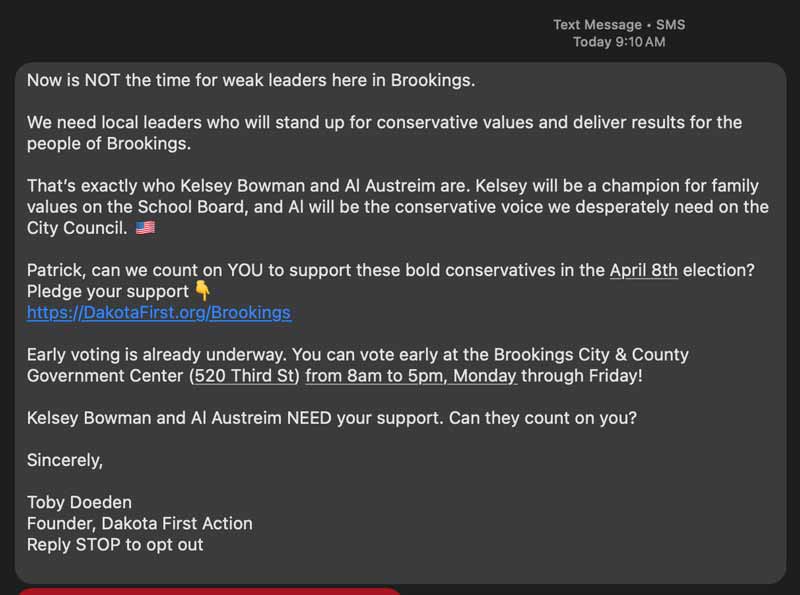
Toby Doeden getting ready to bring in Mike Myers’ former campaign manager Tara Volesky to help his effort

I had someone send this over to me to my great amusement.

Apparently Tara Volesky is getting ready to hop in the Doeden dumpster to give him her support in what ever he’s doing:

Volesky, who at one time was the campaign “manager” for the Independent gubernatorial ticket of Mike Myers/Lora Hubbel, is also known for running for mayor of Mitchell and dumping chemicals in Lake Mitchell because she knew how to cure the algae problem!

You just can’t make this stuff up.

Guest Column: SB 54: Tobacco fund cuts are a bad way to balance a budget by Dr. Allen Nord

SB 54: Tobacco fund cuts are a bad way to balance a budget
by Dr. Allen Nord

Tobacco use is a grave public health threat, perhaps the worst you or somebody you love might ever face.

Tobacco use causes dire consequences, increasing risk for 12 types of cancer. Smokers, on average, die 10 years earlier than those who never have done so.

This has been known publicly for decades.

But apparently not to outgoing Gov. Kristi Noem proposed in her last budget for our state that we should raid funds from South Dakota’s tobacco education and cessation efforts while growing the general fund to the tune of $3 million in taxpayer money.  It is now moving through the process as Senate Bill 54, is through the Senate and is now in House Appropriations. It could be a reality in the very near future.

One of the most important tools in the prolonged fight against tobacco is education about its dangers. This is especially true to our youth, who are particularly susceptible to the constant marketing of corporate tobacco companies who make great efforts to present their products as fun and even safe.

As a longtime South Dakota physician, now retired, I saw way too many of my patients suffer needlessly from smoking, which remains the leading cause of preventable death in the United States. Here in South Dakota, 1,300 die each year from smoking, with nearly 30% of cancer deaths chalked up directly to Big Tobacco.

The Centers for Disease Control points out that “cigarette smoking harms nearly every organ of the body, causes many diseases and reduces the health of smokers in general.”

Heated tobacco products have been shown to contain more than 20 toxic chemicals, including many that can cause cancer. Nicotine use, regardless of form, is bad for your health, dangerous and addictive. This occurs with cigarettes, pipe tobacco, cigars, chewing tobacco, vaping and e-cigarettes.

And since none of this is new information, 60% of South Dakota voters approved Initiative 2 in 2006. It is a tax on tobacco products that has served the state well in many ways beyond the public health sphere:

  • Increasing tobacco price has proven effective in keeping children from smoking and helping adults quit. Fewer South Dakota smokers means healthier South Dakotans and lower health care expenses. Still, each year $433 million in health care costs are directly attributable to smoking as well as $838.8 million in lost productivity via premature illness and death. Our people are our most important resource and tobacco kills those people. Beyond being a killer, tobacco is bad for business.
  • Just in the past 10 years the tobacco tax has put more than $300 million toward the state general fund. The first $30 million each year is directed there and then every dollar after $35 million goes to support the state tax reduction fund, education enhancement fund and the healthcare trust fund.
  • But about that $5 million tabbed for tobacco education and cessation programs: It supports programs designed to help tobacco users quit and keep kids from ever starting. The programs reduce the number of overall users and directly counteract the $24.9 million tobacco companies spend each year on marketing efforts in South Dakota alone.

This tax has not been increased in 18 years.

The proposal to reduce that amount to $2 million annually is a 60% reduction in the investment to keep our state clean of tobacco, but it’s worse than that. The state is already badly outspent in the battle for our next generation’s health and corporate tobacco needs no help reeling in our kids or killing our loved ones.

More than 16% of South Dakota high school students use tobacco products regularly, well more than the national average and higher than the state’s adult average of 14%. With reduced education and cessation investment, there is little doubt that both of those number will increase and corporate tobacco’s investment will serve it well in the form of significant profits at the expense of South Dakotans’ health.

Further, redirection of these needed funds is nothing short of abandoning our youth when there is a clear and present danger disguised in fruit flavors and slick marketing put forth by an opponent who certainly doesn’t care about deceptive tactics in its attempts to sustain its corporate profits.

South Dakota physicians have a duty to speak out on issues so clearly problematic to public health. South Dakota lawmakers have an obligation to do right by the future of this state. Keeping those funds in place is the right thing to do.

Allen E Nord, MD, is past president of the South Dakota Tobacco-Free Kids Network and lives in Rapid City.

Nice shout out for Dusty for Congress Deputy Finance Director Hayley Halverson as one of Sioux Falls Business’ 30 under 30

Hey – I know her!  And if you circulate in Republican political circles, you should too.   Hayley Halverson, the third generation of the Halverson family involved in politics just received a nice recognition as one of Sioux Falls Business’ 30 under 30:

In her own words: “When I moved to Sioux Falls as a practical next step after college, my goal was to make my life better. Once I got involved in the Sioux Falls community, I realized what a special place this is, and my perspective shifted. Now, my goal is to make Sioux Falls and South Dakota as a whole, a better place in whatever capacity I am able. I’m blessed to be able to do work that brings me closer to that goal everyday.”

From the nominator: “Hayley Halverson is a dedicated public servant for South Dakota. Hayley’s commitment to voter education and her professional approach have made a significant impact on the Sioux Falls community. Beyond her political work, Hayley is a founding member of Startup Sioux Falls and an active member of Central Church, where she volunteers with youth every Wednesday and participates in Bible study. She prioritizes community education by volunteering with Junior Achievement in the Sioux Falls School District. Staying informed and engaged in the Sioux Falls community is also a priority for Hayley. She is an active member of the Young Professionals Network, and her involvement inspired my own participation. Overall, Hayley prioritizes her community, her relationships with friends and family, and her faith. Given Hayley’s experience, priorities and current connections, I foresee her becoming a public leader in Sioux Falls, potentially as a politician, and even serving in Pierre as a state representative, senator or governor. 

Read the entire story here.

Hayley’s grandfather was Senator Harold Halverson, who served 26 years in the South Dakota Legislature, with a number of them as President Pro Tempore of the Senate.  Her dad, Representative Jim Halverson is in his first year of service in the South Dakota House of Representatives, after Jim and Hayley and their team pushed hard in his campaign for District 21 House this last year to get Jim elected.  It was amazing how many people pitched in for them to make it a reality.  Hayley was active in College Republicans, and roomed with my daughter for a while, which is testament to her patience for messy people (I kid, I kid). Before she was with Team Dusty, after graduating from SDSU she was also in the insurance industry.

Just an all around good person. We need more people like her in politics.  Congratulations Hayley!

US Senator John Thune’s Weekly Column: It’s Time to End the Death Tax

It’s Time to End the Death Tax
By Sen. John Thune 

Death should not be a taxable event. Anything you leave to your heirs has already been taxed once, and there should be a limit to how many times the government can tax you. Unfortunately, the estate tax, often called the death tax, is a concern for many American farmers, ranchers, and small business owners whose operations could be devastated by this tax. Eliminating the death tax once and for all has long been a priority of mine, and I recently introduced a bill to permanently repeal this fundamentally flawed tax.

I was proud to help secure a doubling of the death tax exemption in the 2017 Tax Cuts and Jobs Act, which has protected a lot of farms, ranches, and small businesses. But the larger exemption limit will expire at the end of this year, and it’s my hope that we will not merely extend the exemption, but that we will put an end to the death tax once and for all.

Death tax proponents talk as if it only affects the extremely wealthy, but that couldn’t be further from the truth. The death tax can sweep up those who have very little money in the bank. Take for example a family farm or ranch, which are often cash-poor businesses. They might have substantial-looking assets on paper, but the vast majority of that is land and farming equipment, and a small fraction of it is money in the bank.

So what happens when a farmer or rancher dies and his estate is subject to the tax? There’s a very good chance that his liquid assets – in other words, the cash that he has available in the bank – won’t come close to covering the tax bill from the federal government. The only alternative for his heirs in that case may be to start selling off land or farm equipment to pay the tax. They may be able to keep the farm – just a smaller version of it – or they may have to sell it off entirely. It’s the same plight that many ranches and small businesses face as well.

But it’s not just those who actually get hit by the death tax who suffer. Many family farms, ranches, and small businesses spend a lot of time and money on estate planning to avoid being hit by this tax. That’s time and money that could have gone into building their business, hiring new workers, and investing in their operation. Others set aside capital to prepare for the death tax, which is money that, again, could go into the building up of their operation.

It’s time we end the death tax once and for all. And I hope that 2025 will be the year that we permanently bid farewell to this flawed and unfair tax.

###

Congressman Dusty Johnson’s Weekly Column: Serving South Dakota

Serving South Dakota
By Rep. Dusty Johnson
February 21, 2025

 BIG Update

I had a great week visiting seniors young and old – high school seniors and senior citizens – across South Dakota this week. I can tell they’re all paying attention to the news because they had great questions about the border, TikTok, and Trump’s first few weeks in office, especially about tariffs and government efficiency.

I always love getting out in the state to talk to real people like you. It keeps me focused on the most important part of my job – serving South Dakota.

  Johnson with students at Canistota High School and seniors at Tieszen Memorial Home

BIG Idea

River Cities Public Transit helps people get around across South Dakota, for things like a doctor’s appointment or a visit to the local Veterans’ Affairs (VA) facility. I stopped by River Cities Transit to learn more about their operations. They shared that they are facing a workforce shortage, especially with the challenge of recruiting drivers with a CDL. Even though we have a shortage of 80,0000 truck drivers, the Biden Administration implemented rules that made it harder to obtain a CDL. Veterans and senior citizens rely on businesses like River City Transit, and their CDL drivers, to make it to their appointments.

I’m a leader on legislation in the House that would make it easier for CDL applicants to get their license, and to expand coverage for rural veteran transportation. These men and women made sacrifices to keep America free and they deserve the highest quality of care we can provide. Ensuring veterans in rural America continue to have access to transportation is a critical first step.

Johnson visiting River Cities Public Transit

BIG News

America has an abundance of energy resources, but we’ve seen a stark contrast between how the Biden and Trump Administrations have stewarded them. Under the Biden Administration, many U.S. energy sources remained untapped as America relied on countries in the Middle East and Russia to meet our energy needs. Relying on these countries poses a risk to the security of our nation, economy, and supply chain. President Trump understands the need to increase energy security and during his first term, America became a net exporter of energy for the first time in nearly 70 years.

To unleash American energy again, President Trump recently established the National Energy Dominance Council, chaired by Secretary of the Interior, Doug Burgum. This council will cut red tape and spur innovation across the energy sector to lower prices for consumers and make America energy secure again.

###

Governor Rhoden’s Weekly Column: Crossing Over 

Crossing Over
By: Gov. Larry Rhoden
February 21, 2025

  Milestones are an important part of any process. They’re a good opportunity to reflect on where we’ve come from, assess where we are, and look ahead to what comes next. Every legislative session, there comes a day called “Crossover” that is a major milestone in the legislative process.

Under our South Dakota system, every bill gets a hearing, and every bill that passes committee gets a vote on the floor of the legislature. Crossover Day is the day that bills must have passed the floor of their chamber of origin, or else they’ll be considered “dead.” So it’s often a long, busy day – and it’s a good opportunity to take stock of how the session has gone so far.

Crossover Day this year is on February 25. As I write this, it remains to be seen just how busy a day it’ll be for our House Representatives and Senators. But I’ll tell you this – it’s been a busy few weeks for me since taking office as Governor.

Just four weeks ago, we had our own “crossover,” so to speak, here in South Dakota. Former-Governor Kristi Noem took office as the Secretary of the U.S. Department of Homeland Security, and she’s doing important work to keep our nation safe. And I took office as the 34th Governor of South Dakota. I got my team established, nominated Tony Venhuizen as my Lieutenant Governor, promoted Mackenzie Decker as my new Chief of Staff, and even hired a new Press Secretary to help deliver open and responsive communication with the press.

To have all that happen in the middle of a legislative session was unprecedented in the history of South Dakota, and it has certainly kept us busy. Serving as Lieutenant Governor for six years, I had a good sense of what the workload of the Governor was. I knew what I was getting into when I shortened my title. But there’s a difference between knowing something and experiencing it for yourself. We’ve certainly had a busy past few weeks of session.

We’ve already been able to deliver some accomplishments to keep South Dakota strong, safe, and free. The first bill I signed as Governor was to ban Sanctuary Cities in our state, which was a strong statement of support for the work that President Trump and Secretary Noem are doing to fix our nation’s immigration system.

I worked with representatives from both the House and the Senate to hammer out an agreement to address the rising burden of property taxes for South Dakota homeowners, and that bill has started to work through the legislative process.

We announced a major force expansion of the South Dakota Highway Patrol in Sioux Falls. This new squad will support local law enforcement to fight crime and keep our communities safe.

We’re continuing to advocate for the construction of a new men’s prison near Sioux Falls – this facility will be crucial to rehabilitate offenders and ensure the public safety of South Dakotans.

And we are already working towards returning fireworks to Mount Rushmore for America’s 250th birthday! I recently spoke with Secretary of the Interior Doug Burgum, and he committed to me that we will work together to make this happen.

So as we reach Crossover Day in the legislature, I am confident that our state is heading in the right direction. Our state’s “crossover” is in good shape, as well. I appreciate all the prayers and kind words that my family and I have received, and I will continue focusing everyday on keeping South Dakota strong, safe, and free.

###