Gov. Rhoden and Colleagues Urge Passage of Permitting Reform

Gov. Rhoden and Colleagues Urge Passage of Permitting Reform

PIERRE, S.D. – Today, Governor Larry Rhoden and 21 fellow Republican governors urged Congress to pass permitting reform to cut red tape, lower energy costs, and strengthen our nation’s infrastructure. You can find a copy of the statement here.

“Republican governors are working every day to cut red tape, increase investment, and make our states the best places in the world to build, innovate, and do business,” wrote Governor Larry Rhoden and his colleagues. “Unfortunately, outdated federal bureaucracy continues to delay critical energy and infrastructure projects and drive up costs for hardworking families at a time when speed and efficiency matter most.”

The Bipartisan American Affordability and Jobs Act would deliver cheaper energy, good-paying jobs, and responsible growth – all while ensuring AI data centers pay for their increased electricity use. Earlier this year, Governor Rhoden signed the “Data Center Bill of Rights,” which similarly protects South Dakotans from increased utility costs and utility shortages caused by data centers.

“Republican governors urge Congress to act swiftly, pass meaningful permitting reform, and send this legislation to President Trump’s desk,” continued Governor Rhoden and his colleagues. “By bringing greater certainty and accountability to the permitting process, we can unleash American energy dominance, strengthen our grid, bring manufacturing and investment back home, and ensure the United States leads the next generation of economic growth.”

Governor Rhoden was joined in signing this statement by Alabama Governor Kay Ivey, Alaska Governor Mike Dunleavy, Arkansas Governor Sarah Huckabee Sanders, Georgia Governor Brian Kemp, Idaho Governor Brad Little, Indiana Governor Mike Braun, Iowa Governor Kim Reynolds, Louisiana Governor Jeff Landry, Mississippi Governor Tate Reeves, Missouri Governor Mike Kehoe, Montana Governor Greg Gianforte, Nebraska Governor Jim Pillen, Nevada Governor Joe Lombardo, North Dakota Governor Kelly Armstrong, Oklahoma Governor Kevin Stitt, Puerto Rico Governor Jennifer González-Colón, South Carolina Governor Henry Dargan McMaster, Tennessee Governor Bill Lee, Utah Governor Spencer Cox, West Virginia Governor Patrick Morrisey, and Wyoming Governor Mark Gordon.

###

Gov. Rhoden and Colleagues Protect Missouri River

Gov. Rhoden and Colleagues Protect Missouri River

PIERRE, S.D. – Earlier this week, Governor Larry Rhoden and five Governors urged congressional leaders to protect resource management of the Missouri River. They sent a letter to leadership on the U.S. Senate Committee on Environment and Public Works and the U.S. House Committee on Transportation and Infrastructure. You can find a copy of the letter here.

“We look forward to working with you to ensure that any final legislation respects established principles of federal and state law while supporting the long-term needs of communities throughout the Missouri River Basin and beyond,” wrote Governor Larry Rhoden and his colleagues.

The letter urged congressional leadership to protect resource management of the Missouri River by removing Section 120 from the 2026 Water Resources Development Act.

According to Section 120, water cannot be diverted or exported from the Missouri River or any of its tributaries without unanimous approval from Colorado, Minnesota, Montana, North Dakota, South Dakota, Nebraska, Iowa, Kansas, Missouri, and Wyoming governors. Furthermore, unanimous approval by the Missouri River state governors is required for the Corp of Engineers to simply study the possibility of such projects.

“Section 120 would grant the 10 governors of the Missouri River states absolute veto power over an entire sector of interstate resource distribution without any standards or guiding principles…This subordinates the Corps of Engineers’ statutory duties based solely on the whim of a single governor,” continued Governor Rhoden and his colleagues. “Such a provision is certain to invite protracted litigation, as well as delay necessary infrastructure projects.”

Governor Rhoden was joined in signing this letter by North Dakota Governor Kelly Armstrong, Colorado Governor Jared Polis, Montana Governor Greg Gianforte, Utah Governor Spencer Cox, and Wyoming Governor Mark Gordon.

###

Legislator who ran and hid from vote claiming South Dakota has a ‘corrupt establishment’

This is just a bizarre string of happenstance.

Former Congressman Matt Gaetz, who found himself the subject of a House Ethics Committee report, where the House Ethics Committee found evidence that Gaetz paid for sex—including with a 17-year-old—and abused illegal drugs during his tenure in the U.S. House of Representatives recently interviewed outgoing crackpot legislator John “California” Carley.

Carley, aside from other things, was the subject of the public’s ire for running and hiding from a vote this last legislative session. Seriously, he left the capital, was not able to be found, and later claimed he went to a dentist appointment.

Why was the earth’s population subjected to the meeting of these paragons of ethical conduct?  They were upset that current South Dakota Secretary of State Monae Johnson said she’d rather vote for a Democrat than support the puppet of the election conspiracists, Heather Baxter as her successor to the office, as they detail on the OAN network:

“unfortunately, very quickly turned and aligned with no election integrity and a kind of corrupt establishment… She went and endorsed a Democrat secretary of state candidate.”   “California” Carley claiming we have a ‘corrupt establishment?’  Yeah. I think he understands the meaning of the word as much as he understood his oath of office. As in not at all. 

If Matt Gaetz and John Carley are for someone… it kind of gives a person pause as to whether you want to be on the same side as these guys.

Release: Pro-Amendment L Group Calls for Truth in Advertising

Pro-Amendment L Group Calls for Truth in Advertising

SIOUX FALLS – The grassroots coalition leading the Yes effort on South Dakota’s proposed Constitutional Amendment L sent cease and desist letters to South Dakota media organizations this week, requesting that they immediately stop airing misleading and untruthful commercials funded by opponents of Amendment L.

Proposed Amendment L protects the South Dakota Constitution and South Dakota citizens by requiring a 60 percent vote to change the Constitution. All other measures remain unchanged.

“Voters deserve an open and honest debate on the merits of Amendment L,” said State Representative John Hughes (R-13), prime sponsor of the measure. “These blatant lies by anti-Amendment L activists are a desperate attempt to mislead voters, and the deceptive advertisements need to be removed from the airwaves immediately.”

The request to pull the misleading advertisement points to opponents’ false claim that the Yes on L effort is funded by wealthy non-residents. Specifically, the ad falsely states “Out of state billionaires and their lobbyists are coming to South Dakota pushing Amendment L” and “Our constitution isn’t for sale to some Californian.”

A ballot question committee in support of Amendment L, Save Our South Dakota Constitution, consists of South Dakota residents and groups of concerned citizens. Supporters of Amendment L include Protect South Dakota Kids, South Dakota Family Voice, South Dakota Retailers, and South Dakota Right to Life.

Official campaign finance disclosures filed with the South Dakota Secretary of State in mid-October will demonstrate that Save Our South Dakota Constitution is funded entirely without financial backing from any California billionaires. Ironically, according to public documents, anti-Amendment L special interest groups have already spent more than $400,000 misleading voters.

“Our state Constitution is a foundational document that makes South Dakota a great state, and that’s worth protecting by passing Amendment L,” Hughes added. “We are asking voters to defend against radical special interest groups who want to allow late-term abortions, take away gun rights, and legalize recreational marijuana.”

Election Day is Tuesday, November 3, 2026. Amendment L was placed on the ballot by the South Dakota Legislature during the 2025 session as House Joint Resolution 5003. The measure passed the Senate with 29 yes votes and 4 no votes; it passed the House with 61 yes votes and 5 no votes.

###

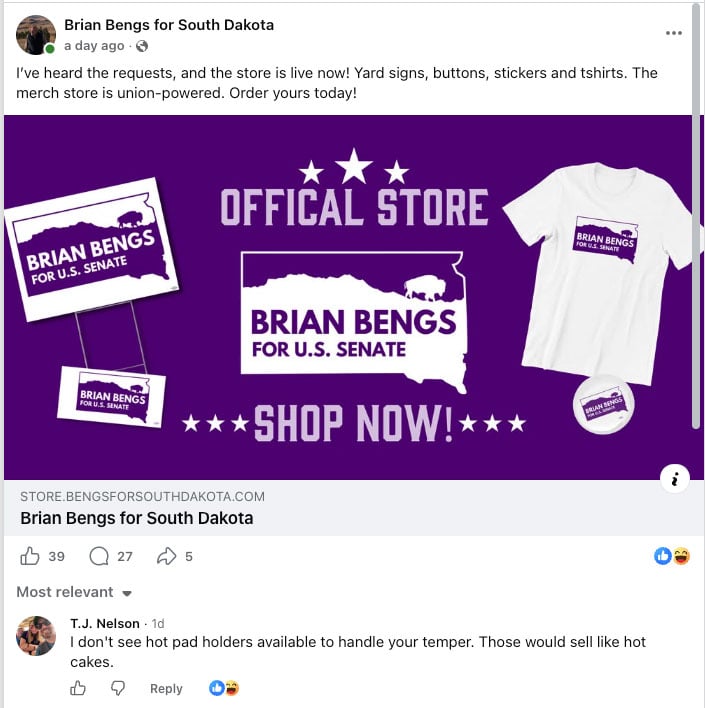
Brian Bengs selling campaign swag on-line to fund effort, charging $20 for a campaign sign.

“Dindependent” US Senate candidate Brian Bengs launched a laughable online store this week to scrape together donations.

The comment made me laugh. I would agree. Strangely, no signs or shirts depicting him snapping his fingers at people. If you want evidence of one of the worst run campaigns by one of the worst candidates in years, shop wisely, as he’s hitting people for $20 for a yard sign.  Trust me. I sell the things. That’s quite the markup.

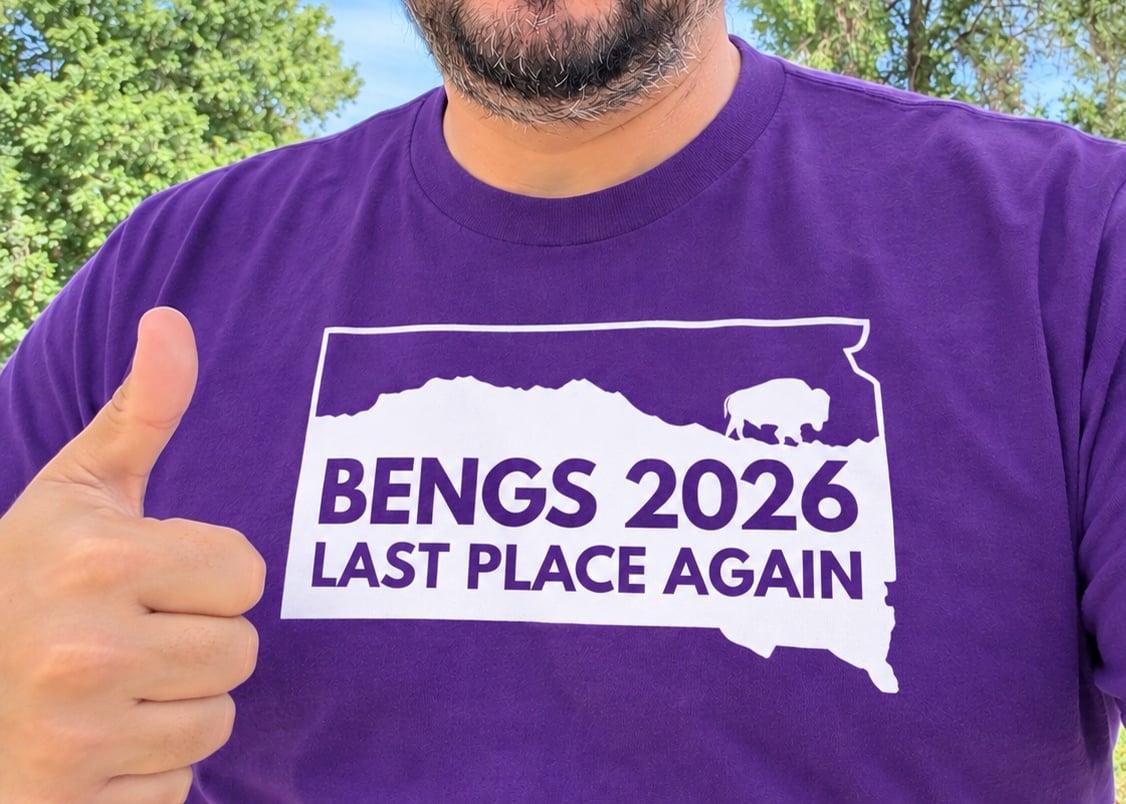
If only there were items available that were useful in the real world.  I’m holding out until they add this shirt to the shelves.

Thune: Republicans Help America’s Small Businesses Grow, Put More Money in Americans’ Pockets

Thune: Republicans Help America’s Small Businesses Grow, Put More Money in Americans’ Pockets

“We’re setting the conditions for a brighter future and keeping the American Dream alive and strong for future generations.”

Click here to watch the video.

 WASHINGTON — U.S. Senate Majority Leader John Thune (R-S.D.) today delivered the above remarks on the Senate floor.

If there are any SD political collectors out there..

Just a note for any collectors of political items out there, I’ve revamped and updated my long ignored eBay store, and linked it with my listings on Facebook Marketplace, whatnot, and Etsy, and I’m clearing out a number of duplicates and things gathering dust.

Lots of South Dakota related presidential pins, as well as other political items as I come across them in drawers and as I unpack what I had for sale when I had a booth at 605 Antiques in Sioux Falls.  (Comics too, but this probably isn’t the venue).

You can check out my current listings of political items on eBay here.

Guest Column: Amendment K is a wise investment in South Dakota By Rep. Chris Kassin (R-17) and Rep. Erik Muckey (D-15)

Amendment K is a wise investment in South Dakota
By Rep. Chris Kassin (R-17) and Rep. Erik Muckey (D-15)

As state representatives, we’ve worked together for the past two years on the Joint Committee on Appropriations. As you might suspect, we don’t agree on everything, but we do seek out common ground whenever we can.

This election season, that common ground is Amendment K. We’re asking you to vote yes on this important amendment to our state’s constitution.

Amendment K takes the funds or assets the state holds for people who’ve lost track of them, known as unclaimed property, and places those claims in a constitutional trust fund. That trust fund lets the state spend only what that fund earns, and the principal stays where it is, available to pay every claim.
Rarely do you find unanimous agreement in the Legislature and with the Governor. This is one of those instances where bipartisanship came together around the common good and finding a real, responsible way to steward the trust of South Dakotans.

Why is Amendment K important?

There may be money in the State Treasurer’s office with your name on it, whether an old bank account from a job you left, or an insurance payout a relative never mentioned. South Dakota took in a record $357 million of unclaimed property in fiscal year 2025, and another $242 million by the time we met in Pierre this session.

When an account or property goes dormant at the bank, a bank whose charter is in South Dakota transfers the responsibility of uniting unclaimed property with its owner to the State Treasurer’s office. The State notes the claim and the value at the time of its abandonment and owes that amount to the owner forever. The claim never grows. Whatever it was worth that day is what we owe, whenever somebody comes for it.

While a good chunk of this unclaimed property belongs to South Dakotans, most of it comes from somewhere else. Banks chartered here hold accounts for people across the country and the world, and when those go unclaimed, South Dakota inherits the job of holding it and finding the owner. We’re carrying more than $1.2 billion in those promises.

For years the state spent a good share of it, and that was a mistake. Collections spiked after the pandemic, and the more that came in, the easier it was to treat as revenue. About $60 million a year shows up in the general fund and gets spent like any other money, and what comes in the door to the state is significantly higher. There was no plan to stop this until recently.

A group of us came together across party lines in the 2025 Legislative Session to end that practice, resulting in Senate Bill 155. Rep. Kassin prime sponsored it in the House, and Rep. Muckey co-sponsored it. Senator Taffy Howard served as the other prime sponsor, and several others in both chambers signed on as co-sponsors. After significant discussion and negotiation between legislators on both sides of the aisle and the executive branch, the Legislature unanimously supported Senate Bill 155 and the Governor signed it. The law weans the budget off using unclaimed property in steps, dropping the general fund’s share from about $61.4 million this year to $25 million by 2035, so nothing gets yanked out from under K-12 education, Medicaid or the state workforce.

Amendment K is the last step, and it’s the one we can’t take as legislators. Without a constitutional amendment, the Legislature cannot direct the South Dakota Investment Council to manage this money as a real trust. Right now, the account holding it earns very little. Because property claims never grow, whatever the money earns while it waits is money the state can use without shorting anyone and meet our obligations to education, Medicaid, and state workforce.

Amendment K would then require three-fourths of both chambers, or 53 of 70 representatives and 27 of 35 senators, in order to take anything from the principal for a purpose other than paying claims.
The Senate voted 35 to 0 to send Amendment K to the ballot. The House voted 69 to 0. The State Treasurer wrote the argument for Amendment K in the ballot pamphlet, and nobody wrote one against it.

The work in Pierre is done to properly manage a liability on our state’s balance sheet. Amendment K will ensure that every valid unclaimed property can be honored and turn a billion-dollar liability into an asset that works for South Dakotans.

All that’s left is your vote. Please vote yes on Amendment K.

—

Chris Kassin represents District 17, lives in Vermillion, and served as the House Prime Sponsor on Senate Bill 155 (2025) that established new unclaimed property financial management practices. Erik Muckey represents District 15, lives in Sioux Falls, and co-sponsored Senate Bill 155. Both serve on the Joint Committee on Appropriations, which writes the state budget.

Attorney General Jackley Releases New State Policy On Constitutional Disclosure Requirements for Criminal Cases

Attorney General Jackley Releases New State Policy On Constitutional Disclosure Requirements for Criminal Cases

PIERRE, S.D. – South Dakota Attorney General Marty Jackley announces that a task force he created in 2025 has developed a recommended model policy to help South Dakota prosecutors and law enforcement agencies address constitutional disclosure requirements in criminal cases.

“This recommended model policy furthers government transparency. It provides South Dakota prosecutors and law enforcement agencies with a consistent framework for addressing Constitutional disclosure obligations,”said Attorney General Jackley. “I thank the task force members for developing practical guidance that promotes fairness, consistency, and confidence in the criminal justice system.”

The recommended prosecutorial guidance addresses the United States Supreme Court’s decisions in Brady v. Maryland and Giglio v. United States. Those decisions require prosecutors to disclose certain evidence favorable to the accused, including information that may affect the credibility of government witnesses, such as law enforcement officers. The disclosure obligations help protect a defendant’s right to a fair trial.

Attorney General Jackley created the task force to review Brady/Giglio disclosure requirements and recommend a practical framework for South Dakota prosecutors and law enforcement agencies. The resulting guidance provides recommended procedures for identifying potential disclosure information, reviewing credibility-related matters involving recurring government witnesses, and making case-specific disclosure decisions.

The recommended model policy is for guidance only. It does not establish a mandatory statewide process or limit the independent professional judgment of State’s Attorneys.

Task force members were:

  • Ernest Thompson, Deputy Attorney General, South Dakota Attorney General’s Office;
  • Matthew Glenn, Supervisory Special Agent and Law Enforcement Training Administrator, South Dakota Division of Criminal Investigation;
  • Lt. Brandon Akron, South Dakota Highway Patrol;
  • Cory Borg, Deuel County Sheriff;
  • Crystal Brady, Chief of Police, Vermillion Police Department;
  • Lara Roetzel, Pennington County State’s Attorney; and,
  • Tyler Larsen, Yankton County State’s Attorney

-30-