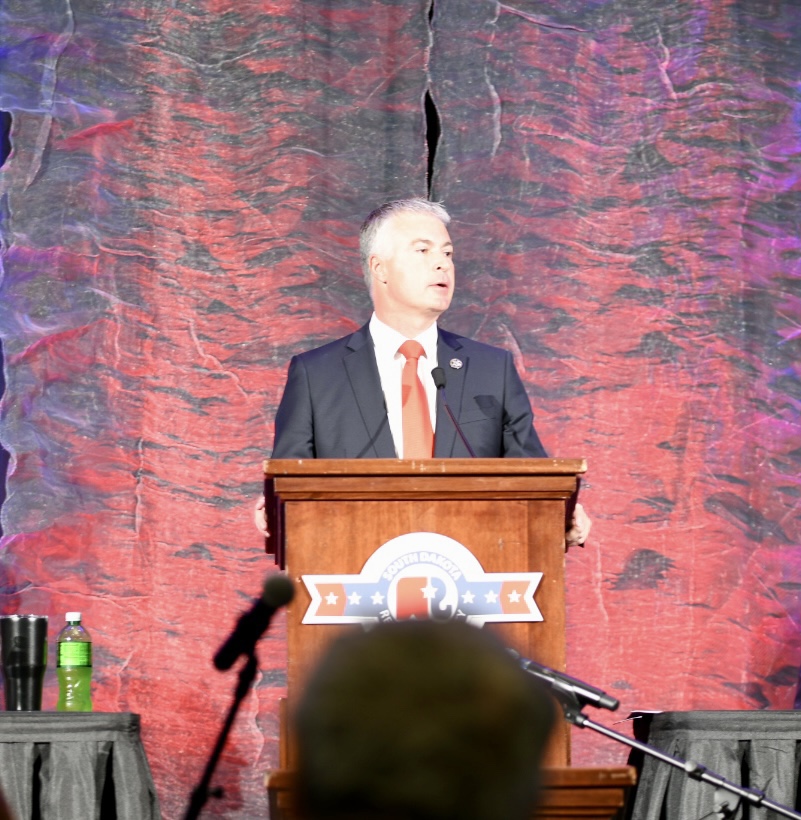
Governor Kristi Noem’s Weekly Column: Go Big, Go South Dakota Tourism 


Go Big, Go South Dakota Tourism
By Governor Kristi Noem
April 29, 2022

There has never been a better time to talk about tourism in South Dakota. May 1-7 is National Travel and Tourism Week (NTTW) across the country. In South Dakota, we celebrate the Great Faces, Great Places that make our state the greatest vacation destination in America.

NTTW is all about celebration. This year’s theme is #FutureOfTravel, but before I look ahead, we have a lot of folks to thank for getting us to this point. While other states were shutting down, the men and women in our tourism industry stayed open for business and open for visitors.

Despite a barrage of partisan criticism, our approach worked. A recent study from WalletHub just named South Dakota the second safest COVID-19 state in the nation, and we led the entire country in tourism growth. By working together, we have kept this state an ideal place for people to visit and enjoy the fresh air and open spaces at our scenic parks.

That is why we have so much to celebrate during this year’s National Travel and Tourism Week. We celebrate the 13.5 million visitors that came to South Dakota last year, an increase of 30% from the previous year. We celebrate the record $4.4 billion that visitors spent while they were here, the 54,208 jobs sustained by the tourism industry, and the $980 in tax dollars saved by each South Dakota household because of the tourism industry.

With a spirit of gratitude, let’s come together and use NTTW as a time to show our appreciation for our travel industry. There are many ways we can do this:

  • Write a letter or social post thanking travel workers – including your favorite SoDak businesses – for everything they do to attract and entertain visitors.
  • Share photos of your outdoor adventures in The Mount Rushmore State and tag the local town or park.
  • Tag your messages with #NTTW22 and #FutureOfTravel to show the world how much you appreciate the many benefits that come from hard-working tourism folks.

This past legislative session, we passed reforms to allow for more agritourism. This allows farmers and ranchers to use their property to generate additional income from tourism without burdensome regulations. And to make sure the future of tourism is bright across the state, we are bolstering our marketing efforts to target smaller communities. We want to be sure the millions of visitors to our state do not miss the hidden gems.

We are also continuing our efforts to strengthen habitat and enhance the experience for our visiting hunters and anglers. We cut regulations to make it easier for hunters to take advantage of our open seasons. And we have worked with landowners and our conservation specialists to increase habitat and reduce nest predator populations.

Since 2019, there has been a $27 million increase in direct spending by hunters. When you combine all outdoor activities — including boating, parks, snowmobiling, etc. — the overall estimated impact on our economy is more than $1.3 billion total. The best part is that portions of those dollars spent on ammo, park fees, and other tools feed right back into our conservation and habitat efforts.

Whether you walk two blocks or drive across the state, I encourage you to take the time to treat yourself to some exploration. Even as Governor, I am consistently surprised with the sights and delights I continue to find across South Dakota.

The future of travel is strong in South Dakota. We have much to celebrate and even more to look forward to. That is the South Dakota way, and that is what National Travel and Tourism Week is all about. Someone once said, “Travel is the only thing you buy that makes you richer.” I could not agree more. Together, let’s make sure that South Dakota will continue to enrich the lives of every visitor that explores our great state.

###

Elevate Rapid City pro-business scorecard out. 7 legislators score 100% Taffy Howard at bottom with 40% score

Elevate Rapid City has their third annual pro-business scorecard out for people to see ranking the pro-business acumen of Rapid City area legislators. Seven of them (Tim Goodwin, Becky Drury, Chris Johnson, Helene Duhamel, Mike Derby and Jessica Castleberry) had perfect 100% scores.

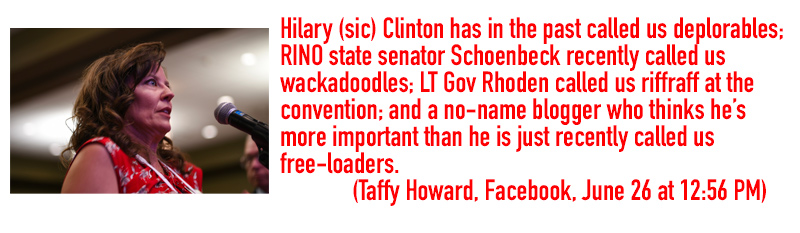
Surprisingly, self-proclaimed small businesswoman and Congressional Candidate Taffy Howard ended up with the lowest score with only 40% of her votes being ranked pro-business:

Read more about it here at Elevate Rapid City.

I’m not sure that all the candidates agree with Taffy…

Among her posts to Twitter today, Taffy Howard expressed some fairly strong religious views..

Hm.. I wonder if other candidates running to the right have the same views on religion..

Religious belief is a world-view, a fiction used to explain our present existence.

and…

In tandem with meditation is the understanding that humanity needs a new one-world religion.

and..

There is no need to pledge allegiance to particular nations or creeds. What we really need is to return to ourselves.

– District 12 House Candidate Cole Heisey writing in The Volante, April 2, 2013.

Well, that’s going to make for some awkward conversations at the Stop the Steal Rallies.

Val Rausch running for District 4 State House of Representative seat

Val Rausch running for District 4 State House of Representative seat

Val Rausch, local businessman from Big Stone City, announces his candidacy for the South Dakota State House of Representatives in District 4.

“After considerable thought and encouragement from area residents, I have decided to run and represent our area for the House,” Rausch said. “My past experience and leadership are essential to the future needs of South Dakota and will help to continue to move the state forward.”

Rausch served in the South Dakota legislature from 2005 – 2012.  As a Representative Val served on the Appropriations committee until serving in leadership his last two terms.  During his time serving the House, he served as speaker pro tempore and then as Speaker of the House.

Val has lived and served the community of Big Stone City, SD for most of his life. Rausch earned his B.S. from Northern State University. He worked for Rausch Brothers Monument Company as vice president and sales manager. Rausch is currently the owner/operator of Omega Lettering Incorporated.  He is a current member of the Glacial Lakes & Prairies Tourism Executive Board, the State Department of Tourism Advisory Board, and board member of the Abbey of the Hills.

Rausch served as mayor of the city of Big Stone City from 1993 to 1999. He was also a member of the County Planning and Zoning Board. Val is a retired volunteer fireman for the Big Stone City Fire Department

He is an active member of St. Charles Catholic Church and the Knights of Columbus.

Val and his wife, Paula, have four grown children and seven grandchildren (and counting).

Was that Tweet over the top? Taffy Howard deletes tweet claiming 2020 election was “stolen.” Replaces it with tweet about there being “questions”

Yesterday, the Taffy Howard for Congress twitter account started tweeting a storm, throwing out all sorts of red meat to her followers, such as this gem, which I embedded on my website:

I was looking at the post this AM, and noticed it wasn’t resolving to a nicer graphic format.. and when I went to check the twitter account – *poof* the tweet had disappeared.    But a new “red meat” statement about the election was in it’s place:

So, does Taffy now believe the election wasn’t stolen, and just wants to question it?

Governor rejects Bicycle Coop’s attempt to certify “equity training” for educator Continuing Ed credits

I think they’re certainly free to offer whatever educational opportunities they’d like.. but the State has a strong interest in setting certain standards over what constitutes continuing education for professions, and what does not.

Governor’s spokesman Ian Fury takes media to task for misleading readers on updating education standards

Governor Kristi Noem’s Chief of Communications, Ian Fury is taking the media to task for their reporting on the Governor’s Education Standards group.

In an e-mail sent out this morning, he points out that the media seems to be intentionally distorting numbers, and misleading people over the people on the panel for the sake of headlines:

Folks, 

The media is not telling the truth about the process to update South Dakota’s education standards. Unfortunately, when South Dakota’s largest media outlets deliberately manipulate the truth, it is the people of our state who suffer. 

The South Dakota Department of Education recently announced a new workgroup to ensure that our kids are taught true and honest civics and history in the classroom. The Department and the Governor’s Office worked together on the membership of this group. After all, the Department of Education is part of the executive branch. They work for the people’s elected Governor, and the Secretary of Education is appointed by the Governor. 

Nonetheless, the Argus Leader apparently found it inappropriate that the Governor would have any involvement in an action taken by her own administration. They took issue with the membership of the group, printing ‘It’s a slap in the face’ in their headline. In particular, they took issue with the group including “only three people with active South Dakota K-12 teaching certificates.”  

That statement is completely misleading. The group includes 15 members, meaning that teachers get 20% of the seats at the table. But a strong majority of the members also have education backgrounds. Two members of the committee are former South Dakota teachers. One teaches in Nebraska. One is a college professor. One is the State Director of Indian Education. One is the State Historian and former Secretary of Education. One is a tribal historian.  

Teachers deserve seats at the table – but there are other stakeholders who need to be there, too. And this is not the only chance teachers will have to come to the table during this process — teachers, parents, students, and the general public will have multiple opportunities to weigh-in on the standards during the public comment period. This will be a transparent and public process. 

The misleading reporting doesn’t end there, though. For instance, three members of the group are Native American. In another example of the media manipulating the facts, Keloland reported earlier this week that “only three members of the new workgroup are… members of tribal communities.” Three of 15 is 20%, or more than twice the 9% of South Dakota’s population that is Native American. These three individuals have extensive knowledge and education in Native American history, culture, and language.  

By using dismissive language, the media is discounting the Native Americans on this workgroup, who will help present a broad, fair, and accurate inclusion of Native American history. Governor Noem recognized that Native American history and culture is an important part of South Dakota’s history, so she ensured that Native Americans were more than represented with seats at the table.  

But this emerging media narrative ignores another key fact that the media should have learned last year – PARENTS deserve a seat at the table, too. ” Governor Noem recognizes that parents should have a voice, so several members of the workgroup are parents of kids currently in school. 

Trust in media remains at historic lows, and not just among registered Republicans. Only 31% of registered Independents trust the media. The media should wake up to that reality and refocus their efforts on truth, not on a preferred political narrative; on education, not indoctrination.  

Regards,
Ian Fury 

What do you think? 

SD News Watch: Delegates lining up on both sides of contested AG contest

South Dakota News Watch has an article tonight regarding the Attorney General’s race, and how delegates are viewing the convention race, as well as the prospect of the impeachment trial on the cusp of the decision:

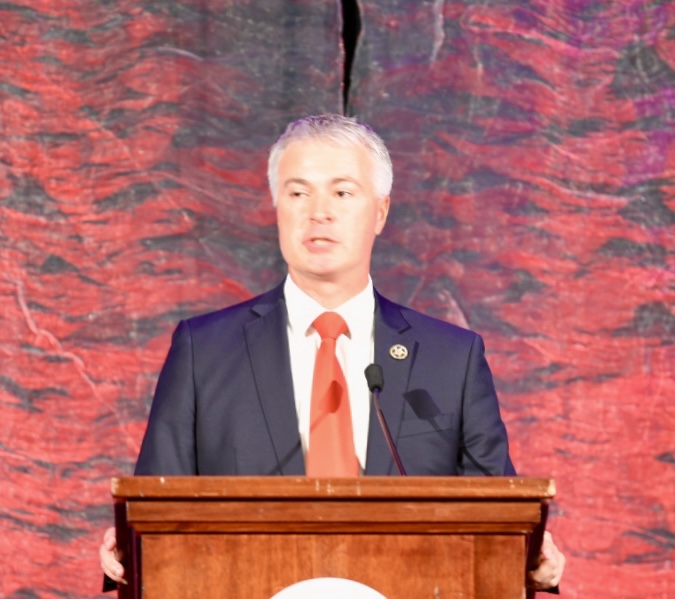
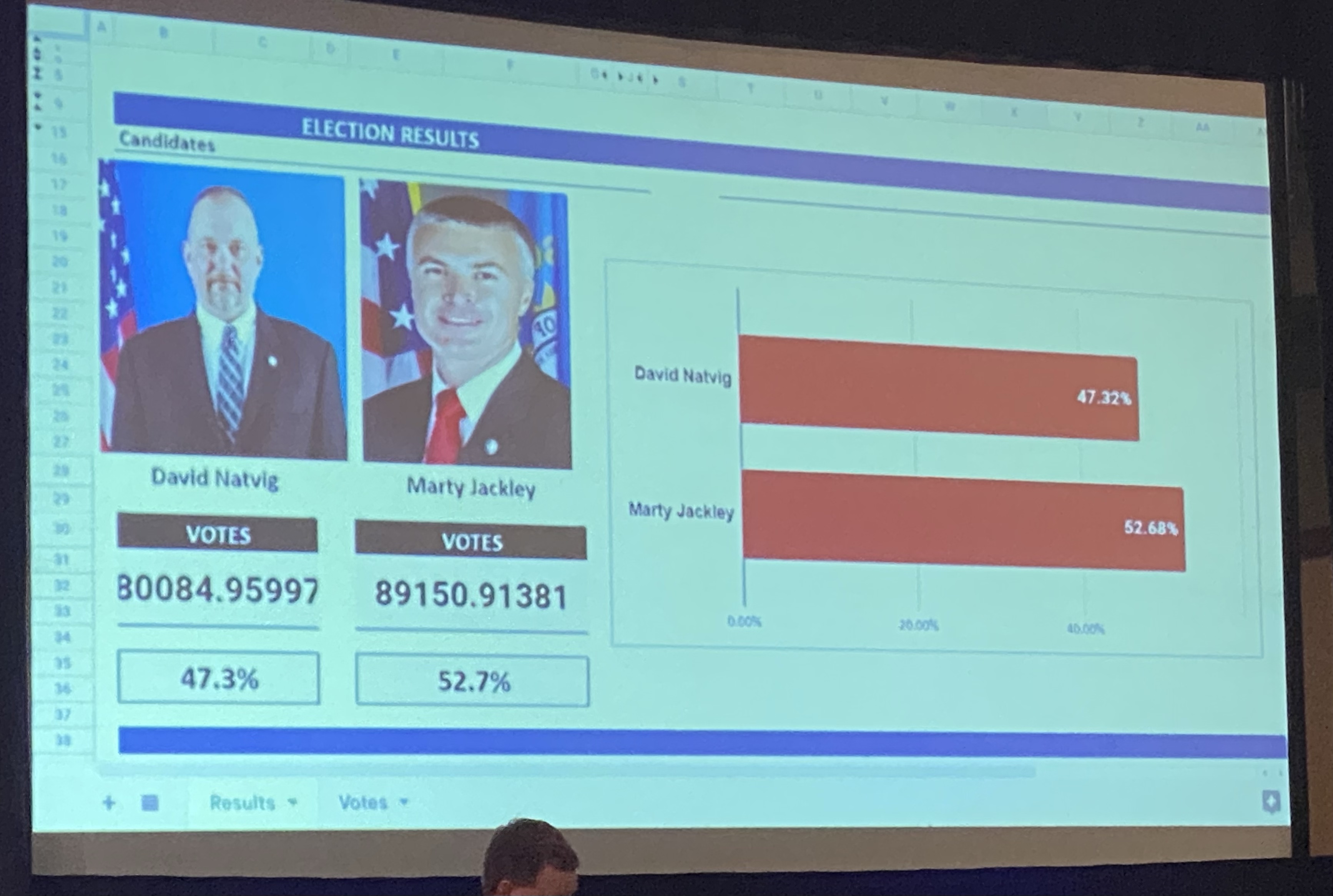
Most political observers see Jackley as a clear favorite, with the understanding that strange things can still happen at the convention. Jim Gilkerson, a party delegate who is chairman of the Brookings County Republicans, said he will support Jackley because of “frustration” over Ravnsborg’s legal troubles and the way he has handled them.

Ravnsborg did not respond to an interview request for this story made through his spokesman, Mike Deaver.

“I really like Jason – he’s a personal friend of mine,” said Gilkerson. “But I don’t think it’s going to work for him to be Attorney General after the problems we’ve had. I don’t know how you have something that serious happen and continue, or even want to continue, in that job.”

and..

Does that mean Ravnsborg’s defeat is imminent? Not to some delegates. Spencer Wrightsman, a District 2 Senate candidate and treasurer of the Minnehaha County Republicans, said he has spoken to Ravnsborg and wants to see the impeachment trial play out before deciding on a nominee. He also criticized the decision to hold the trial so close to the convention.

Read the entire story here.

Taffy Howard wants to be known by the company she keeps.

New tweet from Taffy Howard today..

Of course, this comes on the heels of Cawthorne’s latest scandal.

I’m not sure what to say about that. What Does Taffy think about all this questionable morality?

(From the Rapid City Journal, May 25, 2004)

When will people “wake up and see the cultural battle?”  Hm… Taffy seems sleepy when it’s her friends who might be a little creepy.  Now how about all those R rated movies!

** Bonus Taffy Tweet **

Thune Outlines Broadband Program Priorities to NTIA, Advocates for Internet Access for Rural Communities in South Dakota

Thune Outlines Broadband Program Priorities to NTIA, Advocates for Internet Access for Rural Communities in South Dakota

Senate and House committee leaders share broadband program priorities with NTIA

WASHINGTON — U.S. Sen. John Thune (R-S.D.), ranking member of the Subcommittee on Communications, Media, and Broadband, today sent a letter to Assistant Secretary of Commerce for Communications and Information Alan Davidson outlining priorities for implementation of the National Telecommunications and Information Administration’s (NTIA’s) broadband programs. The letter requests that additional funding be distributed among unserved and underserved communities and be used to protect against waste, fraud, and abuse.

In the letter, the legislators call on the NTIA to:

  • Commit to using the Federal Communications Commission’s new broadband maps, once challenges are resolved, for the Broadband Equity, Access, and Deployment program and not rely on other data sources to supplement or substitute these maps;
  • Follow the Infrastructure and Jobs Act’s directions on eligible project areas to avoid overbuilding;
    Provide an equal opportunity for all broadband providers to compete for grants by not prioritizing municipal networks or networks run by nonprofits or cooperatives and not favoring certain broadband technologies over others;
  • Avoid unnecessary requirements, such as net neutrality, burdensome labor regulations, and rate regulation; and
    Commit to transparency by allowing the public to provide input and review how the agency arrives at its decisions.

The letter was signed by U.S. Sen. Roger Wicker (R-Miss.), ranking member of the Senate Committee on Commerce, Science, and Transportation, and U.S. Reps. Cathy McMorris Rodgers (R-Wash.), ranking member of the House Committee on Energy and Commerce, and Robert Latta (R-Ohio), ranking member of the Subcommittee on Communications and Technology.

Full letter below:

The Honorable Alan Davidson
Assistant Secretary of Commerce for Communications and Information
National Telecommunications and Information Administration
U.S. Department of Commerce
1401 Constitution Ave North West
Washington, D.C. 20230

Dear Assistant Secretary Davidson,

The United States faces a persistent digital divide. Millions of Americans continue to lack access to high-speed broadband and are unable to participate in the digital economy. To attempt to address this problem, Congress provided $65 billion in funding for broadband as part of the Infrastructure Investment and Jobs Act (IIJA). The National Telecommunications and Information Administration (NTIA) is responsible for administering $48.2 billion of this money. Of this amount, $42.45 billion is for the Broadband Equity, Access, and Deployment (BEAD) program, which will provide states grant money to award providers to deploy broadband networks in unserved areas. The other programs are intended to expand broadband deployment on Tribal lands, promote digital equity, and help develop middle-mile networks.

The IIJA included provisions requiring the use of accurate maps, preventing overbuilding, and prohibiting rate regulation and other unnecessary and burdensome requirements on providers receiving funds. We write to share our priorities for how NTIA should implement and further strengthen the integrity of these programs.

Commit to Using Federal Communications Commission’s Broadband Maps

The IIJA requires NTIA to use the Federal Communications Commission’s (FCC) new broadband maps, when they are available, to determine whether a location is unserved or underserved and therefore eligible for funding from the BEAD program. NTIA should not award funds until the FCC’s broadband maps are completed, with challenges adjudicated. The FCC’s challenge process permits any member of the public to challenge whether an area is served, and includes a robust process for verifying and resolving those challenges to ensure accuracy. Awarding money before the FCC resolves challenges could undermine the success of this program.

NTIA should also require eligible entities to use only the FCC’s maps when determining eligibility, as they are being developed though a rigorous process that Congress required to include specific standardization, verification, validation, and challenge processes. The same cannot be said of other data sources. Indeed, some agencies have even used subjective sources, including interviews, speed tests, and “any other information they deem relevant” when determining whether to fund a broadband project. Given the significant funding for the BEAD program, NTIA must not squander this important opportunity by using inaccurate data, which could lead to wasting funds and not closing the digital divide. NTIA therefore should not use other maps or data as a substitute for the FCC’s new maps when administering this program.

Pursuant to the IIJA, NTIA should also require that a state administering a challenge process account for the rigorous challenge process required for the FCC’s new maps under the Broadband DATA Act.[1] As discussed, the FCC’s challenge process already ensures accuracy. Thus, any discrepancy found by a state challenge should be resolved using the same rigorous process used by the FCC.

Follow the IIJA’s Directions on Eligible Project Areas to Avoid Overbuilding

NTIA should not deviate from the IIJA’s explicit instructions for determining areas eligible for BEAD funding. As required by the law, NTIA should first fund unserved areas, defined as areas where 80 percent of locations lack reliable broadband access at speeds not less than 25 Mbps download/3 Mbps upload, and then move to underserved areas, those where 80 percent of locations lack reliable broadband access at speeds not less than 100 Mbps/20 Mbps. Additionally, NTIA has authority to define Priority Broadband Projects. NTIA should use this discretion to prioritize projects in areas where 100 percent of locations lack reliable broadband access at speeds less than 25 Mbps/3 Mbps. Altering the prioritization of projects or the speed threshold, or considering other factors, like “an identified need for additional broadband infrastructure investment,” risks overbuilding existing networks, and leaving unserved and underserved communities without connectivity. Such actions would further exacerbate the digital divide and waste taxpayer dollars. This previously occurred with NTIA’s Broadband Technology Opportunities Program, which misused billions of dollars, overbuilt existing networks, and did little to close the digital divide. We cannot afford to repeat this mistake.

Equal Opportunity for Providers

NTIA should direct states to consider a variety of broadband providers when making their awards, provided they meet the criteria for program participation and awards. Other federal broadband programs, such as those run by the Department of Agriculture and the Department of the Treasury, have prioritized or favored applicants owned, operated by, or affiliated with local governments, nonprofits, or cooperatives. NTIA should not follow their lead. Favoring certain providers over others inhibits fair competition and puts the federal government in the position of picking winners and losers. Additionally, some of these entities have shown that they are not capable of this task. Rather than favoring entities with little or no experience building costly and complex networks, NTIA should focus on funding those with proven track records of successful deployments in a cost-effective manner. NTIA should also resist the temptation to favor certain technologies over others. The program should consider all technologies that can meet the IIJA’s network requirements at a reasonable cost. A technology-inclusive approach will maximize the impact of the funding and efficiently connect more Americans faster.

No Unnecessary Requirements or Rate Regulation

NTIA will need to impose certain requirements on the broadband providers that are awarded grants from states. Such requirements are necessary to ensure these providers have the financial and technical capacity to deliver on their obligations. But NTIA should refrain from adding additional, needless requirements that will increase the cost and challenges of deploying new networks. These include requiring broadband providers to commit to net neutrality restrictions, adopting burdensome labor standards, and favoring open-access networks. Such requirements are unnecessary, go beyond the scope of congressional intent, could raise the monthly cost of broadband service, and could discourage participation from providers, undermining the success of the BEAD program and harming consumers.

Instead, NTIA should work with states to reduce regulatory and permitting burdens that could undermine the effectiveness of the BEAD program. When considering the approval of an eligible entity’s final plan, NTIA is required to determine whether the use of funds “is in the public interest.” NTIA should use this opportunity to ensure that states are taking reasonable steps to reduce permitting barriers to broadband deployment, such as charging higher than cost-based fees, lengthy delays, or duplicative approvals. It is critical that this funding be used to subsidize broadband deployment and not subsidize more red tape.

Affordability is also an important goal of these programs – the IIJA requires broadband providers that receive BEAD funding to offer a low-cost option. This requirement, in addition to subsidies provided by the FCC’s Affordable Connectivity Program, should be sufficient to ensure affordable broadband access for all Americans.

We remain concerned, however, by potential attempts to regulate broadband rates. The IIJA includes a provision barring NTIA from regulating broadband rates. That provision, however, does nothing to restrict states from regulating the rates themselves. NTIA should refrain from indirectly regulating rates by requiring that states regulate broadband rates as a condition of this program. Broadband rates vary within states for a variety of reasons, including terrain and population density. Requiring a one-size-fits-all rate, even within one state, would not account for these factors and could jeopardize the long-term sustainability of these investments. Additionally, NTIA should not abuse the discretion given to the Assistant Secretary to approve a provider’s low-cost option as a way to control rates. Additional intervention to regulate these options is unnecessary.

Transparency

The IIJA exempts the BEAD program from the Administrative Procedures Act (APA). In doing so, the law exempts NTIA from notice-and-comment rulemaking[2] and the Freedom of Information Act, two important statutory protections that ensure transparency in Executive Branch decision making. As a result, the public is left without a formal forum to provide input on the rules that will govern this important program, and without any insight into how NTIA makes decisions. We ask that, notwithstanding the IIJA’s APA exemption, NTIA administer the BEAD program with full transparency and allow the public to provide input and review how the agency arrives at its decisions.

NTIA should also work closely to collect information from other agencies awarding broadband funds and ensure it does not duplicate funding in those same areas. Over the past two years, Congress has created a number of programs spread across multiple agencies to support broadband deployment. Coordination among these agencies will ensure that this money is effectively and efficiently spent.

Closing the digital divide is a top priority of Congress, but this will only be achieved if NTIA carefully administers these programs and prioritizes unserved and underserved communities based on accurate data. NTIA cannot afford to repeat the mistakes of the past. We need to work together to ensure the BEAD program’s success.

Thank you for your attention to this important matter.

Sincerely,

###