Sen. Stalzer claims was at Pillow Guy’s Cyber Symposium as a skeptic

I thought I should highlight this comment, since it got caught in my filters last night, but State Senator Jim Stalzer is offering a rebuttal to the picture posted on twitter claiming he was part of a group that wanted to oversee elections:

“Yes, I attended the Cyber Symposium. In case you don’t know, part of my job before retirement was Cybersecurity and I now serve on the NCSL Cybersecurity Task Force. Thus I attended as a skeptic. As I have told anyone who bothered to ask, the data presented has no chain of custody, so must not be accepted at face value. Yes, I believe some states need further investigation. As for SD I learned enough to ask some questions, but I saw no credible evidence that there was any fraud.

Even the Argus has always had the decency to call before publishing a hit piece. Neither the original reporter nor you bothered to talk to me. The picture used was nothing more than a picture of the legislators who were present on Thursday. As there are several others in the picture who agree with my assessment.”

Comment left by Sen. Jim Stalzer, August 15, 2021

So, apparently quoting what that reporter was told constitutes a hit piece, and I should call the Senator before quoting any tweets about him?

I’ll get right on that.

Otherwise, I would just leave it at that it is a personal belief of mine that I don’t have to attend a nationally ridiculed conference asking if lizard people have invaded the earth to maintain a healthy skepticism that this is probably not a thing that has happened.

But, that might just be me.

I’m getting mixed messages here. Using family values to get out of vaccination versus killing grandma via health care worker carried COVID

Definitely getting mixed messages this morning on COVID vaccination.

The first comes in an e-mail blast from the Family Heritage Alliance, offering a few helpful hints on how people might be able to get out of employer required vaccination:

The next comes from the Argus Leader on how unvaccinated nursing home workers are helping to kill the people they’re charged with caring for:

While some state rollouts bogged down under layers of bureaucracy, South Dakota’s vaccine delivery plan streamlined distribution to the state’s major health providers who could go directly to those who needed vaccines. That plan resulted in one of the fastest and highest vaccination rates in the country among the elderly.

But while nursing home residents have seen high levels of vaccination, the people who are paid to protect and serve them haven’t.

and..

In mid-July, the Good Samaritan Society home in Deuel County reported an outbreak. Ultimately, nine residents tested positive and two died. All had been vaccinated.

and..

Across the 142 Good Samaritan nursing homes, there is an 87% vaccination rate for residents as of Thursday. The rate drops to 58% among staff, Schema said.

Read the entire story here. (Subscription required)

The Family Heritage Alliance, defender of family values in the state is trying to give people tools to get out of the COVID vaccine. That kind of seems problematic if their employer is requiring it TO WORK IN A HEALTH CARE SYSTEM.

Why am I thinking that killing Grandma by COVID exposure is not exactly what most of us would consider a family value?

Guest Column: South Dakota Redistricting – An Every Ten Year Dance by State Senator Lee Schoenbeck

s3.amazonaws.com/ballotpedia-api4/files/thumbs/...South Dakota Redistricting – An Every Ten Year Dance
by Senator Lee Schoenbeck, Senate President Pro Tempore

Across America states are beginning the decennial project of redrawing their legislative districts, a Constitutional obligation to ensure that every citizen’s vote has equal weight in the legislature by equalizing the populations in districts.  The population numbers come from the census every ten years. Thursday afternoon South Dakota legislators received the new county population numbers. So, Thursday night I sat down with a calculator and a map, and drafted a first look at how to fairly divide our state into 35 legislative districts of roughly equal population, that are compact and reflect communities of interest. This article describes that process, a process that will go on until the special session of the legislature finalizes a map on November 8 and 9; or fails to, and the Supreme Court does it the next month.

MATH

Assuming South Dakota stays with 35 legislative districts (we don’t have to), and knowing that the population is 886,655, then the sweet number per district is 25,333. There is a 5% tolerance higher and lower (10% between the largest and smallest) that generally makes the range from 24,066 to 26,600.

LIMITATIONS

When you’re doing this jigsaw, it’s good to start in a corner. You can’t use any of North Dakota, Minnesota, Iowa, Nebraska, Wyoming or Montana that adjoins us, and you can’t give them any of ours that doesn’t fit quite right. You have to make the pieces fit.

COMMUNITY INTEGRITY

Districts that most reflect communities of interest are generally preferred. Legislators will be better able to represent the community, and the community is more likely to know the legislators and candidates that are closest to them. Keeping districts compact is obviously important to achieve that goal.

Outside of our largest cities, citizens don’t know their legislative districts by the number assigned. They know what county group they are usually a part of. If you doubt that, walk down Main Street in De Smet or Eureka or Faith and ask the first twenty people you see: “what number is your legislative district?”. People identify along county lines in rural South Dakota. In Sioux Falls and Rapid City you can’t do that for their many districts, so they are unique and neighborhood line drawing is a different animal.

Tribal communities have historically been grouped together as communities of interest. The Voting Rights Act used to require federal approval that impacted those lines. Now, it’s a recognized guiding principle in drawing boundaries, even if not as substantive of a legal requirement.

SHOEHORNING

The counties won’t fit exactly into the population requirements, because the counties were mostly drawn in the 1890s and the population numbers were released in 2021. So, you do your best to keep them mostly intact. Around the edges, you need to shoehorn a little. For readers under 35, that’s a little device you used to use to snuggle your heel into a good leather dress shoe (when they made those back in the day). In the redistricting context, I use it to describe the precincts around the edges that you need to move into an adjoining county to shoehorn a district into the population constraints. This has always happened.

INFORMATION NOT AVAILABLE YET

The precinct-by-precinct numbers are not  available yet in usable format for the legislators. They will be soon. This map recognizes the limits that the lack of current information imposes. Facts matter, and as those numbers are available, gaps in this map can be improved, and the Rapid City, Minnehaha/Moody/Lincoln, and other divided counties can be fleshed out.

CONURBATION DISTRICT

This is a word you’ll hear in redistricting to mean an area that multiple districts will be drawn from. In South Dakota, that would apply in the Sioux Falls and Rapid City areas. The thing to remember about that fancy word is that it is a useful concept, but it can interfere with good redistricting. It creates new borders. If those are viewed as rigid borders, boundaries can suffer when you need to do a little “shoehorning”.

SO GETTING STARTED

Here’s a first draft, because every process has to start somewhere, that I have provided to the senators and the public, to begin the discussion. Both the House and Senate have redistricting committees that will be holding hearings across the state for input. Ultimately, they will make recommendations to their bodies for the special session. But, you need something on the canvas to begin – a starting point. This is one option.  For people to comment on redistricting, they need to know that every time you push a line somewhere, it causes a bulge somewhere else. Every action has an equal and opposite reaction (who knew physics had application to politics). You can’t look at one line or county or district in a vacuum and you need to look at what matters for the state or region as a whole.  No district should be about protecting or promoting an individual candidate.

A MAP – not THE MAP

DISTRICT 1: Roberts, Day, Marshall and part of Brown Counties

You need to start in a corner, and Minnesota and North Dakota work just fine for Northeast South Dakota’s District 1. The three whole counties that have always been the core of District One make up the Coteau des Prairie and are home to the Sisseton-Whapeton Oyate. Their population is 20,035. They currently also have part of Brown County. They will need to take about 6,500 Brown County voters. The committee would need the precinct data to draw that line

DISTRICT 2: gone

As a result of population growth in Minnehaha-Lincoln , at least one full district in the rest of the state has to disappear. This was the most unusual, elongated, not sustainable district that went from Aberdeen to Lake Poinsett. Its parts would now be needed to fill out three other adjoining districts.

DISTRICT 3: Aberdeen

The committee would need to use precinct data to make an Aberdeen district. Brown County has 38,301 people. They can keep 26,600 in Aberdeen, and that leaves 11,701 to share with Districts 1 and 23.

DISTRICT 4: Grant, Deuel, and Eastern Codington

When District 2 was created ten years ago, it necessitated drawing a long, unusual District 4. It’s two hours across (in our populated I-29 corridor!) and legislators and constituents drive through two other districts to cross it!  The proposed new map would put all citizens within an hour of their legislators – most, a lot closer. Grant and Deuel have 11,851 people and would take half of Codington County and Watertown to fill out their district. The district would match up with school boundaries, and employment and shopping patterns

DISTRICT 5: Clark, Hamlin and Western Codington

Clark and Hamlin have 10,001 citizens and the west half of Watertown and Codington County would make exactly a district. Even more than District 4, the employment and commercial interrelationship of this area is substantial. The only odd thing is that this author would be giving up his biggest Republican precinct and sticking himself in a new district! The current District 5 is inexcusable. A compact district that is 15 minutes across, forces adjoining districts to be very large to find enough population. Its easy for legislators and bad for citizens and public policy.

DISTRICT 6: gone

Not really – its very much intact, see below.  But the numbers have to be changed. It won’t be #6, that was kind of a lazy numbering handover from the last redistricting.

DISTRICT 7: Brookings and Medary Township

This district would take 26,600 of Brookings County and the balance would go to District 8. Brookings County has 34,375 people, so 7,775 extra in rural Brookings County.

DISTRICT 8: Lake, Miner, Kingsbury and Rural Brookings

Kingsbury, Lake and Miner have 18,544, and with the 7,775 of rural Brookings County there would be a district of 26,319. This is a geographically compact and economically interlinked area.

—–TIME OUT —–

Remember, when you push one place, it pops somewhere else. South Dakota’s growth is largely in the Southeast and thus the rubber match is there. To logically follow that process, now go back to the north center of the state. District numbers can change, but the map works generally with current numbers and areas.

DISTRICT 23: Campbell, Walworth, McPherson, Edmunds, Potter, Hand, Faulk, and part of Brown

The German Russians up there aren’t procreating fast enough. This is a demographically older district that has lost population at a significant rate. They need more real estate. The part of Brown County that remains from old District 2, fills that gap. They go from 20,831 to a right sized number.  They do lose the shoehorned precincts from Spink that they had from the last redistricting.

DISTRICT 22: Beadle and Spink

This is a Jim River valley district with a strong community of interest, where two complete counties have a population of 25,510 (sweet spot)

DISTRICT 24: Hughes, Hyde, Sully, Stanley and Haakon

This district needed more real estate, and has limited options. Adding Haakon puts it at 25,325 (sweet spot). Stanley and Haakon are a strong community of interest as ranch country – that does business in Hughes County.

DISTRICT 28: Corson, Dewey, Butte, Perkins, Ziebach and Harding

This map covers the Standing Rock and Cheyenne River reservations and unites all of Butte County in one district. It’s a big real estate eater that would be bigger without all of Belle Fourche. 25,943 (sweet spot)

DISTRICT 29: Meade (partial)

Meade County is now 29,852 and needs to lose approximately 4,000 citizens, and it has historically contributed to the Rapid City districts. So, this district can’t have the shoehorn part of Butte it used to have and would most logically shed those extra citizens to Rapid City in the I-90 area that is really part of the Rapid City trade/employment area.

DISTRICT 31: Lawrence

Once again, this Northern Hills county embodies perfection, weighing in at 25,768 South Dakotans (sweet spot).

DISTRICT 30: Fall River, Custer, and western/southern Pennington

Fall River and Custer are at 15,291 and would need 10,000 Pennington County citizens from the western and southern parts presumably. They likely would no longer need eastern Pennington County.

—-TIME OUT #2—- 

To finish the map West River, its necessary to jump back east a little and see what challenges are caused by the two districts tied to reservations. Both districts did not grow enough to maintain their current boundaries (too small).

DISTRICT 26: Todd, Mellette, Jones, Lyman, Brule, Buffalo, and eastern Bennett

The old district only has 23,067, and so it needs to add 1,000 people. By taking those from eastern Bennett the district maintains in demographic makeup. The other option is to move Tripp County west and sit back and enjoy the federal litigation.

DISTRICT 27: Oglala Lakota, Jackson, and most of Bennett and eastern Pennington

Oglala Lakota, Jackson and the rest of Bennett has a population of 18,859. It would need to replace the Haakon County loss, and eastern Pennington would be of similar demographics and border the northern edge of the Pine Ridge reservation. They would need 5,200 voters from eastern Pennington County. The part of Pennington would go west to somewhere near New Underwood.

DISTRICT 32-25:  Conurbation #1

The four Rapid City districts (#30 may well have some of southern Rapid) would have 99,200 voters to divide up. They would also have the SW corner of Meade referred to above.

DISTRICT 21: Tripp, Gregory, Charles Mix, Douglas, Aurora

These five counties have a population of 24,573. The district needed to grow and realistic had to take Aurora County, to keep counties whole

DISTRICT 20: Jerauld, Sanborn and Davison

These three counties have a population of 23,949 and would need to pick up 100 people (remember the shoehorn) from an adjoining county. Jerauld and Davison are already together, and in the past Sanborn has been in that district.

DISTRICT 18: Yankton and SW Turner

Yankton County can no longer stand alone, it didn’t grow enough to keep up with the minimum necessary. Without making a mess of District 19, or unnecessarily breaking up Clay County, Yankton’s 23,310 would need to be supplemented with 750 voters from SW Turner County.

DISTRICT 19: Bon Homme, Hutchinson, Hanson, McCook and NW Turner County

The four complete counties would have 23,573 and need an additional 500 citizens from NW Turner County. This keeps a long-standing district in place, and avoids the political carving that it has frequently seen over the last few rounds.

DISTRICT 17: Clay and Southern Union

Clay County has 14,965 and would need 9,100 from southern Union County, or about 54%. These two counties were historically joined. The Dakota Dunes community would have strong business, social and cultural ties with the University in Vermillion.

DISTRICT 16: Northern Union, Southern Lincoln and Eastern Turner

This district is a compact community of interest with 1-29 through the middle, the easiest rural district to campaign in (nobody gets an interstate!). Union contributes 7,711 up to south Beresford. Turner contributes Parker and 7,423. Lincoln, from North Beresford up to and including Canton would contribute 11,000.

In this district you can see where the growth area starts to form a push-in and pop-out syndrome. The current district is socially identical to the new one, absent the Dakota Dunes area, which changes makes the district more cohesive.

CONURBATION #2: Northern Lincoln, Moody and Minnehaha – 10 districts

Lincoln would contribute 54,161. Moody 6336. Minnehaha 257, 711. The average is 25,711 – or as they say in this business – the SWEET SPOT

This mechanic’s kid doesn’t know enough about the neighborhoods in the conurbation areas to opine on what’s a right or wrong line, except in two broad strokes outside of Sioux Falls.

The current Lincoln County district that is Tea area to Springdale Township has more than enough voters to exist in Lincoln County on the southern part of the area, and Lincoln County would still contribute over 28,000 to the Minnehaha County districts. This District was numbered 6, but needs a new number.

The “Northern” Minnehaha districts ten years ago were an abomination driven entirely by an effort to create districts for individuals – really bad public policy. The Dell Rapids district, if drawn on a map by a sober third grader, would never touch Iowa or circle south of Sioux Falls! The current one does!  The new conurbation area creates the opportunity for a district around an established community of interest (school districts, sporting events, community celebrations and work patterns) with Moody and northern Minnehaha counties – the Dell Rapids, Flandreau, Tri-Valley area.

CONCLUSION

No one person will draw a perfect map on every point for South Dakota. This mechanic’s kid certainly isn’t claiming to get there. But, for the largest part of the state, any dozen people that weren’t selling some unique agenda, who wanted compact districts that reflected communities of interest, would end up pretty close to this one – other than in the conurbation areas.

Let the mud wrestling begin.

Taffy Howard tells RCJ “nothing official” about her running, just “exploring her options.” Despite declaring her candidacy with FEC, hiring consultants, and putting up a website.

This past Friday, State Representative Taffy Howard spoke at the Brookings County Picnic with a message that she’s “seriously considering” a run for Congress, along with some messaging on immigration and border security. In case you’d like to watch for yourself, I have it here:

And it’s interesting that the message coming from Taffy is that she’s “considering” a race, because that same non-committal message about not being in fully is what she’s putting out across the state, as we’re hearing it in more than one place. From the Rapid City Journal this weekend comes an interview with reporter Abby Wargo where Taffy Howard tries to tamp down stories that “she’s running” by telling the Journal that she’s just “exploring.”

Despite that filing with the Federal Elections Commission:

Taffy Howard, a representative in the state House since 2017, is considering challenging U.S. Rep. Dusty Johnson in the primary to represent the Republican Party in the 2022 election.

The Rapid City woman has told the Journal there’s “nothing official” about her candidacy and that she is still exploring her options. On Aug. 3, however, she filed a statement of organization with the Federal Elections Commission for a “Taffy Howard for Congress” committee.

She re-filed paperwork on Aug. 12 with the FEC, switching her campaign treasurer from Dianne Nelson to State Rep. Rhonda Milstead, R-Hartford.

Howard told the Journal on Friday that filing with the FEC “does open up more possibilities for fundraising.”

“It’s opened doors to meeting more people and gauging my level of support. It’s been great so far to open up those doors, talk with more folks and see what their sense is. The response has been overwhelmingly good,” she said.

Read that here.

Wait, what? So, she files a statement of organization with the Federal Elections Commission, sets up a bank account, has a consultant from out of state working on her campaign, names a treasurer, and doesn’t just name the treasurer, but goes back and switches treasurers?

But, she’s still exploring her options?

How about a few other tidbits I’m hearing.  Such as the fact that Rhonda Milstead is not the only legislator she asked to be her campaign treasurer.

I’m also hearing there’s potentially an out-of-state consulting firm involved with her race already. In addition to Zach Lautenschlager over in Colorado serving as her primary campaign contact.

And there’s also this..

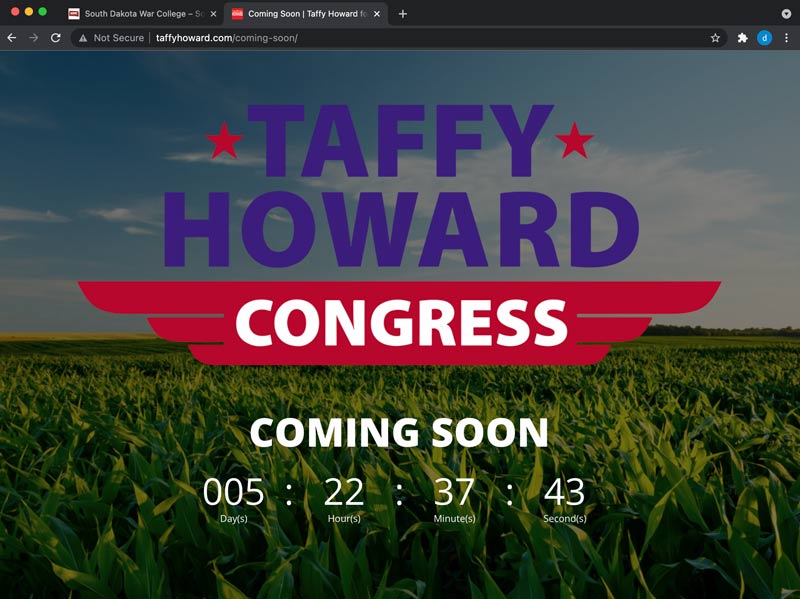
A website to take donations and attack her opponent. That directly says “Taffy Howard for Congress.”

Maybe it’s my cynicism, but this doesn’t sound like someone who is “considering” or “simply exploring” a race.

US Senator John Thune’s Weekly Column: The Fight to Save the Farm

The Fight to Save the Farm
By Sen. John Thune

The long, sun-soaked days of summer have started to shorten, and for kids across the country that can only mean one thing: back to school. In suburban communities or coastal cities, the end of summer might signal the end of family beach trips or days spent lounging by the pool. But for farm families in South Dakota, it unfortunately means one less set of hands – or more – to help with the seemingly endless tasks of summer.

Picking rock with your sister, moving cows, fixing fence with grandpa, and long days in the field eating lunch – and probably supper – in the cab of a tractor is the summertime norm for most farm kids. It’s what their parents and their parents’ parents likely did too – even without the luxury of an air-conditioned cab. From a very young age, kids in rural America are taught to understand the value of a hard day’s work. No one thinks twice about getting their hands dirty. It’s exactly what the generations before them worked so hard to preserve through all of the ups and downs that exist on a family farm.

If you grew up in a rural community like the ones scattered throughout South Dakota you might be surprised that Democrats in Washington are now proposing tax cuts for coastal elites and all the free stuff you can imagine by taxing this way of life – your way of life. It’s becoming clear that for Washington Democrats success and hard work isn’t something to be celebrated, but something that should be taxed.

Our current tax code provides for something called “step-up in basis.” That’s Washington jargon for this: If you’re left something by a loved one who died – whether that’s land or a house – the value of that item is automatically “stepped up” from its original value to its current market value when you receive it. You don’t have to pay taxes on that increase, and you shouldn’t have to. Those gains over time are often unrealized. In other words, you didn’t profit from the increased value while the asset remained in the family. It allows your grandparents and parents to pass the family operation from one generation to the next without penalty. Unfortunately, Democrats want to get rid of this longstanding tax policy, but not if I have anything to do with it.

During my time in Congress, I have helped lead the fight against the death tax. And now I am doing the same with what would amount to a double death tax on South Dakota’s family-run farms, ranches, and small businesses.

I recently introduced an amendment to the Democrats’ budget blueprint to highlight the importance of preventing this double death tax from becoming law. It was approved 99 to 0, and I’m glad all of my Democrat colleagues acknowledged how problematic this change in law could be, but don’t be fooled by their vote. Unfortunately, immediately after passing my bipartisan amendment, all but one Democrat also voted for a watered down version. Long story short, they’re doing legislative gymnastics and trying to have it both ways, and if they get their way, I have no doubt it will be a death blow to rural communities in South Dakota.

Now, summertime in these rural communities isn’t all work and no play. There is 4-H and rodeo, fairs to showcase art, produce, and livestock. Maybe there’s a baseball or softball game, too. But the fun stuff usually comes after the days’ chores are done. Life typically revolves around family and community, and it is all underpinned by hard work and sacrifice.

Farming and ranching isn’t just an occupation, it’s a way of life for the whole family, and it is one to be proud of. And as far as I am concerned, Democrats in Washington could stand to learn a few of these lessons from the heartland.

This fight is far from over. I will continue to do everything in my power to stop the Democrats’ attempt to fund a reckless tax-and-spending spree on the backs of hardworking South Dakota families, farmers, and ranchers. The South Dakota way of life, and the preservation of the family farm, is certainly something worth fighting for. I always will.

###

Congressman Dusty Johnson’s Weekly Column: Work is Opportunity

Work is Opportunity
By Rep. Dusty Johnson
August 12, 2021

Like many South Dakotans, I grew up in a working-class family where the value of hard work was instilled in me at a young age. The ability to earn an income and support your family is one of the greatest opportunities America has to offer.

The COVID-19 pandemic hindered this opportunity as businesses and schools closed across the country and many families found themselves hard-pressed financially.

The federal government took unprecedented steps to ensure that those who were most affected by the pandemic could receive assistance. Bipartisan supported programs like the Paycheck Protection Program were temporarily enacted to keep employees on payroll and help those most in need.

Now, in the midst of reopening our nation’s economy, many of the temporary changes are still in place a year and a half later and hindering our recovery efforts.

The following policies are keeping people from returning to work:

  • Work requirements to receive Supplemental Nutrition Assistance Program benefits remain repealed.
  • The additional $300 a week in federal unemployment benefits continues in 25 states.
  • The automatically reenrolled advanced payments on the expanded Child Tax Credit have started, laying the foundation for universal basic income, a long-sought goal of socialism supporters.  

There is simply no incentive to work when social safety net programs make it more lucrative to stay at home. This is evident in the fact that the labor participation rate remains near peak-pandemic levels.

However, there was good news this month. After half of the nation’s Republican governors ended the extra federal unemployment benefit, the July jobs report did show a lower unemployment rate than past months.

According to a study by the Foundation for Government Accountability, unemployment claims have declined by 30% in states like South Dakota where additional unemployment benefits have ended. Meanwhile, in states that have kept federal unemployment benefits, new unemployment claims continue to rise. The data doesn’t lie – taking away the incentive curbs unemployment and gets people back to work. That’s why I’ll continue to push my Get Americans Back to Work plan which would end the additional federal supplemental unemployment payment across the board.

The American dream is built on the notion that anyone can succeed if they work hard. Work should not be viewed as a punishment, but rather a way forward.

Work yields opportunity, work enriches communities, and work leads to a more prosperous nation.

Our government should encourage work, rather than disincentivize it.

###

Governor’s staff mentions that SDPB funding could be an issue in the near future.

If you recall several days back when I wrote about a social media post from former legislative candidate Joel Koskan against public broadcasting’s funding, the issue seems to have come up again.

Except this time, it’s coming from close to the top as a member of Governor Kristi Noem’s staff mentions that it could be an issue in the near future:

When reached for comment on the governor’s stance regarding SDPB’s funding, Noem’s Communication Director Ian Fury credited the idea’s discussion with SDPB “supporting radical ideology,” but avoided saying the governor supported cutting funding now.

“We’re not surprised to see citizens and legislators voicing their opposition to SDPB supporting radical ideology,” Fury said. “Ibram Kendi and out-of-state professional activists do not represent the values of South Dakotans. SDPB should challenge those individuals on-air for their radical liberal and Marxist beliefs, not give them a free pass from critique. SDPB can do better.”

Read it all here.

Secretary Mike Leidholt Announces Retirement

Secretary Mike Leidholt Announces Retirement

PIERRE, S.D. – Today, South Dakota Secretary of Corrections Mike Leidholt announced his retirement. Governor Kristi Noem issued the following statement:

“I am grateful to Mike for his service to South Dakota and our Department of Corrections. While it is now clear the issues at the Penitentiary were the responsibility of others, I believe new leadership is needed to address the ongoing challenges in our prison system.  I wish Mike well in his retirement after more than four decades of service in South Dakota law enforcement.”

With 43 years as a law enforcement specialist, including 24 years as Hughes County Sheriff, Secretary Leidholt provided valuable experience in leading the Department of Corrections. He also is a past president of the South Dakota Sheriffs’ Association, the National Sheriffs’ Association, and the Dakota Territory Sheriffs’ Association.

Secretary Leidholt’s announcement comes of the heels of the department’s announcement that it will begin a third-party review of practices across the system. The governor has targeted improving standards, increasing recruitment efforts, and implementing new protocols to address the safety of inmates and staff. Tim Reisch will continue his role as interim secretary until a permanent replacement is announced.

###