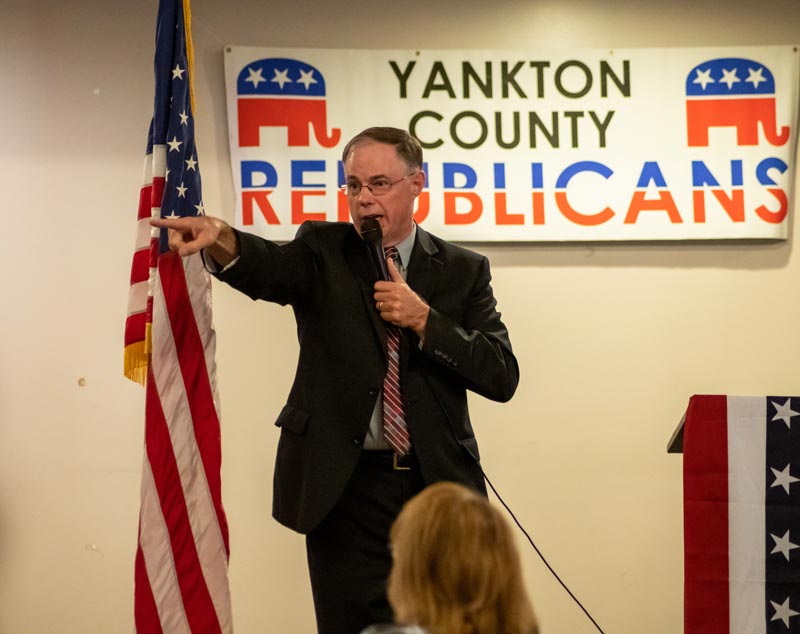
I don’t want to assume that Mowry is unpopular in GOP circles, but… dang. When you’re running for US Senate and the only people who want to join you at your table are your wife and your hat, you definitely have a ways to go in the campaign.
Gov. Kristi Noem to Delay Social Studies Standards
PIERRE, S.D. – Governor Kristi Noem has directed the Department of Education to delay the process to consider revisions to the state’s social studies standards up to one year. She issued the following statement:
“The Department of Education changed the working group’s recommendations to the social studies standards significantly, but it is clear to me that there needs to be more public input to bring greater balance and emphasis on our nation’s true and honest history. Following public feedback from several constituencies, it is clear there is more work to be done to get this right.
“We will be delaying further formal action on the draft social study standards to allow more opportunity for public input, increased legislative engagement, and additional voices to be heard in this discussion.
“Our focus remains the same: ensuring that South Dakota students learn a true and honest account of American and South Dakota history.”
Governor Noem intends to ask the South Dakota legislature to pass legislation codifying Executive Order 2021-11, and banning critical race theory and action civics as the basis for instruction in South Dakota schools.
I mentioned it earlier, but Mark Mowry’s participation in the Jan 6 election protests in Washington DC have caught the attention of the mainstream media today:
Spearfish resident and long-time musician Mark Mowry earlier this year filed his candidacy to unseat Sen. John Thune in the 2022 Republican primary election, fueled by the senior senator’s unwillingness to question the validity of the presidential election.
Mowry told the Argus Leader in a recent interview that he participated in demonstrations near Capitol Hill the day Congress was set to confirm the results of the Nov. 3 election, three months before deciding to challenge South Dakota’s three-term senator. But he was not part of the riots that broke out and led to protesters storming the Capitol, he said.
Governor Noem and Republican Governors Call on President Biden to Change Failed Border Policy
Request Meeting with President Biden at the White House
PIERRE, S.D. – Today, Governor Kristi Noem and 25 other Republican governors wrote to President Biden, urging him to change his failed border policy. The governors requested a meeting within the next 15 days to address this crisis. You can read the letter here.
“The months-long surge in illegal crossings has instigated an international humanitarian crisis, spurred a spike in international criminal activity, and opened the floodgates to human traffickers and drug smugglers endangering public health and safety in our states,” wrote the governors. “A crisis that began at the southern border now extends beyond to every state and requires immediate action before the situation worsens.”
Governor Noem had previously deployed 48 South Dakota National Guard troops to the southern border for a two-month deployment. This was in response to a request from fellow governors Greg Abbott of Texas and Doug Ducey of Arizona. Governor Noem subsequently announced that South Dakota will be sending an additional 125 members of the National Guard to the border for a 9 to 12-month deployment at the behest of the federal government. That subsequent deployment will be made later this year.
The governors highlighted the efforts by the states to fill the void left by the Biden Administration’s policy mistakes: “While governors are doing what we can, our Constitution requires that the President must faithfully execute the immigration laws passed by Congress. Not only has the federal government created a crisis, it has left our states to deal with challenges that only the federal government has a duty to solve.”
Governor Noem was joined in signing the letter by Arizona Governor Doug Ducey, Texas Governor Greg Abbott, Alabama Governor Kay Ivey, Alaska Governor Mike Dunleavy, Arkansas Governor Asa Hutchinson, Florida Governor Ron DeSantis, Georgia Governor Brian Kemp, Idaho Governor Brad Little, Indiana Governor Eric Holcomb, Iowa Governor Kim Reynolds, Maryland Governor Larry Hogan, Massachusetts Governor Charlie Baker, Mississippi Governor Tate Reeves, Missouri Governor Mike Parson, Montana Governor Greg Gianforte, Nebraska Governor Pete Ricketts, New Hampshire Governor Chris Sununu, North Dakota Governor Doug Burgum, Ohio Governor Mike DeWine, Oklahoma Governor Kevin Stitt, South Carolina Governor Henry McMaster, Tennessee Governor Bill Lee, Utah Governor Spencer Cox, West Virginia Governor Jim Justice, and Wyoming Governor Mark Gordon.
(Editor’s Note – Presenting another longform column that ran from this last week in it’s entirety from the SDWC’s sister website South Dakota Political News – PP)
SDGOP Generation Next – The shape of GOP leadership as we move towards 2030
As we prepare for yet another round of redistricting, another gubernatorial election, and another US Senate election, it’s a good.. or maybe an inevitable indication that the environment we see today will not always be what we see. Time always marches on, and a new group of leaders will be there talking the place of the old.
For example, In 2011, our constitutional officers were..
Dennis Daugaard, Governor
Matt Michels, Lieutenant Governor
Jason M. Gant, Secretary of State
Marty Jackley, Attorney General
Steve Barnett, Auditor
Richard Sattgast, Treasurer
Jarrod Johnson, Commissioner of School and Public Lands
Gary Hanson, Chris Nelson, & Kristi Fiegen, Public Utilities Commission
Well.. 5 of the 10 were different than we now have a decade later. And 20 years ago, the slate was completely dissimilar.
Part of what I spend a lot of time doing is trying to predict, or to game out what the future of the political landscape is going to look like. And looking down the line, there seems to be some population and political trends that help us in making an educated guess on who our state’s future leaders might be.
20 years ago, we were more geographically diverse in who served in elected office. Now, we seem to be coalescing to certain areas. I think that trend will continue will more concentration to our population centers as we cruise towards the next decade.
While it had already been broken at the Federal level, Kristi Noem shattered the glass ceiling for who we consider for leadership. And looking at the current makeup of the legislature, many of the more dynamic potential candidates moving up through the ranks look a lot different than they did a decade ago.
Absent a drastic change in political landscape, I think we’re going to remain fairly red.. but we may start to see a bit more purple shading in Sioux Falls. And I’ll just stop there, as this post will get far too long and too far afield if I don’t. As opposed to talking about 2030’s environment – let’s talk about who to watch.
With that, let’s consider and predict what the SDGOP’s “Generation Next” – the future class of elected leaders – is going to look like.
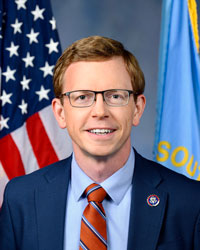
Dusty Johnson
The only person who arguably war games the political environment out as much as a political blogger and will be at the top tiers of elected office is our current Congressman Dusty Johnson.
Except by 2030, he’s no longer going to be Congressman. Expect that Dusty will be in the middle of a term as Governor or US Senator. As hard as it is to imagine, by 2030, Dusty will be the GOP’s future elder statesman.
Dusty is one of the hardest workers in politics and has an indefatigable ground game. If he’s not there in person, he will have people at parades, events, fairs, dinners, etcetera. He can raise money, is popular without being polarizing, and is viewed as intelligent and competent.
If you want to continue to win elections in this state, you have to appeal to a broad base, and Dusty knows how to do it.
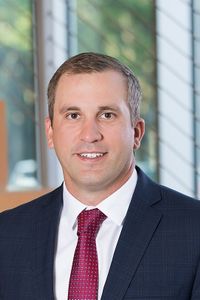
Casey Crabtree
The State Senate is approaching what we can anticipate as an inevitable change of leadership with Senate Majority Leader Gary Cammack hitting term limits in that chamber. While we won’t see a drastic change of the people in the Senate, with those that will go, and the new people coming in, changes are coming which would favor Crabtree moving from Majority whip into a higher position among his peers. If not this next term of office, a future one will be coming which will likely place him in Senate leadership.
Crabtree also has the advantage of coming from what I loosely term as the I-29 corridor, the Eastern-most portion of the state with the majority of the population, the majority of the media, and the majority of the backing to achieve statewide elected office.
As the Director of Economic Development for Heartland Consumers Power District, his name is in front of and he touches a tremendous number of people in his day job and rubs shoulders with our state’s captains of industry. It’s a strong and enviable position if he might contemplate running for statewide office.
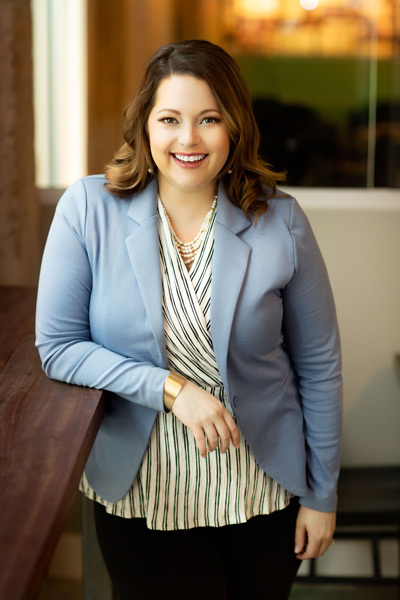
Taylor Rehfeldt
Taylor Rehfeldt is part of a new class of candidates that came onto the horizon this election from the health care industry. They were particularly remarkable in that they were exceptionally strong & savvy ground campaigners, and they were reasonably able to raise money. In her first election cycle, between the primary and the general election Rehfeldt was able to bring in over $56,000.. which is pretty darned good for a first time candidate.
Add to that the fact that Rehfeldt is from Sioux Falls. Yes, in days gone by you might consider that a liability, but no more.
Technically, it’s Dr. Taylor Rehfeldt, as she holds masters and doctoral degrees. Dr. Rehfeldt has been recognized in her professional community as well as in the Sioux Falls professional community for her accomplishments. She’s on the fast track for future opportunities as a statewide leader to watch.
Sydney Davis
Sydney Davis is another health care professional who came on to the scene last year who despite no prior experience in politics managed to run an aggressive ground game and was the top vote recipient by just under 500 votes in a 4-way legislative contest in southeast South Dakota.
Davis holds a nursing degree from SDSU, and a master’s degree from Mt. Marty, and is another candidate who benefits from having her home where the voters are, in the I-29 corridor. But she also brings a particular appeal besides living in the right place.
Because Davis also boasts strong attachments to the agriculture industry. Davis grew up as a 4-H and FFA kid and is a 4th generation cattle producer, bonafides that can only help her appeal to a broad base of South Dakotans.
With redistricting, anticipate Davis will likely move up to the State Senate in short order, with opportunities for statewide office to follow.
Erin Tobin
State Senator Erin Tobin rounds out the trio of healthcare professionals who were swept into office in 2020, and she’s the kind of candidate that opponents should fear. She taught that lesson to the outgoing House Majority Leader in the last election when she took him out more than 60-40% and utterly destroyed her general election opponent nearly 80-20%.
It goes without saying that she’s a tremendous campaigner in a legislative district which stretched far and wide.
Erin is a conservative pro-life Republican who sweeps away preconceived notions of a ranch wife/ag producer, adding medical professional, university instructor and small business owner to her resume. Regularly working in health care from South Central South Dakota as far east as Yankton, and acting as an instructor with USD, Erin touches a very broad base across the state.
Tobin literally follows in the footsteps of a trail blazed by Governor Kristi Noem, and it would not be unexpected at all to see her throwing her name in the ring for Congress or other statewide office if the timing was right.
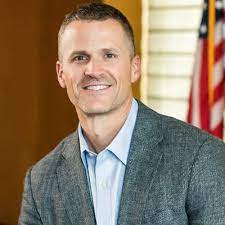
Paul TenHaken
Until he was mayor, he had never held elective office, or served on the Sioux Falls City Council. But he was (and is) honest, forthright, social media savvy and genuine. And he can raise money (235k+) for a mayoral race as expensive as many statewide races. Paul TenHaken is also the best-known politician in the state who hasn’t ran for statewide office yet.
Yet. Because I suspect his time will come. And it will come soon. In his previous electoral effort, TenHaken emerged from a field of six candidates in an initial race, and swamped his opponent in the runoff election on a vote of 62.7 – 37.3% Hardly a day goes by without being mentioned in the state’s largest media market, and generally he’s been able to avoid controversy, and maintain a strong popularity as forward thinking and business oriented.
His only fault might be that he’s too nice, even to fairly cut-throat opponents. But, in South Dakota we don’t punish civility. In fact, we tend to elect it as we see our better angels. Unless he chooses to go back to business – a successful one at that – Paul may eventually end up as one of our US Senators.
Will Mortenson
Besides the I29 corridor, the only other place successful statewide candidates seem to hail from is the Pierre/Ft. Pierre area. And Will has the potential, political savvy and experience to translate that into a run for office.
Will Mortenson has family roots in Central South Dakota’s ranching community. There are not many around Pierre who have not heard of the Mortenson Ranch which goes back generations as a working cattle operation along and near the Cheyenne River in Stanley and Ziebach Counties.
He worked in the Governor’s office as a policy analyst before attending the University of Virginia School of Law where he received his J.D. All during this time and since, Mortenson has been a close confidant and one of Congressman Dusty Rounds primary supporters. To put it mildly, he knows what he’s doing in politics.
Mortenson’s ties are deep in the Republican party, and he has the know how and connections to continue an upward trajectory among his peers in the SDGOP and to translate that into higher office.
Maybe Lee Schoenbeck… If we can talk him into it.
If I could talk him into it, I’d love to see current Senate President Pro Tempore Lee Schoenbeck running for Governor in 2026. But that’s assuming Lee feels like a go for a Gubernatorial level of political nonsense at that point in time.
This last election, Schoenbeck’s political calculus was dead on, and he was able to make things happen. Not to mention personal connections at the highest levels of industry in the state, and an almost unmatched ability to raise money.
Schoenbeck was literally at the point of pulling the trigger several years ago against Lt. Governor Daugaard, but at that time, Lee’s chief fundraiser became unavailable. At the time, Lee noted that he could either raise money or run for office, but not do both jobs at the same time and have a life. Which is an indication that he’s one of the state’s best campaign minds – because he understands what it takes to compete at that level.
Will he be up for it in 2026? If so, I’m in.
What about Kristi Noem?
Governor Noem has 4 years on her next term of office.. and she’s being talked about for the highest office in the land in the middle of it. I have the suspicion that by 2030, Governor Noem will still be part of a national level of politics.
So, absent a very outside chance she’s in the US Senate, I’d watch for her to be in the executive branch of the federal Government in one way or another.
The funny things about politics are that they change on a dime. People come, people go, and the unpredictable happens. Job opportunities come up. Unforeseen events come up. People do things that affect them negatively.
If there is anything predictable, is that the future is unpredictable. But looking at it through the lens of 2021, we can make a few guesses. And we’ll see how the dice land when things are done rolling.
And that’s what my crystal ball sees for the year 2030.
You can find out exactly where your T-shirt was made if you check the tag or label. Is it too much to ask for the same level of certainty when it comes to the beef you feed your family? The answer is plain and simple: no.
Unfortunately, the current beef labeling system in this country allows imported beef that is neither born nor raised in the United States, but simply finished here, to be labeled as “Product of the U.S.A.” Strange, right? In theory, the ground beef you picked up from the grocery store to fire up on the grill this weekend during the game could have originally come from Brazil. Just because it was packaged here in the United States, there could still be a misleading label on it. At that point, the only thing that’s potentially made in the U.S.A. is the packaging it’s wrapped in — if that.
In South Dakota, we take our beef seriously. Like you, if I’m at the local grocery store, I want to make sure the beef I’m buying is coming from producers in our state or one of the other beef-producing states around the country. After all, South Dakota cattle producers work tirelessly to produce some of the highest quality beef in the world.
As a longtime member of the Senate Agriculture Committee, standing up for South Dakota’s cattle producers is, and always will be, a top priority for me. I recently introduced the American Beef Labeling Act, which would require the U.S. trade representative (USTR), in consultation with the U.S. secretary of agriculture, to develop a World Trade Organization (WTO)-compliant means of reinstating mandatory country of origin labeling (MCOOL) for beef. The WTO is essentially the global referee when it comes to trade between nations. Specifically, my bill would give USTR six months to develop a reinstatement plan followed by a six-month window to implement it. If USTR fails to reinstate MCOOL for beef within one year of enactment, it would automatically be reinstated for beef only. That would ensure when you see a label on your beef, you can trust it.
Since coming to Congress, I have been a staunch and consistent supporter of country of origin labeling. I believe that in order to ensure the viability of cattle production in this country, the system in which producers operate must be fair and transparent. I voted in favor of both the 2002 and 2008 farm bills, which included MCOOL that the WTO unfortunately struck down. Throughout the years, I have supported nearly every piece of legislation that has crossed my desk that prioritizes country of origin labeling. And I won’t stop until we get the results our producers need and want.
I recently had the pleasure of speaking at the South Dakota Stockgrowers Association convention in Spearfish about the importance of implementing MCOOL. Folks were crystal clear: South Dakotans want to know where their food is coming from. And I agree.
This past year has showcased the vital role our farmers and ranchers have in the domestic food supply chain and the urgent need to strengthen it. Rest assured, I am working tirelessly to build support for my American Beef Labeling Act because having transparency in labeling that benefits both our producers and consumers is just common sense.
Now don’t get me wrong, there is a long road ahead in order to get this bill into law, but I’ve traveled long roads before. I’m thankful to have bipartisan support from my colleagues in the Senate, and I look forward to working with anyone who is willing to stand up and fight for our consumers and producers.
Recess Recap By Rep. Dusty Johnson
September 15, 2021
With August recess wrapping up and Members of Congress soon returning to Washington, I wanted to provide you with some of the highlights from my time spent in South Dakota over the summer work period.
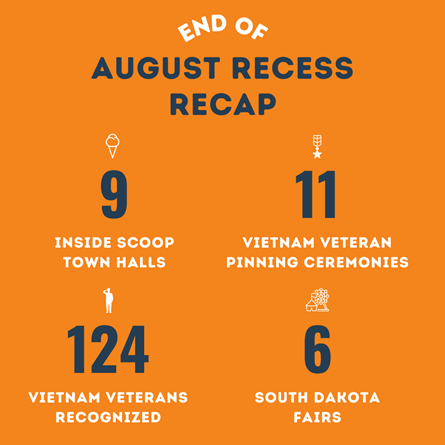
I hosted nine “Inside Scoop” town halls in South Dakota – they ranged from three people to one hundred people – but each one was as engaging and fruitful as the next. Topics ranged from infrastructure and our national debt, to border security and Afghanistan. I am grateful for the feedback and am eager to get back to Washington to work on the most pressing issues South Dakotans are facing.
Throughout the month of August, I had the honor to host eleven Vietnam Veteran Pinning Ceremonies across the state. In total, 124 veterans from the Vietnam era were recognized for their service. From Seabees to airplane mechanics, radio operators and nurses, South Dakotans dutifully answered the call to serve, despite the lack of recognition they received upon returning home.
During these ceremonies, veterans recalled sobering stories of protestors throwing tomatoes and being called names upon their arrival. Others shared more heartwarming stories such as a rifle platoon leader who met an Army nurse in Vietnam and the two eventually married – they have now been married 51 years. It was truly remarkable to listen to South Dakota veterans share stories from a time that is often still difficult to discuss aloud. After many decades, I was honored to look these veterans in the eye and thank them for their service on behalf of a grateful nation.
Finally, nothing says summer in South Dakota quite like a fair. Over the last few weeks, I visited with folks at Dakotafest, Central States Fair, Turner County Fair, Brown County Fair, Sioux Empire Fair, and the South Dakota State Fair. I also had the opportunity to volunteer at the ticket booth, greeting folks as they walked in. It was great to share a few laughs, meet new South Dakotans, and enjoy the beautiful summer weather while eating delicious fair food.
August shaped up to be a rather busy month, but I am feeling rejuvenated from time spent away from the hustle and bustle of Washington D.C. I look forward to heading back to Congress and working on the important issues facing our nation.
After Mark Mowry was hitting Republican Dinners this week, the other candidate who probably won’t be able to get on the ballot, Bruce Whalen, filed his papers making it official in the eyes of the Federal Elections Commission that he’s sort-of running for the US Senate.
What’s maybe more interesting is that it tells us that Whalen has a website out there for the race.. at least if you can get through more than a page at a time without it crashing the browser. But I do see it offers a press release dated from today, 9/19:
FROM BRUCE WHALEN FOR US SENATE, FOR IMMEDIATE RELEASE
Bruce Whalen is showing no signs of slowing down, but he is proceeding with caution through the legalities of campaign finance law. A growing team of supporters finds it more difficult to contain itself as the Whalen team moves in inches, and brings their friends.
Among last evening’s speakers was US Senate candidate Mark Mowry. While he probably won’t get on the ballot, he is out hitting a few of the Republican dinners, claiming that “South Dakotans overwhelmingly question the veracity of the 2020 general election.”
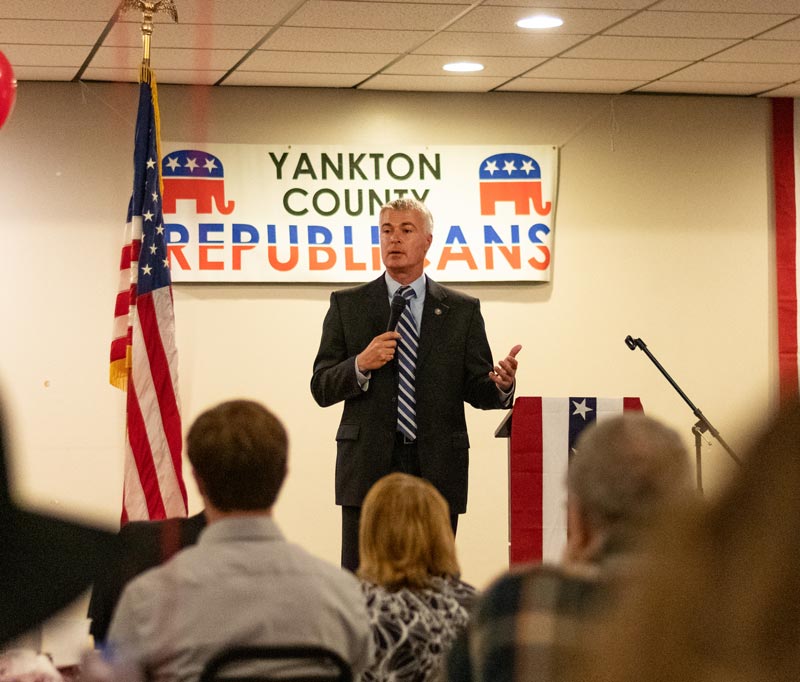
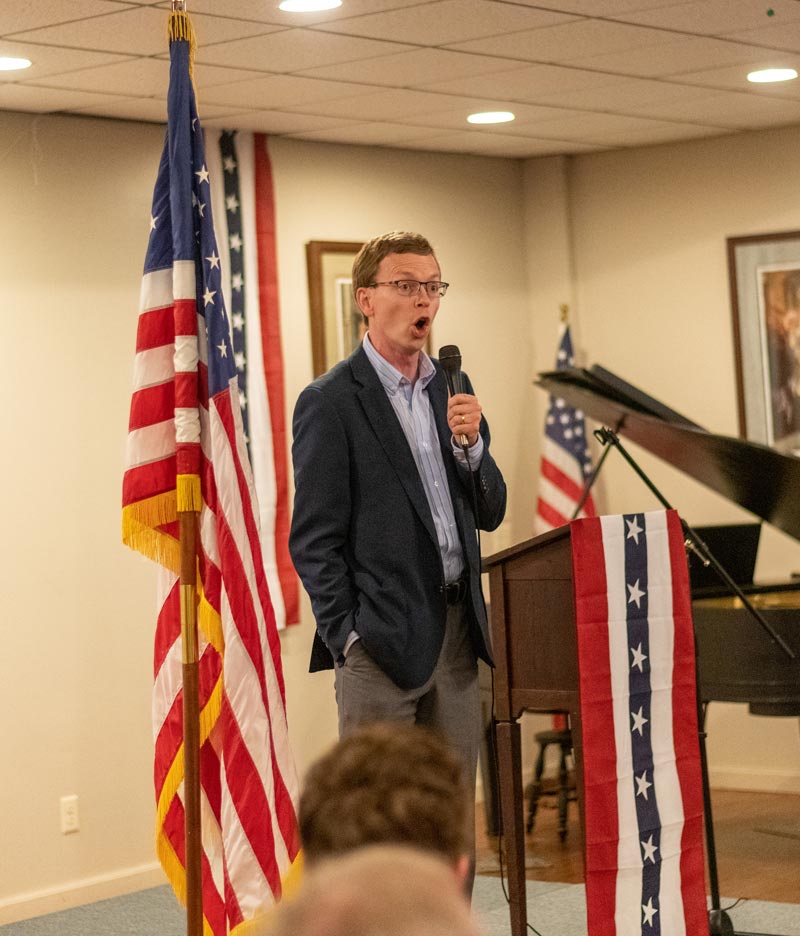
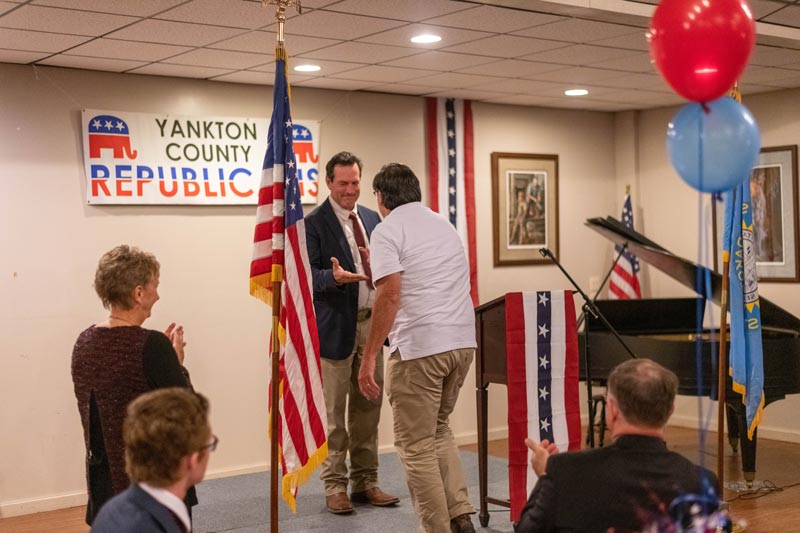
With her second Lincoln Day Dinner in as many days, my daughter Sydney talked me into taking over driving duties to Yankton yesterday, and so I joined her and Congressman Johnson and attended the Yankton County Republican Lincoln Day Dinner last night. And I’m glad I did. I got to see a number of friends, and it was a very well done event. So, I thought I’d share a few highlights from last evening:
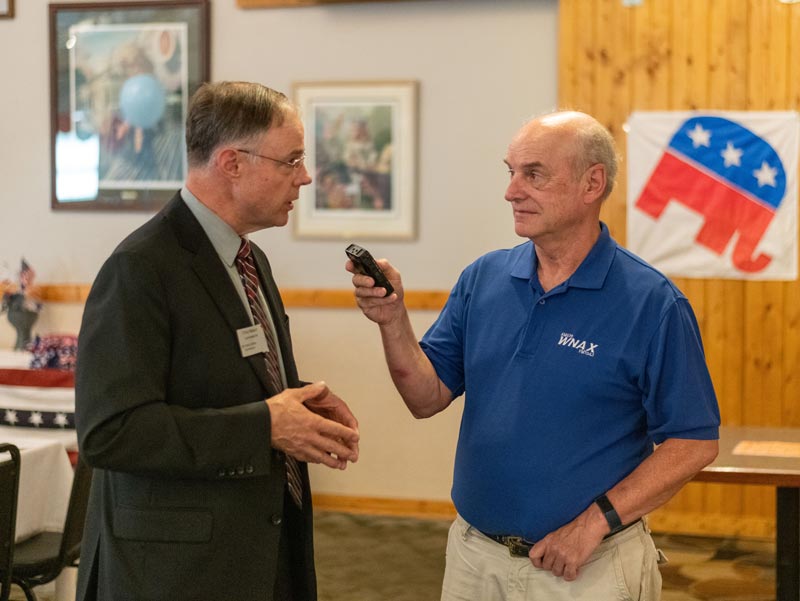
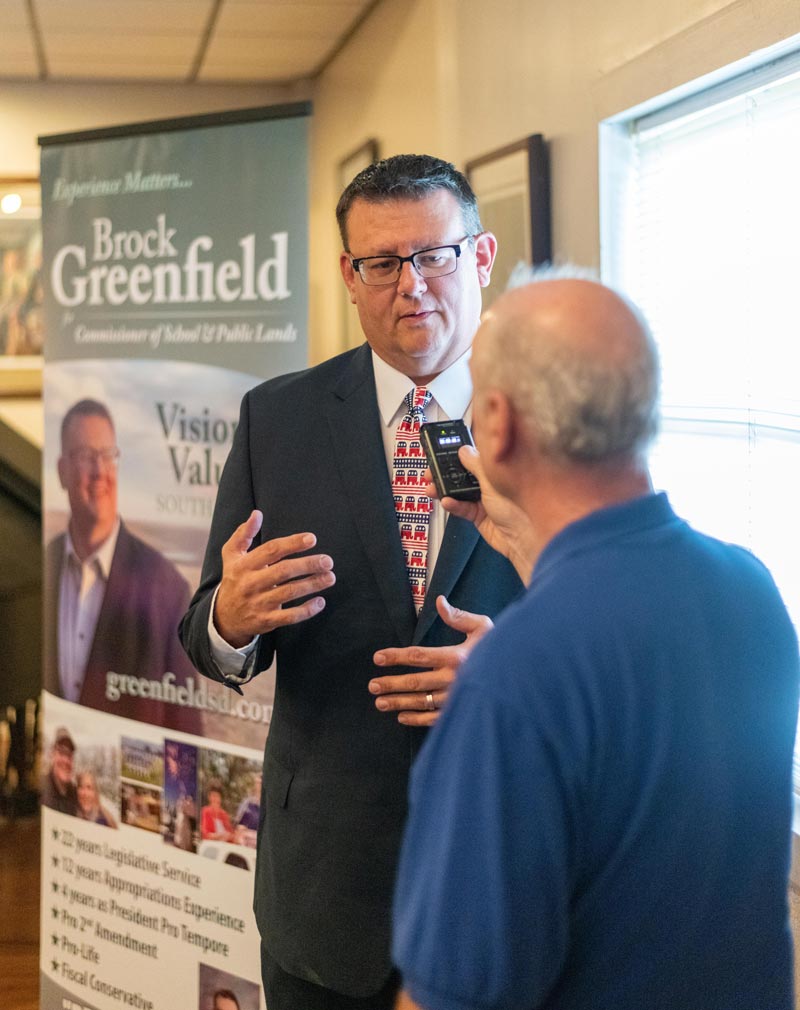
Host Chris Nelson is interviewed by WNAX, as is School & Lands candidate Brock Greenfield:
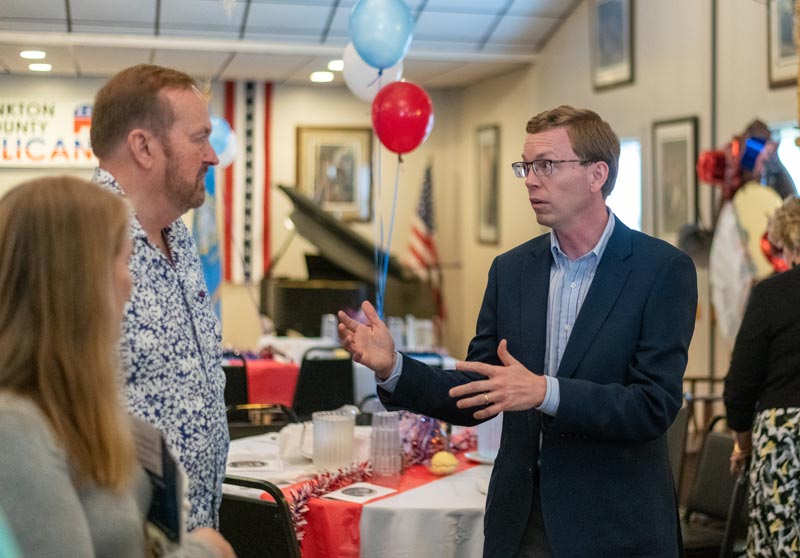
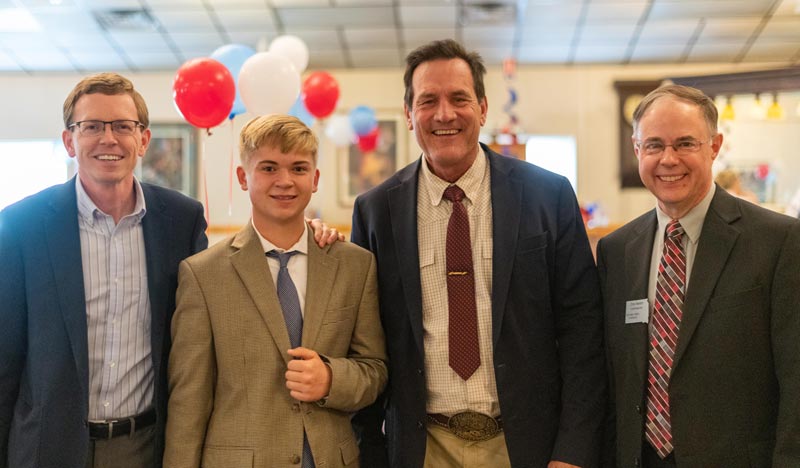
Congressman Dusty Johnson talks with a few attendees during the social hour, and snaps a picture for a young man interested in politics along with Lt. Governor Rhoden & Chris Nelson:
Chris Nelson auctions some fundraising items, Marty Jackley addresses the crowd, and Dusty Johnson rallies the group:
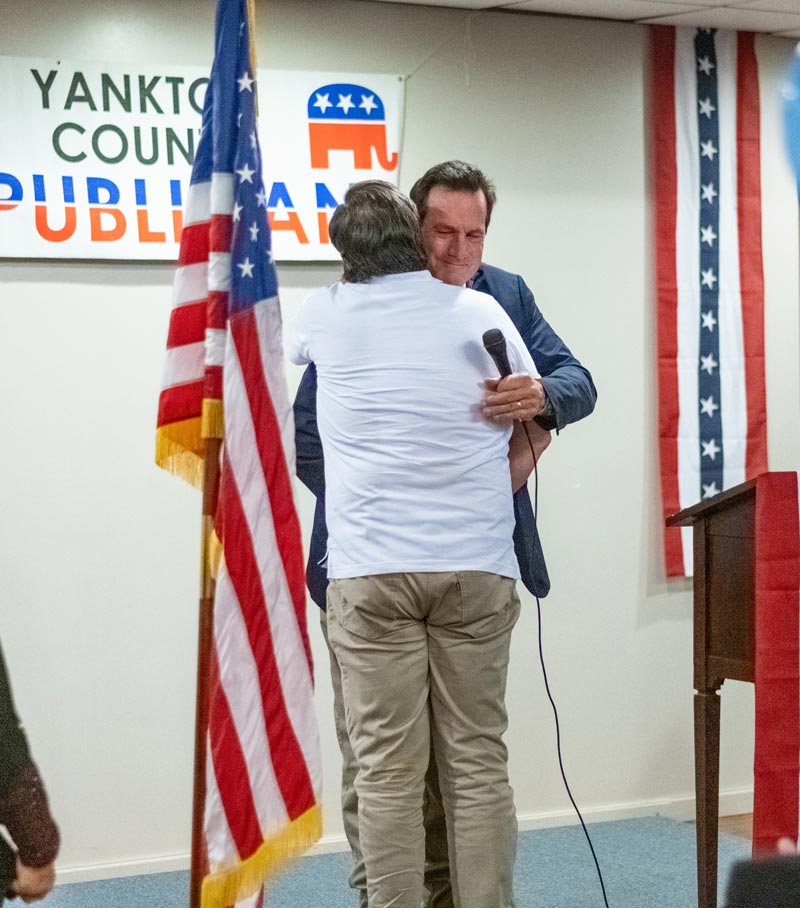
And Lt. Governor Larry Rhoden thanks former Lt. Governor Matt Michels for his leadership and mentorship, and presents him with a challenge coin in appreciation:
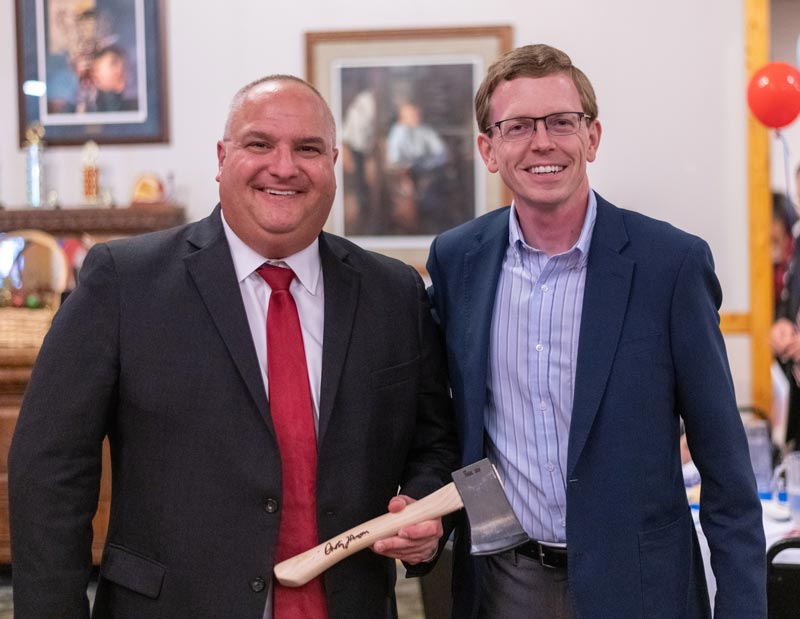
And SDGOP Chair Dan Lederman wanted to ax Dusty about something after the event…







 With August recess wrapping up and Members of Congress soon returning to Washington, I wanted to provide you with some of the highlights from my time spent in South Dakota over the summer work period.