Northern Plains News: Applied Digital pitches Deuel County AI facility as tax reform, national security issue

Applied Digital pitches Deuel County AI facility as tax reform, national security issue

Company executives say South Dakota’s energy, climate, and workforce give it an edge in the global AI race — but current tax law puts the state at a disadvantage.

Northern Plains News, LLC
By Steve Jurrens \ Northeast Radio SD News

WATERTOWN, S.D.—The proposed Applied Digital AI factory in Deuel County aims to enhance local tax revenue and serve as a strategic effort to maintain American technological competitiveness globally.

In a recent interview, Nick Phillips, executive vice president of external affairs for Applied Digital, said South Dakota’s cold climate and energy surplus position it as a key player in the international AI competition.

A TOOL FOR LOCAL INDUSTRY

Phillips addressed common anxieties regarding artificial intelligence, characterizing it not as a replacement for human workers, but as a transformative tool.

He cited examples from the “Grand Farm” initiative near Fargo, where AI analyzes soil and imagery to help farmers increase yields while using fewer resources.

“If you’re still out there with a manual mower… you’re not paying your bills,” Phillips said. “Technology has changed. This is just an extra tool for us to utilize.”

Phillips also shared a personal account of how AI helped his family navigate a medical diagnosis, emphasizing that the technology’s benefits are already being felt in healthcare and energy production.

THE LEGISLATIVE LANDSCAPE

Despite the region’s operational benefits, Phillips said current state law makes South Dakota an outlier. Along with Colorado, South Dakota is one of the few Midwest states that charges sales tax on data center equipment.

Rep. Kent Roe has proposed legislation to eliminate what Phillips described as a “bricks and sticks” tax disadvantage. Phillips said the bill is essential to leveling the playing field with neighboring states such as Iowa and Nebraska.

“South Dakota energy is already powering these facilities in other locations,” Phillips said. “Why not bring home the benefits of having these facilities right in the state?”

Some local residents and lawmakers have raised broader questions about large-scale data centers, including long-term grid capacity, infrastructure strain, and whether projected tax benefits match public costs over time.

CONSUMER PROTECTIONS AND ACCOUNTABILITY

Phillips said the proposed law includes explicit protections designed to ensure that the arrival of a large-scale power user does not shift costs onto residential ratepayers.

He emphasized that Applied Digital is not seeking a “free ride,” but rather a tax structure that allows it to compete with other states for multi-billion-dollar investments.

COMMUNITY INVITATION

As the project moves forward, Phillips said Applied Digital plans to continue engaging with local residents.

He confirmed the company will host another town hall meeting in the third or fourth week of February.

“Spend the time to look at it,” Phillips said. “I don’t see any better economic development opportunity for the state of South Dakota right now than bringing folks in that are very compatible from a workforce standpoint.”

The facility is expected to bring 200 to 250 jobs to the area, primarily in mechanical, electrical, and facility maintenance roles.

More on shutting off access to legislators and facilities in the State House

I had someone send me more on the House blocking off access to the bathrooms. Accompanied with a photo, they noted that not only has the Speaker decided to prohibit public access to public restrooms, they’ve also sealed off access to the offices of the majority leader and assistant majority leader.

There’s the South Dakota House of Representative’s version of being open & transparent.

State Rep. Will Mortenson chides Governor Rhoden for problems in his property tax proposal

In Will Mortenson’s column in the Pierre Capital Journal today, the District 24 State Representative has some big problems with Governor Larry Rhoden’s property tax relief proposal, particularly that “his plan is paid for by a new tax, rather than spending cuts, and the math checks out.”

The Rhoden Plan would allow the establishment of a county-by-county sales tax of up to 0.5%, which would then be used to reduce homeowner property taxes. Because it is permissive, the plan would result in different sales tax rates county-by-county, depending on whether and how much each county chooses to increase its sales tax rate. If all counties adopt the plan, it would reduce homeowner property taxes by about 20%, spread unevenly across the state.

The big problem with the Rhoden tax plan is where the real estate tax benefit falls, and who pays to provide that benefit. The Rhoden Tax Plan focuses property tax relief on the biggest houses in the biggest towns. It is hard to imagine a property tax plan that would be a more direct shift of dollars from rural South Dakota to the bigger towns, and from lower-income South Dakotans to high-net worth property owners.

and..

Just as prominently, the Rhoden Plan allocates the bulk of the property tax benefit to the biggest houses in town. The plan calls for the property tax cut to be proportional to assessed value. So, someone owning a $5 Million house will receive twenty times the benefit of someone living in a $250,000 house. Most of the concerns raised by citizens about property taxes have focused on the middle-class, senior citizen homeowners on a fixed income. The Rhoden Plan doesn’t prioritize middle-class South Dakotans, who might only receive a cut of $200 or $300, but instead allocates the vast majority of the property tax relief to the biggest houses in town. 

Read the entire column here.

This is going to be a challenging year to figure out what form of property tax relief might possibly work.

Does this mean Shad Olson is now in charge of Brandei Schaefbauer’s legislation?

From Facebook:

Does this mean ex-newsreader Shad Olson is now in charge of State Representative Brandei Schaefbauer’s legislative activities?

He reads stuff on the Internet, writes up overly verbose proposals (today’s missive is overly long in typical ShadGPT form) and Brandei smiles, nods, and drops it in the hopper?

If Shad is going to take over as Aberdeen’s representative, does that mean he’s moving into the district?

What constituents are asking for this one? California Carley proposes new gold currency.

Really? Sometimes there’s legislation that leaves no doubt that we are going to hear a lot of crazy this year.

How many of you have reached out to your state legislator to tell them “I think we need to establish a new state currency based on gold or silver.” Show of hands?

We can’t figure out how to keep pace with state law on funding education this year, but we are wasting time & effort on this bag of goofiness?

Seriously.

SOS Monae Johnson responds to concerns over sharing of voter data

Secretary of State Monae Johnson was interviewed by KOTA TV regarding recent public concerns over the Secretary of State’s sharing of voter information with the Department of Justice:

“I’m supporting any effort to make our voter rolls clean, and it didn’t matter if it was a Democrat or a Republican president or The Department Of Justice, they have legal right to have that information that we have in our system,” said Johnson.
Johnson says the state turned over the rolls to the Department of Justice, but she declined to sign a memorandum of understanding as the state and federal government ultimately did not agree on terms.

“I’m supporting any effort to make our voter rolls clean, and it didn’t matter if it was a Democrat or a Republican president or the Department of Justice, they have legal right to have that information that we have in our system,” said Johnson.

Johnson says the state turned over the rolls to the department of Justice, but she declined to sign a memorandum of understanding as the state and federal government ultimately did not agree on terms.

Read/Watch the entire story here.

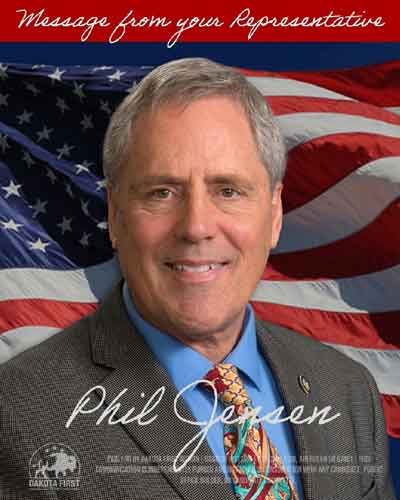
Rep. Phil Jensen lashes out at House leadership, claiming they have “declared war on conservatives.”

From South Dakota Searchlight, State Representative Phil Jensen apparently remains in a state of war with House Leadership after he was removed from House Education Committee over his behavior. According to the story filed today:

Odenbach told members of the media at a leadership press conference Thursday that Jensen and some other members of the House Education Committee planned “an effort to disrupt the committee,” which is “unacceptable behavior.” Republican leaders pulled the members from the room to “deal with the issue out of sight” of the public.

and..

Jensen alleged to South Dakota Searchlight that the Republican legislative leadership has “declared war on conservatives.” He said the new seating arrangement isolated conservative legislators from each other. House Speaker Jon Hansen, R-Dell Rapids, “threw” Jensen and other members of the committee “under the bus” by siding with the chair, Jensen alleged.

“The speaker chose to support an out-of-control chairman who instructed committee members last session to stop talking with each other and forbid them from using their phones to communicate on how they were voting on bills,” Jensen said in an emailed statement, adding that he and some other members were treated “as children.”

Read the entire story here.

I’m sure that’s going to end well for Phil.

Update..

If you think about it, Phil is complaining that the chair told them to stop secret discussions over their phones on how they were voting in committee. Not thinking he is going to win that argument.

Speaker Hansen reserves certain bathrooms for the legislative elite.

I noted it in the post below, but it’s worth pulling out of all that text. I was informed today by a lobbyist that Speaker of the House Hansen has now declared that some of the formerly public restrooms in the Capitol are now solely reserved for legislators.

Really?  Apparently it’s being overheard frequently that people have to say “I’m sorry are there public restrooms on this floor, or are they all reserved for legislators?”

I think someone is taking the legislature’s control of the 3rd & 4th floors a little too literally. Unless there are going to be a lot of votes that people have to hide on, I don’t think they aren’t going to be occupied so much they have to turn the public away. Or with it being an election year, are they?

The pitfalls of creating a protected class of elites. And what about all the elected officials they leave for the wolves?

In the legislature this session Attorney General Marty Jackley has several bills tweaking open government laws. As I’m sure we’ll see this session, legislators will be demanding more transparency in how government operates. Yet, at the same time we have House Bills 1083 and 1084 being introduced, weaponizing criminal law against taking note of legislators’ residential addresses, and wiping that same information from voter files.

That doesn’t sound very open. It doesn’t lend itself to transparency, and the threat of running afoul of a felony would cause most news organizations from even consider running a story that notes this information. It seems more like legislators will be voting on creating a protected class for themselves and standing apart from every other Joe Schmoe in the state.  That’s bad and contrary to a free society.

Why is disclosure of this information important for voters?  It is important to the responsibility they take on to fairly and equally represent the people of their district, their adherence to the laws the rest of us have to follow, and so voters may ensure that they live where they claim to live.

And they’re responsible to the voters to do that. The Secretary of State isn’t charged with verification. Legislators themselves aren’t that great about enforcing it. In past controversies of that nature, once they’re sworn in, they’ve claimed that the time for it is in the election.

So, it’s up to voters to judge. And if that information has now been designated as protected and secret under a proposed charge of a felony offense, then they’ve effectively silenced critics.  Is that what we’ve elected legislators to do? To use the legal system to crush and imprison critics?  If so, it’s a much different America than the one I thought I lived in.

I view elected officials as being on the same level as everyday people. No better, and no worse. And the availability of their un-redacted voter registration records should remain vital information with a public interest. In fact, I’ve written what might be dozens of news stories which are directly related to where candidates and legislators live as important and very factual information.  More recent stories include:

And those are the most recent examples. There have been many others over the years, but you get the point.  This all started with the examination of public records – including voter registration – and public information.

The first problem with the legislation is that Public information is how you eliminate elected officials’ temptation to flout the law, uncover conflicts of interest, and how a free citizenry can investigate improper actions. Making it privileged flies in the face of the public’s interest.

—

Part two of the problem with this legislation is a big question that we face right now in just plain communication: How do you get ahold of the people we sent to Pierre?

We have all these people who we sent to Pierre to represent us and – as of last year – they’ve removed their home addresses from the legislative website where we used to be able to write to them independently and say “Please support my bill” or “you’re great” or as the case might be, “you stink.”   Now, we’re limited to sending them mail up to the State Capitol. Which is great during session. But what about the rest of the time?

They might argue that we can e-mail them, which from some e-mail addresses doesn’t work so well in the system controlled by state government. And even in this day and age, especially for older people – not everyone has e-mail.

As many legislators have listed, another alternative is that we can call them at the phone numbers they have listed with their legislative profiles on the LRC website. The problem here is that many (most?) just provide the phone number to the House or Senate desk in the chamber. Has anyone tried to do this in July? This does not work so well at any time outside of session. It places the time and manner of constituent’s communication with legislators under the control of legislators. Not the people they work for.

Maybe it sounds like some tin-foil has rubbed off on my head, but these bills – 1083 and 1084 – come from a place of elitism, and placing legislators above us all.  In terms of communication, it says it’s ok for elected officials including legislators to have your address and send you mail (especially during campaign season). But if you want to do the same..  that’s a privilege reserved for them.

—

Interestingly, I was informed today by a lobbyist that Speaker of the House Jon Hansen has now declared that some of the public restrooms in the State Capitol building are now solely reserved for legislators.  Kind of like the protections being offered by the proposed legislation – they’re a bit elitist. Which gets to the third part of the problem with this legislation. Why are certain public officials singled out for special treatment, but not the rest? According to the proposed law making it a felony to disclose such information..

For the purposes of this section, “public official” means:

(1) An elected official holding statewide office;
(2) A federal or state legislator;
(3) A federal or state judge or justice; or
(4) A law enforcement officer as defined in § 22-1-2.

I don’t know that they publicize Judge’s addresses now, and for the record, I think judges and law enforcement officers could be treated differently, as they are enforcing laws and not representing voters. But according to the proposal, this is the definition they’re planning to work under..

(22)    “Law enforcement officer,” any officer, prosecutor, or employee of the state or any of its political subdivisions or of the United States, or, while on duty, an agent or employee of a railroad or express company or security personnel of an airline or airport, who is responsible for the prevention, detection, or prosecution of crimes, for the enforcement of the criminal or highway traffic laws of the state, or for the supervision of confined persons or those persons on supervised release or probation;

We’re worrying about railroad agents? A separate reason this legislation is not ready for prime time.

But getting back to topic of the publicly elected officials. Who do these proposed changes in law cover, and who does it not?

  • U.S. Senator (Protected)
  • U.S. Representative (Protected)
  • Governor and Lieutenant Governor (Protected)
  • Secretary of State (Protected)
  • Attorney General (Protected)
  • State Auditor (Protected)
  • State Treasurer (Protected)
  • Commissioner of School and Lands (Protected)
  • Public Utilities Commissioner (Protected)
  • 105 Legislators (35 Senate, 70 House) – (All Protected)
  • County Commissioners
  • County Sheriff (Protected)
  • State’s Attorney (Protected)
  • County Auditor
  • County Register of Deeds
  • County Finance Official (Combined office Counties)
  • Mayors
  • City Commissioners
  • School Board members

Bold text are those in the protected class under House Bill 1083. The offices in red are those the law proposes throwing to the wolves.  If the argument is that we need to protect elected officials from people who would do them harm, why does this law propose cutting things off at the legislative level (except Sheriff and State’s attorney by virtue of being law enforcement)?  Why are legislators worthy of protection, but County Commissioners and School Board members are not?  Sorry, Mayor Tenhaken. You might represent more than half of the people on this chart, but you’re not on the “special” list being proposed.

Where does the protected class start, and where does it stop? As far as this legislation is concerned, it seems to stop with them.

—

The problem is that this proposed legislative package – HB 1083 and 1084 – falls apart under many arguments.  1083 and 1084 are bad for transparency & open government. They’re horrible for citizens having access to communicate with the people who are supposed to represent them. And the measure is elitist, singling out some officials, including themselves, while excluding others.

Voters should take strong notice on where legislators sit on this measure, and whether they support the harsh legislation and preferential treatment it proposes? Or are they in favor of being one of the people they’ve been elected to represent.