Dusty Johnson on political violence; Quit demonizing each other, and talk together about how to get better

The Argus Leader interviewed Congressman Dusty Johnson on how we might quell the increase in political violence that seems to be getting worse in our country:

U.S. Rep. Dusty Johnson wants Democrats and Republicans to quit demonizing each other as the nation grapples with rising political violence.

and..

“I’ve got a list of things that I’ve identified that I can personally do to try to improve the quality of our discourse,” Johnson told the Argus Leader. “Give people the benefit of the doubt. Don’t always assume the other party is motivated only by malice. Don’t engage in whataboutism. If your side has done something wrong, be willing to analyze that wrongness and make changes where necessary rather than always try to turn the guilt to someone else.”

and..

“Don’t always be so quick to criticize others, right?” Johnson said. “Spend some time on personal reflection and try to figure out what you and the people in your universe can do to get better. That rarely means, it sometimes means, but doesn’t always mean public condemnation. Sometimes, it means that we talk together about how to get better.”

Read the entire story here.

Toby Doeden claiming was attacked over Charlie Kirk. Waiting for the police report

4% Gubernatorial wannabe Toby Doeden was involved in an incident yesterday at the Northern State University game where a woman allegedly did something which found her charged with simple assault and released.

Yet if we’re to believe his campaign manager, there were threats on his life and the whole thing related to the Charlie Kirk assasination.

Considering the aggressive promotion that the Doeden dumpster-fire team is pushing this story with across social media where he was assaulted by some woman… I think I want to see the police report before commenting further.

Governor highlights Board of Regents firing of USD Professor for facebook post critical of Charlie Kirk

This popped up on my social media this afternoon:

Obviously, the Governor took umbrage at the USD Professor’s comments, and noted that the Board of Regents intends to end his employment.   What do you think about it?

Did it go beyond free speech, and cross the line of decorum and discourse that university employees need to publicly exhibit?  Should there be a line that instructors should not cross?  What is the line?

Whether crazy people are out there killing kids, political figures on any part of the spectrum, or those in the media, those are all things it’s entirely appropriate to be concerned about.  It’s ok to say crazy people should not be killing people.  I suspect the way he went about it that has the leader of the state highlighting his removal from employment.

But at what point do we say “this is too far” outside of the freedom of expression that we will allow?

Looks like there’s trouble in Rapid City. That’s Trouble with a T, that stands for TIF…

Looks like there’s trouble in Rapid City, as Senator Taffy Howard and the Citizens for Liberty are now at war with a former ally of theirs that they used to be connected at the hip with.   If you’re not familiar with what’s going on, this is all surrounding the development of Liberty Land Amusement Park in Rapid City, and the Tax Increment Financing they were awarded to help make this huge Economic Development Project a reality:

The TIF would cap at around $125 million to support the development of Libertyland USA. Thirteen percent of the generated increment would go Rapid City to support surrounding infrastructure.

Alongside the planned theme park are plans for a neighboring retail and commercial center. The proposed district now heads to the full city council for approval. Rapid City Tax Increment Financing Planner Mike Dugan says the city says the project will be a great economic driver for the city.

Read that here.

But did I say there’s trouble in Rapid City? Possibly because South Dakota has a BANANA problem as of late, where we’re infested with people who insist upon “building absolutely nothing anywhere near anything.”  So, of course, the huge liberty themed project has run up against a roadblock of the Citizens for Liberty, who have come out against Liberty. Liberty Land, that is. They’re going to war with the patriotic themed amusement park.

As noted in the Rapid City Journal:

Two strong opponents since the first time Libertyland passed are state Sen. Taffy Howard, R-Rapid City, who represents District 34, and Tonchi Weaver of South Dakota Citizens for Liberty. Both have taken to the podium many times at council, finance committee and planning commission meetings to express their concerns with the Tax Increment Financing District. They’re spearheading the petition drive.

Read that here.

In the article on-line is a picture of Tonchi Weaver, and Julie Frye-Awful of the legislative suckling scandal who are both out campaigning against Liberty (land).  Citizens for Liberty has also taken to social media to campaign against Liberty (land):


So, in the face of the Citizens for Liberty’s opposition to Liberty (Land), what do the Liberty Land developers do? Apparently, they have gone and hired someone to organize the anti-petition effort, which has started with social media…

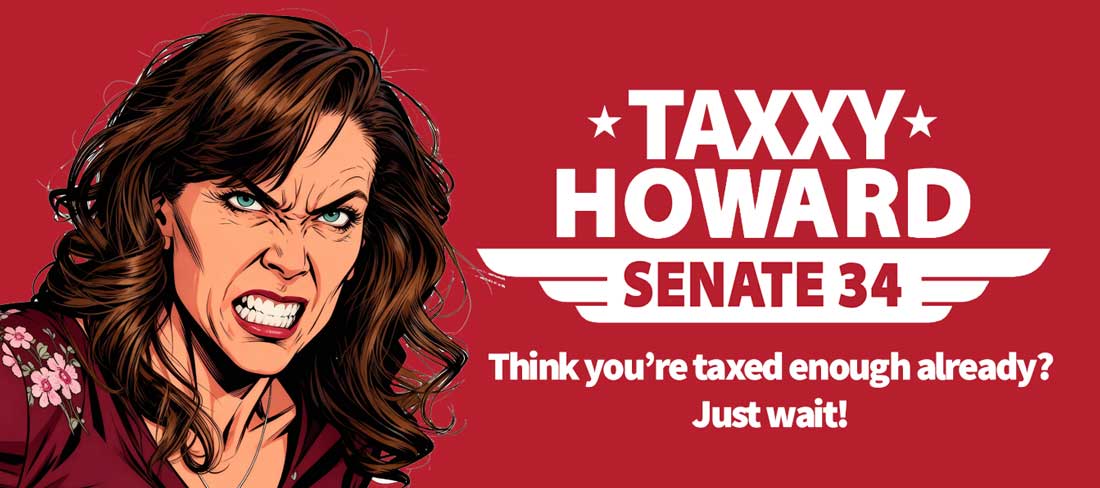
Umm… why does that design work look familiar? Overly wordy, and the identical same all-caps font that I could spot from a million miles away that is used time and time again?

We can assume that would be the same person that the Citizens for Liberty claimed in their post that “The developer of Libertyland has hired a political operative who is now working to impede the petition signature-gathering process.”  In a social media post that was flagged for me today, my suspicions were just confirmed, and this just got much, much funnier.

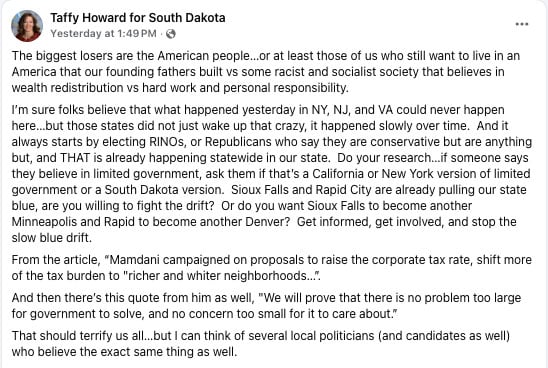
Senator Taffy Howard just confirmed that she and Tonchi Weaver are now at war with self-styled ultra-conservative political consultant Jordan Mason.  And it gets more hilarious from there. Why? Let me explain.

Jordan has had a business out collecting petition signatures in Rapid City, including the measure to place increased tobacco taxes on the ballot in 2018. Who has been a long-time petition circulator for Jordan? Tonchi Weaver.  But it just gets better.  Who has Jordan done quite a bit of work for, most notably in her run for Congress?   Taffy Howard.

These are all people who have had a somewhat close association with each other for some time. Yet, now it seems like Jordan is on the outs with Tonchi and Taffy, as everyone is fully on the attack.

Get your popcorn. And see if you can figure out if you want to cheer for Satan, Lucifer or Azmodeous in this battle of the far-right in Rapid City.

Tall tales from Toby, who doesn’t sound very conservative as he promises to spend up to 10 million.

In an article today at Dakota Scout, the candidates were interviewed with regards to wild-ass allegations that Toby “Dumpster Fire” Doeden was making on facebook claiming there was a nefarious plot to buy off Governor Rhoden in the race.. well, for Governor.

The unsubstantiated accusation, made in a social media post Tuesday and amplified through a paid Facebook ad, underscores the intensity of the high-profile clashing of candidates in an election still nine months away; also signaling South Dakota could be headed for its most combative gubernatorial battle in decades.

and..

Johnson refuted any insinuation of bribery or unethical political jockeying outside of the public eye. His campaign dismissed the charge as “just another tall tale from Toby.”

and..

Johnson has about $7 million in political contributions, while Doeden has pledged to spend “as much as it takes” to match that total. The Groton native, who touts a broad business empire that includes gas stations, truck stops and real estate, has said he is willing to put $10 million or more of his own money into the contest as he positions himself as the conservative alternative to the Republican establishment.

Read the entire story here at Dakota Scout.

Understanding that Doeden does not really have any popular support or donors… If you have to declare you’re going to spend 10 million of your own money, can one really claim one’s self as “the conservative alternative?”  It doesn’t really seem he’s walking the conservative walk when he flies his jet into his events (while Logan Manhart and Cole Heisey log highway miles driving the bus), and says he’ll spend $10 million of his own money on the campaign.

If you or I had ten million dollars of our own money? Who in their right mind would spend it on a political campaign?!? That doesn’t sound as if a person is conservative. That sounds more like someone has an unchecked ego that they want to unleash on the state.

Release: South Dakota’s Public Universities Report Steady Enrollment

South Dakota’s Public Universities Report Steady Enrollment

 PIERRE, S.D. – South Dakota’s public university system continues its upward momentum in student enrollment. This marks the fourth consecutive year of targeted system growth and the second successive year with more than 36,000 students – a notable benchmark in the face of national challenges in higher education.

More encouraging, a greater number of South Dakota high school graduates are choosing to pursue higher education within the state than in years past. The number of South Dakota students enrolled across the six public universities rose to 22,410, up more than 1,600 students since Fall 2021. This trend is a strong indicator of confidence in the state’s public higher education system.

“South Dakota families are showing continued trust in our public universities, a testament to the quality of education and strong return on investment provided at our institutions, and we’re proud to see more of our high school graduates staying in state to pursue their degrees,” said Nathan Lukkes, South Dakota Board of Regents Executive Director. “We know from long-term data that more than 70% of resident graduates stay in South Dakota after earning their degrees, contributing directly to our state’s economy and workforce.”

The 2025 Fall Semester saw year-over-year increases in full-time equivalent (FTE) enrollment and student credit hours compared to the historically strong Fall 2024 semester, indicating that students are enrolling in more courses and progressing toward degree completion at a steady pace. The total system-wide headcount for Fall 2025 remained at 36,091, a student count that broke numerous records across the system in 2024.

While annual percentage growth was flat this year compared to the previous 5% surge seen in 2024, system officials note that the year-over-year stability is positive given the already strong base of last fall’s enrollment.

“Our South Dakota public universities have demonstrated resilience and relevance in a changing higher education landscape, and I am proud of the work our campuses have done to keep the needs of our students and state at the forefront,” Lukkes added. “Any increases on top of already high performance are signs of sustained success – especially when paired with increased resident enrollment, strong return on investment, and workforce retention.”

-30-

Release: NEW NFIB SURVEY: Small Business Optimism Improves Again  

NEW NFIB SURVEY: Small Business Optimism Improves Again  
Main Street cites labor quality as the top issue

PIERRE, SD (Sept. 11, 2025) – The NFIB Small Business Optimism Index rose 0.5 points in August to 100.8, nearly 3 points above the 52-year average of 98. Of the 10 Optimism Index components, four increased, four decreased, and two were unchanged. The increase in those expecting real sales to be higher contributed the most to the rise in the Optimism Index. The Uncertainty Index fell by 4 points to 93 but remained well above the historical average. The decline was due to a decrease in uncertainty about financing expectations and planned capital expenditures.

“Optimism increased slightly in August with more owners reporting stronger sales expectations and improved earnings,” said NFIB Chief Economist Bill Dunkelberg. “While owners have cited an improvement in overall business health, labor quality remained the top issue on Main Street.”

“The increase in small business optimism is visible if you walk many of South Dakota’s Main Streets,” said NFIB South Dakota State Director Jason Glodt. “The focus on reducing government red tape, combined with the recently passed small business tax relief give our entrepreneurs the freedom to reinvest and grow.”

Key findings include:

  • In August, there was a notable improvement in overall business health. When asked to rate the overall health of their business, 14% reported excellent (up 1 point), and 54% reported it as good (up 2 points). Twenty-seven percent reported the health of their business as fair (down 4 points), and 4% reported poor (unchanged).
  • The percent of small business owners reporting labor quality as the single most important problem for their business remained at 21%, continuing to rank as the top problem.
  • In August, 32% (seasonally adjusted) of all owners reported job openings they could not fill in the current period, down 1 point from July. The last time unfilled job openings fell below 32% was in July 2020.
  • The net percent of owners expecting higher real sales volumes rose 6 points from July to a net 12% (seasonally adjusted). This component contributed the most to the Optimism Index’s increase.
  • A net 0% (seasonally adjusted) of owners viewed current inventory stocks as “too low” in August, up 3 points from July.
  • The net percent of owners raising average selling prices fell 3 points from July to a net 21% (seasonally adjusted), the lowest reading of this year.
  • The frequency of reports of positive profit trends improved 3 points to a net negative 19% (seasonally adjusted). August’s reading was the best since March 2023.
  • In August, the average rate paid on short maturity loans was 8.1%, down 0.6 points from July and the lowest reading since May 2023.
  • Twenty-three percent of all owners reported borrowing on a regular basis, down 2 points from July. The last time the percent of business owners borrowing on a regular basis was below 23% was in November 2021.

As reported in NFIB’s monthly jobs report, a seasonally adjusted 32% of all small business owners reported job openings they could not fill in August, down 1 point from July. The last time unfilled job openings fell below 32% was in July 2020. Twenty-eight percent had openings for skilled workers (down 1 point), and 13% had openings for unskilled labor (up 1 point).

The difficulty in filling open positions is particularly acute in the construction, manufacturing, and transportation industries. Nearly half (49%) of small businesses in the construction industry had a job opening they could not fill, down 6 points from July and 11 points below last year’s level. This suggests a softening in the job market. Openings were the lowest in the wholesale and finance industries.

A seasonally adjusted net 15% of owners plan to create new jobs in the next three months, up 1 point from July and the third consecutive monthly increase, a positive trend but historically low.

Of the 53% of owners hiring or trying to hire in August, 81% reported few or no qualified applicants for the positions they were trying to fill. Twenty-six percent of owners reported few qualified applicants for their open positions (down 3 points), and 17% reported none (down 2 points).

In August, 21% of small business owners cited labor quality as their single most important problem, unchanged from July and remaining the top single most important problem. Labor costs reported as the single most important problem for business owners fell 1 point from July to 8%.

Seasonally adjusted, a net 29% reported raising compensation, up 2 points from July. A seasonally adjusted net 20% plan to raise compensation in the next three months, up three points from July.

Fifty-six percent of small business owners reported capital outlays in the last six months, up 1 point from July, but remaining historically low.

Of those making expenditures, 37% reported spending on new equipment, 22% acquired vehicles, and 17% improved or expanded facilities. Thirteen percent spent money on new fixtures and furniture and 5% acquired new buildings or land for expansion.

A net negative 9% of all owners (seasonally adjusted) reported higher nominal sales in the past three months, unchanged from July.

The net percent of owners reporting inventory gains rose 2 points to a net negative 6%, seasonally adjusted. Not seasonally adjusted, 10% reported increases in stocks, and 14% reported reductions. A net 0% (seasonally adjusted) of owners viewed current inventory stocks as “too low” in August, up 3 points from July. A net 1% (seasonally adjusted) of owners plan inventory investment in the coming months, unchanged from July.

Over half (54%) of small business owners reported that supply chain disruptions were affecting their business to some degree, down 10 points from July. Three percent reported a significant impact (down 1 point), 15% reported a moderate impact (down 2 points), 36% reported a mild impact (down 7 points), and 44% reported no impact (up 8 points).

Looking forward to the next three months, seasonally adjusted, a net 26% plan to increase prices, down 2 points from July. The net percent of owners raising average selling prices fell 3 points from July to a net 21%, seasonally adjusted, the lowest reading of this year. Unadjusted, 33% of owners reported higher average prices and 13% reported lower average selling prices. Eleven percent of owners reported that inflation was their single most important problem in operating their business (higher input costs), unchanged for the third consecutive month.

The frequency of reports of positive profit trends improved 3 points from July to a net negative 19% (seasonally adjusted) in August. Among owners reporting lower profits, 37% blamed weaker sales, 18% cited the rise in the cost of materials, 10% cited price change for their product(s) or service(s) and 9% cited labor costs. Among owners reporting higher profits, 65% credited sales volumes, 18% cited usual seasonal change, and 5% cited higher selling prices.

Four percent of owners reported that financing and interest rates were their top business problem in August, unchanged from July. Twenty-three percent of all owners reported borrowing on a regular basis, down 2 points from July. The last time the percent of business owners borrowing on a regular basis was below 23% was in November 2021. A net 3% reported their last loan was harder to get than in previous attempts, down 1 point from July. A net 6% reported paying a higher rate on their most recent loan, up 1 point from July. In August, the average rate paid on short maturity loans was 8.1%, down 0.6 points from July and the lowest reading since May 2023.

The net percent of owners expecting better business conditions fell 2 points from July to a net 34% (seasonally adjusted). In August, 14% (seasonally adjusted) reported that it is a good time to expand their business, down 2 points from July.

Seventeen percent of small business owners reported taxes as their single most important problem, unchanged from July and ranking as the second top problem. The percent of small business owners reporting government regulations and red tape as their single most important problem rose 1 point to 9%. Five percent reported competition from large businesses as their single most important problem, down 1 point from July.

The NFIB Research Center has collected Small Business Economic Trends data with quarterly surveys since the fourth quarter of 1973 and monthly surveys since 1986. Survey respondents are randomly drawn from NFIB’s membership. The report is released on the second Tuesday of each month. This survey was conducted in August 2025.

###        

For over 80 years, NFIB has been advocating on behalf of America’s small and independent business owners, both in Washington, D.C., and in all 50 state capitals. NFIB is nonprofit, nonpartisan, and member-driven. Since our founding in 1943, NFIB has been exclusively dedicated to small and independent businesses, and remains so today. For more information, please visit nfib.com.

Northern Plains News: South Dakota least engaged in nation for AI Adoption

S.D., Northern Plains Trail Nation in AI Adoption
In Brief: South Dakota is at the bottom of the nation in adopting artificial intelligence, according to recent studies

By Todd Epp, Northern Plains News

New studies show South Dakota, Wyoming, and Kansas lag far behind in artificial intelligence use and efficiency, raising concerns the region may repeat the digital divide of the 1990s.

Why It Matters:

The findings highlight a widening digital divide across the Northern Plains. While AI is now a mainstream tool for work, study, and communication, the region’s lagging adoption means fewer productivity gains and risks repeating the broadband gap of the 1990s.

The reports found that Washington, D.C., leads the country in overall AI use, while Rhode Island ranks first in efficiency. States across the Midwest — especially South Dakota, Wyoming, and Kansas — trail well behind, according to studies published Sept. 4 by Digital Information World and Aug. 8 by Phrasly.ai.

South Dakota residents save an average of just 0.81 hours per month using AI tools, the lowest figure in the country, Phrasly.ai found. By comparison, Rhode Islanders save more than 32 hours monthly, nearly a full workweek, according to Digital Information World. South Dakotans also spend the least time per session, just over 10 minutes, compared to Delaware’s 17 minutes, the nation’s highest, Digital Information World reported.

Wyoming users save about 1.1 hours per month, and Kansas users about 2.8 hours, according to Phrasly.ai. Analysts said these states may benefit from AI training programs, especially for business users, Digital Information World reported.

The reports also showed that high usage does not always equal efficiency. Washington, D.C., records the most sessions but only saves 7.5 hours a month, Phrasly.ai said. Rhode Island, with fewer sessions, is far more efficient.

Only half of business projects using AI succeed, often depending on whether organizations adapt operations and data systems, according to a separate study by Infosys Knowledge Institute cited by Digital Information World.

AI usage patterns also vary. South Dakota and neighboring states see peak activity around 5 p.m., suggesting residents turn to AI at the end of the workday, according to Phrasly.ai. Nationwide, Monday at 8 p.m. is the most common usage time, Digital Information World found.

Oregon, Vermont and Delaware log in earlier in the workday, while Pennsylvania and Idaho peak at night, Digital Information World reported. No state saw weekends as its busiest time, according to Digital Information World.

In Wyoming, the University of Wyoming has launched the “AI4WY” initiative to prepare a workforce skilled in artificial intelligence and apply the technology to energy and agriculture, Digital Information World reported.

Analysts warned that without similar programs, Northern Plains states risk repeating the digital divide of the late 1990s and early 2000s, Digital Information World said.Artificial intelligence has become mainstream, from generating text to assisting in health care and education.

But how much Americans benefit depends heavily on where they live, the reports concluded. For the Northern Plains, catching up may take investment, training and cultural change, according to Digital Information World and Phrasly.ai.