Release: South Dakota PUC approves permit to construct North Bend Wind Project

South Dakota PUC approves permit to construct North Bend Wind Project

PIERRE, S.D. — The South Dakota Public Utilities Commission approved a siting permit for the North Bend Wind Project, a wind energy facility slated for Hyde and Hughes counties capable of generating up to 200 megawatts of energy. The action by the PUC was taken during its regular meeting on Jan. 5, 2023, in Pierre.

North Bend Wind and PUC staff filed a settlement stipulation with the commission on Dec. 13, 2022. The agreement specified 45 conditions that must be adhered to during the construction and operation of the project. Land and road restoration, shadow flicker, noise levels, ice detection and ice throw, post-construction grouse lek monitoring and decommissioning are all among the issues the conditions address.

“It’s obvious that significant negotiations have taken place between parties to get us to this point. My concern is for landowners; to ensure that reclamation will be done properly and that things will be made whole for landowners once construction is done,” said PUC Chairman Chris Nelson. “Largely, the conditions parties have stipulated to have worked for other wind farm permits that have been issued by the PUC. It’s my belief that landowners will be protected in the issuing of this permit,” Nelson stated.

PUC Vice Chairperson Kristie Fiegen reflected the important role that PUC staff play in each siting docket brought before the commission. “Our staff take their role in protecting all landowners and citizens very seriously and I really appreciate the countless hours they work to protect the land and interests of both participants and non-participants alike. Including a condition related to aerial spraying is a great example of that dedication,” she said.

North Bend Wind, LLC filed its application with the commission on June 23, 2021, starting the clock on a statutory nine-month review period that included a public input meeting held in Pierre in August 2021. In both November 2021 and February 2022, the company filed requests to extend the deadline for a commission decision, thereby extending the PUC’s review period.

Intervenors participating in the North Bend Wind docket included Judi Bollweg, individually and on behalf of the Tumbleweed Lodge and Bollweg Family, LLLP, and Michael Bollweg, individually and on behalf of Bollweg Family, LLLP. The commission granted their intervention in September 2021 and granted their request to withdraw from the docket at this week’s meeting.

“It is nearly always to the benefit of intervenors when parties negotiate and resolve issues prior to the commission making a final decision. Those negotiations not only allowed the intervenors to withdraw today, but also eliminated the need for a hearing in this docket saving a great deal of time and resources,” stated Commissioner Gary Hanson.

The project will include up to 71 wind turbines and will span approximately 46,931 acres of land in Hyde and Hughes counties. Other components of the project will include access roads and associated facilities, underground 34.5-kilovolt electrical collector lines, underground fiber-optic cable, a 34.5-kV to 230-kV collection substation, a 230-kV interconnection switching station, an aircraft detection lighting system and one permanent meteorological tower.

North Bend Wind estimates construction of the wind farm will cost $265 million to $285 million. The project will interconnect to Western Area Power Administration’s Fort Thompson-Oahe 230-kV transmission line, which crosses the southern portion of the project area. The project is owned by ENGIE North America and is anticipated to be operational in late 2023. Basin Electric Power Cooperative will purchase the power produced by the wind project.

The North Bend Wind Project docket can be viewed on the PUC’s website at https://puc.sd.gov, Commission Actions, Electric Dockets, 2021 Electric Dockets, EL21-018 – In the Matter of the Application by North Bend Wind Project, LLC for a Permit to Construct and Operate the North Bend Wind Project in Hyde County and Hughes County, South Dakota.  

-30-

Governor Kristi Noem’s Weekly Column: New Year, New Growth

New Year, New Growth
By: Governor Kristi Noem
January 6, 2023

In a radio address to the nation on January 1st, 1983, President Reagan said that “New Year’s Day was an especially American tradition, full of the optimism and hope we’re famous for in our daily lives-an energy and confidence we call the American spirit.” Now, as we ring in 2023, I reflect not only on Reagan’s words, but also on South Dakota’s growth over the past year.

South Dakota is thriving. We have the strongest economy in America. We are the best state in the nation for personal income growth. We are the best state in the nation for veterans. And we are the best state in the nation for freedom.

In short, we are the best state in the nation to build the American Dream.

Our population continues to grow four times faster than the nation. This is because we kept South Dakota “Open for Business.” We allowed South Dakotans to exercise their freedom and personal responsibility to create their own economic growth; to achieve the American Dream.

Thanks to the state’s booming economy, the state government has generated record surpluses multiple years in a row. We keep breaking records for state revenues, and with the number of individuals and businesses moving to South Dakota, we know that this growth is sustainable. That is why 2023 will be the year of putting money back in the pockets of South Dakota families.

Last month, I unveiled my budget for this fiscal year. It is critical that this budget be executed in order to return our record revenues to the people. Taxpayer dollars belong to the taxpayers. This year, we will eliminate the state sales tax on groceries, support South Dakota schools, combat inflation, and strengthen our families, businesses, and infrastructure.

In 2022, I took a stand against China. While President Biden took no action against the Communist nation, South Dakota took the lead in protecting our people. I banned TikTok for state government employees. Now, many other states are following our lead. I also announced my plan to prohibit nations that hate America from purchasing our agricultural land, and I will work with legislators this year to make it happen. It is critical to keep South Dakotans’ rural way of life protected, and that starts with preventing intervention from foreign nations like China. In 2023, we will continue to secure the people of South Dakota.

President Reagan said, “let us renew our faith that as free men and women we still have the power to better our lives. And let us resolve to face the challenges of the new year holding that conviction firmly in our hearts. That, after all, is our greatest strength and our greatest gift as Americans.”

We can all appreciate Reagan’s words as we face this new year with hope and optimism. My administration is dedication to protecting our small-town values and trusting South Dakotans to make the best decisions for themselves. Our state has had great success, and 2023 will show us that the best is yet to come. Happy New Year!

###

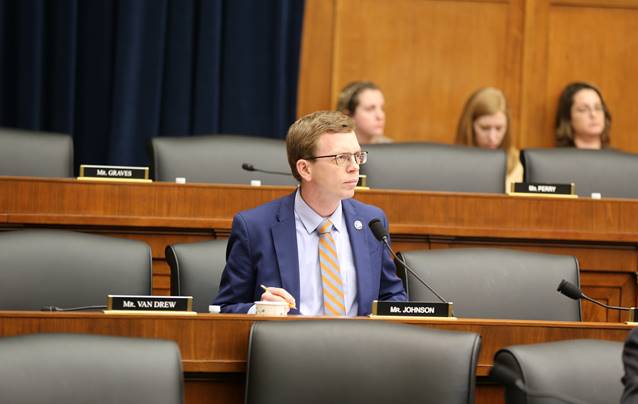
Congressman Dusty Johnson’s Weekly Column: What is going on in the House of Representatives?

What is going on in the House of Representatives?
By Rep. Dusty Johnson
January 6, 2023

“Groundhog Day.” “Stalemate.” “Deadlocked.” “Messy.” What is going on in the House of Representatives?

For the past 100 years, electing a Speaker of the House has only taken one vote, and then it’s off to the races. There’s a lot to do at the beginning of the Congress. Swearing-in of all Members, old and new; assigning Committees; and voting on legislation. But this year, electing a Speaker has taken multiple votes. This isn’t unprecedented. Over the course of our history – fourteen times – a Speaker election has taken multiple votes. In 1856, there were 133 ballots until a Speaker was elected.

Essentially, electing a Speaker is a math problem. To become Speaker, a candidate, in this case Representative Kevin McCarthy, needs 218 votes, which is a majority of the 435 Members of the House. Here’s a breakdown of the numbers:

  • Democrats have 212 Representatives in the House, so they are unable to get to the magic 218 on their own.
  • Republicans have 222 Representatives. Republicans could elect a Speaker on their own, we have the Majority. McCarthy has the support of more than 95% of the conference, which is 215 Members. Seven Members are holding out their support for McCarthy and voting for several other candidates, many who have repeatedly stated they do not want the job of Speaker.

The only Member of the House that can get relatively close to 218 votes is Rep. Kevin McCarthy. As the week has gone on, we have seen progress and movement on both sides, inching McCarthy to 218.

Without a Speaker, nothing can happen in Congress. No Members sworn-in. No Committees or investigations assigned. No legislation passed. No oversight of federal agencies. No opportunity to secure the border.

We need to put our heads together, overcome this obstacle, and get to work for the American people. There is real work to do, and we must elect a Speaker to do the people’s business.

Thankfully there is a silver lining. I believe out of all of this we will be able to govern more effectively as a Republican conference, knowing each other much better than we did last year.

###

US Senator John Thune’s Weekly Column: Helping Farmers and Ranchers Weather the Storm

Helping Farmers and Ranchers Weather the Storm
By Sen. John Thune

South Dakota farmers and ranchers work hard every day to feed America and the world. When severe weather is added to the mix, they work even harder. In the last few weeks alone, snowstorms and severe cold weather have affected communities across the state. While schools have closed and many South Dakotans have worked from home during winter storms, there are no snow days for producers who must feed and care for their livestock day in and day out regardless of the weather. As a longtime member of the Senate Agriculture Committee, I’ve worked to ensure that there is a strong safety net for producers to help them overcome whatever challenges may come their way.

With that in mind, one of the most important things Congress will do this year is consider the 2023 farm bill, which will be the fifth farm bill I’ve helped craft. As always, I wouldn’t be able to do this without invaluable input from the real experts: South Dakota farmers and ranchers. In roundtable discussions across the state and countless informal conversations, our agriculture producers have provided insights into the challenges they face and improvements that can be made to make things easier in this demanding way of life.

In previous farm bills, I have helped author and strengthen Farm Service Agency (FSA) programs that assist livestock producers affected by severe weather. The Livestock Indemnity Program helps producers cover a portion of the costs they incur for livestock losses due to severe weather, including snowstorms or droughts. And the Emergency Assistance for Livestock Program helps cover additional costs of feeding and grazing livestock that may be incurred due to adverse weather or disease. I’ve worked to maintain and strengthen these programs based on the needs I hear from South Dakota producers. I encourage producers affected by the recent storms to contact their local FSA office to learn more about the assistance that may be available to them.

In preparation for farm bill reauthorization, I’ve already held multiple roundtables across South Dakota – with more to come – to receive input on the various farm bill titles and programs that support our state’s top industry. A common theme from my discussions was the importance of the producer safety net. Crop insurance is a critical risk management tool for producers that I will continue to support in the 2023 farm bill. Agriculture Risk Coverage and Price Loss Coverage help producers when commodity prices drop, and I will continue working to strengthen these programs, particularly given the current high rate of inflation that has sent the price of inputs like fertilizer and fuel soaring.

In addition to strengthening the farm safety net, I am also working on other measures to support farmers and ranchers. I have consistently advocated for reforming our beef labeling system so consumers know when they’re buying American beef. I am proud to have introduced bipartisan legislation to require mandatory country of origin labeling for beef. Improving the Conservation Reserve Program to ensure it remains an effective option for producers and landowners is also a top priority for me.

I also recognize that farmers and ranchers are facing additional burdens from heavy-handed regulations. I was disappointed that the Biden administration has moved to finalize its misguided retread of the Obama-era Waters of the United States rule. Opening nearly every body of water to federal jurisdiction would be a nightmare for our agriculture industry in South Dakota and across the country. I will continue to urge the administration to abandon this rule, and if it does not, I will push for the Senate to overturn this over-reaching regulation.

When it comes to farm policy, the real experts are those in the field, literally. As Congress prepares for the 2023 farm bill, I’ll be bringing the perspective of South Dakota’s farmers and ranchers to Washington to ensure farm policy continues to support producers as they do the important work of feeding America.

###

Update on SDSOS Staff Hires..

Updating my notation on what little we know about Monae Johnson’s Secretary of State staff hires (as opposed to the staff fires), the South Dakota Open Government website has updated salary information for the few staff we know about who have taken positions.

We had earlier known about Deputy Secretary of State Tom Deadrick coming in with a salary of $120,000, about $20-25k more than Jason Lutz’s salary as Deputy, which was at the same level Deadrick was pulling down when he departed the AG’s office.

Reported to me to be Kea Warne’s replacement as Director of Elections, Elaine Jensen is noted on the open government website as being on the Secretary of State’s staff at a salary of $80,000, almost $6500 less than Warne had been making in the position after a number of years.

Incoming elections Department employee Logan Manhart‘s salary according to open.sd.gov has him at a starting salary of $46,000.

Stay tuned for more updates as more people are hired. (Or if anyone is left, fired.)

A proposal to fix the Republican convention. But we’ve heard a lot of it before. Might there be a third way?

Do you recall the GOP Convention precinct representation bylaw change proposal that’s going to be discussed a the State Central Committee next weekend?  I had provided it on an informational basis the other day, but hadn’t weighed in with any thoughts. .

In case you missed it, here’s a refresher. The Republican Party is trying to find a solution to the battle of people registering to be precinct committeepeople, only to find they disappear when it’s time for the work to be done. This year, not only did we have the fair weather delegates, as commenters have pointed out, we had freeloading delegates who were trying to vote themselves a free ride, attempting to have the party pay for all the meals, etcetera.  Not cool.

The recent report of the bylaws committee notes:

The Committee believes that a well-rounded convention delegation consists of a mix of county party leaders, elected delegates, and public officials. Accordingly, the Committee concluded the public officials who are currently members of the county central committee should become delegates. These individuals are subject to election at the primary and are responsible for making and implementing good public policy; therefore, they are well suited to represent the voters and to elect quality candidates to be the party’s nominees for statewide office. Further, the Committee decided that the counties with largest populations should have more than three at-large delegates, so it included in its proposal a mathematical system for electing more than three at-large delegates based on population. Based on that formula, for the next state convention every county would elect three at-large delegates at the primary election except as follows:

  • Minnehaha 20
  • Pennington 14
  • Lincoln 8
  • Brown 4
  • Codington 4
  • Lawrence 4
  • Meade 4

The Bylaws Committee recommends adoption of Proposed Amendment 1.

You can read that here.

The only problem with it, is that this is not a new proposal. It appears to be almost identical to one made 18 years ago to fix the problems they were having with disappearing delegates. From South Dakota War College (Classic):

What is the new proposal (actually, the old one)? For county representation at the convention:

  • The County Chairman, Vice Chairman, State Committeeman and State Committeewoman.
  • 3 at-large delegates, plus another 3 delegates for every 2000 votes that county cast for Governor.

What a great way to take the party back to the days of back room deals, smoke filled halls, and complaints about a lack of volunteers. I don’t know a soul who wants the conventions to be more “intimate” and have the attendances plummet from a crowd of 800 down to ‘a cozy group of 150.’ Why would we change the convention from having people by the hundreds, to one that produces the numbers we tease the Democrats about on their convention.

Acting as a delegate was the one carrot attached to the job of being a precinct committeeperson. Who is going to want to be one under this proposal?

You can read that post from my first year on the blogosphere here.

This proposal was overwhelmingly rejected at the time. The problems are the same, and unfortunately, a chunk of the solution proposed by the bylaw committee is the same. Literally.

Regarding reports I’m hearing from the field, it does not sound like current central committee members are overly enthused about this solution.  And to be honest, I look at it myself as a long-time activist who does not hold office in the party, aside from being a precinct committeeman, and I’ve had to fight for that position almost every single year I’ve done it.  As written, It would cut me out of convention, and leave people like me competing in a field with at minimum, 6 at-large positions, likely against people who have an electoral history in the county. It costs enough to run as a precinct person, now I’m expected to have to run a county-wide primary race? Ugh.

I have always believed that the Republican Party is best when it is a large and open tent. I reject efforts to make it smaller.  That being said, I absolutely agree that things need to be fixed. But obviously from my reaction 18 years ago, I didn’t care for dropping precinct people then and I’m not excited about the prospect now.

So if the proposed solution doesn’t have me all excited, what are the alternatives?

There’s a huge problem with a lot of these people who are recruited with a singular agenda who evaporate once convention is over.  And even worse, these are the same people who HOWL bloody murder about things like convention fees, paying for meals, etc.  They’re going to a political party convention. It’s not going to your local courthouse or church and casting a vote.  It’s a major event that most cities in the state can’t handle. And even those who do are challenged to handle it well.  I’ve been to the national convention a couple of times, and there is certainly a convention fee for that which covers staff, events, and a number of other things. So why should that expectation be any different for the state convention.  The expectations of a free lunch need to end among those who attend convention.

We all recognize that those voting need to be more representative of the people in their precincts. Who is kidding who when they went to the convention to try to vote for Steve Haugaard for Lt. Governor in a last minute candidacy, and try to claim that’s what their people wanted? It was the height of self-indulgent hubris and lunacy.

Given that he was overwhelmingly rejected for Governor, Haugaard punched far above what he should have in the fight for Lt. Governor. Because an inordinate proportion of those delegates represented no one but themselves. The Republican Party is more than a group of ultra-conservative activists. It is an electorate, and somehow the other 80% of Republican voters who don’t think we’re stuck in the 1950’s need to be considered. The Amendment proposal to add voting rights for “Republican public officials who are members of the County Central Committee” is a great step in bringing representative government back to the convention. Adding the representation of people who have experience being responsible to voters for their actions should set an example.   This is a good thing.

So, what do we do about the flurry of recruiting people who never show up again?  I agree, that’s an issue. We don’t have poll watching and runners like we used to, due to technology.  But we need to have a substantive task that precinct committeepeople are expected to do and they need skin in the game. How many counties struggle to put on events besides a single annual dinner? If they had more people involved in the process, that task might be much easier.

One alternate proposal I have heard is that instead of signing up in by the end of March to go to convention in late June, is that precinct committeepeople sign up in January to take office as precinct person in July –  after convention. That takes much of the gamesmanship out of the convention delegate recruitment process. And means that they are signing up to be part of the solution for nearly an entire cycle that peaks with candidate selection, instead of one that begins with convention. That means that the party stands a chance at people who are more educated about who is running and why, and more engaged than those who show up and leave.

In my opinion, making the election process more exclusive is not the answer. I’m all in favor of expanding the universe of who selects our candidates to make it more representative at convention.

But if that fails, as an alternative, I would support throwing the entire selection process open to the state as a whole and selecting all constitutional officers in the June primary.  And then moving the convention to April or May. The party could change bylaws, and as many states do, including North Dakota, have a convention where delegates decide as a party on endorsing a candidate.   A convention endorsement process could also provide an added benefit every 4 years providing for a presidential caucus process, bringing more people back into and moving up South Dakota’s participation in the Presidential nomination process.

Whether the South Dakota Republican Party chooses to stay the course or go with the bylaw recommendations as presented is entirely up to the State Republican Central Committee.

Whatever they decide, I’d encourage them to be flexible and include the greatest number of Republicans in choosing our candidates. And ask them to be willing to explore whether there’s a third way to fix what seems to be broken.

Incoming Minnehaha County Auditor howling because the County Commission is paying her less than her predecessor

From The Dakota Scout, incoming Minnehaha County Auditor Leah Anderson is pretty upset she’s coming in at the entry level of the pay scale, making $50k less than her predecessor:

Minnehaha County’s new auditor isn’t happy that she’s making less than her predecessor.

And auditor-elect Leah Anderson is accusing county commissioners who set her annual salary of playing politics with her pay.

and..

“I’m pretty sure when the people elected me as auditor, they felt like I was qualified or they would not have elected me,” she said, alleging that members of the five-person board did not support her campaign to become county auditor. “I realize that you guys did not support me in my election, you did not want me elected.”

Read the entire story here.

Kind of divided on this one. Coming in after a man making a lot more isn’t really kosher. But, the prior auditor Ben Kyte was hired/appointed for an interim period, which may be one reason to make the salary more competitive at the time – just to get someone to do it. So I’m not sure how political it was, as he may have been lowered to this rate upon election.

But I’m sure it came as a bit of sticker shock for it to be more in line with other newly elected County officials.

Thune Statement on Repeal of the Biden Administration’s Toddler Mask Mandate  

Thune Statement on Repeal of the Biden Administration’s Toddler Mask Mandate  

“History will not look kindly on the bureaucrats who imposed unnecessary mask mandates on America’s toddlers and caused irreparable harm to their early development and education.”

SIOUX FALLS, S.D. — U.S. Sen. John Thune (R-S.D.) today released the following statement after the U.S. Department of Health and Human Services (HHS) issued a final rule that repeals the Biden administration’s toddler mask mandate at Head Start facilities:

“The Biden administration’s toddler mask mandate is a national embarrassment, and its repeal is long overdue,” said Thune. “History will not look kindly on the bureaucrats who imposed unnecessary mask mandates on America’s toddlers and caused irreparable harm to their early development and education.”

The Head Start program is a federal program that provides qualifying, low-income children with early education services. Program facilities are located throughout the nation and, up until the issuance of the HHS interim final rule in November 2021, individual locations were largely successful in setting and enforcing their own COVID-19 protocols.

Thune has led the congressional effort to repeal the Biden administration’s toddler mask mandate:

  • In September 2022, Thune and Sen. Richard Burr (R-N.C.), ranking member of the Senate Committee on Health, Education, Labor, and Pensions, requested that HHS Secretary Xavier Becerra rescind the department’s one-size-fits-all federal mask mandate on Head Start programs.
  • In May 2022, the Senate passed Thune’s resolution, with the support of seven Democrats, to repeal the Biden administration’s mask mandate for toddlers in the Head Start program.
  • In April 2022, at a hearing held by the Senate Finance Committee, Thune pressed Secretary Becerra on the department’s one-size-fits-all federal mask mandates on Head Start programs.
  • In February 2022, Thune and House Republican Whip Steve Scalise (R-La.) authored an op-ed calling on the administration to repeal the toddler mask mandate.
  • In February 2022, Thune introduced a resolution to nullify HHS’s Head Start mask mandate.
  • In January 2022, Thune led 16 of his Senate Republican colleagues in urging Secretary Becerra to rescind the one-size-fits-all federal mandates on Head Start programs across the nation.
  • In December 2021, Thune introduced the Preventing Mandates on Toddlers Act, bicameral legislation that would nullify HHS’s Head Start mask mandate.

###