Senator Sydney R. Davis completesregional leadership institute
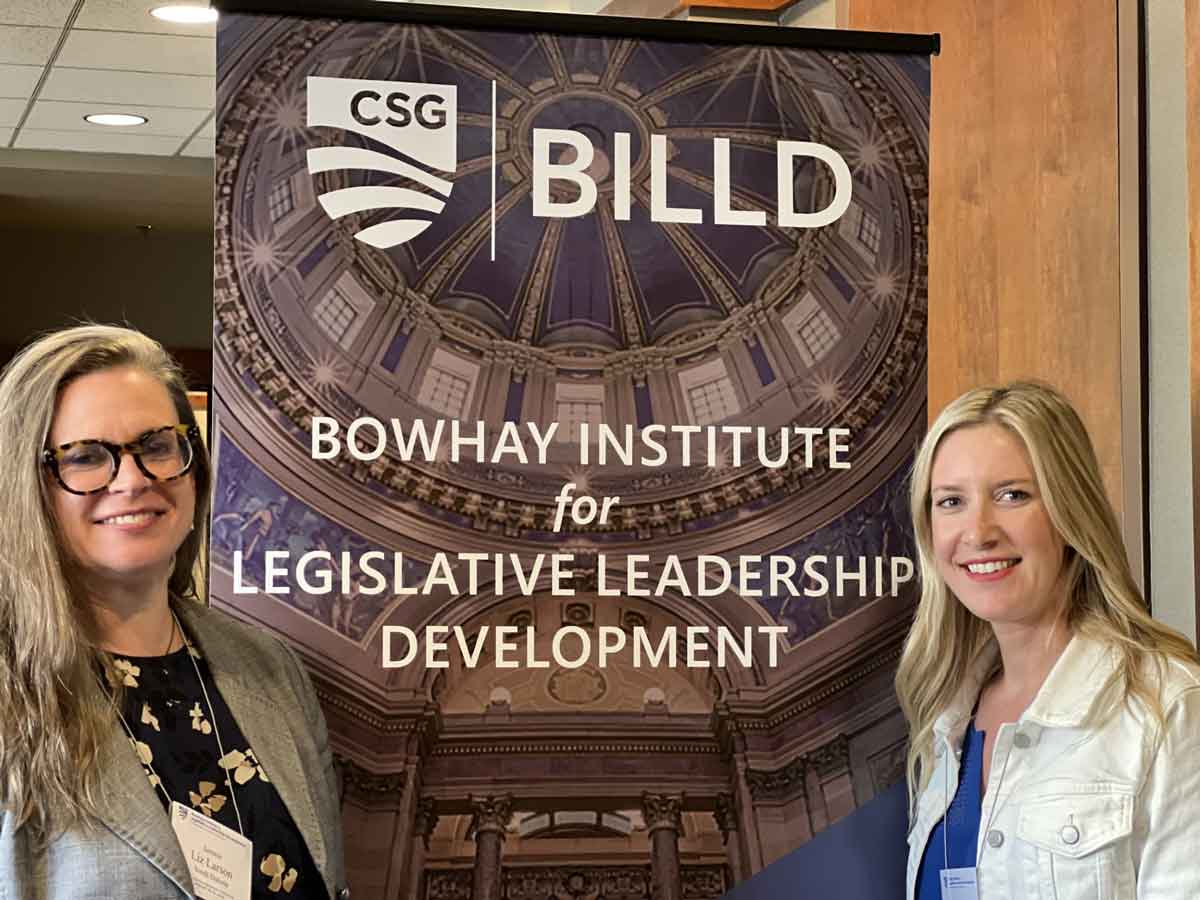
(Lombard, Ill.) August 22, 2023 — State Senator Sydney R. Davis of Burbank was among 37 select lawmakers to complete a leadership training program that identifies and assists emerging state and provincial leaders in the Midwest.
Senator Davis met with fellow lawmakers from South Dakota, 10 other Midwestern states and two Canadian provinces on August 18-22, in Madison, Wis., for The Council of State Governments’ 28th annual Bowhay Institute for Legislative Leadership Development (BILLD).
“The Bowhay Institute is one of the premier leadership training programs in the nation,” says Iowa Sen. Amy Sinclair, who serves as co-chair of the institute’s steering committee. “The legislatures in the region have benefited greatly from the skills their members have gained through this unique educational experience. Many of the graduates now hold leadership positions in their states.”
Since 1995, more than 900 lawmakers have graduated from the Bowhay Institute. State legislators from Illinois, Indiana, Iowa, Kansas, Michigan, Minnesota, Nebraska, North Dakota, Ohio, South Dakota and Wisconsin are chosen to participate through a competitive, nonpartisan selection process. Members of the Alberta, Manitoba and Saskatchewan legislative assemblies are selected by their caucuses to take part in the program.
BILLD was founded in 1995 to help new legislators meet the demands of increased policy responsibility being shifted to the states and, in many states, term limits and high legislative turnover. These continued forces highlight the shortage of training available for state legislators – a void that BILLD aims to fill.
A program of The Council of State Governments’ Midwestern Office, the 2023 BILLD program included courses and seminars conducted by policy experts, Midwestern legislative leaders, and professional development trainers. In addition to curriculum designed to develop leadership skills, the program analyzed a variety of public policy issues, including the economy, trade, and energy policy.
The program is funded through grants from foundations, organizations and corporate sponsors, as well as in kind contributions provided by The Council of State Governments’ Midwestern Office.
The Bowhay Institute for Legislative Leadership Development is named in honor of the late James Bowhay, longtime director of The Council of State Governments’ Midwestern Office. Founded in 1933, The Council of State Governments has national headquarters in Lexington, Ky., and regional offices in Atlanta, Chicago (Lombard, Ill.), New York City and Sacramento, Calif. The goal of the national, nonpartisan organization is to assist and advance state government.
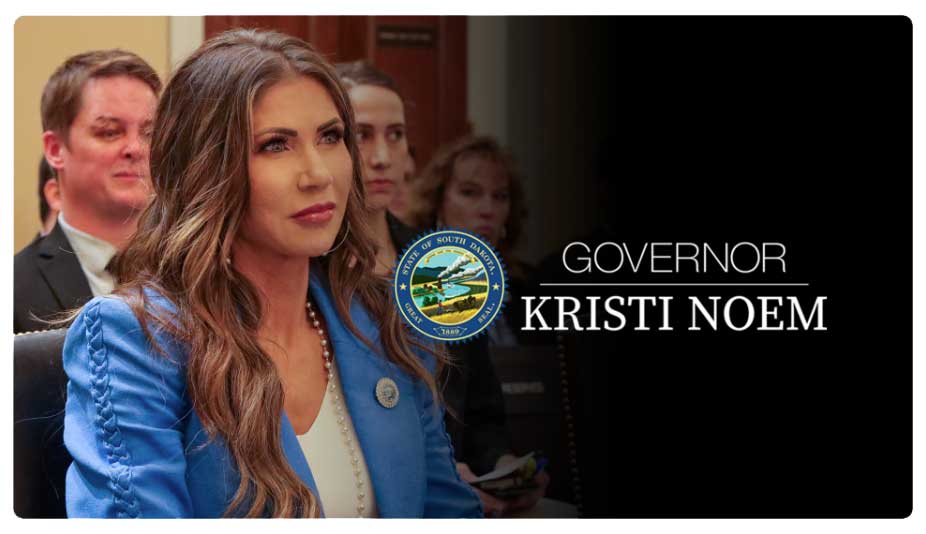
Governor Noem Leads Governors Urging Congress to Address Nationwide Prescription Drug Shortage
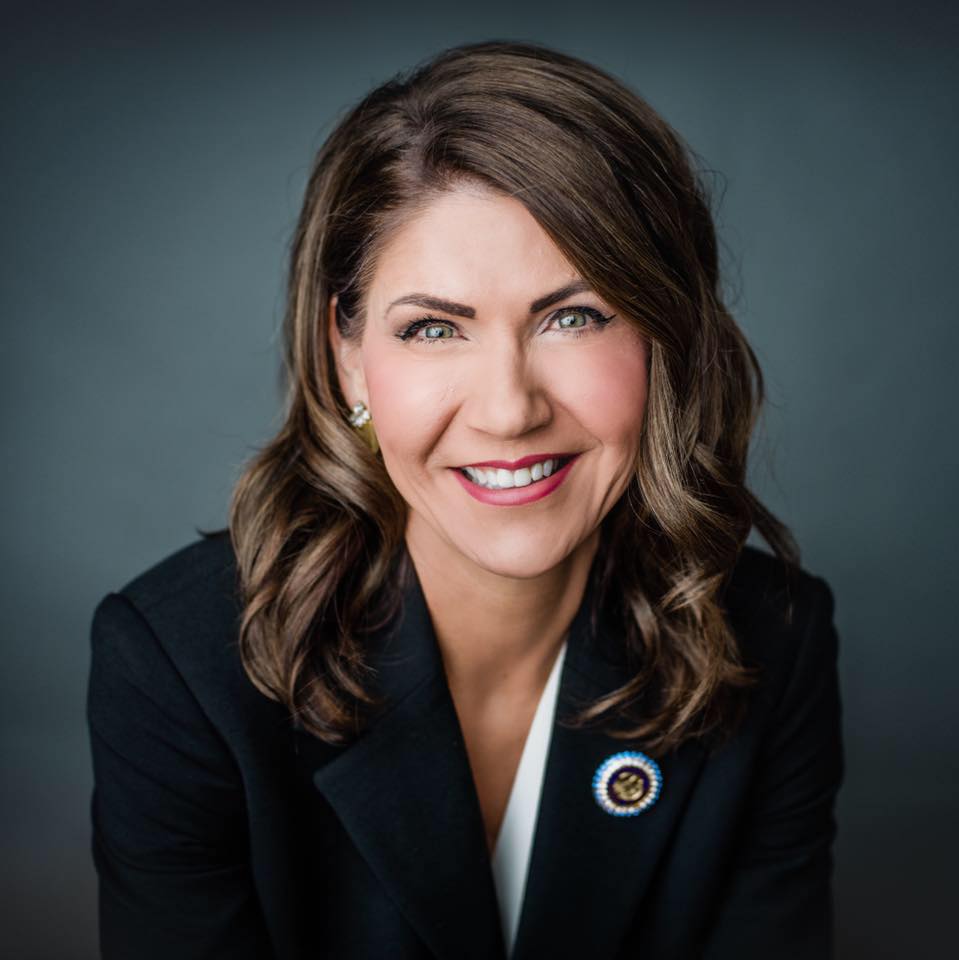
PIERRE, S.D. – Today, Governor Kristi Noem led ten of her fellow Republican governors in urging Congress to address the nationwide shortage of prescription drugs. Governor Noem and her colleagues submitted a letter to leadership in the U.S. Senate and House of Representatives. The letter was addressed to Speaker of the House Kevin McCarthy (R-CA), Senate Majority Leader Chuck Schumer (D-NY), House Minority Leader Hakeem Jeffries (D-NY), and Senate Minority Leader Mitch McConnell (R-KY).
“A widespread and long-lasting shortage of critical drugs has been impacting the United States of America for years,” wrote Governor Noem and her colleagues. “Many of the most used prescription drugs in the country are facing extensive shortages – drugs like albuterol, amoxicillin, and chemotherapy drugs…To create real change, the states need Washington to take action.”
Governor Noem and her fellow Republican governors call on Congress to consider adding the following important policy solutions to any upcoming legislation aimed at addressing drug shortages:
Transparency in the pharmaceutical manufacturing chain from sourcing raw materials to the finished product, including country of origin labeling;
Increased diversity in the manufacturing of generic medications with regards to both raw materials and final manufacturing;
Require transparency from the FDA related to shortages and events that cause supply disruption;
Extending useful life of medications when appropriate by re-examining FDA guidance related to expiration dates;
Waivers to allow purchasing of medications from Canada to expand our supply chain capability quickly;
Creation of a regulatory environment that is more favorable to U.S. manufacturing to include instituting shorter “cure periods” for U.S. manufacturing plants; and,
Requiring a risk assessment of foreign source active pharmaceutical ingredients.
“Congress needs to improve the inspection process for manufacturers to decrease the risk that everyday Americans are currently facing,” continued Governor Noem and her colleagues. “These practical steps toward greater transparency and flexibility will ensure safety and dependability in our pharmaceutical supply chain.”
Governor Noem has been a leader in combatting the shortage of prescription drugs. In May, Governor Noem signed Executive Order 2023-07, which required the South Dakota Department of Health (DOH) to investigate the cause of the prescription drug shortage and recommend action to be taken back to the governor. With the results of that study, Governor Noem announced that DOH will be expanding its medical caches to help combat the shortage of prescription drugs in July.
The following Republican governors joined Governor Noem in signing the letter: Arkansas Governor Sarah Sanders, Indiana Governor Eric Holcomb, Iowa Governor Kim Reynolds, Mississippi Governor Tate Reeves, Missouri Governor Mike Parson, Montana Governor Greg Gianforte, Nevada Governor Joe Lombardo, New Hampshire Governor Chris Sununu, Texas Governor Greg Abbott, and Wyoming Governor Mark Gordon.
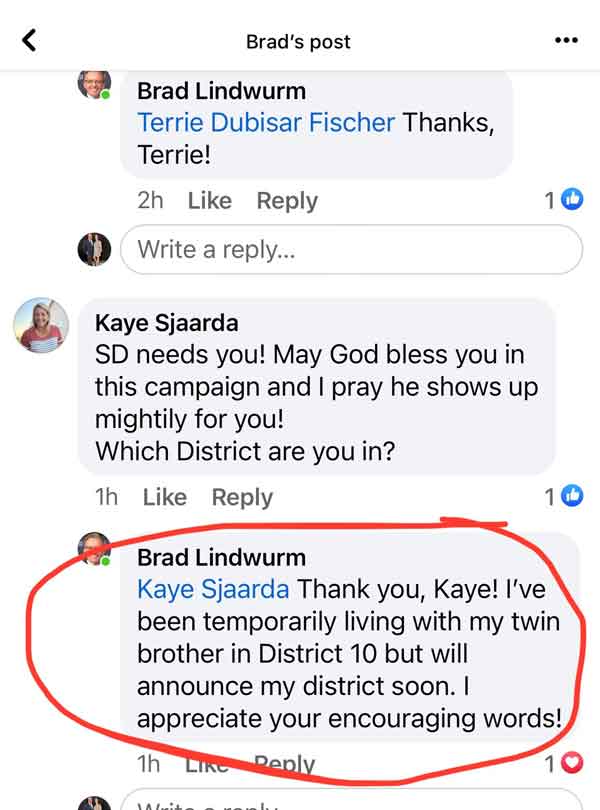
“I’ve been temporarily living with my twin brother in District 10 but will announce my district soon.” So, Lindwurm, who announced he is buying a billboard that starts on 9/11 is apparently worrying more about establishing his campaign than his housing situation (with or without his twin brother)?
The only problem, is that he hasn’t mentioned where, or in what District. And the rumor mill was that he was rumored to be pulling a “Cole Heisey” and move elsewhere – other than his current District 10 – referring to the District shopping that the former Minnehaha County candidate Cole Heisey was doing after re-districting in 2021 to find his best opportunity to run in 2022. The official registration on file still has him at his old address in D10, where he would face D10 Democrats Erin Healy and Kameron Nelson. It’s a Dem District, so Healy will be fairly tough, and Nelson is going to need the right candidate running against him.
As was sent to me a short time ago by a correspondent, it appears that Lindwurm is continuing down this path of running and spending some bigger money… but still without noting where:
And, I guess that’s ok to spend it if you’ve got it. Might be a little early, but whatever.
However, in looking at his disclaimer, I was still curious to see if he’s landed on a district where he claims to be running from. That’s where I found something that caught my attention:
The last filing he’s made with the Secretary of State was back in 2020, and that was to terminate his D14 campaign committee of the same name.
So, how exactly is he opening his checkbook without that information being current?
SDCL 12-27-3 lays out the ground rules:
12-27-3. Statements of organization to be filed for political action committee, candidate campaign committee, and ballot question committee–Violation as misdemeanor.
A statement of organization shall be filed as follows:
(1) The treasurer for a political action committee shall file a statement of organization with the secretary of state not later than fifteen days after the date upon which the committee made contributions, received contributions, or paid expenses in excess of five hundred dollars. However, if such activity falls within thirty days of any statewide election, the statement of organization shall be filed within forty-eight hours;
(2) A candidate shall file a statement of organization for a candidate campaign committee with the secretary of state not later than fifteen days after becoming a candidate pursuant to this chapter; and
(3) If the treasurer for a ballot question committee does not file a statement of organization pursuant to chapter 2-1, the treasurer shall file a statement of organization with the secretary of state not later than fifteen days after the date which the committee made contributions, received contributions, or paid expenses in excess of five hundred dollars. However, if such activity falls within thirty days of any statewide election, the statement of organization shall be filed within forty-eight hours.
Any statement of organization may be filed electronically pursuant to § 12-27-41. A political committee that regularly files a campaign finance disclosure statement with another state or the Federal Election Commission or a report of contributions and expenditures with the Internal Revenue Service is not required to file a statement of organization. A violation of this section is a Class 2 misdemeanor. A subsequent offense within a calendar year is a Class 1 misdemeanor.
Under the law, Lindwurm will officially has 15 days to fess up where he’s running after he spends the money, as I’m sure Lamar is like anyone else doing political business, requiring cash up front.
Chairman Wiik Announced Extra President Donald Trump Tickets
PIERRE, SOUTH DAKOTA – Today, South Dakota Republican Party Chairman John Wiik announced extra tickets will be available for the Monumental Leaders Rally with President Donald J. Trump and special guest Governor Kristi Noem. After selling out in less than a week of ticket sales, with over 6,000 tickets sold, we have added an additional 900 seats!
“Our Monumental Leaders rally will be a record shattering event for the SDGOP, and we are proud to host President Donald J. Trump” said Chairman Wiik. “As the front runner in the Republican Presidential Primary, President Trump will be joining us in South Dakota with Governor Kristi Noem. We are overwhelmed by the excitement.”
The rally will be hosted at The Monument in Rapid City, SD on September 8th. Tickets will be available to those on the waitlist starting Tuesday August 29th at 10:00 AM MT and open to the general public on Thursday August 31st at 10:00 AM MT. Tickets will be sold on a first serve basis.
Visit SDGOP.com for more information and online ticket access to ticket sales.
202Forward: building an even stronger South Dakota in the next legislative session. by State Senator Erin Tobin
“Every day begins with new possibilities.”
This is one of my favorite quotes from Ronald Regan, especially because it brings about a strong frame of mind as we prepare for the upcoming legislative session. That being said, let me take a moment to update you on where we are now and where we can optimistically go, by continuing our work for the pro-life, pro-business, pro-family, and pro-farmer (and rancher) values that make South Dakota the great state it is.
Looking back to the 2023 session, there is a lot to be proud of.
First and foremost, I am most proud to say all the constituent bills I brought to Pierre were signed into law by Governor Noem. This is a true example of how Government should work for The People who rule.
For the first time in years, we saw the legislature raise reimbursement rates for long term care providers, to 100%. This move, which I expect to continue far into the future, proves South Dakota’s commitment to family and quality of life of our elderly. Also, within healthcare, we clarified and improved the code related to our medical cannabis program, ensuring access for conditions such as PTSD while making sure no one is cheating the system.
Your legislature also made the classroom a priority at all levels of education. I supported legislation to increase the South Dakota Opportunity Scholarship, freeze tuition increases at our public universities, and give our teachers a 7% raise.
We also renewed our commitment to fiscal responsibility, which was proven by our ability to make all these investments in our state while leaving a strong fiscal surplus, and delivering the largest tax cut in South Dakota history, putting $100 Million back into the pockets of South Dakotans.
In all areas of policy, last year was an enormous success. But the job is never finished, and I’m still working hard for District 21.
Next year and every year into our future, fighting for the lives of the unborn and the health of mothers will be a front and center issue. My belief on this issue is steady and focused on producing the best outcome for all South Dakota families. We will continue to fight for the lives of the unborn and the mothers that carry them. To do this, we need to clarify the 20-year-old abortion laws to ensure that there is never confusion during any medical crisis and allow families to work through these issues without feeling that their wife, sister, mother, or daughter’s life is less valued.
You can also expect me to remain focused on agriculture. Keeping our South Dakota farms strong means not only supporting farmers but making sure there are opportunities for value-added agricultural products across our state. Property rights are a constitutional given right that were high priority to our founders. Ag and economic development to support our communities, both rely on a healthy balance between industry and individual.
Looking locally, I intent to bring legislation to finally remove the Gregory Pump Storage project from the preferred water projects list. While the effort was unsuccessful last year, I have already been in touch with legislative leadership about this issue, and I am confident that this year we will get the job done.
Lastly, I have approximately the same number of constituent bills that I have been working on for the 2024 session. I am thankful for your trust in me to take on the issues that affect you. I have done and will continue to do my due diligence for The People of District 21.
As we get ready for next year, I want to hear your feedback. As a team, we can continue to keep bringing strong policy that we can all be proud of to support the future generations of District 21 and keep stopping bad policy that would hurt future generations. If we work together, the possibilities are endless.
The Republican presidential nomination process has officially begun! It began in Milwaukee with the first debate, and will end in Milwaukee with the Convention! pic.twitter.com/Mpu5soLAd3
The GOP was citing on Twitter earlier today that the Republican Presidential Nomination process is underway, which will ultimately culminate in the 2024 convention held to be held in Milwaukee Wisconsin, on July 15-18, 2024.
With the convention taking place in the Midwest, it’s likely to draw considerable interest from South Dakotans eager to attend, including myself. But as someone who has attended two conventions, and was selected to go for a third, I’m wondering if there need to be some changes made in the process.
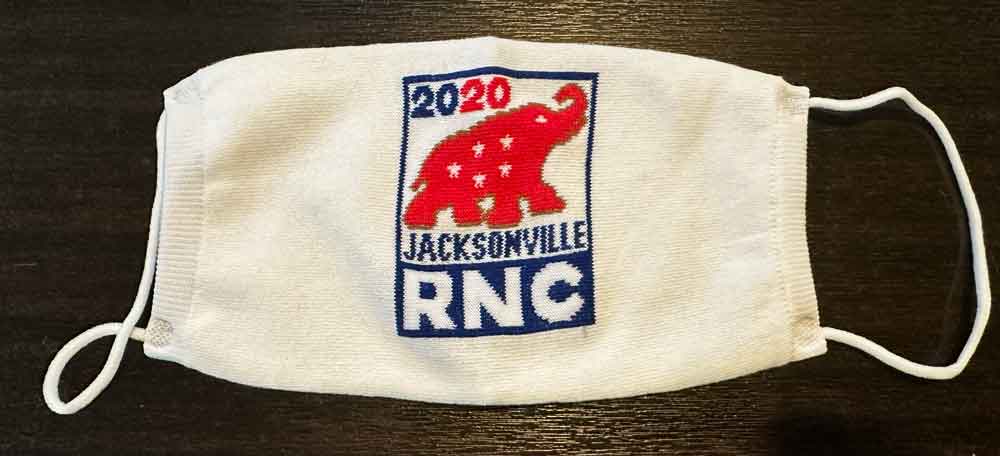
One of the COVID masks the RNC created for the 2020 Charlotte/Jacksonville convention.
My last GOP National convention I’d been able to go to was supposed to be the 2020 Convention in Charlotte, North Carolina. Then it became Jacosonville, Fl. Which ended up even stranger as COVID canceled the main run of the convention that ended up being a bit of a sh*tshow for attendees. Attendees who had paid convention fees and made reservations found themselves canceled, and left with little else but a request for their proxies and a later note thanking them.
They did send states some COVID masks they made for convention, which the South Dakota GOP later distributed at the election night party in Sioux Falls in 2020, as you can see here. They’re actually pretty nice, and the logo was weaved into the fabric. But, not really a substitute for attending the convention. However, facing COVID, it was not an ideal situation for anyone, so you make due.
With the first GOP Presidential Debate behind us, if I have any observation about the process how we as a party select our nominees, it is that changes in recent years puts South Dakota Republicans who want to participate at a distinct disadvantage, and we need to consider turning back the clock when it comes to how we select our delegates.
Suggestion Box item #1 – Think about an earlier Presidential Primary Date.
Unfortunately, South Dakota is kneecapped in the Presidential Primary process because of the late date of our Presidential Primary.
With our voice in the Presidential Process coming in the first Tuesday in June, we are very, very late in the game. And even moreso with the conventions moving from September to next years’ convention taking place in mid-July, how on earth can you plan attending the darned thing?
If South Dakota wants to have a stronger voice in who we select as President, the only way to do so is to move our presidential primaries back to where we had them from 1988-1996.
When we first had the early primary in 1988, I can tell you that South Dakota actually received a bit of attention. As a Legislative Intern at the time, I can personally relate that we had a number of speakers in Pierre – including Bob Dole (I got to shake his hand), and Vice-President George Bush, who our Intern group got to eat lunch with. Phil Gramm who later won the state that year, was in South Dakota several times, and also spoke to the Legislature.
I believe that an earlier primary makes South Dakota a greater part of the national conversation. And that’s not a bad thing.
But there’s another item in the Presidential Primary conversation that should be looked at – how we choose the people who choose the nominee.
Suggestion Box item #2 – We need to go back to electing candidate slates.
As a result of changes made by the state for accommodating the national convention, over the last 2 convention cycles, South Dakota Republicans have been forced to be homogenous in our thought. What am I referring to? If you look at the SDGOP’s bylaws, they note as follows:
SECTION VI SELECTION OF NATIONAL CONVENTION DELEGATES
1. All delegates and alternates to which South Dakota may be entitled under the National Convention membership formula shall be elected at large. All elected delegates and alternates shall be bound to support the winner of the primary election as provided in this section.
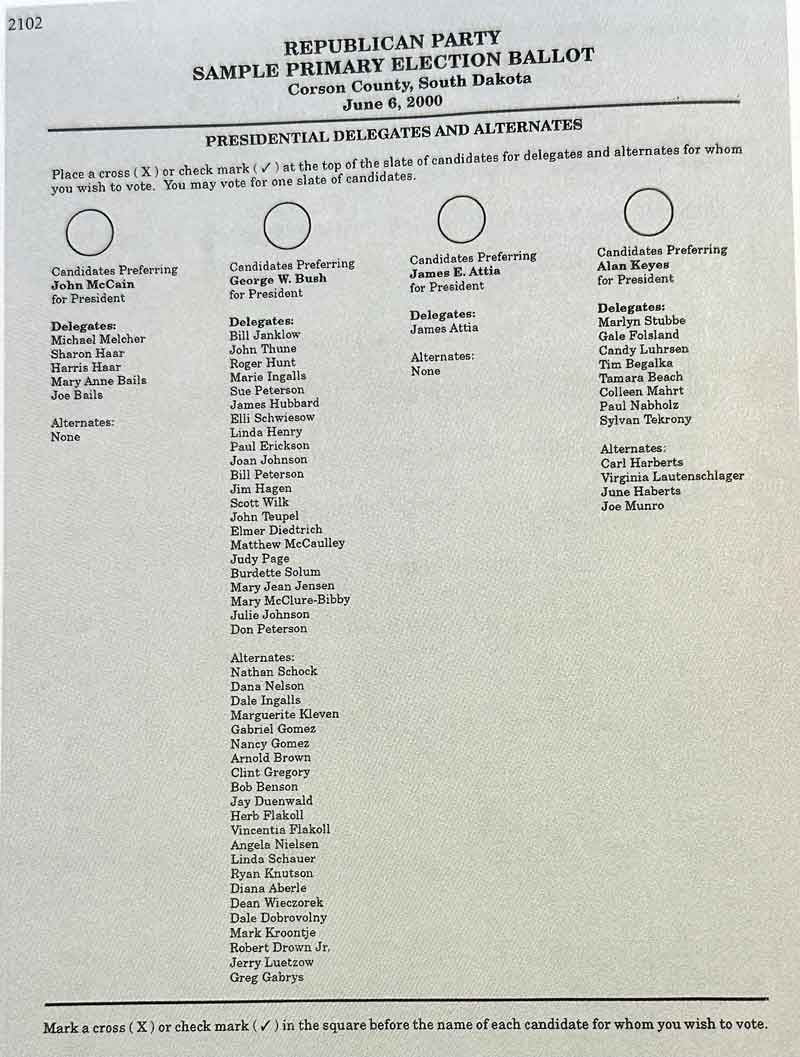
The key point in that passage are that “All delegates and alternates….shall be elected at large.” And that has been the case for the last two Presidential elections, where delegates are not selected in the primary by their actual candidates’ slate winning the election, but by another process. It was different in 2016, but as it sits currently, if you want to go to convention, you’re selected as follows:
Applications will include information detailing the applicant’s activities and contributions to the party, including, but not limited to, time commitments and financial donations to national, state and county Republican parties, and to official Republican national, state, county and local candidates. Applications may include a checklist and/or a written summary of the applicant’s activities in support of the Republican Party. Applications may include a statement regarding the applicant’s interest, qualifications, and ability to serve on one or more of the national convention committees.
In years gone by, South Dakota Republicans would caucus in Pierre, and after caucusing at a county party gathering, where supporters of each candidate would organize themselves, the winners from the counties would meet in Pierre, and from there you would see considerable horse trading based on your county’s weighted vote. I went through this process and horse trading several times under the tutelage of Gordon Pederson and Lee Schoenbeck, both of whom have attended a number of national conventions.
The distinct difference under the prior system, even after the primary was pushed back to the regular June primary, was that you as a convention delegate/alternate were able to run to support the candidate of your choosing, as opposed to being lumped together in the “at large” category, where you have no affiliation or specific allegiance. Under the current system, there is no incentive, advantage or disadvantage to promote one candidate over the other. You’re literally just a blank vote.
Now, I’m not saying that a person’s activity with the party (under the current system) isn’t important. To the contrary. But I think that’s reflected in how successful you are in the process, and how well you’re known at the time of the caucusing.
But getting back to the larger point, it’s no shock thar South Dakotans in the political process have definite opinions on the candidates they prefer. Why not let potential delegates – as they did for decades – line up behind their candidates of choice?
Because people representing our state should be more than jut a vote. They should be allowed to be the face of their candidate.
***
At least, those are my thoughts on how we can improve the presidential primary and the associated GOP National Convention delegate process. Any other suggestions?
Support South Dakota Businesses This Summer BySen. John Thune
Summer is in full swing in South Dakota. Fair season is ramping up. The weather is great for a hike in the Black Hills or a day at the lake. And visitors from all over are flocking to South Dakota’s unique sites and natural wonders. With so much to see and do, it’s no wonder that South Dakota is a popular tourist destination each year.
The tourism season is an important contributor to South Dakota’s economy. Tourism supports countless jobs and small businesses around the state. Last year, 14.4 million people visited our communities and spent $4.7 billion while they traveled from town to town. Growing up in Murdo, at the intersection of Highway 83 and I-90, I saw firsthand the impact of tourism on our small town. Everyone in my family worked a job related to the travel industry. From my job at the Star Family Restaurant, I saw families from across the country coming through Murdo on their way out west to visit the Black Hills and make a pilgrimage to Mount Rushmore.
Tourism is not the only thing that’s contributing to our state’s strong economy. Today, South Dakota has the lowest unemployment rate in the country. While this is great news, it can also pose challenges to job creators who need workers to staff and grow their business. I recently met with business leaders in Yankton who expressed a frustration I hear often from businesspeople around South Dakota in nearly every sector: They need more workers.
With South Dakota’s unemployment rate under 2 percent, it can be hard to find workers to fill openings. And when there aren’t enough workers on the payroll, it can hold back businesses’ operations and growth. To help fill this gap, many South Dakota businesses rely on the H-2B visa program, which allows businesses to hire nonimmigrant foreign workers for temporary, nonagricultural jobs. Employers in the tourism, hospitality, construction, and forestry industries have benefited from an additional pool of workers when they have struggled to find domestic labor to hire. I’ve made it a priority to ensure South Dakota’s businesses aren’t held back by labor shortages.
I recently introduced legislation to empower states to alleviate workforce shortages through the H-2B visa program. The State Executive Authority for Seasonal Occupations Needing Additional Labor (SEASONAL) Act would allow governors to request a specific number of additional visa slots when their states have experienced persistently low unemployment. Visa recipients would still be subject to existing program requirements that protect the domestic workforce, ensuring that states can fill open jobs without negatively impacting hardworking Americans or their wages. Governors could request supplemental visas for specific occupations or economic regions, while state legislatures would be able to impose limitations on the program. And while the federal government continues to balk at reforming our broken immigration system, my bill would ensure that Washington’s inaction doesn’t prevent state leaders from strengthening their states’ economies and supporting local businesses.
Summertime is a great time to experience the best of South Dakota, and more workers could amplify the economic success of our businesses. Whether you’re at a local fair or going down Main Street, I encourage you to support our local businesses and the products that are made right here in South Dakota. And I hope to see you there.
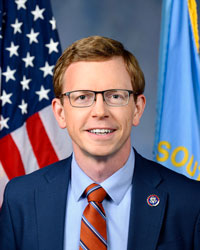
Teenage Dream By Rep. Dusty Johnson August 25, 2023
When I was a teenager, I was eager to start my first job. When I wasn’t doing homework or running track, I wanted something else to do – I didn’t like to sit around. A part-time job was a great option for me. Plus, I really needed the extra cash if I wanted to go on dates or have gas money.
At the time, a part-time job was something to keep me busy, but looking back, I learned what it meant to work hard from a young age. That’s a value that can’t be understated, especially in this day and age. Work is not punishment, but it’s an opportunity to solve problems, sharpen our skillsets, and help others.
These skills don’t just happen overnight – they take time to develop with hours and days of applying yourself to learn and improve. Unfortunately for our teens, the hours they’re allowed to spend in the workplace are limited. Currently, 14- and 15-year-olds can only work 18 hours per week during the school year. That’s not even two and a half traditional 8-hour shifts. Current regulations don’t allow teens to work past 9:00PM year-round – including summer break – or past 7:00PM during the school year. They’re not allowed to work even if they wanted to, but they can make the decision to play in football games until 9:30PM or play video games through the night.
I introduced a bill to alleviate these restrictions to give teenagers the option to work a little bit more if they want to. Hear me out. I’m not saying all kids need to work 40-hour weeks or slack off on schoolwork or extra curriculars. What I am saying is if teenagers want to work a couple extra hours in a week and make investments in their future, they should have the flexibility to make that choice.
My bill, the Teenagers Earning Everyday Necessary Skills (TEENS) Act, increases the number of workable hours per week from 18 to 24, and allows teens to work from 7:00AM to 9:00PM year-round. We want to raise kids who make wise choices. Many teens love their summer jobs. We should encourage them to continue those jobs if they want to, not restrict their ability to do so.
The World’s Best Hope By: Governor Kristi Noem August 25, 2023
The Great Seal of the Unites States contains a phrase – “E Pluribus Unum,” “out of many, one.” Out of a nation filled with many different people of many different backgrounds comes one government that is elected “of the people, by the people, and for the people.”
This is an ideal that has been intertwined with the very soul of our nation since July 4th, 1776: we have the God-given right to self-governance. It was a radical idea, a hope, that our founders risked “our lives, our fortunes, and our sacred honor” to actualize.
Since the signing of the Declaration of Independence, America has become hope itself. In his first inaugural address, Thomas Jefferson called America “the world’s best hope.” In an 1862 address to Congress, Abraham Lincoln called America “the last best hope of earth.”
Today, that hope is dwindling. It feels like America is breaking.
In the last few years, some politicians have locked down entire states, told businesses that they were not essential, and took Americans’ individual Freedoms away. In schools across the country, young Americans are being taught that our history is something to be ashamed of rather than something to be proud of.
The breaking of America is being accelerated – even driven – by the radical policies of the Biden Administration. President Biden has crashed America’s once-proud economy into the ground, driving down wages while propelling inflation and the national debt to unheard-of heights. Under his watch, our Southern border has become a warzone. And America – the great hope of nations around the world – looks weak on the global stage because he has refused to lead.
My goal, and what I believe should be the goal of every American, is to live a life of significance. I get up every single day and do what I can to protect this great experiment – to guarantee that our Freedoms survive for my kids and grandkids.
And I will continue to tell South Dakota’s story because it has become a story of hope to the country – just as America is a story of hope to the world.
Today, it is the job of every American to fight to put this country back on its foundation. America has stood the test of time because we have not given up on the ideals upon which we were founded. That has been the job of every American in history – to not drop the ball on our watch.
The Freedom that we enjoy is not a guarantee. It’s something that has been fought for by generations before us. Our duty is to defend it for generations yet to come.
Over a decade before he became president, Ronald Reagan said this: “You and I have a rendezvous with destiny. We’ll preserve for our children this, the last great hope of man on earth, or we’ll sentence them to take the last step into a thousand years of darkness.”
Our founders gave us an incredible gift. What matters now is what we choose to do with that gift. We can either ignore it, take it for granted, or we can use it to ensure that America will continue to be the greatest nation to ever exist for our kids, our grandkids, and their grandkids.
“E Pluribus Unum.”
Out of many generations, out of many elections, out of many leaders, out of many tribulations, out of many triumphs, comes one great nation.
The United States of America – the world’s best hope.