If you’re following the controversy over party-infighting between people getting involved with the party at the local level for the first time trying to toss out those who have been involved for years or decades, there are a few realities that come to mind.
It’s apparent that these groups haven’t really thought it out very hard about what happens when they get their way and they’re now “in charge,” and they can proceed on their mission of “replacing ‘establishment Republicans’ with grassroots conservatives,” as the coalition of confederates claim to be doing.
A couple of items bring to light the headaches that they’ve set themselves up for.
A climate of distrust.
If you recall a recent article in the Yankton Press and Dakotan, a situation came to light where the outgoing leadership of the Yankton County Republican Party determined that they felt they needed to create a Political Action Committee to ensure that funds raised from the donor base went to their intended goal, to support candidates, because they didn’t believe that the incoming group would spend them for those purposes.
The Yankton County Republicans are seeking a sheriff’s investigation into three former board members’ transfer of $12,000 last fall from party funds to a political action committee (PAC).
And..
“We did this (PAC) before the meeting (where they elected new officers). We weren’t reacting to anything,” he said. “We just thought it was prudent to put aside the funds, that it was a good move.”
The former board members are following state GOP by-laws, Meyer said. In addition, he said he conferred with the South Dakota Secretary of State’s office in setting up the PAC.
And..
The former board members didn’t transfer the full amount in the Yankton County GOP treasury, he said. The county party still has a mailing list while another copy of the list remains in private hands, he noted.
As for the Facebook page, the site belongs to a GOP member and not the party, he added.
Read the entire article here.
The new people involved in the Yankton County Party are just howling, but a political party forming a political action committee is not uncommon, nor is shifting funds between the two. Completely legal, and fairly common.
The only difference here is that the new group of county people are trying to rescind the action of the old, and are being told no. And it sounds as if the group is in significant disarray.
There’s also rumors that the new group may be filing suit against the old. In effect, the new group spending what limited funds they have on an attorney to try to claw back money legally spent by the old group to support candidates.
What kind of message does that send to donors, large and small? It’s not a good one.
As messy as the Yankton County GOP is, the Minnehaha County group is even more of a cautionary tale.
Back 30 years ago, the Minnehaha County Republican Party had a well-funded and long-established organization, which had an executive secretary, with sometimes more employees. In the late 2000’s the internal organization of the office started to crumble, but fundraising and events were still going reasonably strong. That is, until Lora. In 2012, Lora Hubbel was the first wave of the political outsiders to hit Minnehaha County – and it literally crashed the organization overnight. And it has not recovered to any significant degree since.
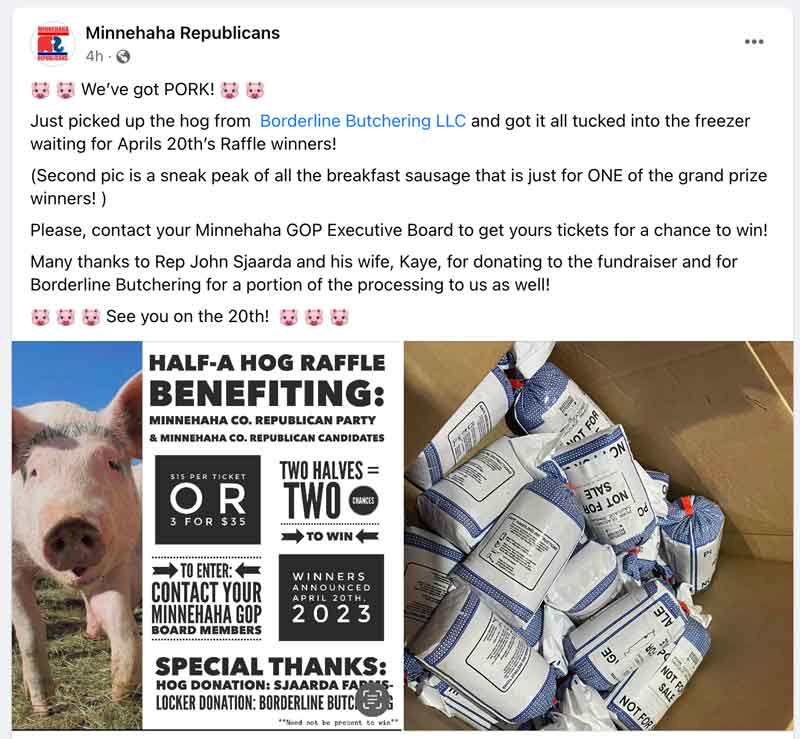
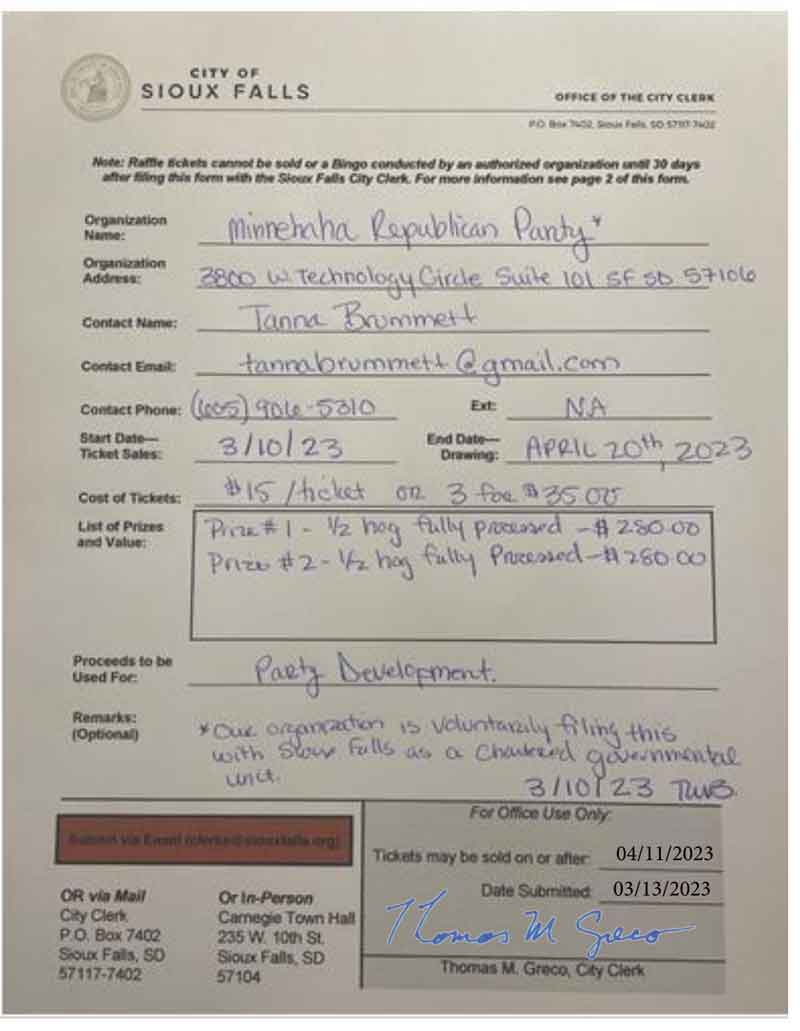
In their first meeting this year, the Minnehaha County GOP has announced they had either $1400 in the bank, or $4500, but they weren’t sure. So now they’re raffling portions of a donated hog, valued at $500.
The biggest county in the state has less than $5000 in the bank? That’s a bit of a head-scratcher, because for the state’s largest county, you would think the chair has the ability to raise ten times $500 in a brief period of phone calls. You would think.
But, I have the feeling the number of willing donors in those circles are not exactly opening up their checkbook.
With the rhetoric coming from a number of these groups calling for the excommunication of ‘establishment republicans,’ there is a strong climate of distrust. And as Yankton and Minnehaha are finding out, it’s bad for their bottom line. People won’t give money to groups they don’t trust.
Blowing up the Pyramid of Giving
If you’ve spent any significant time involved in fundraising, you’ve heard of the pyramid of giving.. and if you’ve heard of it, it’s clear that the people involved in these groups demanding the ouster of long-time volunteers, and the repudiation of ‘establishment politicians’ don’t have a clue on how to raise funds for a stable and functional organization.
The pyramid of giving is really, fundraising 101 for organizations and non-profits. And grasping the concepts are how an organization can make the shift from short term efforts to long-term goals.
This might be the best example of it I can find that’s applicable to the area of political organizations..
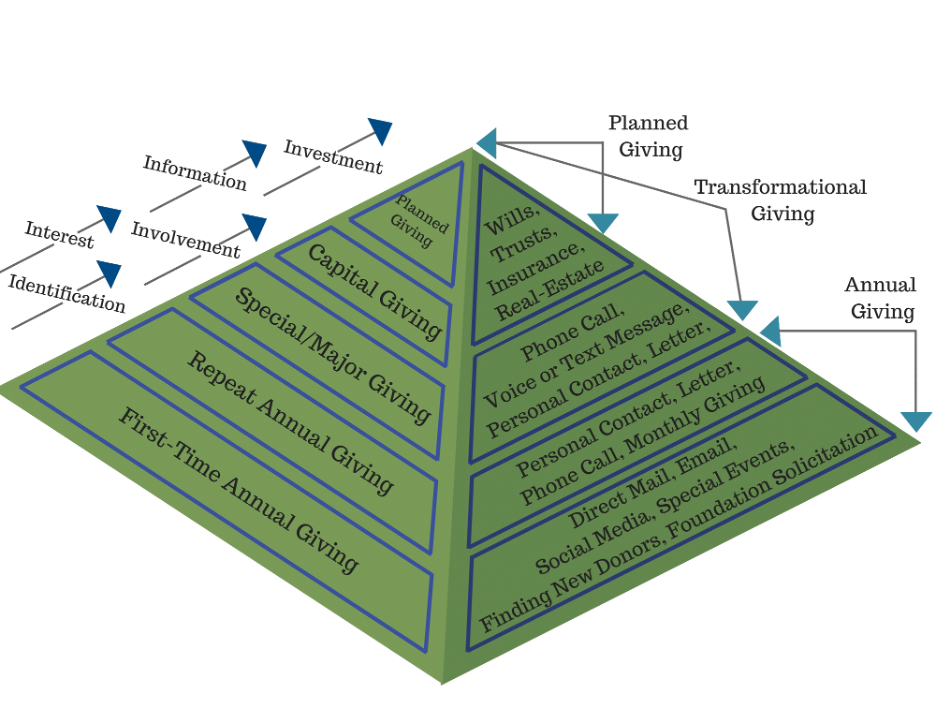
As you can see, it involves donor acquisition, getting them used to donating on a regular basis as you move them up the pyramid, and possibly getting them all in for larger and larger donations. I don’t know that I agree completely with this example, as letters are lower level in this field, as if you want larger political donations, there’s more of a personal element to the ask. But you get the hint.
Now, some say a more modern version of the pyramid is a funnel..

Which I stole from here.. (Please visit their website)… but it’s the same principle. You engage with people, and over time you build their engagement to the point where they are foundational.
Healthy organizations are going to be constantly working at all levels to bring people into the pyramid (or funnel) of giving.. and this is something that takes YEARS, if not decades, to gain their personal investment into the group or cause to the point where they’re willing to make major or transformational gifts to a county Republican organization.
People are not going to build their involvement in a group to the point where they make generational gifts to a county Republican organization when there are people who come in and express their goals are to completely nuke the Republican organization and throw people out. It literally is the most counterproductive thing to organizational efforts that they could do!
If you blow an organization up about the time people become a repeat donor, you are not going to achieve organizational stability and long-term growth. You’re going to have to start over every time.
A fact, as Minnehaha has found, and I’m sure Yankton will find out if they haven’t already.
Who cares if we throw those guys out?
Of course, there are those who have blinders on, and will cluck around the chicken coop saying “who cares if we throw those guys out?” For party organizations, they should. They really, really should. Because it directly affects their longevity as a group, and their ability to conduct activities.
With campaigns, I was taught that a successful campaign is a mixture of experienced campaign veterans and new people with enthusiasm and energy. They both benefit each other. The same goes with party organizations. Organizations without new blood – even if they are good – will become stagnant and outdated. Organizations without experience will make some really dumb mistakes, and have to re-learn everything, sometimes in a painful manner.
Contrary to what some may think, political party organizations are extremely challenged to raise funds, because they are the least sexy aspect when it comes to receiving donations.
If I have limited resources, and my options are a candidate I like, who believes the same things I do, versus the county party organization, who is saying they want to throw out all the establishment republicans, or have craziness like people claiming vaccines cause autism or they can heal illness with essential oils… guess who I’m going to support? The candidate. People will donate to candidates first and foremost almost every time and will skip the party unless their relationship with the party is foundational to their goals.
Speaking as someone who has been involved in campaigns for several decades now (or as my daughter claims, it’s my I’m old line), county political organizations are a tool for candidates if they can provide useful resources.
If candidates can rely on them for assistance with volunteers, support them in some manner at election time, help with mailings, sign locations, etcetera, that’s a great thing. If not? Well, then they become an obstacle to go around. And candidates do not spend a lot of time debating whether they should do so or not. It’s a snap judgement, and then the candidates move on with their own volunteers and their own fundraising.
Which leaves the organization a bit in an awkward situation when they claim they’re helping the candidates, and the candidates will directly express to anyone that asks that they can’t rely on them. Over time, it will wear on that group.
Elections are still actually about the future
It used to be that Republicans would have their primary election fights, and then at times bruised and battered, at least begrudgingly move forward towards running the election in the fall against Democrats.
But especially over the past two elections, there’s a climate where there are those who are less interested in uniting as a group for mutual goals are more focused on being the group “in charge,” claiming to be the true Republicans and ignoring the fact that those they call the ‘establishment’ were a decade ago the ‘grassroot conservatives’ they themselves try to lay title to at this point.
I would offer to them that it might be a rude awakening in 2033 when they find themselves called the ‘establishment moderates’ when a new generation of republicans try to flex their muscle because they want to be the ones in charge, pushing out those they consider old guard in the future.
In perspective, it’s very generational, and it’s all happened before.
Probably the best advice to offer groups who aren’t interested in history, and wish to declare their version of republicanism is supreme, is to go ahead, and lead by example. Put the work in, and show us how you have raised tremendous amounts of money, built a group that will stand the test of time and be there after you’re gone, and put us all to shame. And most importantly, get candidates elected.
Because we will know if you don’t, and electing candidates is what county organizations are supposed to be about.
Elections are about the future. And that is what we should all be working towards.