Hard-right Citizens for Liberty group hosting annual dinner at Grand Gateway Hotel, whose owners are being sued by US Department of Justice, others for discrimination

Mark this one down in the “you cannot make this up” category.

Former US Senate Candidate Bruce Whalen, who now calls his facebook presence “Whalen for Freedom” (after losing the US Senate Primary to Senator John Thune 73% to 19%) is advertising the annual dinner for hard-right group Citizens for Liberty, which they are holding at Rapid City’s Grand Gateway Hotel, with a gathering later in the “Cheers” bar on site.


“Place: Grand Gateway Hotel… Guests are invited to retire to Cheers after the Gala!”   Why do the “Grand Gateway Hotel” and “Cheers” sound familiar?  If you recall, there was a bit of a “to do” this last year there:

A recent social media post by a hotel owner in Rapid City, S.D., announcing that Native Americans would be barred from the business after a shooting in one of the hotel’s rooms has prompted swift condemnation from community leaders, a protest and a federal civil rights lawsuit.

The owner, Connie Uhre, was upset about an attack at the 132-room Grand Gateway Hotel early on March 19 in which the gunman and victim were both Native American. She also voiced more general concerns about what she described as increasing crime in the city.

“We will no longer allow any Native American on property,” Ms. Uhre, 76, wrote on Facebook on March 20. “Or in Cheers Sports Bar,” she said, referring to the on-site lounge where karaoke takes place six days a week. “Natives killing Natives.”

Read that here.

The hotel is more recently subject to a lawsuit from the US Department of Justice relating to the incident:

The US Department of Justice Department is suing the owners of a Rapid City, South Dakota hotel for saying on social media and elsewhere that it would not serve Native Americans.

The DOJ says the owners’ policies and practices violate the civil rights act.

In March, an owner of the Grand Gateway Hotel and Cheers Sports Lounge posted on Facebook that Natives were no longer allowed at the hotel and bar following an overnight shooting in their building. Days after, Native Americans tried booking rooms at the hotel twice and were allegedly denied service.

and..

“Policies that prohibit Native Americans from accessing public places are patently offensive, racially discriminatory and have no place in our society today,” she said.

Read that here.

You know, if they wanted to demonstrate they were for ‘freedom,’ why would they pick the hotel and bar that is the subject of a lawsuit for allegedly being the opposite.

Crabtree Confident on South Dakota Fiscal Strength

Crabtree Confident on South Dakota Fiscal Strength
Senate GOP committed to fiscal responsibility, balanced budget

PIERRE–South Dakota Senate Majority Leader Casey Crabtree today echoed Gov. Kristi Noem’s confidence in South Dakota’s economy and the state’s financial health as the Legislature prepares to set the 2024 Fiscal Year Budget in the upcoming Legislative Session.

“South Dakota has a proud tradition of fiscal responsibility, and South Dakotans can expect the Senate GOP caucus to advance a budget that spends their tax dollars wisely,” Crabtree said. “The Governor’s proposal is a good starting point for our appropriators as we collaborate with the House to take care of South Dakota with a balanced budget. I’m confident we can reach consensus on what is best for our citizens.”

Sen. Crabtree especially looks forward to working with the governor on supporting South Dakota veterans with 100 percent reimbursement of state university and technical college tuition. Additionally, helping vulnerable populations by reaching 90 percent of the reimbursement rate for nursing homes, community support providers and other providers is greatly needed for these essential services. Lastly, increasing wages for state employees and teachers to keep up with inflation caused by the reckless policies by President Joe Biden and the Democrat-controlled Congress.

“South Dakota’s fiscal strength is thanks to economic freedoms in a low tax, low regulation state. In South Dakota, state government does what’s best for its citizens. We collect what we need and spend it efficiently on essential services, all while keeping our budget balanced,” added Crabtree. “The GOP-led Senate is dedicated to making sure our residents are taxed fairly and that South Dakota remains fiscally sustainable in the long term.”

The 98th South Dakota Legislative Session begins Jan. 9, 2023.

###

Johnson to Mayorkas: End Devastating Drug Trafficking

Johnson to Mayorkas: End Devastating Drug Trafficking

 Washington, D.C. – Today, U.S. Representative Dusty Johnson (R-S.D.) urged President Biden and U.S. Department of Homeland Security (DHS) Secretary Mayorkas to take all necessary actions to secure the southern border following a traffic stop on the Lake Traverse Reservation that resulted in the seizure of approximately 12.4 pounds of fentanyl pills and 3.6 pounds of fentanyl powder, enough to kill every South Dakotan four times.

“While fentanyl busts of this magnitude sadly may be more common in some urban areas, this is rare for a South Dakota community – this is likely the largest drug bust in South Dakota’s history,” said Johnson. “I ask your administration to immediately take all legal and necessary actions at your disposal to secure the southern border, rectify the dangerous policies this administration has put in motion over the past year, and put an end to this devastating drug trafficking that is wreaking havoc on American families.”

In October, Johnson met with Pennington County Sheriff-elect Brian Mueller to discuss crime in the area. Mueller relayed that the influx of drugs in the county are primarily coming from sources south of the United States and have caused an increase in violent crime. According to Mueller, the number one thing Congress can do to combat crime is secure the southern border.

Click here to read the full letter.

###

Gov. Noem Delivers 2022 Budget Address

Gov. Noem Delivers 2022 Budget Address

 PIERRE, S.D. – Today, Governor Kristi Noem delivered the 2022 Budget Address, unveiling her budget proposal for the remainder of Fiscal Year 2023 and Fiscal Year 2024.

You can find the full text of Governor Noem’s 2022 Budget Address below:

Good afternoon, Lieutenant Governor Rhoden, Mr. Speaker, members of the House and Senate, and my fellow South Dakotans:

Before I begin today, I want to thank my team at the Bureau of Finance & Management, the folks at the Department of Revenue for all of their hard work preparing all the data and information for today. They do their work with excellence, and I am so thankful for their help.

I also want to thank my family who is here today.

Today I will present my budget to you for consideration. This budget will cover the remainder of Fiscal Year 2023 and all of Fiscal Year 2024. Before I discuss our future, I want to remind you where we have been and how we stand financially today.

The last four years, we have made South Dakota the strongest state in America.

We lead the nation in almost every single economic metric. Our personal income growth is number one. And over the last year, both our new housing development and new business applications have been the best in America. Our kids lead the nation in educational outcomes, and we are breaking tourism records year after year.

This past year, our unemployment rate has been the lowest it’s ever been in history. Today, we have less than 700 people in the entire state on unemployment.

Our population is expanding at ten times the national average. I will continue to recruit Freedom-loving Americans to come join us here in South Dakota, particularly those who can fill high-demand positions. My budget today will help address these workforce challenges, as well.

South Dakota’s government is small but effective.

While we have grown, we have also been fiscally responsible. We have the best funded pension plan in the country. We continue to have a AAA credit rating, and we balance our budget.

I recognize that taxpayer dollars are not our own – they belong to the people of South Dakota. We all must remember throughout our budget discussions, that this money belongs to the hard-working people of South Dakota.

In South Dakota, our state motto declares “Under God, the people rule.” These aren’t just words we say…we believe them, and take action based on them. We MUST for the future security of our great state.

Frankly, the irresponsibility of the federal government demands it. No nation in history has ever survived the tax burden and spending spree that this White House is pursuing. They haven’t balanced the federal budget in decades, Congress continues to raise the debt limit with no plan for spending, and leaders in DC print money only to turn around and go into debt with foreign entities that are our enemies.

Then they declare that they MUST reach into the pockets of everyday Americans to grab more of their earnings to keep us safe, enforce law and order, and subsidize programs designed to enslave families to government. We have seen the incredible power grab of these leaders the past few years. They have used unconstitutional actions and the enticement of more money to take unprecedented action to make people more dependent, weak, and apathetic. It is irresponsible and wrong.

That’s not how we run our state. We make hard decisions and recognize that a limited government respects people AND their dollars and that it is the way to preserve the American dream for our children and our grandchildren. We don’t make decisions to only benefit us today. We look far into the future and the realize the ramifications of our decisions and make the hard choices, so that future South Dakotans have the chance to grow up in a place of opportunity and freedom.

The nation is watching how you in this body make decisions. That may not have been true 5 to 10 years ago. Whether you like it or not, people now know where South Dakota is. They see this state as a beacon of hope. A place of Liberty. How you decide to govern, budget, and communicate to our people will be watched, evaluated, and judged. Has your job gotten easier with more revenue? I would say No. It is much harder. We must be disciplined in order to protect our state from an expansion of government in our lives through new programs and subsidies. Let’s not forget that government should be beholden to the people and not the other way around. Our founding fathers did not believe in a centralized government. They believed in the rights of individuals and their ability to govern themselves.

Our state is bringing in incredible revenue.

People are making more money, our businesses have expanded, we have recruited new industries and because of the way we have followed our states’ motto “Under God the people rule” we have permanently grown the state’s economy. We have lived through unprecedented challenges since I’ve been your Governor:  bomb cyclones, a pandemic, the Derecho – make no mistake, this economic growth is an unprecedented event as well.  We must be leaders who protect South Dakota’s way of life as we look to the future.

On November 8th the people of this great state gave us a mandate. They turned out in record breaking numbers to make sure we in this building heard from them loud and clear. They demand low taxes, less regulation, and more freedom. They were also clear that they want us to take care of people and create opportunities to succeed.  As Governor, I will continue to listen to our people. I will guide our discussion and decisions based on my constitutional authority.

We have $423 million in reserves. Historically, our goal is to keep 10% in these funds. Since I’ve been Governor, we have almost doubled that number. We ended last year with a record-breaking budget surplus of $115.5 million.

That historic surplus in Fiscal Year 2022 was largely thanks to sales & use tax receipts growing by more than 12% over the prior fiscal year. So far in Fiscal Year 2023, sales & use taxes have grown by another 14.1%. Early indications for November have us beating revenue projections by another $58.8 million, putting us up $135.3 million fiscal year to-date. Sales tax alone is running $81.8 million ahead of the estimates that you adopted.

In South Dakota we know to prepare for the future. Let me be clear, we have done everything we can in our state to be successful. However, economists indicate there will challenges ahead. Bad policies coming out of Washington, DC will unleash a recession on this country. We will be impacted. Earlier this year our country had two consecutive quarters of negative economic growth. The Federal Reserve’s increase of interest rates is another indicator that a recession is on the horizon.

But South Dakota’s growth in tax revenues continue, because our state’s economy is in a far stronger position than the nation’s as a whole. Economists expect that the upcoming recession will be primarily “investment-led.” They expect that our unemployment rate will remain low. And they don’t expect consumer spending to be heavily impacted. Those factors affect how we budget here in our state.

In my budget today, I am keeping our revenue projections for the future very conservative. The people of South Dakota deserve safe planning that protects them from future tax increases or drastic cuts to state services.

We expect $310 million in ongoing revenue available for Fiscal Year 2024. And we are anticipating $216 million in one-time revenue will be available in the upcoming Fiscal Year, as well. The budget that I am proposing to you today invests every single dollar of those revenues wisely.

Eliminating the sales tax on groceries is the biggest way that my budget helps South Dakotans tackle the challenge of Biden’s inflation and protect hard earned money. Unfortunately, food costs have risen by far too much. And families are struggling to make ends meet, as a result.

You have heard me talk about the rapid increase of the costs of milk, ground beef, eggs and other groceries. Eggs alone have increased to over 140% of what they were a year ago. Even with South Dakota having the best personal income growth, family budgets are not keeping up. We can grow incomes even more by letting people keep more of their own hard-earned money in their pockets.

Gas prices continue to increase because of President Biden’s energy policies. New regulations and taxes, a lack of utilization of American energy sources, and a dwindling reserve indicate this trend will continue.

Senior citizens, working parents, single moms – every South Dakotan is paying more for food, gas, and to heat and cool their homes. Their family finances are struggling under the strain. Over the last 10 years, Americans have saved 7 to 8 percent of their monthly income on average. During the pandemic, that jumped to 20 to 30 percent. Today, they are saving less than 4 percent because almost every dollar they make is needed to pay their monthly bills. They are no longer saving for college or to buy a new house or a new car. They are just barely getting by. We need to give them relief, and we can do so by giving them a $100 million tax cut by eliminating the sales tax on groceries.

We have $310 million in permanent revenue growth. And we still have $208 million even after we deliver this tax cut to the people. We have been exceeding estimates by about $25 million a month. The people of South Dakota overwhelmingly want this tax cut, and they know we can afford it.

Remember – our revenues are strong because we have grown our economy. It is the strongest in the nation. People have moved their families, their jobs, and their businesses to South Dakota. Our new housing developments are here to stay. New industries are thriving. The jobs of the future are right here in South Dakota.  And once again, we have the fastest growing incomes in America. This growth is sustainable. And there won’t be a better opportunity in the future.

My team and I are fully confident that this is the right tax cut at the right time. Let’s get it done.

Medicaid expansion passed on the ballot, and therefore it will be implemented.

In every other state where Medicaid Expansion was passed, the costs exceeded their expectations. That’s why this past year, we did our homework, researched those states, and consulted with experts to put together this budget plan to ensure the law is followed.

The federal government incentivizes states to implement Medicaid by subsidizing costs the first few years. After that, the burden falls on the state. The first year, the cost for Medicaid Expansion will be $66 Million, but the state’s responsibility will be $13 million. In the second year, the program will cost just under $70 million, and the state will cover $16 million. We expect the cost of Medicaid Expansion to be $66 million in year one, just under $70 million in year two, rising to more than $80 million by year five.

Make no mistake, the expansion of Medicaid – as passed on the November ballot by the people of this state – is an expansion of a government program that will give free healthcare to a population of the state that the majority are able-bodied, single males. Our goal in policy should be to give people the opportunity to have more freedom in healthcare options, not government-run programs. Let’s keep that in mind in the coming days and give people the dignity of responsive and responsible healthcare that they control – not the government.

There are on-going budget increases we address every year in the legislature. State statute requires we address state aid to education, and we also take care of state employees and providers. This year, I am recommending a 5% increase for all three, which is almost double what is required by state statute.

A few years back, the legislature created a process to establish a rate-setting methodology for health and human service providers – this would affect services delivered by community-based providers. This methodology reflects the reasonable amount that we should pay for services that are provided.

Unfortunately, as the cost of living has increased, reimbursement rates for many of these services have struggled to keep pace. Today, I am recommending that we invest $22 million in targeted increases to reimburse at least 90% of the reasonable rate for all providers of these services.

Some have fallen too far behind. To get to 90%, we will need a 21% increase to nursing homes; a 17% increase to community support providers for South Dakotans with developmental disabilities; and a 26% increase for psychiatric residential treatment facilities. These providers are critical to our state and ensure we can continue to take care of some of the most vulnerable among us.

We must address the fact that we are having a very difficult time recruiting state employees. Today they are falling behind industry, and we often train people for their positions only to have them leave for jobs elsewhere. My budget has $11 million in targeted pay increases for specific job areas and $11 million in added benefits to ensure state government has the workforce it needs to carry out critical services that are necessary for us to fulfill our responsibilities.

I want to remind everyone of one thing that the media seems to forget every year – the governor and the legislature do not decide where all of these dollars go. We cannot dictate to schools and healthcare providers how these dollars are spent. But I would encourage all of them to put as much of it into pay increases as they can. South Dakota has the fastest growing incomes in the country, but if you don’t continue to invest in your workers, providers, and teachers, they will find good paying jobs elsewhere.

Because of President Biden’s inflation, building projects that have already received legislative approval are coming in far over budget. I am recommending $25.6 million in one-time funding to finish these critical projects that we’ve already started.

This request includes $13 million to the State Public Health Lab; $7 million to Board of Regents projects; and $6 million to the DEX – or Dakota Events CompleX – at the State Fair. All of these projects have received prior legislative approval, and they need to be completed.

Margaret Thatcher, famously said, “There is no such thing as society. There are individual men and women, and there are families.”

Amen sister.

When I became Governor, I implemented Paid Family Leave for state employees. We told state employees that if they were bringing a new child into their home – whether by birth or adoption – that the state would cover 60% of their pay via paid family leave.

Today, I am announcing that we will be extending that benefit to cover 100% of pay for state employees. This will cost $3 million in ongoing dollars.

One of the biggest challenges facing our state overall is workforce. Too often, new parents have to leave the workforce when a new child joins the family. Those early days are so crucial to give moms and dads the opportunity to bond with the new child. By extending paid family leave opportunities, we can help workers and families.

To do this, we will be including $20 million in one-time incentives – spread out over four years – to incentivize private businesses to buy in to a new paid family leave opportunity.

We will also be supporting mothers and families through funding for adoption – and pregnancy and postpartum care for Medicaid patients. And we will be funding scholarships for foster children. You will hear more details about each of these proposals in my state of the state address in January.

But it isn’t just birth and adoption where families need our help. We can strengthen families by continuing to help them through some tougher circumstances, too. Over the last couple years, you have helped invest in regional behavioral health centers.

Too often, when someone is experiencing a mental health crisis, they just end up in jail or in the emergency room. That isn’t how we get them the help that they need. And that isn’t a responsible use of taxpayer dollars. These facilities will help these individuals get better care as soon as possible. And it will be closer to home.

We’ve built these facilities in communities across the state. Two years ago, you provided funding for facilities in Pennington County and Watertown. Last year, you provided an additional $15 million to expand these regional facilities statewide.

You built the buildings – now we need to fund the operations. My budget proposes $5.6 million in ongoing funding to these regional facilities to get these individuals the help that they need sooner. It will not only be better care, it will also be more efficient and cost-effective than what we are doing today.

The final way that this budget will continue to build on South Dakota’s strength is by investing in public safety and infrastructure. These are core functions of state government.

Over the last four years, we have made tremendous infrastructure improvements. We have repaired dams, roads and bridges, and built railroads to help support South Dakota’s incredible growth.

My budget continues to guarantee our state’s public safety, as well. South Dakota has set itself apart as a place that respects law enforcement and our military. We realize that our people cannot enjoy our state’s tremendous Freedom if they are not safe in their homes or on our streets.

Last year, we started the hard work of addressing the challenges within the Department of Corrections and prison system. We put $86 million into a new Incarceration Construction Fund and funded $3.8 million for land and design costs for a new women’s minimum-security prison in Rapid City. The new Incarceration Task Force agreed with these recommendations.

The engineering and design process came back with dollar figure estimates. Updated population projections indicate that we will need 300 beds at the women’s facility. The cost estimate for construction is $200,000 per bed, or $60 million. We can cover this cost with the money that you set aside in the Incarceration Construction Fund, and my budget reflects that.

We also need to address the state penitentiary. We know it is outdated, not compliant with ADA requirements, and overcrowded.  It has been an issue for many years, long before I was your Governor.

I am recommending that we take the same multi-year approach that you have taken with the women’s prison in Rapid City. My budget includes $52 million in funding to purchase land and conduct engineering and design for this new facility. $27 million of that will come from the remaining dollars in the Incarceration Construction Fund, and $25 million will come from one-time general funds.

I am recommending we transfer excess funds that are above and beyond the traditional 10 percent we always hold in reserves, to address this situation.  We remain committed and will continue to maintain 10% in reserves as we always have in the state of South Dakota.

We also have a responsibility to secure people’s personal information. We can’t do that with our current operational system. Our state’s accounting and software system is 35 years old. It is vulnerable to hackers and in danger of crashing in the future. Imagine using the same computer you used 35 years ago. Many of you wouldn’t dream of it, yet our state does. Also, we have no backup for this outdated system, which is a major security concern that comes with incredible liabilities.

Think about our agencies and all the personal information they are responsible to keep secure for the people of South Dakota. For instance, the Department of Health and the healthcare information they hold for individuals, or Social Services and their case work and child protective programs, to name a few. We need technology systems that will ensure privacy for all our citizens. Every hour, our state servers encounter thousands of hacking attempts. We need a system that will ensure privacy for all our citizens.

It will take 4 years and $70 million dollars in one-time funding to replace this accounting system – but we must get it done. We don’t want to look back and wish that we’d taken this threat seriously.

My budget also provides one-time funding to upgrade the State’s Emergency Alert System and upgrade remaining state radio infrastructure to support our law enforcement. They are our heroes, and they must have the tools and equipment they need to continue to serve our state.

Our National Guard serve us every day, and we can do more to support them. Currently, the state covers 50% of tuition if a Guard member attends a Board of Regents institution. We cover more than 80% of tuition at our state’s tech colleges. I want to take both of those numbers to 100%. We should fully support the men and women in our National Guard as they pursue their education and serve our state and country.

We are also going to address the needs of finishing the Sioux Falls Readiness Center. We will also be providing $8 million in additional federal fund authority to help them complete that project.

And I am also supporting $29 million in federal fund authority for a Field Maintenance Shop for the National Guard in Watertown. This will help us get more of our readiness capabilities in the same location.

I love South Dakota. It is a beacon to the rest of the nation for what is possible when we follow conservative principles and fiscal responsibility. We have become a success story because we keep government limited and live within our means.

Our blessings don’t just happen to us. Oh yes, God is good. All the time. But we have choices to make that will come with consequences for generations to come. If we are wise, we will preserve for our children the last best hope on earth. If we fail, well – Ronald Reagan defined that type of failure as “sentencing our children to take the last step into a thousand years of darkness.”

I have faith we will be up to the task at hand.

That we will remember the sacrifices of our founding fathers, the blood shed by the greatest generation so we can be here in this chamber today, and the commitment of our deployed military who stand – right now – in harm’s way so we can be free.

We have no idea what “hard” is. What they did – what they do – that’s hard. We are lucky. Honored. Blessed.

Let’s never forget that – and let’s get to work. Merry Christmas!

###

Convention of States says they’ll be back this year. Ha. Ha. Ha.

Former Presidential hopeful Rick Santorum was in Pierre today to sample the bitter cup of disappointment he’ll be drinking from this next session when the legislature once again rejects a measure to open up the US Constitution for Amendment:

Santorum blamed legislative leadership in the state Senate for its failure. Last session, Sen. Lee Schoenbeck, the Senate’s president pro tempore, opposed the resolution.

Santorum predicted that incoming leadership in the House would also prove a challenge.

Read the entire story here (Subscription required).

Doubt me? Go ahead and read this and this.

They dumped 1/2 million into attack ads which turned them from a benign lobbying group into one trying to buy elections that people will now actively oppose.

They weren’t going to move the needle forward in the State Senate. And now they admit House Leadership will be tough for them.

Game over.

Thune Launches Nationwide Broadband Oversight Effort  

Thune Launches Nationwide Broadband Oversight Effort  

“I’m committed to expanding access to broadband services and strengthening connectivity in rural areas in South Dakota and around the nation.”

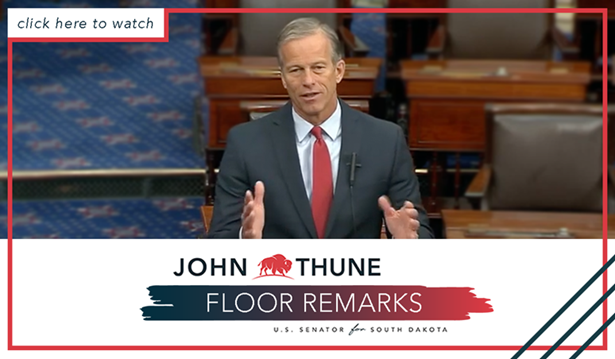
WASHINGTON — U.S. Sen. John Thune (R-S.D.), ranking member of the Subcommittee on Communications, Media, and Broadband, today announced that he will be launching a nationwide oversight effort that will review numerous broadband programs spanning several federal agencies. The primary goal of Thune’s effort is to hold these agencies accountable and ensure that previously authorized broadband funding is being used in the most efficient way possible to protect taxpayer dollars. In a letter sent today, Thune seeks input on the current broadband regulatory structure from a diverse group of stakeholders, including broadband associations, public interest groups, and free market think tanks.

“I’m committed to expanding access to broadband services and strengthening connectivity in rural areas in South Dakota and around the nation,” said Thune. “In order to ensure rural communities have access to these services, it is critical for federal agencies to efficiently spend funds on the areas that need it the most. Every federal dollar that has been spent should go toward the stated purpose of expanding connectivity to truly unserved areas. Congressional oversight has been noticeably absent in these areas, and there is serious concern that the federal government would repeat previous mistakes where agencies’ gross mismanagement of broadband funds fell on the backs of taxpayers across the country. It is time for Congress to exercise its oversight responsibilities and hold the government accountable to hardworking taxpayers.”

Since the onset of the COVID-19 pandemic, Congress has allocated nearly $80 billion in federal broadband investments. Additionally, the so-called American Rescue Plan allocated $350 billion for state, local, territorial, and tribal governments that can be used for broadband infrastructure. Due to this unprecedented amount of funding for broadband-related services, Thune believes stringent oversight of how these dollars are being spent is necessary to avoid agencies misusing billions of taxpayer dollars.

Full letter below:

Dear stakeholder:

Fixed and mobile broadband services are vital to America’s communities. The expansion of these services has played a critical role in ushering advancements in health care, education, economic development, and much more. As you know, Congress has allocated billions of dollars with the intent to expand these services to unserved areas.

More than a year has passed since the Infrastructure Investment and Jobs Act (IIJA) was signed into law. As part of the IIJA, Congress provided a $65 billion investment in broadband services, the majority of it going to the Broadband, Equity, Affordability, and Deployment (BEAD) program administered by the National Telecommunications and Information Administration (NTIA).

In addition to NTIA, the Federal Communications Commission (FCC), U.S. Department of Agriculture (USDA), and U.S. Department of Treasury (Treasury), play a role in advancing broadband services across the United States. Additionally, multiple other agencies and states have adopted programs to help support the expansion of broadband services. In fact, the Government Accountability Office (GAO) recently found that broadband funding is spread out over 15 separate agencies and more than 130 separate programs.

The fragmented approach the federal government has taken to address the digital divide raises a number of concerns. As GAO noted, “U.S. broadband efforts are not guided by a national strategy with clear roles, goals, objectives, and performance measures.” This creates a serious risk of misallocating the broadband funding Congress has appropriated which may result in billions of taxpayer dollars being spent with little to show.

As a longtime member and former chairman of the Senate Committee on Commerce, Science, and Transportation, which has jurisdiction over telecommunications services, I believe it is imperative Congress exercises its oversight responsibilities and seeks feedback on how to best expand broadband services in the most effective, efficient, and fiscally responsible manner so that we can close the digital divide once and for all. Absent such oversight, there is a significant risk the federal government will repeat the mistakes of the past where agencies misused billions of dollars and overbuilt networks.

In light of the importance of ensuring federal dollars for broadband services are implemented properly and broadband deployment more generally, I ask you to provide your organization’s comments on the current broadband regulatory structure and your organization’s priorities, as well as provide responses to the following specific questions no later than Friday, January 6, 2023:

Infrastructure Investment and Jobs Act-specific Issues:

  1. As part of the IIJA, Congress established a technology-neutral approach for the BEAD program. Do you believe NTIA followed Congress’ intent in establishing a technology-neutral approach? If not, should Congress consider amending the IIJA statute to make it more explicit that all technologies are allowed to participate? If so, how?
  2. In the BEAD Notice of Funding Opportunity (NOFO), there are detailed reporting requirements on subgrantees who do not use a unionized workforce or a project labor agreement. As a practical matter, do you think this favors certain providers over others? Does Congress or NTIA need to take further action to remove this requirement?
  3. The BEAD NOFO promotes government-owned networks. Do you believe government-owned networks are an effective entity to deploy broadband networks? If yes, please explain.
  4. One of the provisions of the IIJA requires products and materials used for broadband projects to be produced in the United States. Given the current supply chain issues, should Congress consider modifying this obligation or otherwise clarify this provision?
  5. The Broadband Buildout Accountability Act, S. 3671, would remove the Freedom of Information Act exemption in the BEAD program. Should Congress enact this legislative proposal? If not, why?
  6. Are there other technical issues in the BEAD program that Congress should address before NTIA announces funding allocations by June 30, 2023?

General Broadband Issues:

  1. As noted above, there are over 130 programs supporting broadband access across 15 agencies.
  2. To date, which of these programs do you believe has had the most success in delivering broadband services to truly unserved areas?
  3. Should Congress consider eliminating any of these programs? If so, which ones?
  4. Should Congress merge and combine any of these programs? If so, which programs would be best suited to be merged?
  5. What specific reforms and constraints should Congress consider to ensure federal funds are not being awarded where providers are receiving other federal or state broadband funding support?
  6. Should Congress take additional action in response to concerns that broadband funding may be used to overbuild existing service? If so, what reforms and constraints should be implemented?
  7. Should Congress take additional action in response to concerns that broadband funding may be conditioned upon recipients imposing some form of rate regulation of broadband services, whether or not such requirements are explicitly denominated “rate regulation?” If so, what reforms and constraints should be implemented?
  8. Should Congress take additional action in response to concerns that broadband funding may be conditioned upon recipients imposing some form of “net neutrality” mandates upon broadband services, whether or not such mandates are explicitly denominated “net neutrality?” If so, what reforms and constraints should be implemented?
  9. How effective have the Memoranda of Understanding between the (1) the FCC, USDA, and NTIA, and (2) the FCC, USDA, NTIA, and Treasury been with respect to broadband coordination efforts? Are there additional reforms federal agencies should implement to better coordinate on broadband deployment efforts?
  10. Should Congress take steps to increase the transparency of agencies when allocating and disbursing broadband funds? If so, what steps should Congress take?
  11. What, if any, permitting regulations at the federal level are impeding broadband deployment?
  12. Does the FCC presently possess sufficient authority to preempt state and local requirements that may unreasonably impede the deployment of broadband networks? If not, what steps should Congress consider to address the unreasonable impediments?
  13. What specific steps can Congress take to reduce costs to broadband providers when deploying new networks?
  14. Would updating pole attachment regulations spur more rural broadband deployment? If so, what actions should be taken?
  15. How are federal broadband programs addressing cybersecurity challenges? Should Congress consider reforms to improve cybersecurity?
  16. Are there other broadband policy issues that Congress should consider reforming during the 118th Congress?

###

What form will the new political reality take in the next election? Changes to be proposed for GOP Convention, possibly the primary.

Two and a half years ago, back in mid-2019, I charted out a timeline of how the top political races in the state looked for Republicans moving forward several years into the future.

Not that long after I wrote it, my thoughts on 2022 seem to have been largely thrown out the window when I predicted that 2022 would be “a quiet time.”  It was anything but.  However, I was looking at it with a crystal ball before Jason Ravnsborg’s accident which affected a lot of things, as it exacerbated the divisions and hostilities some members of House Leadership had against the Governor, as well as the Senate.

It also didn’t take into account the rise of, for lack of a better term, a wave of Trump-worshipping populism within the GOP which is less concerned with getting Republicans elected as a whole versus getting “their version”of a Republican elected to office. It’s an undercurrent that’s always been there, but this group, where a group of the hard-right is Republican in name only, preferring to identify themselves as “conservative” as opposed to Republican. They’re more dogmatic than pragmatic in their approach towards policy, and it shows.

Since the time of that 2019 column, Republicans have had two wildly successful elections under the leadership of State GOP Chair Dan Lederman, who has opted to pass on another run for chairman. The heir apparent to the State GOP Chairmanship, State Senator John Wiik, appears to be running with the blessing of the major officeholders, and at least at this juncture, is coming in with a clean slate and the opportunity to bridge gaps.

The party process is important in this equation, as there are fundamental changes coming up on how statewide candidates are selected.   Some might pooh-pooh the role of political parties, but governments don’t have the people or the resources for basic things such as informing people about issues, and turning out voters and engaging them in the process. Political parties do that messy work at the grassroots.  And one portion of that process is presenting and filtering choices for those who have chosen to affiliate with them.

That primary process has been a bit messy for State Republicans as of late. With a convention process that seems at least dented, if not damaged to the point some would call it broken.  The basic problem which has developed over several elections is that the party convention process has become less representative, and more a contest of who can recruit the most delegates to register en masse for precinct positions.. only for the recruits to never be seen again. And the mainstays of the GOP seems to be a bit weary of this.

As a result of the last Republican Convention, the SDGOP will be voting on bylaw changes which will affect how candidates are selected, which in turn will drive changes in state law in the next legislative session.

One leading proposal from the party I’m hearing about is to add Republican elected officials to the roster of voting delegates able to participate at the biennial Republican State Convention. Which has always been a little odd that they haven’t automatically been given that status. There are other proposals out there, but this is the one which is getting the most attention.  The belief is that this may temper the convention, and the candidates selected at it, and make it more representative of the GOP as a whole by bringing in people who actually answer to constituents on a daily basis.

Depending on what the SDGOP moves forward, the legislature as a whole will assess how they want to move forward with the candidate primary selection process for constitutional officers.

It is a given that Lt. Governor will move to a post-primary appointment by the Gubernatorial candidate.  That is nearly certain, and made little sense to split the ticket in such a manner.

What is also a strong possibility from speaking with members of the legislature is that there is movement to have Attorney General and Secretary of State join the Governor and federal candidates as being selected in the primary.  And leave the remaining positions to the parties.  Some who want to fix the process express that they will be happy just putting AG & SOS to voters.  And that actually works with the order of ballot, where you aren’t skipping over one race to get to another:

One thing that some don’t automatically notice is that Secretary of State is before Attorney General in the order of succession, so it would be challenging to put AG to the petition process and not SOS, unless they’re going to change the succession law as well.

But could they go farther?

There is also the possibility that lawmakers may choose to take the selection of all party candidates for all constitutional offices out of the hands of the convention process and leave it to party voters statewide through the petition process.  That may be less certain, but you never know what you’ll end up with once people start legislating.

How could delegates still have a voice if everyone went to a primary ballot? If there was a move in that direction, the party system in South Dakota could change even more.

In years past, when changes to the presidential primary process in the state has come up, there has been talk of moving the Republican convention significantly earlier in the year so the group could have a louder voice in nominating a Presidential candidate for State Republicans. Think of a caucus election process.

If all Constitutional Candidates were moved to the ballot, that would not preclude the GOP from changing it’s bylaws to allow an endorsement for constitutional candidates in a primary. The endorsement would be non-binding among voters, but it would hold significant weight in a primary election if one candidate had the endorsement, and others didn’t.  That could be in the cards if Legislators decided to go all the way with changing the process.

We still have a month and a half before we see what form that the convention reform process will take.

But, change very well may be on deck for the next election.

Gov. Noem to Deliver 2022 Budget Address Today

Gov. Noem to Deliver 2022 Budget Address Today

 PIERRE, S.D. – Today, Governor Kristi Noem will deliver the 2022 Budget Address, unveiling her budget proposal for the remainder of Fiscal Year 2023 and Fiscal Year 2024.

Governor Noem will discuss South Dakota’s best economy in America and continued record revenues.

The address will take place at 1pm CT/12pm MT in the South Dakota House of Representatives. The address will be livestreamed on South Dakota Public Broadcasting, SD.net, and Facebook.com/GovNoem.

WHAT: Governor Noem to deliver 2022 Budget Address
WHEN: Tuesday, December 6, 2022, 1:00 pm CT/12:00 pm MT
WHERE: South Dakota House of Representatives
WATCH: SDPB, SD.net, and Facebook.com/GovNoem

###

Rounds Issues Statement on Former President Trump’s Call to Terminate the United States Constitution


Rounds Issues Statement on Former President’s Call to Terminate the United States Constitution


WASHINGTON – U.S. Senator Mike Rounds (R-S.D.) today issued the following statement after the former president called for the termination of the United States Constitution:

“Americans have a deep appreciation for the Constitution and our Founding Fathers who risked their lives to establish it.

“As elected officials, we take an oath to support and defend the Constitution. We should never dishonor that oath. No one is above the Constitution.

“As I’ve said before, there is no evidence of widespread voter fraud that would alter the results of the 2020 election.

“Anyone who desires to lead our country must commit to protecting the Constitution. They should not threaten to terminate it.

“In South Dakota, Mount Rushmore serves as an enduring reminder of that commitment and the stability our Constitution has provided for over 200 years.

“Despite their imperfections, our Founding Fathers crafted a Constitution that has stood the test of time and sets America apart from the rest of the world. We continue to strive for a more perfect union.

“I believe Americans want leaders, like those on Mount Rushmore, who will defend the Constitution and unite us in our belief that America is truly a shining city upon a hill.”

###