Rounds Takes Oath of Office for Second Term in U.S. Senate

Rounds Takes Oath of Office for Second Term in U.S. Senate

WASHINGTON—U.S. Sen. Mike Rounds (R-S.D.) made the following statement after taking the oath of office for his second term serving South Dakotans in the United States Senate:

“Continuing to work on behalf of South Dakotans in the United States Senate is a tremendous privilege and honor. I’m also incredibly thankful Jean was able to join me for the ceremony.”

“I look forward to getting to work on the important issues that will define our future.”

Rounds was sworn into office by Vice President Mike Pence and escorted by U.S. Sen. Jim Inhofe (R-Okla.). Video of Rounds taking the oath is available HERE.

The reenactment photo, below, was taken in the Old Senate Chamber of the U.S. Capitol following his official swearing in. This is Jean’s first trip to Washington, D.C., since she first started cancer treatment in June 2019.


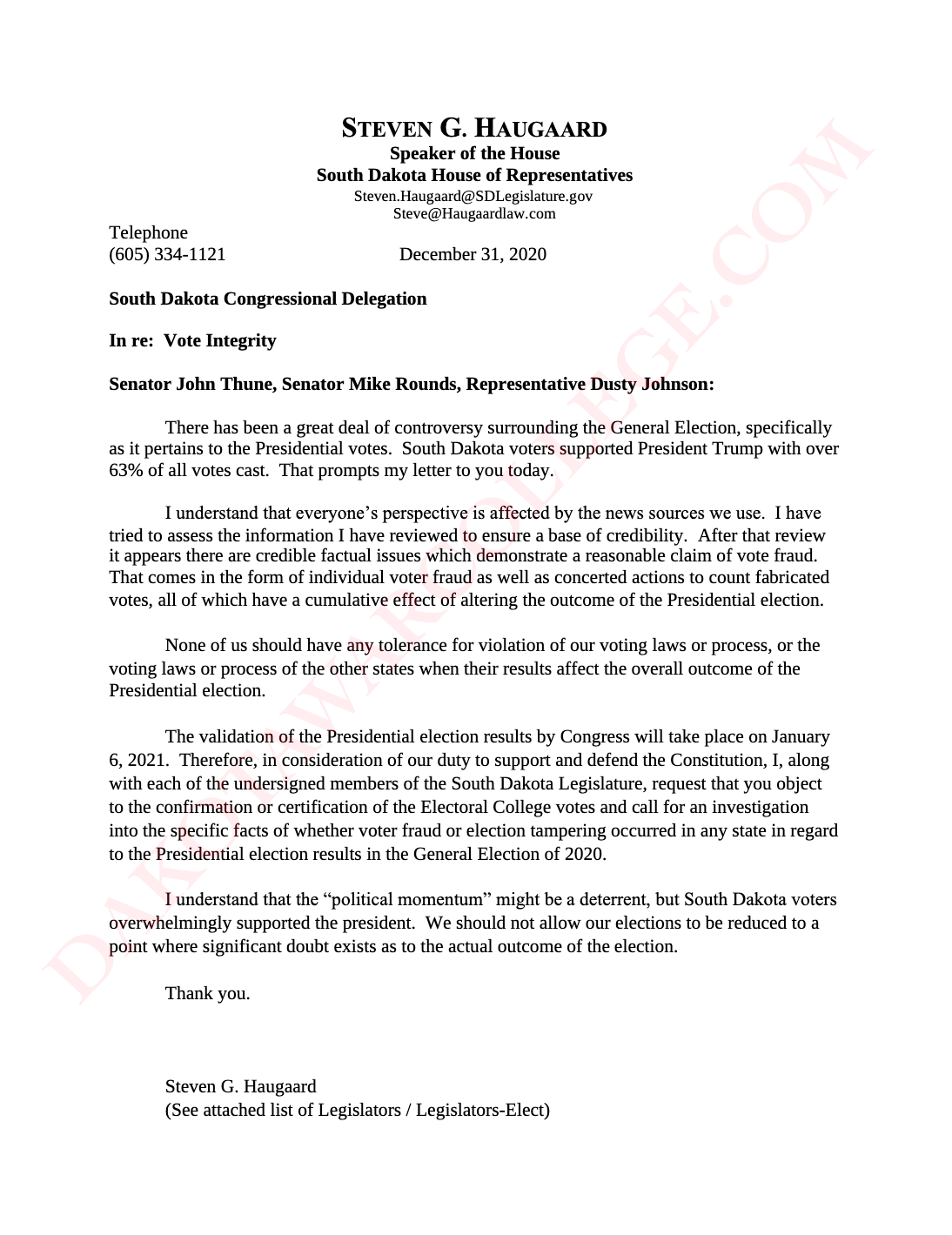
Now outgoing House Speaker Haugaard seems to be doubling down on presidential fraud accusations, attending rally with “Proud Boys” members speaking.

After yesterday’s solicitation for names to include with a letter to the states federal delegation alleging election fraud in the presidential election, outgoing Speaker of the House Steve Haugaard was in attendance at a “Stop the Steal” rally in Sioux Falls… which you can read about yourself:

Two speakers self-identified with the “Proud Boys,” a far right-wing group with a history of violent confrontations, and were acting as guards for the stage.

Current legislator and former Speaker of the South Dakota House of Representatives Steve Haugaard was in attendance but declined to comment. He did say he would be sending out letter voicing frustrations with the election.

Read it at the Argus Leader.

Outgoing Speaker of the House trying to make last act to gin up letter to state congressional delegation about alleged voter fraud in other states

Happy New Year… and apparently happy conspiracy day from outgoing Speaker of the House Steve Haugaard, as he sends out an e-mail early this evening to Republican State Legislators asking them to join him on a letter he intends to send out to to our state’s Congressional delegation tomorrow:

On Jan 1, 2021, at 5:59 PM, Steven Haugaard <[email protected]> wrote:

Dear Legislators,

I am writing to invite legislative members to join in the attached request being forwarded to our Congressional Delegation. Congress will act upon the report of the vote on January 6. Evidence of fraud needs to be evaluated. Please respond to this email OR text me to let me know if you want your name included on the attached letter.

I know this is short notice as I expect to send this later tomorrow, but I will update the list of names as I receive additional responses.

Thanks, and Happy New Year!

Steve

Steven Haugaard
Speaker of the House
South Dakota House of Representatives

From the response Haugaard received from the incoming Senate President Pro Tempore Lee Schoenbeck, I get the distinct impression that Haugaard’s plea to use his office to contest elections in other states is not entirely appreciated:

On Jan 1, 2021, at 7:27 PM, Lee Schoenbeck wrote:
This RHINO behavior should stop. Please at least pretend to be a real Republican.
The next legislative session might just be one of the more interesting ones.

Top Ten South Dakota Political Stories of 2020 – part 1 (counting down from #10-6)

Normally I would have worked on a post such as this a week ago, but to be honest after an incredibly busy 2020, I was enjoying my time off from work before diving back into it with what I anticipate will be an already busy 2021.

I thought it would be a useful exercise to go back, and tick off what I think are the most important South Dakota specific political stories of 2020, with a few notes why. So without any further fanfare, here are the Top Ten South Dakota Political Stories of 2020

Top SD Political Stories in 2020

10. Record number of women elected to SD State Legislature.

As Governor Kristi Noem shattered the glass ceiling in state politics, while maybe not a primary motivator for the women who ran for the South Dakota State Legislature, I can’t help but believe it at least affected attitudes in some way among Republican women, who captured a massive percentage of the seats won by women in the South Dakota legislature.

Over 30 years of being involved, I can honestly say that it seems that we’ve largely moved past the days when people would vocalize that “women should be home with the kids instead of serving in Pierre” to an attitude that “it’s ok for dad to help hold down the fort while mom heads to Pierre for a few weeks.” And that’s ok.

9. House members bring accusations against Senators.

The relationship between State House and State Senate members hit a new low when early in 2020, members of House Leadership including the Speaker of the House Steve Haugaard and the House Majority Leader Lee Qualm brought accusations against the Senate President Pro Tempore Brock Greenfield and Senate Majority Leader Kris Langer claiming they participated in the last day of session while inebriated.

Neither of the House Members actually witnessed the behavior giving rise to the accusations, but they were glad to make hearsay accusations that after headlines and accompanying folderol, ultimately ended with an “admonishment.” Or as the committee said, “the committee didn’t find that Langer and Greenfield violated the rules banning the storage or consumption of alcohol in the Legislature’s areas of the Capitol and disorderly conduct.” Yet even though it ended in a “meh,” the damage was done via publicity.

Langer withdrew from election, and while running unopposed, Greenfield did not win another term as President Pro Tempore among his colleagues. Yet the accusers didn’t go unscathed either.

In trying to move to the Senate, Lee Qualm, with few allies found himself historically decimated in the Senate primary by newcomer Erin Tobin. And Haugaard was utterly ousted from House leadership, with the incident being the culmination of a very rocky leadership term for both House members.

8. Dems fail to run Congressional Candidate to their own doom.

“Hey, do you remember that time when Democrats didn’t run a congressional candidate?” Well, that was 2020, and it didn’t do South Dakota Democrats any good. After having two relatively decent candidates (for Democrats) the State Democrat organization faltered so badly that they could not assist either candidate with successfully completing signatures, leaving Dusty Johnson a wide open field.

Sure, Johnson had a Libertarian on the ballot to face, but it wasn’t a challenge that required any degree of effort. So what did Dusty change with his campaign team, ready for action after being honed in a primary election. He didn’t change anything. And that meant trouble for Democrats.

Not in his race mind you, but he kept his team out campaigning and encouraged them to be a rising tide that lifted all Republican boats.

7. Liz May fizzles for Congress.

In 2020, former State Representative Liz May launched a campaign from the right against Congressman Dusty Johnson. At least.. her Texas based consultant did. Because from the time May announced most of the effort came across on facebook while May largely stayed at home claiming COVID.

Liz managed to be ensconced in her home area until Mid-may, but by that time her anonymity with the at-large electorate of South Dakota was guaranteed.

Sure, Liz had her supporters, such as State Representative Tom Pischke who claimed she was the “True Republican” in the race.

But the claim somewhat fell flat, as Liz May found herself crushed 77-23 in the primary.


6. SD GOP Sweeps Legislature.

There was no other way to say it on the night of the election other than “Republicans seem to be setting the stage for amazing and unprecedented wins.”

And when the dust settled a couple days later (thanks to the Minnehaha County Auditor’s inability to complete a count that night), there was no doubt. The South Dakota GOP set a new modern benchmark for the number of Republicans in the South Dakota Legislature.

What set the stage for it? For starters, Democrats conceded a great number of seats before the races even began.  Individual GOP candidates gave exceptionally strong performances in many campaigns. And there was more.

As they have done for a couple of elections under Chairman Dan Lederman, the State GOP provided support for legislative candidates in the form of slate mail and other support.  In many cases, it was like a submarine attack where they listened where things needed help, and brought in more subtle support bolstering name ID.

From the results, it certainly worked as election night came and went leaving Democrat ranks decimated even further with only 3 Senators and 8 State Representatives.

And with re-districting coming up… that’s kind of a bad time for Democrat’s election efforts to have collapsed on them.


Stay tuned for part 2..

Are we back doing this again? Trump tweets against Thune again, despite @kristinoem saying @johnthune is friend and not going to do it.

From Twitter this morning:

Didn’t we do this once already? With Kristi Noem taking a solid pass:

It’s kind of dumb at this point, especially since the names being thrown about among the Thune haters are names such as Bruce Whalen, Neal Tapio, Liz May, and even non-Republicans such as Shad Olson. At this rate, pretty soon we’ll see Lora Hubbel. None of whom could make a dent.

The biggest problem with the attacks from the President is that after more than a decade of work by many Republicans – with huge help from and kudos to the Thune campaign organization – the State GOP is at a historic high point with the entire Federal delegation and all state offices, etcetera in Republican hands.

We’ll see what the coming months bring us. Hopefully we can lay off the attacks, ignore twitter, and work to move the state forward with Kristi Noem as Governor, and return John Thune to the US Senate and Dusty Johnson to Congress.

Delegation Bill to Allow Tribal Grant Schools to Devote Additional Resources to Improving Education Signed Into Law

Delegation Bill to Allow Tribal Grant Schools to Devote Additional Resources to Improving Education Signed Into Law

WASHINGTON — U.S. Sens. John Thune (R-S.D.) and Mike Rounds (R-S.D.) and U.S. Rep. Dusty Johnson (R-S.D.) applauded the U.S. Senate and U.S. House of Representatives for passing their legislation that will allow tribal grant schools to participate in the Federal Employees Health Benefits and Federal Employees Group Life Insurance programs and cover at least the employer’s share of the premiums. This change will free up resources to improve recruiting and retention efforts for professional educators in tribal communities by allowing schools to spend less on health insurance and more on education-specific items. The bill was included in the broader COVID-19 relief and government funding package, which was signed into law earlier this week.

“As the son of two educators, I understand how critical it is to have adequate resources available to schools and how it can have a positive effect on their success,” said Thune. “I’m glad that our bill to ensure tribal grant schools can participate in federal health insurance programs is now law and that these schools will soon be able spend more of their money on our top priority – the students.”

“Our legislation will enhance teacher benefits at South Dakota’s 19 tribal grant schools and, at the same time, save the schools thousands of dollars annually,” said Rounds. “This will not only help improve teacher and administrator retention rates at tribal grant schools, it will allow these schools to redirect resources to the students in the classroom. It’s a commonsense law that benefits everyone.”

“Tribal schools have enough challenges without having to deal with unnecessary red tape,” said Johnson. “Ensuring this fix is made has been a longtime coming, and I’m grateful to Cecelia Fire Thunder for working for years to get this done. The Tribal School Federal Insurance Parity Act provides a simple fix that allows funding to flow directly to the students instead of healthcare costs.” 

Currently, tribal schools are operated either directly by the Bureau of Indian Education (BIE); by tribes, through Indian Self-Determination and Education Assistance (ISDEA) Act contracts; or through Tribally Controlled Schools Act grants, which help support tribal grant schools. As of December 2018, 128 schools nationwide operate as tribal grant schools, including nearly 20 in South Dakota, and three schools operate through an ISDEA contract. BIE operates 52 tribal schools across the nation.

###

Dem Legislator indicates that she isn’t traveling to Pierre for session. Does that mean she’s going to skip her daily per diem?

From the Argus Leader, Democrat State Rep. Linda Duba points out that she’s not going to be coming to Pierre during the legislative session:

Rep. Linda Duba, D-Sioux Falls, was tapped by her District 15 constituents to serve a second term in Pierre in November’s election. But with coronavirus continuing to spread in the state, the 64-year-old former educator and Citibank executive told her colleagues and constituents last week that she doesn’t feel safe attending session in person and instead will fulfill her obligations as a legislator remotely.

“We’ve had time to discuss the things that truly matter to us as a family. We believe my personal health needs to take priority,” Duba wrote in an email sent to legislative leadership and the governor’s office. “As a result, I have made the difficult decision to participate in all legislative activities (committee work, caucus, general session) remotely until such a time as I am able to receive the required two doses of the approved vaccines.”

Read that here.

Whether she shows up for the legislative session is between her and her constituents.

But when I first heard about this, it brought to mind a question regarding whether she’s going to be paid for mileage, meals and her hotel, since she’s likely to be hanging out at home on the couch instead of being in Pierre.

That’s a considerably different matter.

According to SDCL 2-4-2, the statute that spells out legislative pay (My emphasis):

2-4-2. Salary and expense allowances of legislators.

The salary of each member of the Legislature is equal to one-fifth of the South Dakota median household income reported by the United States Census Current Population Survey, as ascertained and adjusted each year by the State Board of Finance to take effect on the first day of January of each year for every regular legislative session. In addition, each legislator shall receive:

(1) Reimbursement to be paid after the legislative session for actual mileage or its equivalent traveled to and from home not more than once each weekend or between days of recess during the regular legislative session, at state rates established by the Board of Finance;

(2) Expenses of one hundred twenty-three dollars per day for each day of a regular or special legislative session as prepaid reimbursement for living expenses, including meals and lodging, laundry, cleaning and pressing of clothing, and all other uncompensated expenses as defined in § 2-4-2.1 incident to the performance of legislative services, or at the amount fixed for the per diem allowance that is authorized by the United States Internal Revenue Service to be excluded from the gross income without itemization as of October first each year, whichever of the two is greater; and

(3) Five cents once each session for every mile of necessary travel in going to and returning from the place of meeting of the Legislature by the most usual route.

For each day’s attendance at special sessions, each member, in addition to mileage and expenses, shall receive a per diem calculated by the director of the Legislative Research Council equal to the normal daily compensation for the regular session immediately preceding the special session.

Read that here.

(note: Federal per diem is currently about $96 for lodging and $55 for meals and incidentals. )

While mileage is spelled out as actual, the parameters around hanging out at home during session seems to put little incentive on showing up.

So, taxpayers are going to be footing a bill of $151/day for Duba’s meals and lodging while she hangs out in her living room at home? I believe it totals close to $6000.

I don’t believe that would fly with anyone else on the state payroll.  Why should Duba be able to cash out with $6k of hotel, meals, etcetera, when any state employee would be charged with a crime if they submitted vouchers for expenses they didn’t have?

As I was discussing with a Legislator this evening, it’s one thing if they get COVID and have to stay in their hotel room. In that case, I think all would agree that the per diem is entirely appropriate.

But if Duba isn’t going to incur an expense for her “meals and lodging, laundry, cleaning and pressing of clothing,” then why should she be able to pocket that as a legislator who isn’t showing up in Pierre?

What are your thoughts?