Author: @SoDakCampaigns
US Senator John Thune’s Weekly Column: An Ode to the Pheasant Capital of the World

An Ode to the Pheasant Capital of the World
By Sen. John Thune
For many South Dakotans, the third Saturday of October is Christmas morning’s toughest competition. Opening weekend is a time when friends and loved ones can come together, enjoy a beautiful fall weekend, and hopefully bag a few ringnecks in the “pheasant capital of the world.”
I know I’m not alone when I say this unofficial holiday is circled on my calendar every year. For me, this has always been a family experience. I’m forever grateful to my dad for instilling this South Dakota tradition in me and my siblings. And I’m even more grateful to be able to pass this tradition down to future generations.
The hunt itself can sometimes be overshadowed by the anticipation – digging up the blaze orange, cleaning shotguns, and telling stories about seasons past. It’s all part of the tradition, and it never gets old.
It’s hard to picture what fall in South Dakota would be like without hunting ringnecks. For hotels, restaurants, sporting goods stores, and hardware stores, opening weekend signifies weeks and months of hard work and preparation. Folks from around the world travel to South Dakota to experience pheasant hunting season, and they bring hundreds of millions of dollars in economic activity with them.Small businesses across the state depend on the revenue generated from the influx of hunters and out-of-town visitors throughout the season.
This may be obvious, but without pheasants, there’s no pheasant hunting. A key contributor to South Dakota’s pheasant population is the Conservation Reserve Program (CRP), which was created to take environmentally sensitive land out of production and increase wildlife habitat. Now, CRP has evolved into a 20+ million-acre program that saves millions of tons of soil from erosion and improves water quality so pheasants can adequately nest and raise their young. CRP also provides a sound economic alternative to placing expensive seed, fertilizer, and chemicals on high-risk marginal land. As a longtime member of the Senate Committee on Agriculture, Nutrition, and Forestry and a lifelong hunter, I am a strong supporter of CRP and grateful for the farmers and landowners who participate in the program.
Hunting season in South Dakota is a special time of year. I hope folks are able to carve out some time in the next few months to get outside and partake in this timeless tradition. I wish all the hunters a safe and successful season.
###
Congressman Dusty Johnson’s Weekly Column: Pheasant Season is Here


Pheasant Season is Here
By Rep. Dusty Johnson
October 15, 2021
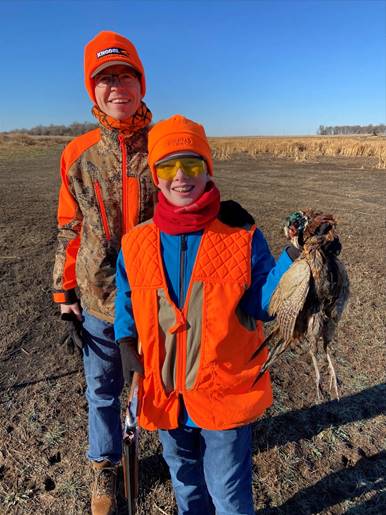
Break out your blaze orange vests; pheasant season is back again in South Dakota!
As the leaves begin to turn and the air turns crisp, I am taken back to the many fall afternoons I’ve spent walking fields in the hopes of flushing a rooster. Like many South Dakotans, I cherish the great memories made during the tradition of sportsmanship with my family and friends.
The success of pheasant hunting in South Dakota is a testament to how private enterprise and local government can work together to promote both economic development and wildlife conservation.
 Effective management of our pheasant populations has turned what was already a long-standing pastime into a real driver of economic growth for the state. From lodging to licenses, pheasant hunting generated $218 million for South Dakota in 2018. Overall, outdoor recreation generates an estimated $1.3 billion in economic activity annually.
It is equally important to remember that as sportsmen, it is our duty to preserve our state’s wildlife and natural resources for future generations. The South Dakota Department of Tourism has renewed its partnership with Pheasants Forever, a nonprofit organization dedicated to habitat conservation to ensure that South Dakota remains the “Pheasant Capital of the World” for years to come.
While many in Washington are pushing for increased environmental regulations across the board, South Dakota has shown how successful a local approach can be to wildlife management. Our pragmatic approach is the reason so many people can experience and enjoy one of South Dakota’s greatest traditions.
Happy opening weekend, South Dakota!
US Senator John Thune’s 2021 3q FEC Report: $376k raised, $213k spent, $14.8 Million Cash on Hand.
John Thune 2021 3q FEC by Pat Powers on Scribd
At a time when his most prominent primary challenger is noting they haven’t raised enough to meet the reporting threshold, US Senator John Thune had a good month of fundraising, where he took in $376,544.52 into the Friends of John Thune Committee, spent $213,243.41, leaving him with only $14,839,846.75 to run the next election.
Governor Kristi Noem’s Weekly Column: It’s National Disability Employment Awareness Month
It’s National Disability Employment Awareness Month
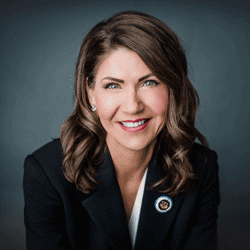
By Governor Kristi Noem
October 15, 2021
I’ve spent a lot of time lately talking about South Dakota being ranked one of the hardest working states in the nation. And we continue to be the number one state for economic recovery — Moody’s Analytics has our economy operating at 105% on its “Back to Normal Index”. Despite all these positive economic indicators, businesses here are still struggling with a common challenge: workforce shortages.
Now is a great time to remind employers across South Dakota that it’s National Disability Employment Awareness Month. South Dakota is already among the top states for employing individuals with disabilities, according to data from the Census Bureau and U.S. Bureau of Labor Statistics. And we lead the nation in the percentage of individuals with disabilities working in management occupations.

That’s because we understand that these folks aren’t defined by their disabilities. They are defined by their strong work ethic, strength of spirit, and their ability to overcome adversity. Those are strong characteristics that any employer should want in their workforce.
The Centers for Disease Control estimate that about 25% of adults in South Dakota have a disability — the lowest in the country. And yet, about 52% of individuals with disabilities in the state are currently employed. We are far outpacing states like California and Florida, where barely a third of individuals with disabilities are employed. Nationally, the average is around 38% employment rate for individuals with disabilities.
As businesses look for ways to address workforce shortages, I encourage them to reach out to the Department of Human Services for information and resources on hiring individuals with disabilities. The Department of Labor and Regulation is also an excellent resource for businesses.
On October 5th, the Department of Human Services hosted the Governor’s Awards in the Capitol Rotunda. This annual event recognizes individuals with disabilities who are advocates and active in the community, as well as businesses that support and work with individuals with disabilities. This year’s honorees were:
- Outstanding Individual with a Disability: Mark Sternhagen, Brookings;
- Outstanding Employee with a Disability: Eric Larson, Menno;
- Outstanding Private Employer (small): TMA of Mitchell;
- Outstanding Private Employer (large): MasterBrand Cabinets/Starmark Cabinetry, Sioux Falls;
- Outstanding Employer (other): Brown County Register of Deeds, Aberdeen;
- Outstanding Transition Services: Cindy Bierman, Mitchell; and
- Distinguished Service: Vicki Nelson, Sioux Falls.
Each one of these individuals and businesses is doing their part to empower people with disabilities in our state. They’re providing jobs and workforce training. They’re working in their communities to encourage other businesses to offer employment opportunities to those with disabilities.
In a state that prides itself on freedom, having businesses that provide these individuals with economic stability and independence is vital. We want to be a state that offers everyone a chance to achieve their version of the American Dream.
I am grateful to every person who is playing a role in this issue and fighting for positive outcomes. We are proud that our state is open for business and that unemployment rates remain among the lowest in the country. That should be the case for everyone in our state, regardless of disability status.
If you are a business owner or employer looking for solutions to your workforce shortage, take the time to learn more about hiring someone with a disability. You will be glad you did.
###
Guest Column: Senate Redistricting Committee updates on progress of redistricting meetings
Senate Redistricting Committee updates on progress of redistricting meetings
by Senate Redistricting Committee
The House and Senate Legislative Redistricting Committees spent three days traveling across South Dakota to take public input on what the state’s new legislative districts should look like. We started at 8:00 a.m. on Monday in Rapid City and ended at 8:30 p.m. on Wednesday in Sioux Falls. We traveled over 1,100 miles, making stops in Mission, Mobridge, Aberdeen, and Watertown along the way. More than 200 people attended our listening sessions. We heard from about 100 people who took time to weigh in on South Dakota’s future legislative districts.
Several key themes emerged from public comments:
Many people indicated they generally like their current legislative districts. As we move forward, we are trying to preserve the core of the current districts as much as possible. Because of changes in South Dakota’s population – an increase of about nine percent over the past ten years, primarily in the southeast part of the state – we know that at least 34 of the state’s 35 legislative districts will need to change to comply with our constitutional requirement of one person, one vote. The only district that doesn’t need any alteration is the one encompassing Lawrence County, which grew at the right pace to comprise a legislative district.
Voters and county auditors would like counties to be left whole where possible. According to the census, seven of our state’s 66 counties are too large to fit within one legislative district. Brookings, Brown, Codington, Lincoln, Meade, Minnehaha, and Pennington counties will have to be split into more than one district, to satisfy the constitution’s equal protection clause. As we work to assign the rest of the state into logical legislative districts, we are trying to minimize splitting any of the remaining counties as much as possible.
There were many comments about keeping urban districts as urban as possible, and rural districts as rural as possible, particularly near Sioux Falls. The U.S. Census Bureau defines an urban area as 2,500 residents or more. As the Senate looks at growth patterns along the I-29 corridor, we are working to keep the urban districts as compact as possible, and the rural districts as rural as possible.
We heard from the Native American community about protecting minority voting rights. One of the ways our committee is addressing this is to follow the current boundaries for Districts 26, 27, and 28 as much as possible to meet the requirements of the Federal Voting Rights Act, while also meeting population requirements as required by the Constitution.
Protecting communities of interest is another theme that emerged from our listening sessions. While this concept is not clearly defined in law, we heard how citizens see their local community of interest. As our state becomes more diverse, we expect this conversation to continue.
Over the next few weeks we will be working to incorporate these suggestions into a proposal for legislators to consider during the Special Session on Redistricting, set for November 8-9 in Pierre. Our over-arching goal is to develop a map that meets our constitutional obligations and statutory guidance, and is fair for the residents of our state.
Proposed maps are available for the public to view at sdlegislature.gov. Additional thoughts and ideas can be emailed to sdredistricting@sdlegislature.gov.
Congressman Dusty Johnson’s 3q FEC Report: $219k raised, $43.5k Spent, and $1.7 Million Cash on Hand
Boom. Hours after congressional challenger Taffy Howard filed her first FEC Report, Congressman Dusty Johnson more than doubled that haul with dozens more donors, and is left with over twenty times more cash on hand than his challenger.
Dusty Johnson 2021 3q by Pat Powers on Scribd
Congressman Dusty Johnson posted $219,020.01 raised against $43,516.89 in expenses. Leaving him a massive cash advantage of $1,713,182.55, over 23 times as much as Taffy has sitting in the bank.
And to his advantage, Dusty’s money isn’t primarily from one family, but from a broad base of donors including State Rep. Arch Beal, Former Ag Secretary Walt Bones, former State Rep. Deb Fischer-Clemens, State Senator Jean Hunhoff, former State Senator Al Kurtenbach, Former State Rep. Matt McCaulley, State Rep. John Mills, Regent & Former State Rep. Jeff Partridge, State Rep. Sue Peterson, State Rep. Taylor Rehfeldt, and a number of our state’s captains of commerce.
Plus, I don’t believe most of his donors have maxed out as Howard’s donors have.
Taffy Howard for Congress’ first FEC Report: $86.5k raised, $14k spent, 72.6k Cash on hand.
Taffy Howard got her first FEC Report in…
Taffy Howard 2021 3q FEC by Pat Powers on Scribd
$86.523.18 raised against $13,922.22 spent. Leaving her $72600.96 cash on hand.
And apparently Taffy is big with the Assman family, as their donations comprised roughly $50,000 of that total, with poker playing insurance agent Luke Blindert adding another $5800 to the kitty, as well as Texans Dan Kreamer & his wife kicking in another $5800.
Who got Taffy’s money? Looks like Jordan Mason & the Lautenschlagers tag teamed to drain taffy’s coffers of $1000 for Consulting for Jordan’s Lunch Collective, and the Lautenschlager’s Red Mountain Direct took $6792 out of the campaign purse.
Governor Noem Appoints Kay Schallenkamp and Brad Greenway to Board of Technical Education
Governor Noem Appoints Kay Schallenkamp and Brad Greenway to Board of Technical Education
PIERRE, S.D. – Governor Kristi Noem has appointed Dr. Kay Schallenkamp and Brad Greenway to the Board of Technical Education. Kay Schallenkamp will replace Scott Knuppe, and Brad Greenway will replace Rod Bowar. Both appointments are effective November 1, 2021.
“The new members of the Board of Technical Education will ensure that South Dakota’s technical colleges remain the very best in America,” said Governor Kristi Noem. “Kay and Brad’s expertise will help put our kids and grandkids on a path to lifelong success.”
Dr. Kay Schallenkamp served 41 years in higher education prior to her retirement in 2014. She served as President of Black Hills State University (SD) from 2006-2014 and President of Emporia State University (KS) from 1997-2006. Prior to that, she served as provost and vice chancellor for academic affairs at the University of Wisconsin-Whitewater and Provost at Chadron State College (NE). She started her higher education career at Northern State University (SD) as a faculty member of communication disorders and later served as department chair and dean.
Schallenkamp is currently on the Board of Directors for the Crazy Horse Memorial, Board of Trustees for Baker University (KS), and the Cultural and Diversity Committee for the Sanford Underground Lab. She previously served on the Board of Directors for the Council for the Accreditation of Educator Preparation, the SD Board of Educational Standards, and the SD Board of Junior Achievement. She also served as a member of the Board of Directors for the American Association of State Colleges and Universities, the North Central Association (now the Higher Learning Commission) and the Renaissance Group. In addition, she served as chair of the American Association of Colleges for Teacher Education, the Presidents Council for NCAA Division II, and the National Teachers Hall of Fame, as well as the steering committee for the American College and University Presidents’ Climate Commitment. Schallenkamp served as a Consultant Evaluator for the Higher Learning Commission for 25 years.
Brad Greenway attended one year at Southwest Minnesota State University in Marshall, MN before returning to Mitchell and graduating with an associate degree in Agriculture Management from Mitchell Technical Institute in 1984.
Locally, Brad serves on the township board, Davison County Fair Board, has been involved with the Davison County Pork Council for 30 years, and served on the SD Pork Producers Council from 2000 to 2015, including as president from 2005-2006. He served on the National Pork Board (Pork Checkoff) from 2009 to 2015. He most recently was a board member for U.S. Farmers & Ranchers in Action and served as chairman from 2016-2018.
Brad has received several statewide awards including Pork All American, Governor’s 2014 Ag Ambassador of the Year, Mitchell Technical Institute Outstanding Alumnus of the Year in 2016, and together with his wife Peggy received the South Dakota Pork Promoters of the Year award in 2015. Greenway was selected as America’s Pig Farmer of the Year in 2016.
Brad and his wife Peggy farm just west of Mitchell, South Dakota, where they run a diversified farm. Their two adult children, Mandi and Brent, live in Mitchell with their spouses. Brent has recently joined the family farm. Brad and Peggy enjoy spending time with their children and three grandchildren.
Photos of Dr. Kay Schallenkamp can be found here. A photo of Brad Greenway can be found here.
###
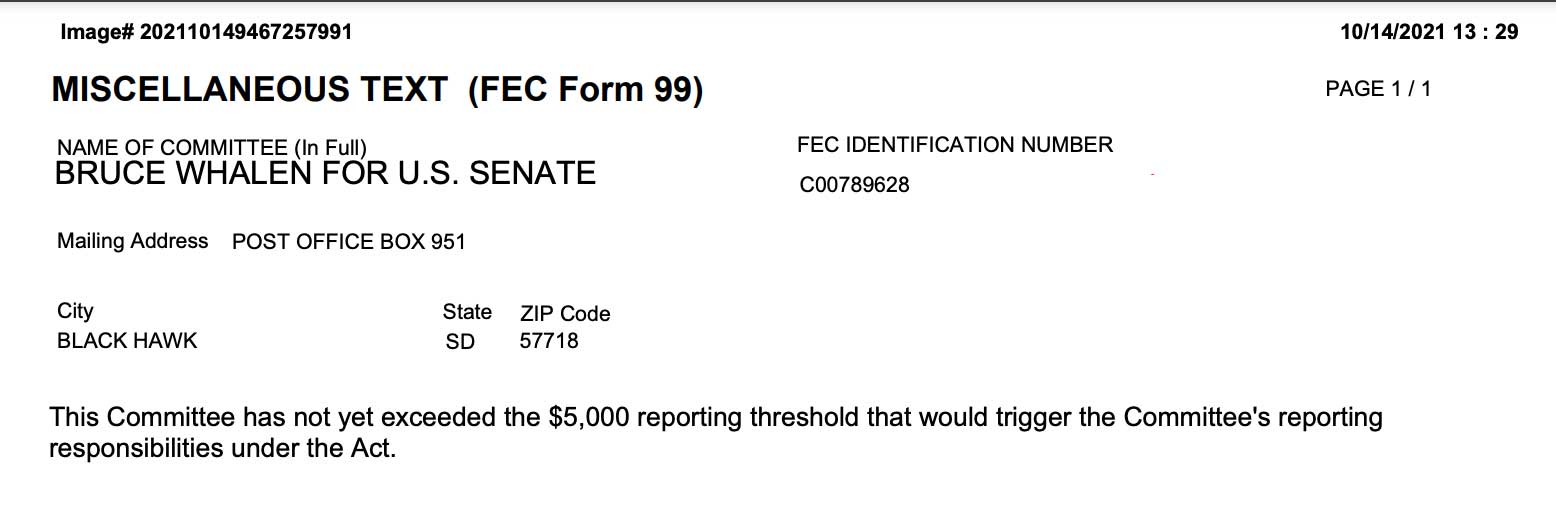
Whalen for US Senate yet to hit $5k reporting threshold.
From the Federal Elections Commission, looks like it’s been slow going for the Whalen for US Senate committee so far: