Rounds: Bidenomics is taking a bite out of South Dakota family incomes
From x.com (f.k.a. Twitter)
Latest inflation report from today shows Bidenomics at work. ⬇️ pic.twitter.com/0Imc9eJb7w
— Senator Mike Rounds (@SenatorRounds) June 12, 2024

From x.com (f.k.a. Twitter)
Latest inflation report from today shows Bidenomics at work. ⬇️ pic.twitter.com/0Imc9eJb7w
— Senator Mike Rounds (@SenatorRounds) June 12, 2024
South Dakota News Watch has a story about a poll conducted in South Dakota in mid-May among 500 participants, noting that the Open Primaries measure was tracking with nearly 55% support among South Dakota voters:
South Dakotans by a wide margin support a constitutional amendment that would change the way the state conducts primary elections, according to a scientific poll of 500 registered voters co-sponsored by South Dakota News Watch.
The statewide survey, also sponsored by the Chiesman Center for Democracy at the University of South Dakota, showed that 55% of respondents favored the plan to change the state’s election format, with 33% opposed and 12% undecided.
That’s a jump in support from a similarly structured November 2023 poll, which showed 49% supporting the measure, 34% opposed and 17% undecided.
This might portend a stormy campaign for those in the Republican Party who oppose this measure, as this polling came before the divisive primary election that was just held, with the lowest turnout in the 30 years of statewide tracking on primary election voter turnout.
Further complicating it for opponents is that the most organized opponent to the measure, the South Dakota Republican Party, finds it’s fundraising at a low point, and may be scrounging for resources to do it’s primary job – support Republican candidates this election – much less to mount an organized effort in opposing a ballot measure, which is secondary to it’s purpose of electing candidates.
I’ve spoken to a number of Republicans who have moved off of strong opposition to Open Primaries to more or less ambivalence in the wake of an election that put some fringe Republicans in the driver’s seat for the fall contest. And that may not be good for those opposed to the Amendment.
With 55% support before the primary, I’ll be more curious to hear an updated benchmark of where it is after the primary.
That may be even more telling.
The Argus Leader has a story on Minnehaha County Auditor Leah Anderson’s continued goofiness, as today she wants to spend a bunch of money hand-counting every Minnehaha County vote from the June 4 primary:
Minnehaha County Auditor Leah Anderson says she’s planning on performing a hand-counted audit of the 13,058 ballots cast in the county’s June 4 primary election.
Anderson informed county officials of the plan at Tuesday’s meeting of the county’s canvassing board, saying that as long as she’s within her budget she has the authority to decide to go above and beyond the state requirements, which call for auditing five percent of precincts.
But the item that grabbed more of my attention in the story was buried at the end, as it related to some of the election night interference that was going on from election conspiracy group SD Canvassing:
The group’s president, Jessica Pollema, made two challenges in Minnehaha County on June 4, calling for ballots to be rejected in precincts 4-16 and 5-16, claiming that the voters didn’t live in Sioux Falls.
The challenge in 5-16 was rejected, but Anderson told board members on Monday that 132 ballots had been rejected in 4-16.
WHOOOOAAAA… hold on here. The Argus buried the lede in this story. In one of the lowest participation elections of 30 years, 132 ballots were rejected in one precinct based on a challenge from the election nuts who hold the auditor’s chain? I don’t think anyone is paying attention, because that represents a TREMENDOUS number of the ballots cast in that precinct.
Go back to the story they ran from June 5th..
Pollema said she also challenged absentee ballots at precinct 4-16, which used the Word of Life Pentecostal Church as its polling location. She claimed her challenge was successful and resulted in dozens of ballots being rejected.
It is unclear if those absentee ballots were truly rejected, and if they were, how many.
Pollema and Anderson were seen talking together to some degree: An Argus Leader reporter was speaking with Pollema while ballots were being counted, when Anderson interrupted to ask if the canvassing group leader knew whether some or all of the challenged ballots were tossed. Anderson later handed Pollema, a citizen, a stack of unknown documents, as the county auditor was wrapping up the ballot count for the night.
Not dozens… Over a hundred ballots were rejected. And it’s even more interesting if you look at how many votes they actually counted in precinct 4-16:
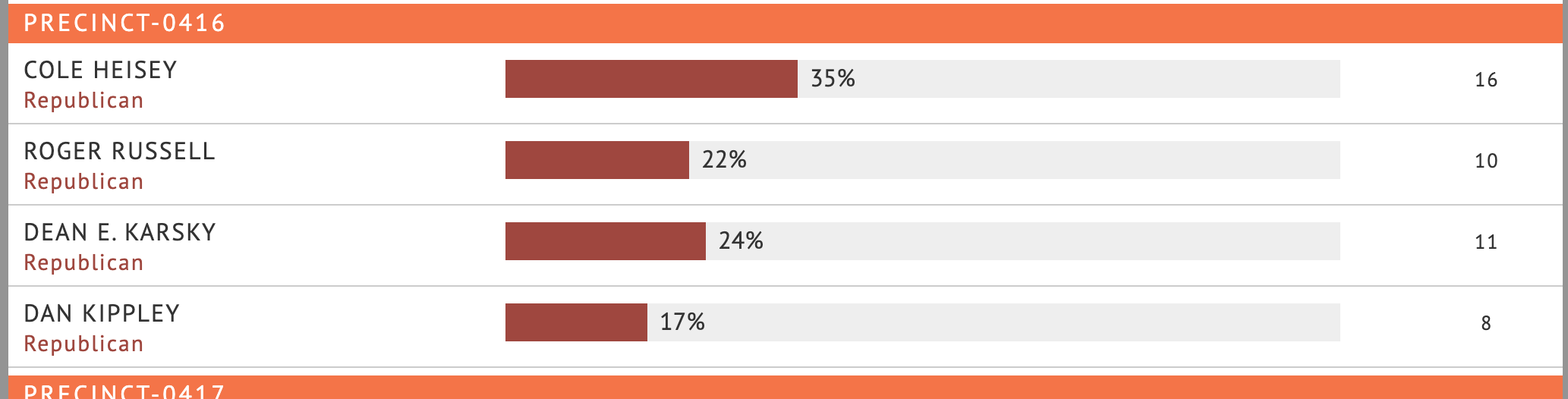
In a race where they could choose up to 2 candidates, if we ignore the under-vote, and total the votes up, and divide by 2, we come up with roughly 23 voters who had their votes counted. If they threw out 132 ballots, Leah Anderson acting at SD Canvassing’s bidding might have thrown out up to 85% of the ballots cast in that precinct.
How does the county auditor, working with an election conspiracy group make the decision to just toss out more than 3/4 of the ballots cast in one precinct?
They had one, maybe two races to vote on, and a massive number of them were just thrown away? Here’s what people need to focus on, especially the Secretary of State, the Minnehaha County Commission, and possibly the Attorney General.
Because if I was one of those voters, I would be asking why my vote wasn’t counted.
*Update*

If those rejected ballots were Democrat ballots, the percentage of challenged ballots would be even higher.
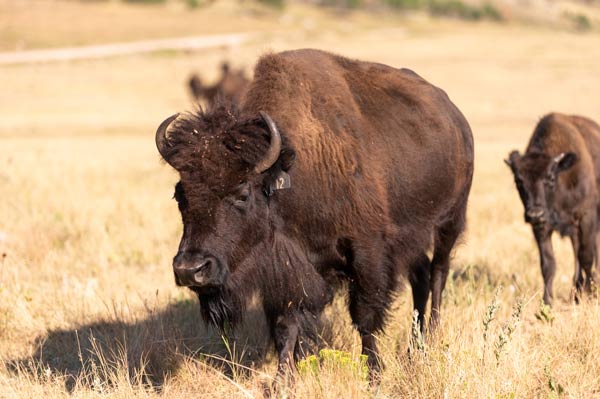
KELOland has a story on their website today for Custer State Park tourists which most everyone in South Dakota knows – Don’t pet the fluffy cows. Because they will mess you up:
“Here at the park, it’s been decades since we’ve had any fatalities with the bison but we still have injuries,” Austin said. “So that’s why we encourage folks to give them the distance, to keep your trip safe. You don’t want to ruin it with a trip to the hospital so enjoy from the safety of your car and enjoy Custer State Park.”
“it’s been decades since we’ve had any fatalities with the bison” should be people’s first hint.
There are also places out in the Black Hills with less intimidating wildlife. But, you probably don’t want to mess with them either, since right now they are experiencing an outbreak of sylvatic fever, a.k.a. the plague, the Black Death, etc:
South Dakota is currently experiencing an outbreak of the plague, a disease infamous throughout history for its high mortality rate, rapid transmission, and ability to incite widespread fear and dread.
Government agencies have verified that a plague outbreak is responsible for the mass deaths of prairie dogs in Badlands National Park, Buffalo Gap National Grassland, and the surrounding Conata-Badlands ecosystem area.
and..
However, this disease can also infect humans, pets, and other wildlife species.
Read that here. And more on it here (as wildlife experts are mainly concerned about the Black Footed Ferrets who eat prairie dogs)
Great to have people come and visit our great state. But some of the wildlife isn’t as cuddly as people think.
WEEKLY ROUND[S] UP: JUNE 3-9, 2024
Welcome back to another edition of the Weekly Round[s] Up! We had another busy week in the United States Senate, getting back to business after our Memorial Day in-state work period. While I was back in South Dakota, I attended the ‘Let Freedom Fly International Airshow’ in Pierre which was the product of many hours of work by local and national organizations. Events like these are important as we look to recruit the next generation of young men and women who will serve our country in the military. I went to Brookings and Watertown for Memorial Day activities to recognize and honor our veterans. I also went to Sioux Falls and hosted a health care roundtable with NIH Director Bertagnolli and South Dakota health care stakeholders on how AI could be the key to curing cancers and other deadly diseases. I am grateful Dr. Bertagnolli accepted my invitation to visit South Dakota and see firsthand all the work being done in the state. This past week in Washington, we welcomed several South Dakota groups to our nation’s capital, including nearly 250 students and parents from South Dakota schools. I also introduced two new pieces of legislation which will impact folks living in the rural parts of our country. More on that in my Weekly Round[s] Up:
South Dakotans I met with: Students from Madison, Dakota Valley, Harrisburg and Sioux Falls; South Dakota members of the U.S. Global Leadership Coalition; members of the South Dakota Health Care Association; South Dakota members of the National Grain and Feed Association; Dr. Steve Smith, professor at the South Dakota School of Mines; Mike Mimick of South Dakota’s UBS branch; and Colby Olson with the South Dakota Cattlemen’s Association. I also stopped by a gathering hosted by the South Dakota State Society on Wednesday to celebrate 605 Day.
Met with South Dakotans from: Aberdeen, Black Hawk, Dakota Dunes, Harrisburg, Madison, Marion, Mitchell, Rapid City and Sioux Falls.
Other meetings: General Ahmad Husni, Director of Jordan’s General Intelligence Department; Harry Coker Jr., National Cyber Director; Peng Zhao, CEO of Citadel Securities; Ken Kartsen, Senior VP at Trellix; Seleshi Bekele, Ethiopia’s Ambassador to the United States; Directors from national labs affiliated with the Department of Energy; and the Defense Strategy Institute’s SmallSat & Space Access Summit. I spoke with members of the Healthcare Leadership Council about our work on artificial intelligence in the Senate.
I also attended our Senate Prayer Breakfast, where our speaker was Mary Landrieu, a former United States Senator from Louisiana. While our prayer breakfast consists mostly of current members of the Senate, we always enjoy welcoming our former colleagues back to participate.
Votes taken: 8 – most of these were on nominations to a judge position in the District of Columbia, as well as executive positions in the Department of State and the Nuclear Regulatory Commission.
We also voted on the Right to Contraception Act. I voted no on this bill. Senate Democrats brought this legislation to the floor as an election year scare tactic. There is no threat to contraceptive access in the United States. There are no restrictions on contraceptives. They are required by law to be offered at no cost by health insurers. In addition, if you read the fine print, this bill could open the door for public elementary schools to offer contraceptives to little kids. It could even allow the federal government to force religious institutions and schools to offer contraceptives. It’s massive government overreach.
Legislation introduced: This week, I introduced the Postal Processing Protection Act, legislation that would require the US Postal Service to consider consequences for rural areas during their closure or downsizing review process. Rural mail services are a lifeline for residents of many communities across South Dakota. USPS should be required to consider the impact of closing processing facilities on rural residents, just as they consider it when closing retail locations. I’m pleased to be introducing this legislation to make certain rural residents receive their mail in a timely and efficient manner.
I also introduced legislation that would reauthorize the Reclamation Rural Water Supply Act which lapsed in 2016. This bill would allow the Bureau of Reclamation to carry out the required feasibility studies for rural water supply projects instead of Congress. This would streamline the process of getting approval for rural water improvement systems including three rural water projects in South Dakota: the Water Investment in Northern South Dakota (WINS), the Western Dakota Regional Water System and the Dakota Mainstem which are all looking to spread water from the Missouri River throughout the state.
Student Loan Letter: I joined my colleagues Senator Bill Cassidy (R-La.) and Representative Virginia Foxx (R-N.C.) in sending a letter to the Department of Education urging them to withdraw their latest student loan forgiveness plan. This proposed rule will cost hard-working Americans an additional $147 billion and bring the total student loan debt transferred to taxpayers to as much as $1 trillion.
Hearings: I had one hearing in the Select Committee on Intelligence.
Classified briefings: I attended one classified briefing this week: our bi-weekly cyber education seminar on U.S. Cyber Command and International Partnerships.
My staff in South Dakota visited: Aberdeen, Brookings, Deadwood, Mitchell, Salem, Sturgis and Vermillion.
Steps taken this past week: 44,890 steps or 22.57 miles.
Photos of the week:

Editor’s note – This should raise a flag for those who profess to be Republican. – pp
_________________
DNC Investing $70,000 in South Dakota Democratic Party
FOR IMMEDIATE RELEASE
June 11th, 2024
The Democratic National Committee recently announced nearly $2 million in new grants to 11 non-battleground state parties, including $70,000 for the South Dakota Democratic Party. This first of its kind investment will support voter registration efforts and down ballot candidates. A significant portion of this funding will support voter registration, engagement and rides to the polls on South Dakota’s Native reservations.
“This investment in the Tribal Nations across South Dakota will mean Native American voices are heard when it comes to the future of this state and the reservations,” said SDDP Chair Shane Merrill. “In a year where relations between the state government and tribal governments are declining, it’s extremely important to make sure tribal members can cast their ballot and vote for people who will best represent their interests.”
You can read the full news release from the DNC HERE.
For questions, you can contact the SDDP Executive Director Dan Ahlers at dan@sddp.org or contact the state party office by phone at 605-271-5405 or 605-940-3071.
Does anyone think that Justin McNeal is capable of running a competent campaign at this point?
First he was unable to get sufficient signatures to be placed on the ballot as a Republican.. after it was said he might have jumped the gun on that circulating petitions as a Republican, before changing his party to Republican. Then he circulated petitions to run as an Independent, his prior affiliation. And that didn’t work.
Now, he’s thinking of bringing a lawsuit to try to get on the ballot…
McNeal said he missed the General Election ballot by 122 signatures out of the 3,502 he needed to qualify.
But he added that many petitions were rejected because of technicalities. Some were sent in by certified mail instead of registered mail. In one case a circulator didn’t sign the petitions. In another, a notary didn’t stamp the petition right. In another, petitions were disqualified because a circulator didn’t put a city and state in the address line.
South Dakota courts have taken a liberal interpretation of such rules in favor of trying to ensure that voter intentions are taken into account and not dismissed because of technicalities.
The second time around, McNeal could get signatures from anyone registered to vote who had a pulse. And he still managed to screw it up and not get on the ballot.
Maybe he could get a judge to place him. Maybe.
But, is this a person we want representing us in Congress? I don’t think so.
Former State Representative Ron Volesky is in the Huron paper today, not for being a train wreck, but reaching out to others and talking about overcoming depression:
“I was the second youngest person ever elected to the state legislature,” said Volesky, who basked in the novelty at the time. “I started to believe my own press. I fell into bad habits, I did things I’m ashamed of today.”
Emotion colored his voice as he remebered isolating himself from the world around him.
“I was ashamed, and I hid away,” he said. “For a year or longer I would walk down the alley to get to my office so I wouldn’t meet people.”
Volesky said his world turned inward and the sadness grew as he continued to isolate himself from others. “You can’t find help until you admit it,” he added. “It’s okay to say I need help.
Read the entire story here in the Huron Daily Plainsman.
If Ron has been able to tame some of the demons that would land him in the press from time to time, good for him.
If you feel the need to torture yourself for a while, the Fall River County Commission listened to the election conspiracists go on ad nauseum about absentee balloting, until one of them just had enough, as he told the election nut to take it to the Secretary of State, and that after bending over backwards to make unhappy people unhappy, he was tired of the bull****.”
Start watching at around 2 hours and 40 minutes, and you’ll want this person to shut up as well:
This is disgusting. This racist behavior has no place in South Dakota or anywhere. https://t.co/HPKBkGmhcL
— Senator Mike Rounds (@SenatorRounds) June 9, 2024