Legislator attending myPillow guy event claims voting machines used in SD could be linked to Internet

Kevin Jensen was one of the very few South Dakota State Legislators that attended the Mike Lindell Cyber Symposium. And as they whipped up the conspiracy theories, what he claims he found there has him troubled. Because he claims South Dakota voting machines could be part of a fraudulent voter scheme to change votes:

I attended Mike Lindell‘s Cyber Symposium for all three days, from open to close. I did not attend because I am a “right wing conspiracy nut.” I attended because I do not believe both sides were heard. I do not think justice and due process have been served regarding their claims.

and..

The courts have refused to hear their case stating the plaintiffs have no “standing,” which simply means the ones bringing the case were not in the proper jurisdiction. None of the evidence they laid before us was ever allowed in court. The amount of information the Lindell team produced was impressive to say the least.

and..

So, what about South Dakota Tabulators used in the 2020 election. A 10-minute Google search revealed troubling information about the tabulators. In an NBC News story from January 10, 2020, by Kevin Monahan, Cynthia McFadden and Didi Martinez, they reported “We found over 35 [voting systems] had been left online and we’re still continuing to find more, Kevin Skoglund, a senior technical advisor at the election security advocacy group National Election Defense Coalition, told NBC News.” Let me remind you this is the mainstream media worried that Russia interfered with the 2016 election.

and..

Interestingly, the response I received from the SD Secretary of State office said “As you’ll note, our election machines are never connected to the internet.  The only time an internet system is accessed is when the unofficial numbers are displayed on the election night reporting page for the public, which is directed by SDCL 12-20-13.” So then, are we or are we not connected to the internet???

and..

We should all want to have a forensic audit in all 50 states. Any state not willing to audit maybe holding the smoking gun.

Read the entire opinion piece here.

Like a malt-liquor hangover, I have the feeling the goofy MyPillow Symposium’s after-effects are going to linger for longer than anyone cares for them to.
Dusty Johnson campaign releases polling data showing strength in state

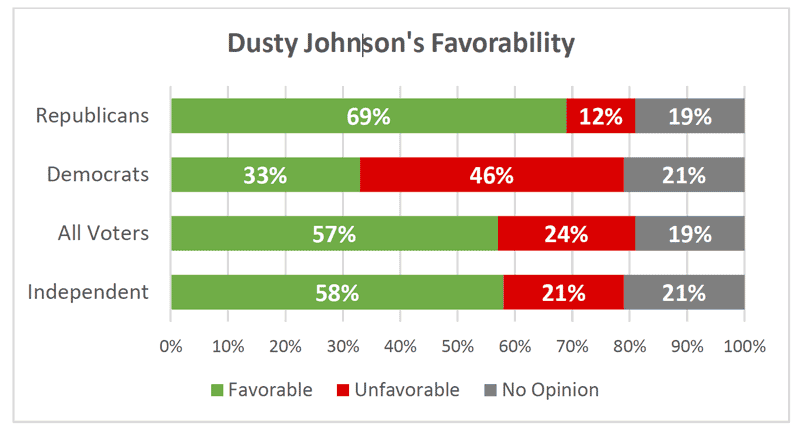
The Dusty Johnson for Congress campaign released a poll this evening showing that no matter who might be “exploring” a challenge to Dusty in the Congressional race, he’s definitely starting the campaign from a position of strength:

Dusty, however, has a plus 33% net favorability among all voters. This is the highest among South Dakota elected officials. Even more impressive, Dusty’s net favorability is plus 57% among South Dakota Republicans (69% favorable, 12% unfavorable). This is the highest among South Dakota elected officials, as well.

Check out the entire polling memorandum for yourself:

Dusty Johnson – August Polling Results by Pat Powers on Scribd

Watertown columnist says conservative legislators are using language of pro-choice movement

From the Watertown Public Opinion, liberal columnist Brad Johnson is taking a shot at three of the legislators who want a special session on COVID, claiming that their rhetoric resembles that of the pro-choice movement:

• Thumbs down to three South Dakota legislators who want the Legislature to prevent employers from requiring their employees be vaccinated against COVID-19. Republican Reps. Scott Odenbach of Spearfish, Taffy Howard of Rapid City and Jon Hansen of Dell Rapids want a special session to consider their proposals.

That’s not likely to happen. Still, it’s ironic these conservative legislators are using language similar to the liberal pro-choice movement.

“Medical decisions should be made through patients and doctors not through corporate coercion or government mandates,” Hansen was quoted in an Argus Leader story. “Free and informed consent requires freedom to choose without punishment or adverse consequences.”

Read it all here.

Ooo.. I might think the call for a special session involves more government, but those sound like fighting words.

“..Social engineering attacks vectoring through the woman-folk” Ok. Tapping out on responding to that statement.

From the comment section:

Fathers need to be present to identify and thwart the social engineering attacks vectoring through the woman-folk.”       – SDWC Commenter John Dale. 8/23/21

You got me there. I’m out on this one.

I’m not sure if that’s one best responded to by those who don’t believe in conspiracy theories, or women in general.

Guest Column – Gen Z could be catalyst that restores critical thinking to our nation, by State Rep. Trish Ladner

Gen Z could be catalyst that restores critical thinking to our nation
By State Rep. Trish Ladner

There are those special moments in life when you meet someone who renews your faith in the next generation and gives you hope for the future. That is exactly what happened to me at the closing of the American Legislative Exchange Council’s Annual convention in Salt Lake City a couple of weeks ago.

One of the keynote speakers to close out the conference was a young woman named Rikki Schlott. Rikki, is a beautiful, articulate young woman who is a 21-year-old junior at New York University.  Six months ago, she was just your typical college student keeping her head down and as she put it, simply trying not to get “cancelled!”

She was always quietly political, but after the pandemic hit, simply going along, to get along became impossible for her. For the first time in her young life, she saw the liberties and freedom she had always taken for granted, suddenly in question and ultimately, in jeopardy of being taken away and she found herself speaking out more and more.

Gen Z’s were raised in the “lessor of two evils” era where communities and Thanksgiving tables were torn apart by partisanship and as a result, Gen Z’s political window is very narrow however, they are still open, receptive and independent thinkers and are actually more moderate than we are led to believe by the radical fringes. Did you know that forty percent of Gen Z college students consider themselves moderate and over half are registered Independents?

As the pandemic dragged on, Miss Schlott became a bridge or moderator between Zoomers (Gen Z born between 1997-2012) and Boomers (born between 1946-1964). Her message resonated with many and her role began to quickly expand with speaking engagements around the country and writing articles for the NY Post and the Wall Street Journal.

After listening closely to her, I had to wonder if this upcoming Gen Z generation could be the catalyst that restores critical thinking and normalcy to our nation? Something that we have all been longing for.

I share this story of new found hope with you because you have a chance to judge for yourself. Rikki will be the key-note speaker at the upcoming Pennington County GOP Lincoln Day Dinner on 9/11 in Rapid City. This is an amazing opportunity for you and our young people to hear her speak and learn what the next generation values, thinks and believes. It gave me new hope in the upcoming generation, and I believe that it will encourage you too.

Rep. Trish Ladner
District 30

Rep. Howard “considering” Congress for few weeks until her already planned announcement.

It’s a bit anti-climactic by now, but as I’d heard from Dakotafest and as noted on-line today, apparently State Rep. Taffy Howard is making little secret that she has already scheduled her announcement for Congress:

With that as a clearly confirmed fact by Taffy herself, the claim of “considering” and “exploring” the race as noted in her speeches and media interviews seems a bit silly.

Congressman Dusty Johnson’s Weekly Column: Back to School

Back to School
By Rep. Dusty Johnson
August 20, 2021

Summer is coming to an end and students across South Dakota are heading back to school. I was home to see my three boys off to start the 2021-2022 school year this week.

While many schools in our state remained open during this past year, the same cannot be said about school districts across the country.

According to UNESCO, American schools were closed either fully or partially for 58 weeks. In comparison, Canadian schools were closed 51 weeks and schools in the United Kingdom 27 weeks.

How has over a year of school closures impacted students? Study after study is showing significant learning loss for students participating in distance learning. Additionally, truancy rates are up and attainment rates in core subjects like math and reading are down.

The impacts that loss of instruction time, student to teacher interaction, and peer collaboration will have on our kids cannot be minimized. While the effects of school closures on the mental, emotional, and social well-being of our children cannot be fully realized, even the CDC has published a survey suggesting that virtual instruction presents more risks to a student’s mental and emotional health than in-person learning.

These datapoints are not to downplay the effort and creativity of teachers and administrators alike in trying to make remote learning as engaging and effective as possible. But when we are dealing with something as transformative and significant as educating the next generation, we must stop and think about the impact a decision to keep schools closed will have on our youth in the short and long term.

Back in March 2021, a year after COVID-19 began, only half of American schoolchildren were in person partially or full. I am grateful for the school administrators and teachers who went above and beyond to ensure South Dakota schools were safely open to students last school year.

To date, Congress has authorized an unprecedented $190.5 billion to the Elementary and Secondary School Emergency Relief Fund to provide financial assistance to state and local educational agencies to ensure that schools can reopen safely. Teacher health and student welfare do not have to be at odds.

I firmly believe that a good education opens doors and sets a child up for success. The data is clear that it is best for students to be in the classroom learning.

The Biden Administration has assured me it’s their top priority to keep schools open as our nation continues to deal with COVID-19 – it’s imperative they follow through on that promise. It’s time to reopen and keep open our schools.

US Senator John Thune’s Weekly Column: Bridging the Digital Divide

Bridging the Digital Divide
By Sen. John Thune

“Bridging the digital divide” is something that’s often discussed in the halls of Congress. While there are plenty of divisions in Washington, a digital divide isn’t one of them. You have to leave the Beltway and travel to places across America where you actually have to think twice about whether or not you’re going to have an internet connection – places like rural South Dakota where certain connectivity challenges can remain frustratingly unresolved. It’s 2021, and private companies have developed technology to send customers into outer space, yet we’re still talking about the importance of connecting rural America with reliable, high-speed internet. That needs to change.

As a member and former chairman of the Senate Commerce Committee, which has jurisdiction over the internet and everything from planes, trains, and automobiles to the depths of the ocean to the heights of outer space, expanding mobile and fixed broadband access in rural America and to tribal communities has long been a priority of mine. And as a senator from a rural state, I’ve always looked for opportunities for South Dakota to help lead the nation in its deployment.

The good news is that things have come a long way over the last few years because of the sustained investments made by telecommunication providers across South Dakota and the rest of the country. In 2019, Sioux Falls became one of the first communities in America to become 5G-enabled. As we continue to lay the groundwork and pave the way for future development and deployment, South Dakota has frequently attracted the attention of, and visits from, leaders at the Federal Communications Commission, the federal agency where the majority of the government’s broadband expertise resides. We’re doing the right things, and we’re heading in the right direction.

The bad news is that there are still corners of our state that don’t have the benefits of reliable broadband services. A strong internet connection is critical for small businesses to connect with customers, for farmers who rely on precision agriculture technology to maximize crop yields, and for patients who depend on telemedicine to get the care they need when a hospital or medical professional is physically out of reach. For many, it can mean the difference between success and failure or potentially life and death.

I’m glad broadband is now being recognized as vital infrastructure. We need to continue investing in its success, but we have to do it wisely. We must prioritize our needs and identify the appropriate partners, both in and out of government, to help reach our goal of fully connecting every South Dakotan who wants it. But simply dumping more federal funds into a pot and spinning the acronym wheel to see which federal government agency it lands on is not the way to do it.

I fully support using targeted government funds to help meet these needs, but the federal government cannot solve this problem on its own. It certainly can’t just spend its way out of it. We must be effective with our planning and efficient with our investment as we look for a holistic approach that continues to move broadband from luxury to necessity – that leverages available government resources and incentivizes private sector innovation to push the boundaries of this effort toward success.

For too long we’ve talked about bridging the digital divide. It’s time to actually do it. Access to reliable broadband has the potential to connect South Dakotans to a larger marketplace, to increase the quality of education for students, and to continue enhancing parts of our everyday lives. I’ll continue to support smart investments that use taxpayer dollars responsibly – because government waste won’t help anyone.

###