PIERRE, S.D. – Today, Governor Larry Rhoden unveiled a county map that shows how much South Dakotans save under his plan to cut property taxes, SB 96. You can find that map here.
“South Dakotans deserve a real property tax cut – and that is exactly what my plan delivers,” said Governor Larry Rhoden. “This new interactive map allows South Dakotans to see firsthand how much they can save under my plan. It puts numbers behind our promise to deliver relief for homeowners across our state.”
Governor Rhoden previously introduced his plan to cut property taxes, which gives counties the option to replace their share of property taxes with a half-cent sales tax. County commissions could implement this tax cut, or it could be referrable to a vote of the people, or the people could also initiate it for a vote in their local community. The proposal would also help counties draw more revenues from tourists and out-of-state visitors.
You can find more information about Governor Rhoden’s plan to cut property taxes here.
###
Editor’s note.. Here’s a few samples from the map:
Thune Joins Larry Kudlow on Fox Business, The Guy Benson Radio Show
“You saw the president’s vision for the future of this country, and then you saw the open borders, sanctuary cities … defund law enforcement, raise your taxes, reduce American energy independence Democrats sitting there on their hands at virtually every opportunity when they should have been up cheering … it’s unfortunate.”
WASHINGTON — U.S. Senate Majority Leader John Thune (R-S.D.) today joined Larry Kudlow on Fox Business and the Guy Benson radio show.
On President Trump’s State of the Union address:
“[President Trump] crushed it … both in tone and substance … And I thought it was optimistic, it was hopeful … reflecting on America’s greatness and those who have come before us. Having a couple of those 100-year-old veterans in the audience … having the American … hockey team … congratulations to both the men and the women for their gold medals.
“But it was really the kind of message and speech that I think most people should find inspiring and aspirational and all that – except the Democrats in the chamber. So I thought what you also saw last night was kind of the two Americas. You saw the president’s vision for the future of this country, and then you saw the open borders, sanctuary cities … defund law enforcement, raise your taxes, reduce American energy independence Democrats sitting there on their hands at virtually every opportunity when they should have been up cheering … it’s unfortunate.”
[…]
“The president laid out a bold vision. And some of the things he talked about last night – on top of the things … that we got done in this last year through the first reconciliation bill – but … a housing bill, talking about something on additional energy development, permitting reform, AI. I think there’s some real areas that we can be working on and working with the White House, and hopefully in a bipartisan way … to get some solutions for the American people. But those are all things that kind of strike at the heart of this question of affordability. I think the president has zeroed in on that.
“What we believe are the answers as we look to the future … are safer streets, which the president has been dialed in and zeroed in on since he came to office and before; obviously more money in the American people’s pockets, and we have done that, and you’re going to see more of that … as the year wears on; and then obviously new opportunities to get ahead for working families, and there are so many areas in which the president has delivered on that.
“There’s more to do, but you look at just as an example, the Trump newborn accounts … [T]hat is a wonderful idea for the future and to get people saving for their kids. And I think that’s something that is going to serve the American people and working families well, well into the future.”
On the SAVE America Act:
“[W]e will vote on the SAVE America Act in one way, form, or another. And if the Democrats block it, I think it’s a great contrast to draw going into these fall elections. Do you want to be the people who are voting against actually requiring people to be American citizens to vote in American elections? I think that’s a fairly straightforward issue, but if the Democrats want to … stand in the way of that, then we’re obviously happy to litigate that in the fall elections.”
On the Democrats’ DHS shutdown:
“The president and his team have been … operating in good faith in terms of trying to get a solution here … We have now had [three] votes in the Senate … on the very bill the Democrats negotiated on the Department of Homeland Security, on that appropriations bill, and then subsequently walked away from and voted against it as recently as last night. And we’ll give them more opportunities to vote on that.
“[Republicans are] not going to do anything that jeopardizes or puts at risk law enforcement officials who are out doing their jobs. They have a right to be able to do their jobs, to do them in a safe way. And these sanctuary cities, which create these hostile environments where, puts not only … these law enforcement officials at risk, but also their families, that’s just crazy … There are a whole range of issues I think the White House has been willing to deal on, and the Democrats haven’t been there, because I think they see this as a political issue, and it’s really unfortunate, because nobody wins in a shutdown.”
From my mailbox, State Representative David Kull has thrown his name in the ring to run for District 2 State Senate:
Last year I made an announcement that I was not going to run for a third term in the South Dakota House. At that time I also had no intention for running for the Senate as Senator Steve Kolbeck had indicated that he was going to run to retain his seat. He has since made the decision that he was not going to pursue reelection.
In the ensuing months, I have had internal debates, followed by conversations with my wife, colleagues and friends and have arrived at the decision to announce my candidacy for District 2 Senate.
It has been an honor to represent the people of District 2 for the past four years and hope I can garner enough support to continue to do so in a slightly different role.
Gov. Rhoden Appoints Kevin Nyberg and Chuck Spring to GFP Commission
PIERRE, S.D. – Today, Governor Larry Rhoden appointed Kevin Nyberg and Charles “Chuck” Spring to the Game, Fish & Parks (GFP) Commission.
“There are few things I appreciate more than enjoying God’s creation – and I know many South Dakotans share that same sentiment. That is why we need people like Kevin and Chuck to preserve it for future generations,” said Governor Larry Rhoden. “Kevin and Chuck are servant leaders and avid outdoorsmen. I trust they will bring a fresh perspective to the GFP Commission and strengthen our great outdoors for years to come.”
Kevin Nyberg is the President and CEO of Nyberg’s ACE Corporation and has served on several boards, including the Augustana University Board of Trustees, the South Dakota GFP Foundation, and the Sioux Falls Chamber of Commerce Board of Directors. Nyberg is passionate about the outdoors, holding patron member status with Pheasants Forever and being a lifetime member of the Rocky Mountain Elk Foundation.
“South Dakota offers some of the finest outdoor recreation opportunities in the country. Whether camping, hunting, or fishing, South Dakota’s outdoors have provided numerous memorable experiences with family and friends,” said Kevin Nyberg. “Thank you to Governor Rhoden for giving me the opportunity to help guide South Dakota’s outdoor resources for future generations to enjoy.”
Kevin Nyberg lives in Sioux Falls with his wife, Linda. They have four children and five grandchildren. You can find a photo of Kevin Nyberg here.
Chuck Spring has strong roots across western South Dakota, having spent his lifetime ranching near Union Center. He has extensive experience with GFP’s West River Deer Task Force and Depredation Committee, and he formerly served as a GFP Commissioner from 2020 to 2024.
“I would like to thank Governor Larry Rhoden for the opportunity to serve as a GFP Commissioner,” said Chuck Spring. “Hunting has always been an important part of my life, so one of my goals is to work with the Department to help find solutions to bring back the big game numbers to what they used to be in certain areas of the state.”
Chuck Spring has been married to his wife, Claireen, for 51 years. They have three sons who also help run their ranch. You can find a photo of Chuck Spring here.
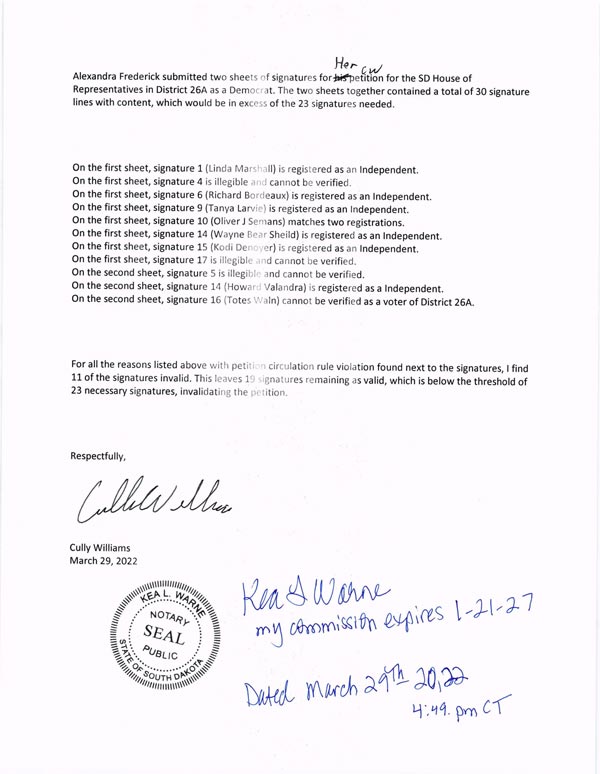
Just had this sent over to me. Democrat activist Cully Williams now living in Spink County has announced that he’s running for the South Dakota legislature:
It’s curious, as just a short time ago, he was filing to bump other Democrats off the ballot..
To any observer of the legislative process, and after other colleagues had unsuccessfully hidden in offices and bathroom to attempt to avoid a vote, no one is buying it, and it places the legislature, and particularly Senator Carley under a harsh spotlight.
But it appears that there are attempts to scapegoat others in the chaos of yesterday’s Senate session.
The other person being villainized by some in our legislative morality play and in risk of caucus banishment? Senator Michael Rohl. Because he has a little red book, and he’s not afraid to read it.
But why is Senator Rohl being threatened with banishment from the Senate Republican Caucus? What was the unforgivable sin? He did a bad, bad thing in the eyes of some. He read the rules and used them.
Senator Rohl moved moved that all bills on the consent calendar be moved to Second Readings of Senate Bills and Joint Resolutions and Second Readings of House Bills and Joint Resloutions… Which motion prevailed. He requested roll call votes, which were honored.
OH – this might be one of his greater sins. “Sen. Rohl requested that SB 221 be read in full pursuant to Art. III, Sec. 17 of the South Dakota State Constitution.”
Follow the constitution? How dare he?
California Carley is said to be under threat of caucus banishment after running and hiding from the responsibilities of his job. But the other word I’m hearing is that Rohl is being threatened with the same penalty.. for using the rule book, and following the State Constitution.
If reading the rule book and the state constitution and following those rules earns you threats of being red-carded the same as someone who left the state capitol when faced with doing their job.. well, that’s not much of an example of leadership, is it?
We’ll see what the report is after session today.
You’ve got to hope that following their own rules and the state constitution is held in higher regard than someone abandoning ship.
—————
Update:
I’m informed that no one got kicked out of caucus, and no one is in trouble. all is good… nothing to see here….
So, running away from the Capitol and hiding is the same as reading from the rule book, according to Senate Leadership.
Get ready for the election season. I have the feeling it’s going to be quite the thing.
In the midst of all the Pischke hiding in the john and Carley abandoning the Capitol business, there was another moment of unintentional humor in the Senate chambers, and a lesson.
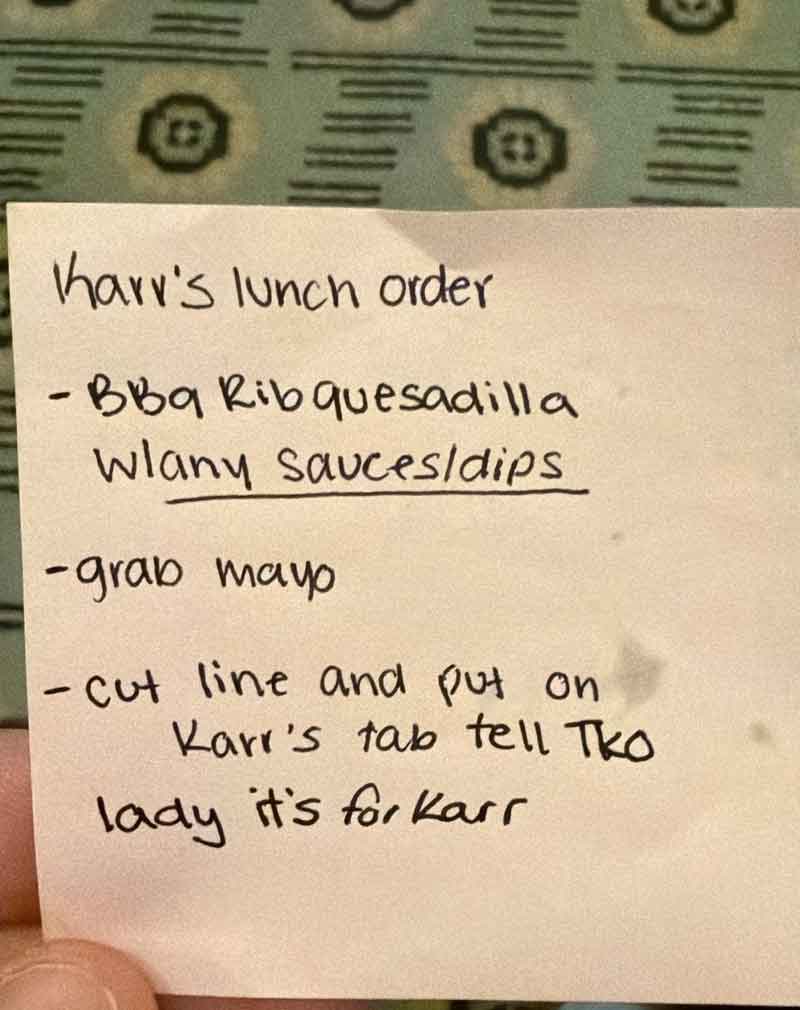
If you’re given lunch instructions on a post-it for the Senate President Pro Tempore Chris Karr, don’t drop it in the Senate Lobby. Because it will find it’s way to me:
It’s not so much the first two instructions. Even though the thought of adding Mayo to a BBQ Rib Quesadilla already laden with sauce sounds a bit heavy. It’s the third instruction.
“- Cut line and put on Karr’s tab tell TKO lady it’s for Karr.”
Is there somewhere in the red book that says the Senate President Pro Tempore is allowed to send a minion to cut the lunch line in the basement because “it’s for Karr?” I must have missed that rule.
Rank has it’s privileges in the State Capitol. Chris Karr might not be able to get everyone to show up and vote. But he still has the ability to send a minion to cut in line for him to get his lunchbox. And extra mayo.
—-
UPDATE:
One senior member of the lobbying corps tells me “Several of the days his page/intern has cut the line, there were at least three dozen people patiently waiting, including other legislators (and legislative leadership).”
And interestingly, a former President Pro Tempore of the Senate mentioned to me this AM that he was happy to run down and get a sandwich from the grab & go cooler, on those days he had a moment.
These are most certainly different days in the upper chamber.
Was I the only one disgusted with the “Coward of Meade County” California Carley abandoning the state capitol and the job he was elected to do to instead run and hide? No. In fact, a former Governor was there to witness it, and was not impressed:
“It’s not a good look for the Senate,” said Sen. Tim Reed, R-Brookings.
and..
The chaotic scene Tuesday played out in front of Republican former Gov. Dennis Daugaard, who is also a former lieutenant governor and former state senator. Daugaared, the father-in-law of Lt. Gov. Venhuizen, was visiting and watched the Senate from the gallery.
Daugaard disapproved of the actions of Pischke and Carley.
“Both were, I believe, intentionally absent from their seats to avoid voting,” Daugaard said in response to Searchlight questions. “This was a parliamentary maneuver on their part, so that they could avoid voting. And I really think that’s a discredit to the citizens of their districts, who elected them.”
What does a not-crazy Republican do about it? It may be time to start PAC n’ Heat. Or at least donating to the political action committee by that name. The PAC n’ Heat (2.0) political action committee is beginning a campaign to hold bad politicians’ feet to the fire, as they begin their research and accountability efforts for 2026.
As noted on their website:
TIME TO RETURN to Normal
We are dedicated to building a better future for our country through solid and sensible policies that reflect the best of conservative values. We believe in engaging in constructive dialogue, rejecting the politics of fear, and working to unite Americans around shared goals—strong families, safe communities, and a prosperous nation.
Together, we can reject the noise of division and focus on building a future where personal responsibility, freedom, and common-sense solutions lead the way.
As we move forward in the race, you can bet that politicians just like John Carley will feel that heat as groups such as PAC n’ Heat raise the temperature in races, and weak politicians like John Carley are held accountable for their actions.
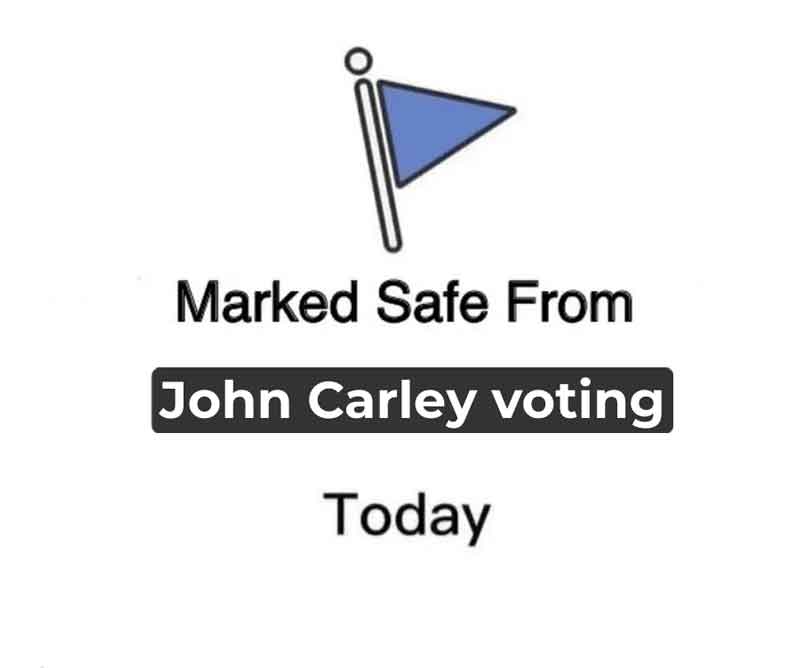
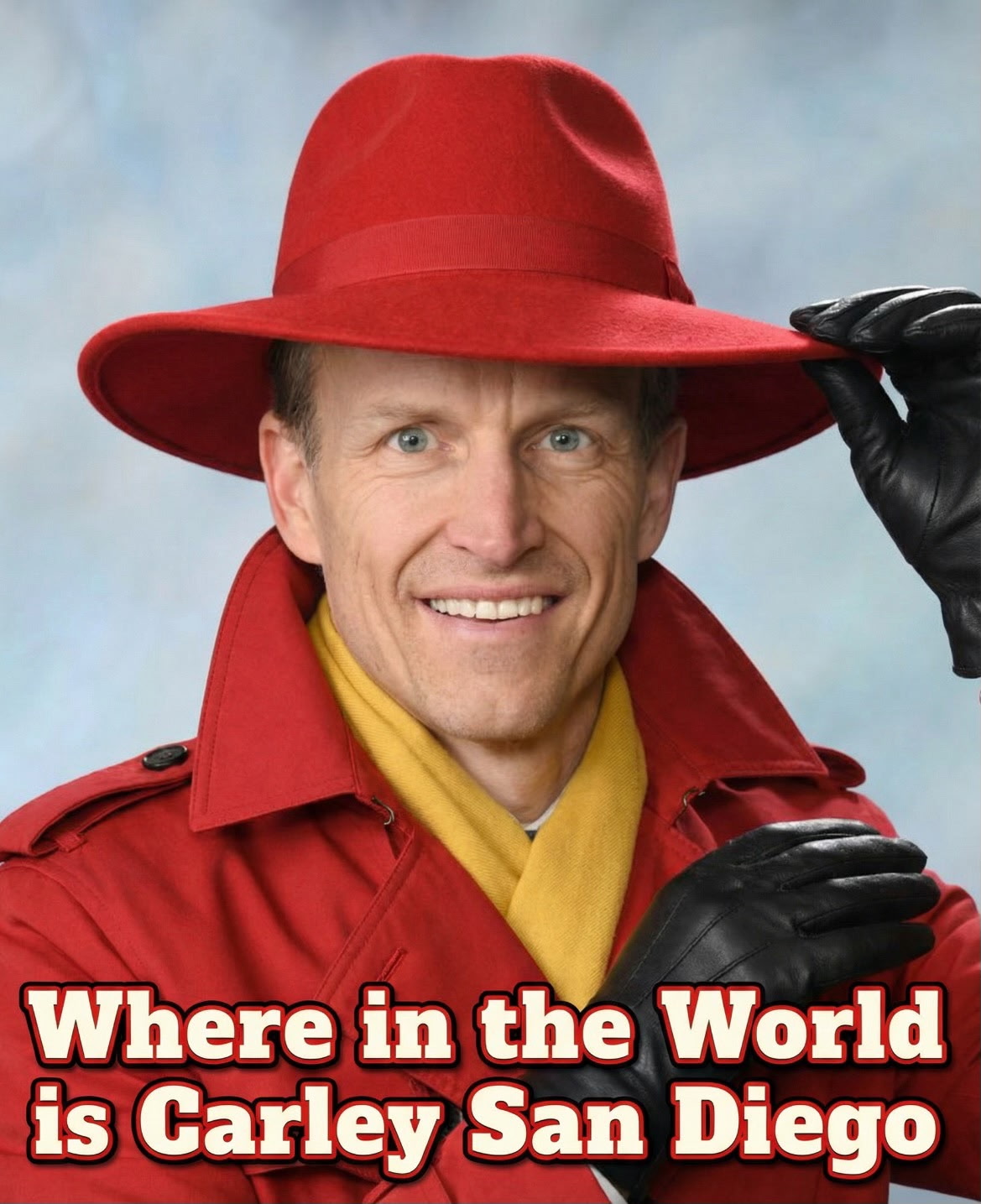
In case you haven’t seen the dozens of memes running around, State Senator John “California” Carley went AWOL from the State Capitol today. As related by KELOland:
Carley was last seen in the Capitol around 11:30 a.m. on the Senate floor.
“They’ve searched all the offices in the building and have not found him,” a report from the Senate sergeant at arms said.
A call of the house was ordered during Tuesday’s Senate floor hearing because of Carley’s unexplained and unexcused absence.
and..
Republican Sen. Tom Pischke had disappeared for a while on Monday. After a call of the house, he returned. In a comment to KELOLAND News, made prior to the Senate convening on Tuesday Pischke indicated that something unusual might happen later on Tuesday afternoon.
I’ve heard different stories about Pischke’s absence; one that he was hiding in Carr’s office, and another that he was hiding in the john. But Carley is a different story entirely. He just vamoosed.
And a flurry of memes ensued from the ranks of the lobbyists and others.
Just remember: If you see a Senator, remind him that he’s being paid to show up and vote. Not to avoid them.
Tyler Tordsen is inviting those in Pierre to an informal fundraising gathering tonight in support of his campaign for the South Dakota legislature. Stop on by! (I’m sure it will be cheaper than last night’s lobbyist event with the Gov!)




 The talk around the westernmost chamber of the legislature – the Senate – is that the coward of Meade County, Senator Carley, who decided to cut and run from doing his job in Pierre might be subjected to caucus banishment
 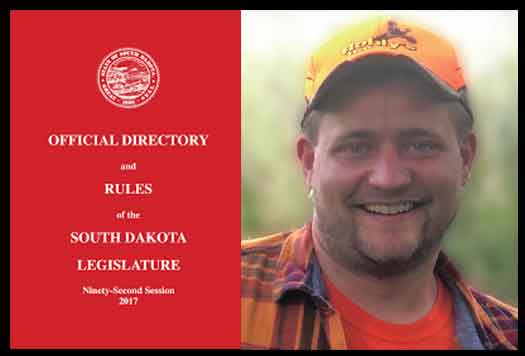 If you’re not familiar with the archaic volume, the “red book” is slang for the much more stuffy name, OFFICIAL DIRECTORY and RULES of the SOUTH DAKOTA LEGISLATURE.