New Video from Senator Rounds: We have a beef with packers
From Facebook, US Senator Mike Rounds posts a video regarding a bipartisan review of beef packers:

From Facebook, US Senator Mike Rounds posts a video regarding a bipartisan review of beef packers:
Just received the latest for my collection today, and as opposed to being a South Dakota item, it pre-dates our state by nearly 30 years. And it’s pretty darned cool. This is the centerfold from the May 12, 1860 edition of Harper’s Weekly:

(I hope I look this good at 161 years old)
Noting how each of the portraits are featured for the “Prominent Candidates for the Republican Presidential Nomination at Chicago,” it clearly favors Seward. But, in the writeups for each candidate (on the reverse) it does note Lincoln as a man “acquainted with the industrial classes, and now they claim him as one of their number – ‘The Flatboatman!‘”
I’m watching in the aftermath of the Sioux Falls School Board election, and seeing that a former educator (Marc Murren) and incumbent (Kate Parker) won the evening. And I’m not surprised.
Of the winning candidates, Murrren seemed to have broad based community support and consistent branding.

Kate Parker seemed to have phoned it in, but as the incumbent you can do that. But, it also showed with how close Anthony Pizer came to her vote total, with Parker coming in second at 2322, and Pizer at 2120, just 202 votes shy.
Pizer seems to have had a clear message, as well as fairly good support. But I think I would have made that logo bigger on the sign. Subtlety has no place in a political campaign.

Looking at materials from others in the race, I saw awful yard signs, inconsistent logo use, and a few other missteps which did not help them.
Paulette Ludens had an ok and readable logo, and seemed to use them consistently.

But then from her facebook, I can see she also had nice 3-inch buttons. Which for what she spent on them, she could have bought door hangers. In fact, if you look at the news story on what candidates spent – at $1320 in campaign spending, you can see one reason things did not gel for her at all.
In addition to being underfunded, and possibly under-advertised (at $2185 in expenditures) Cory Begley’s campaign might have been hurt by the fact he kept shifting his branding. Because his design work just seems to have been a hot mess, with at least THREE different logos..


with the campaign choosing the worst one for their yard sign..

Sorry guys, but is someone supposed to be able to read any of that while going by at 25 m.p.h? Because all they’re seeing is a star, a name with an odd & stretched font that’s challenging to read, and some other stuff they can’t make out.
Design sins aside, it’s pretty apparent that to be serious in a Sioux Falls School Board race, just to meet the basics to fully cover the land area and to cut through the competing chatter, they need to plan on raising/spending $15-20,000.
Fox news is covering the story of Spearfish, SD resident Mike Mowry telling media he’s entering the US Senate Contest:
South Dakotan Mark Mowry, who has never held elected office, announced this week he will challenge Thune in the state’s June 2022 Republican primary.
Thune won reelection to his seat in 2016 with 71% percent of the vote. Before being elected to the Senate, he represented South Dakota’s lone congressional district in the House from 1997 to 2003.
and..
Mowry also, without a clear explanation, said he is running against Thune due to his response to the Jan. 6 riot. “On the subject of running on the Republican ticket for the office of United States Senator- IT’S PERSONAL,” he writes on his website. “I believe that John Thune, [Sen.] Mike Rounds, and [Rep.] Dusty Johnson all know the reality of the January 6 breach, and I believe that these men need to be brought to account for allowing their constituencies to be left dangling in uncertainty regarding the serious consequences of inadequate and questionable security measures conducted that day.”
Um..ok..
Why do I get the feeling that GOP dinners are going to run off the rails this fall? And then Mowry is not going to get on the ballot.
Business, Agriculture, and Immigrant Leaders from Across South Dakota Will Discuss Urgently Needed Immigration Reform in Virtual Roundtable
South Dakota’s Immigrants, Essential Industries, and Economic Engines Need Congress to Act Now to Stabilize Our COVID-19 Response and Support Our State’s Economy
PIERRE, SD — Tomorrow, Wednesday, May 19, 2021, business and agriculture leaders from across South Dakota will join one of our state’s Deferred Action for Childhood Arrivals (DACA) recipients in a virtual roundtable to discuss urgently needed immigration reform and why Congress should act swiftly to fix our broken system. Featuring representatives from some of the state’s largest industries and business groups, the roundtable will specifically highlight the $678 million impact immigrants and immigrant workers have on our state economy and essential workforce.
In South Dakota and across the nation, undocumented immigrants are playing a significant role in our COVID-19 response efforts and have long been enriching South Dakota’s communities, culture, and economy. With more than 23 million undocumented essential workers in America — including more than 200,000 DACA recipient essential workers — contributing to industries such as agriculture, health care, education, construction, and sanitation, the stakes couldn’t be higher to enact commonsense immigration reform.
Congress should enact needed reform that would allow our economy and communities to grow.
Join David Owen, President and CEO, SD Chamber of Commerce and Industry, Debra Owen, Policy Director, Sioux Falls Area Chamber of Commerce, Dr. Nathan Sanderson, Executive Director, SD Retailers Association, Don Haggar, Executive Director, Americans for Prosperity — SD, Tom Peterson, Executive Director, SD Dairy Producers, Kari Karst, President and CEO, BX Civil & Construction and Dells Materials Company, and Karen Benitez-Lopez, a teacher and DACA recipient from Sioux Falls for this important discussion on the need to establish bipartisan, commonsense solutions to advance immigration reform legislation and the opportunity at hand for Congress and the Biden Administration to reform the U.S. immigration system.
What: Virtual Roundtable on South Dakota’s Urgent Need for Immigration Reform
Who:
David Owen, President and CEO, SD Chamber of Commerce and Industry
Debra Owen, Policy Director, Sioux Falls Area Chamber of Commerce
Dr. Nathan Sanderson, Executive Director, SD Retailers Association
Don Haggar, Executive Director, Americans for Prosperity — SD
Tom Peterson, Executive Director, SD Dairy Producers
Kari Karst, President and CEO, BX Civil & Construction and Dells Materials Company
Karen Benitez-Lopez, Teacher and ‘Dreamer’
When: May 19, 2021 from 1:30–2:15 p.m. CDT
Where: Zoom — Register Here
XXX
While many look at the long stretch of months between the last legislative session and the end of 2021 as the doldrums of politics when little to nothing is happening, it’s actually an important planning period for those behind the scenes.
For potential candidates, it’s a time to float trial balloons about running. Because next year, they have to actually produce, and get go collect signatures. Which is more complicated than just saying that you’re running.
Even more importantly, for serious candidates it’s a long uninterrupted stretch for fundraising, which is why you see those engaged in the process beginning their efforts. It takes a long time to gather the amounts necessary to sustain a statewide candidacy. This is the marathon part before next years’ sprint to the finish.
Same goes for political parties. This is the time when they build their machines to try to follow through to a successful next years’ election.
Now that we’re in the build-up for 2022, what are the parties doing?
South Dakota Democrats currently find themselves with two field directors, but still searching for the organization’s third executive director in so many years during financially and electorally rocky years.
Former State Senator Pam Cole had lasted approximately one year after historic losses by the party. Before her, Stacey Burnette managed to last from early August to late October in 2019. (Before she and party Chair Paula Hawks abandoned ship because of disastrous party financial issues.) Before that Sam Parkinson lasted slightly longer as Executive Director from June 2017-April 2019, when state Democrats showed a few signs of life, but still lost the presidential race in the state by 30 points and were crushed in the state legislature.
While Democrats are claiming in recent interviews that they’re searching for an executive director, why is there is no job advertisement on their website anymore? The job closed at the end of January, and remains unfilled.
They also made an announcement that the national party may dump some money into the state. This is nothing new, as National Democrats dumping money into the state on a monthly basis has been their life support. Literally, it is one of the only things that have kept their doors open over the course of the last three years. So, this will not be a big change in routine.
Comparatively, the electoral process for South Dakota Republicans has provided far more success than their Democrat counterparts have experienced with far fewer staff.
South Dakota GOP Chairman Dan Lederman is currently in the midst of his third two-year term of office, beginning in February of 2017. Favoring a more hands-on managerial style, he has been running a lean shop with a number of functions outsourced on an as needed basis.
In the previous two cycles, Lederman had been able to successfully coordinate party efforts, improving on them every time as he’s fostered an environment conducive for the GOP to expand their hold on the number of Republican voters in the state, which currently give an advantage of 144,000 more Republicans than Democrats.
Unlike Democrats who seem to be distracted with ballot measures, and many things which are not the function of a political party, Republicans under Lederman have managed to strengthen already historic highs of the number of Republican elected officials.
What I’m hearing is that Republicans don’t have any significant revisions planned, and according to their chairman are going to be doing many of the same things that have brought them good fortune in the past several cycles. Chairman Lederman recently commented to me that “Candidate recruitment is key to success,” indicative that the party is already in that part of the planning cycle.
With the Sioux Falls area having had more attention from the GOP last cycle, I’d watch for efforts to continue along that vein.
There’s likely more brewing, but that seems to be the undercurrent of discussion at the moment on the GOP side.
While it continues to be quiet on the surface, we’ll continue to keep an eye on things as bubbles of activity begin to form.
Public Invited to Discuss Strategies to Expand Homeownership in Sioux Falls
Sioux Falls, SD: Councilors Alex Jensen and Christine Erickson will hear from citizens on how the city can make homeownership more accessible in Sioux Falls. Ideas gained from this outreach effort could be used for future legislative efforts intended to tackle the lack of homeownership opportunities.
When: Thursday, May 20th
Where: HyVee at 37th and Minnesota
Time: 7:30am to 9:00am
Visit https://www.siouxfalls.org/council for more information on the city council.
# # #
If you start digging into the social media for US Senate Candidate Mark Mowry (who announced his candidacy in the mainstream media today after becoming a Republican) you quickly see that my offhand derision that he’s the QAnon candidate might not be too far off the mark.
Because if it walks like a duck, and sounds like a duck.. well…
For starters, Mowry noted that he was in attendance at a certain US Capitol Rally earlier this year. One that eventually went a bit… sideways.
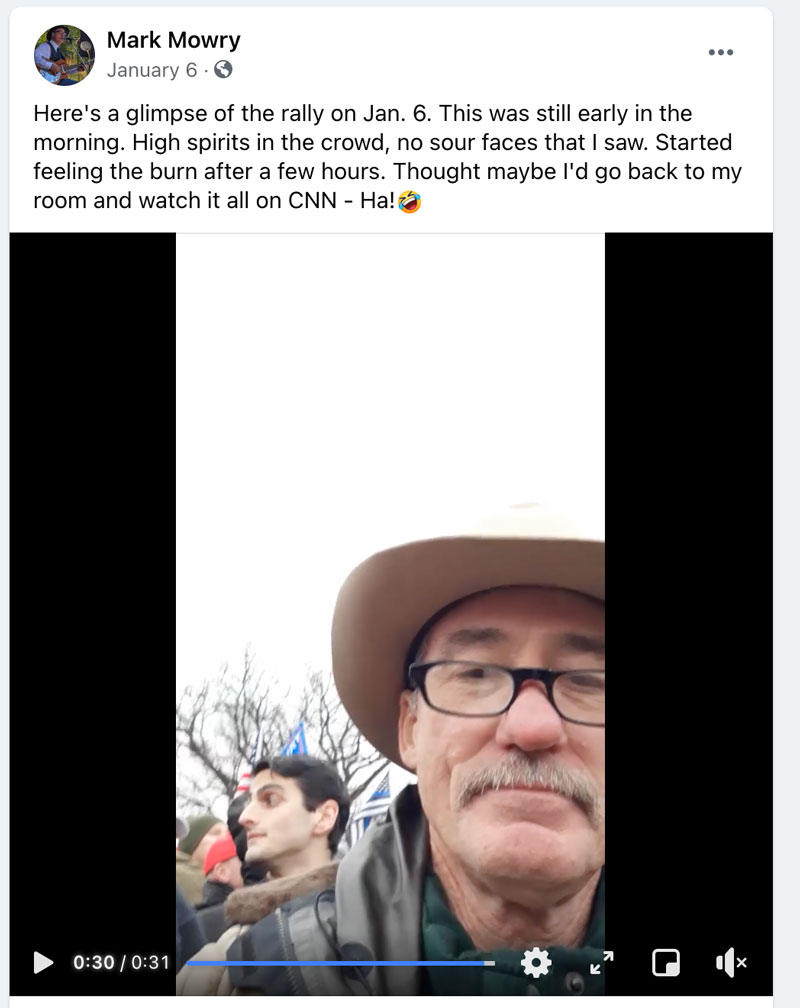
Of course, aside from his attendance, we also have him promoting claims that the Nashville bombing was done to hide fraud with Dominion voting machines.
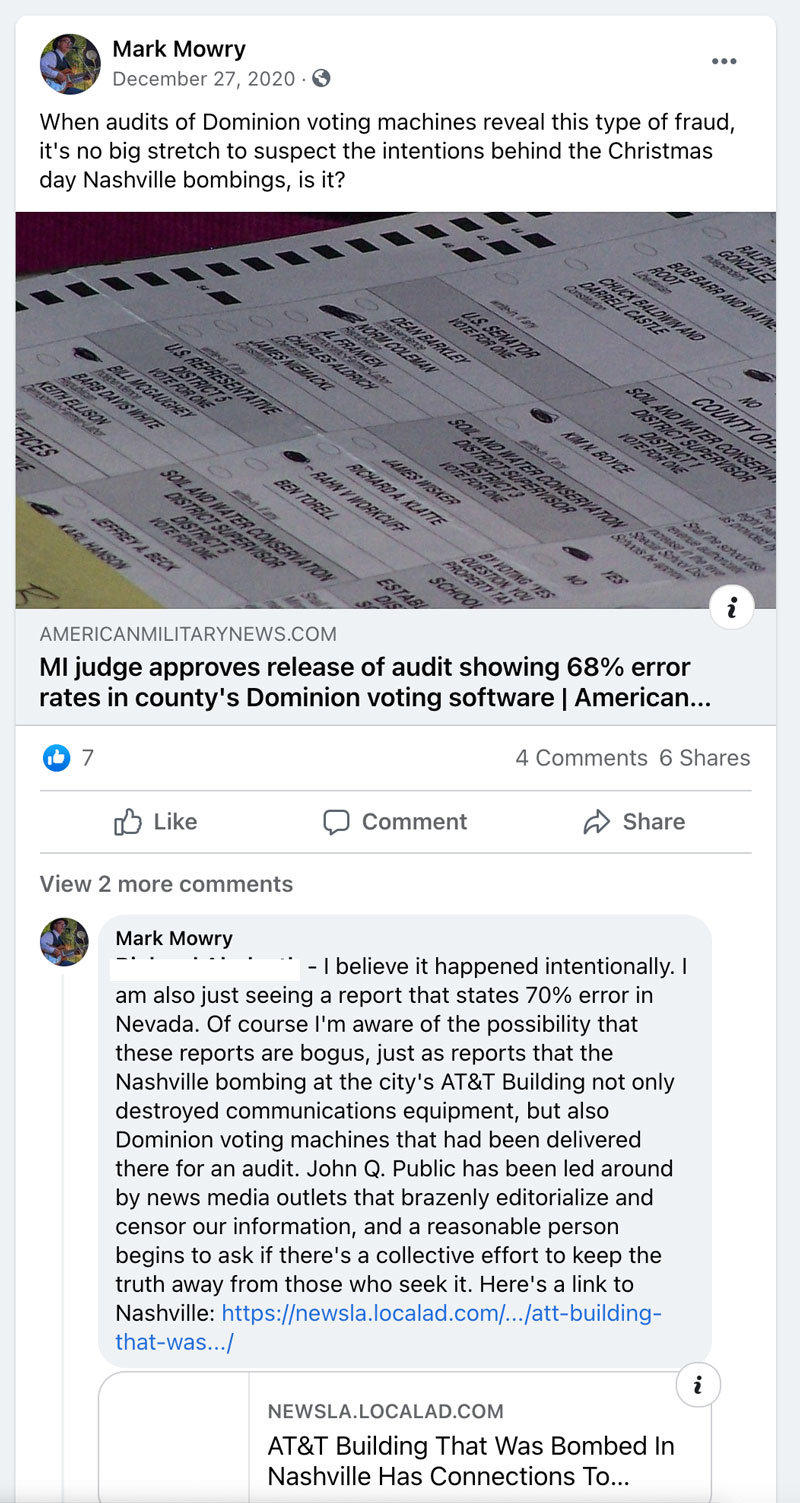
Repeating the conspiracy claim was bad enough, but then we have Mowry explicitly stating that he believes the bombing “happened intentionally?”
(Of course, it didn’t exactly happen as Mowry speculated.)
If you like Marjorie Taylor Greene in Congress, I suppose that Mowry might be to your liking.
But for the rest of us, I prefer our US Senators not promote crazy facebook conspiracies.
From Fox News comes more chatter that everyone wants South Dakota Governor Kristi Noem on their speaker list, and she’s hitting some visible and notable events that you might see presidential hopefuls speaking at:
The influential Iowa based social conservative group The FAMiLY Leader on Wednesday announced that Noem will headline their 10th annual Leadership Summit on July 16th in Des Moines.
Gov. @KristiNoem Iowa Bound in July To Headline @theFAMiLYLEADER Event https://t.co/0c0sEXdder #FITN #iapolitics #IAcaucus
— Iowa Field Report.com (@IAFieldReport) May 12, 2021
For a half century Iowa’s caucuses have kicked off the presidential nominating calendar, and any stop in the Hawkeye State by possible White House hopefuls generates more 2024 buzz.
Mark Mowry, the Q-Anon candidate of choice has finally gotten around to changing his political party to Republican, and has announced his candidacy against US Senator John Thune in the media:
Mark Mowry has announced his intent to run for U.S. Senate, the office currently held by Minority Whip John Thune, in the June 2022 Republican primary.
“Our conservative leaders have talked loudly and forcefully, but then they enter the battle with tin swords and soon come retreating back to their constituencies with a feeble ‘I tried.’ South Dakotans love their freedom and independence, and they expect and deserve more from their leaders,” Mowry said in a press release.
In checking today, it appears that he finally got around to becoming a Republican, despite not being one as recently as the end of April. (Believe me, I checked).
But, being a Republican for 2-weeks does not solve some of his other problems, as I noted regarding his recent facebook chat he gave to the “Primary John Thune Group in 2022” group:
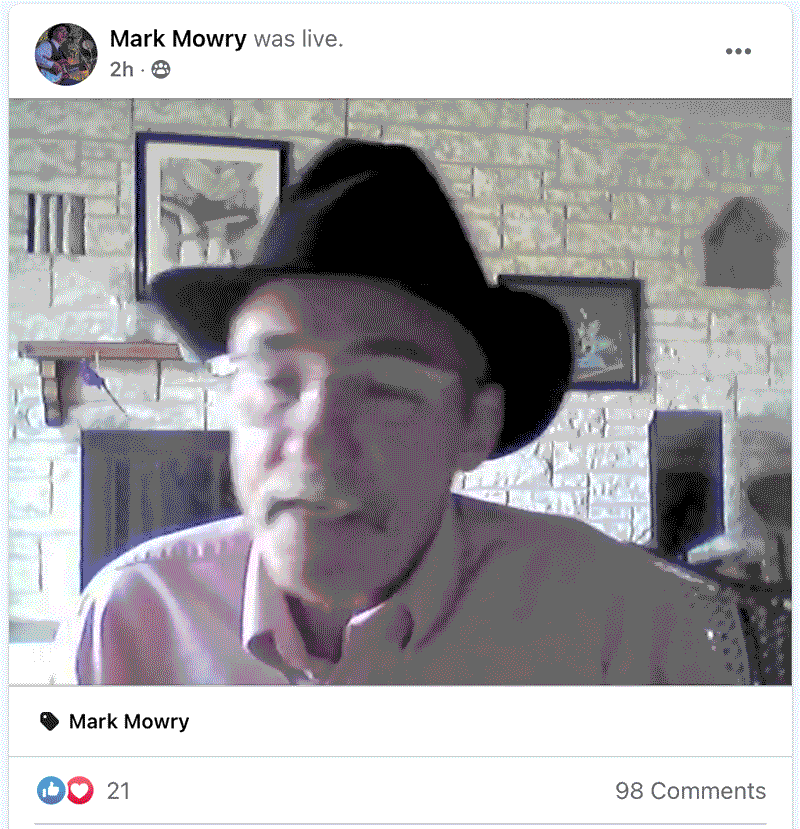
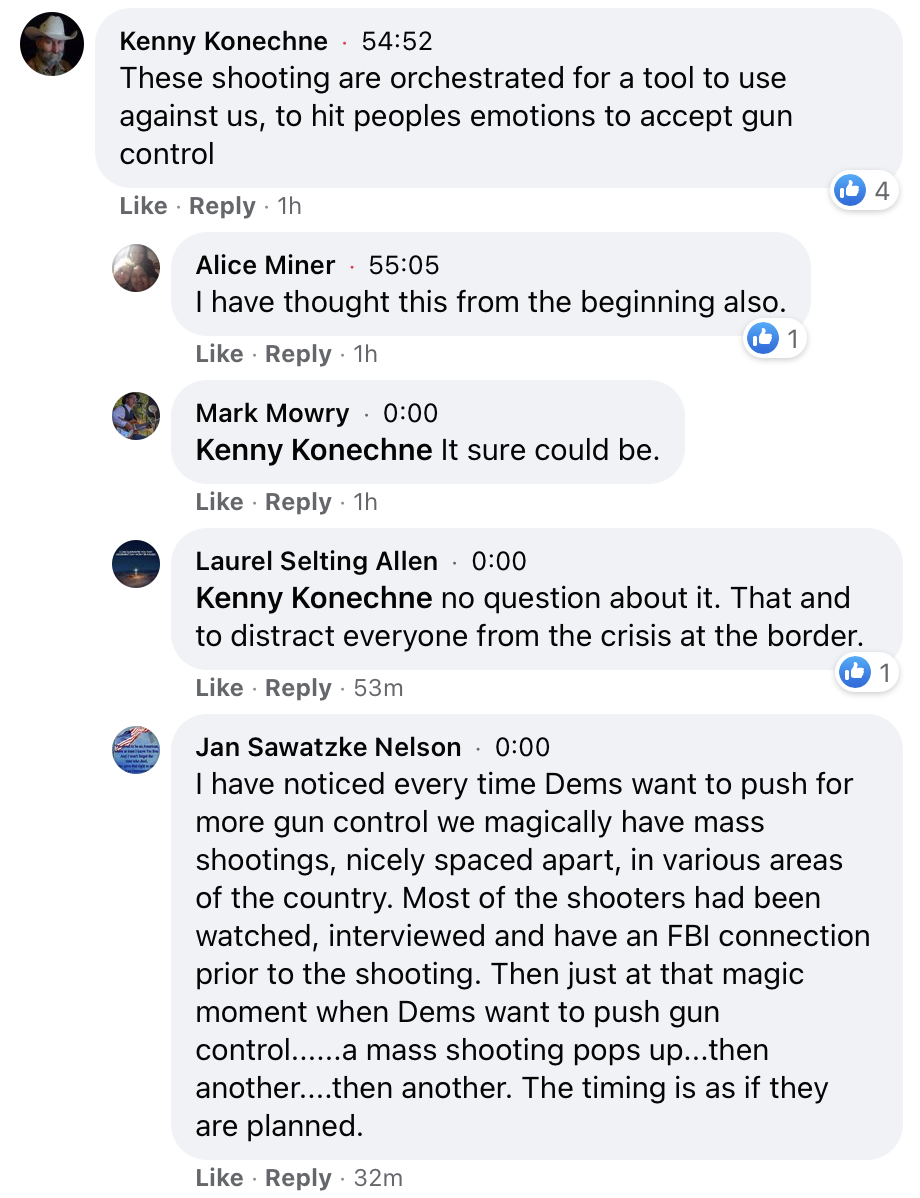
Read my prior story on it here.
I really don’t think that South Dakota Republicans are interested in nominating a candidate who believes that mass shootings “sure could be” orchestrated to get people to accept gun control.
Moving on.