Impressions from the 2024 Republican State Convention

After a day or so convalescing from the activities of the 2024 SGOP State Convention, just wanted to summarize some of what went on, and my impressions of the event, overall.

The SDGOP is heading into the fall a little divided, and cash starved.  While it might not have been open combat, at times – especially on Thursday and Friday – there did not seem to be an overarching sense of party unity as has been evidenced in the past.  In fact, the convention came off like a reluctant religious pilgrimage more than a convivial atmosphere where people wanted to be there. Many people seemed to go out of a sense of obligation, if not to prevent the other side from winning.

This was what we might consider “the poor convention.” as it was lean and mean.  Lean, as in the ‘swag bag’ of past conventions with trinkets, coupons, items from sponsors and communities was flat out gone. There wasn’t even a bag. Upon registration attendees got Governor Noem’s books, and a program devoid of information, except a schedule, and a list of donors. (This is why you hand the program off to someone who knows what they’re doing).  A lot of people stayed away until the last possible day. Many in the ultra-right were emboldened, and we had the usual goofiness inserted into the GOP Platform/resolutions.  They re-instated Yankton for the Convention, after they re-wrote their bylaws to “do what they want,” which underlined that there were plenty of people who did not care about the GOP as an organization, rather than a means to an end.

But there were also moments of clarity. A broad base of delegates came in for the vote on Saturday. In the face of calls against foreign ownership in all agriculture one delegate pointed out that in this world, it’s impossible anymore. Get rid of foreign ownership, and Smithfield and many other ag markets go away. And there were other moments where it seemed like a normal convention. Maybe we’re not too far gone?

Candidates who have been running for the long haul still matter.  While there were rumors and fear of the ultra-right going after convention as they did the primary elections, it really didn’t happen. There were moments, such as the goofy Phil Jensen for National Committeeman candidacy that were a bit of a wild ride.

Phil jumped in at the last minute in an unchallenged race that was a shoe-in for current Committeeman Ried Holien. Facing the group that was there on Thursday & Friday, Holien actually went to the step of drafting a withdrawal from the race that was sent out very early Saturday morning. But it was then immediately clawed back.  Why? Because the larger Saturday crowd was a far different group.

As the run up to the race drew near, R. Shawn Tornow and Phil Jensen’s wife were counseling him at the Clubhouse breakfast area that it was going to be close (before they noticed me eating breakfast there, and scurried away).  But when the vote finally came down to it, after some lackluster nominations, Phil Jensen gave a short speech, announced the Freedom Caucus was more important to him, and withdrew from the race, and Ried Holien took the position again.

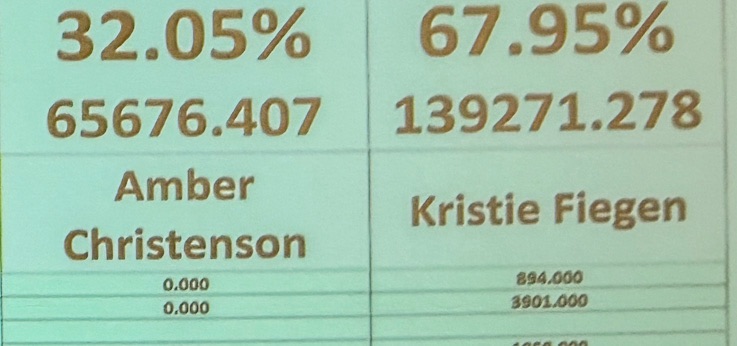
It was the same case for the other races. Public Utilities Commission had a goofy opponent jump in at the last minute against incumbent commissioner Kristie Fiegen, who has been working the race for months, with the support of her fellow officeholders.  That was no contest, especially in the contest where the GOP needed a proven commodity to move forward for the fall election.

National Committeewoman might have been the only race where the hard right seemed to have some movement, as they moved to punish candidate Amber Hulse for taking out Julie Frye-Mueller in the State Senate Race just a few days before. But, to her credit, winner Heidi Engelhart had also been unwavering in her run for the office which had started last year, versus Hulse who had gotten into the race mid-stream. Hulse came into the race with significant Trump bonafides, which didn’t seem to move delegates.  Amber will likely move forward into the State Senate, after moving past the token Democrat opposition. Except now, as the hard right has shown Amber, they are most certainly not her friend.

The Community of Pierre seems to be on an upswing. There’s enough new construction in the central core of Pierre, especially down by the river, to be noticeable with a long, long-overdue updated aquatic facility, event venues, etc. I wanted that riverside crab shack to be successful, but as was explained to me, an outdoor venue in 105 degree Pierre summer heat isn’t always a winner.

Overall, I think a lot of people took a pass on a convention they didn’t believe would be very fun. It was definitely subdued, and generally people were on good behavior. But it came off as more of a chore than a celebration.  And that’s a bit of an issue for a group that calls itself the “Republican Party.”
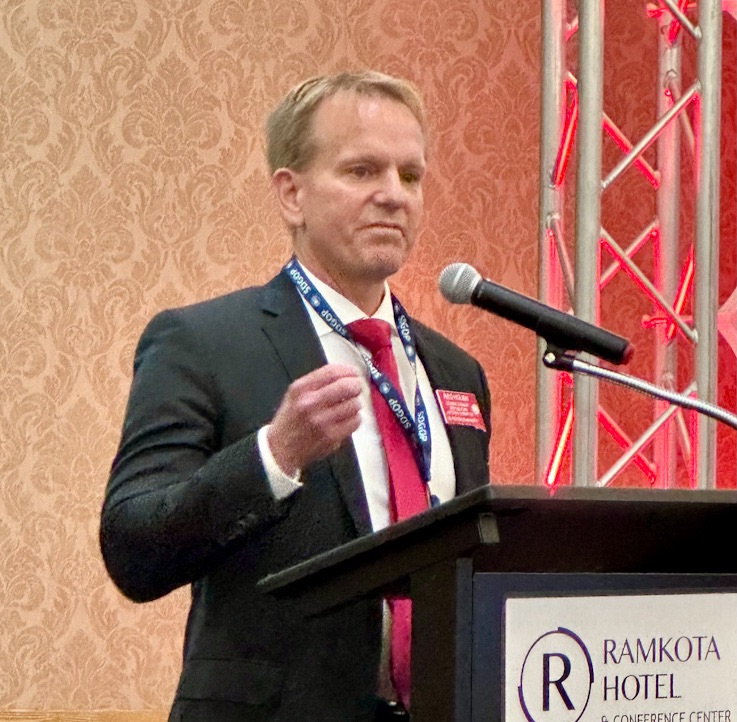
 

Ried Holien v. Phil Jensen for SDGOP National Committeeman, Jensen withdraws.

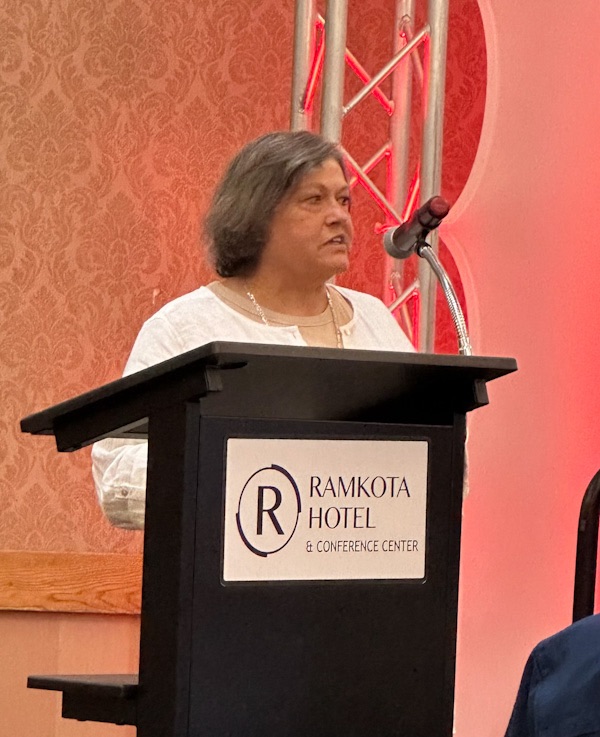
Watertown Mayor and current SDGOP national Committeeman gave delegates a red meat speech campaigning for a return to his position against his opponent, controversial State Representative Phil Jensen.

Jensen gave a speech on his background on his history in SD politics after moving to SD from out of state. Jensen admitted his membership as a founding member of the state Freedom Caucus… and then withdrew from the race.

A unanimous ballot was cast, re-electing Holien to the position.

PUC candidates speak to GOP Convention

Kristie Fiegen and Amber Christiansen are vying for being chosen as Public Utilities Commissioner as they give speeches to the assembled delegates.

Fiegen gave a standard speech of making sure South Dakota has a stable electrical supply, and being an impartial judge of utility matters.

Christiansen invoked Jesus a few times, and talked about the case she filed with the PUC, where she failed to show up.

Incumbent PUC Commissioner Fiegen handily won the race on a better than 2-1 basis, and managed to hold on to that vote throughout the entire balloting process.

Saturday Morning strater-gizing

So my wife and I sit down at the breakfast nook at the clubhouse, as I get ready to have something before the Republican party convention today, and who is all gathered in a little corner, but Phil Jensen, his wife, and R. Shawn Tornow all chattering away by the table my wife picked.

Funny, but the group quickly scurried away when they noticed us.

This comes amidst rumors this morning of cold feet on Phil’s part in the National Committeeman race. I would assume since the issues I pointed out earlier of his awful candidacy will be laid on him a hundred-fold by the national media, he might be having second thoughts.

We can only be so lucky.

An (updated) history of South Dakota Republican Party State Conventions

For the last several years, I had produced the SDGOP Newsletter, including a special convention edition that was distributed at the SDGOP Convention.  Since I’m no longer doing that, I thought I’d share one of the most interesting items that I would regularly include in it; a history of the South Dakota Republican Party’s conventions.


  • 1889 – September 4, Huron
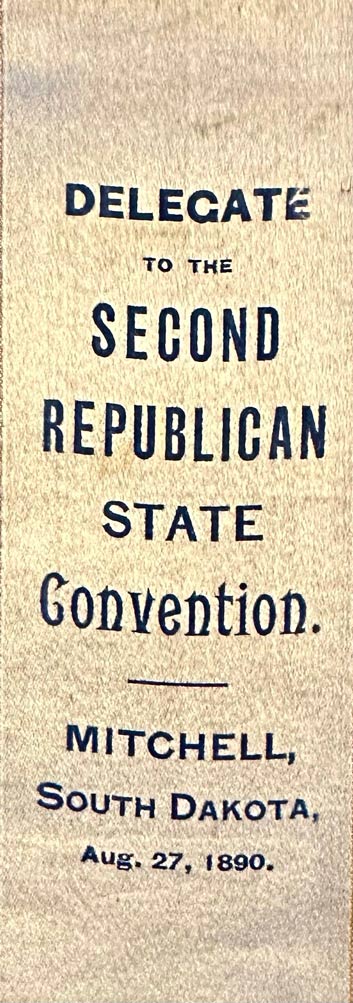
  • 1890 – August 27, Mitchell
  • 1891 – September 29, Aberdeen
    (Special to fill Cong. vacancy)
  • 1892 – July 27, Madison
  • 1894 – August 25, Yankton
  • 1896 – July 8-9, Aberdeen
  • 1898 – August 24-25, Mitchell
  • 1900 – May 23, Sioux Falls
  • 1902 – June 4, Sioux Falls
  • 1904 – May 4, Sioux Falls
  • 1906 – June 6, Sioux Falls
  • 1908 – July 18, Mitchell
  • 1910 – July 5, Sioux Falls
  • 1912 – July 2, Huron
  • 1914 – January 5, Pierre
  • 1916- July 5, Huron
  • 1918- July 2-3, Sioux Falls
  • 1920 – August 9, Huron
  • 1921 – December 7, Pierre
  • 1924 – July 18, Huron
  • 1926 – December 1, Pierre
  • 1928 – August 17, Huron
  • 1930 – May 20, Pierre
  • 1932 – May 24, Pierre
  • 1934 – May 29, Pierre
  • 1936 – June 2, Pierre
  • 1938 – June 27, Pierre
  • 1940 – July 22, Pierre
  • 1942 – June 6 – Pierre
  • 1944 – May 29, Watertown
  • 1946 – July 8, Pierre
  • 1948 – July 12, Pierre
  • 1950 – July 17, Pierre
  • 1952 – July 21, Pierre
  • 1954 – July 26, Pierre
  • 1956 – July 16, Pierre
  • 1958 – July 14, Pierre
  • 1960 – August 1, Pierre
  • 1962 – July 15-16, Pierre
  • 1964 – August 1, Pierre
  • 1966 – July 30, Pierre
  • 1968 – July 15, Pierre
  • 1970 – July 13, Pierre
  • 1972 – June 26, Pierre
  • 1974 – July 13, Rapid City
  • 1976 – July 10, Pierre
  • 1978 – June 22, Sioux Falls
  • 1980 – June 27-28, Aberdeen
  • 1982 – June 24-26, Yankton
  • 1984 – June 28, Rapid City
  • 1986 – June 28, Mitchell
  • 1988 – June 22, Watertown
  • 1990 – June 29, Sioux Falls
  • 1992 – June 26, Spearfish
  • 1994 – June 24, Pierre
  • 1996 – June 27-29, Aberdeen
  • 1998 – June 25, Pierre
  • 2000 – June 22-24, Spearfish
  • 2002 – June 21-22, Sioux Falls
  • 2004 – January 23-24, Sioux Falls
    (Special to fill Cong. vacancy)
  • 2004 – June 24-26, Mitchell
  • 2006 – June 22-24, Watertown
  • 2008 – June 19-21, Oacoma
  • 2010 – June 25-26, Huron
  • 2012 – June 21-24, Sioux Falls
  • 2014 – June 19-21, Rapid City
  • 2016 – June 24-25, Aberdeen
  • 2018 – June 21-23, Pierre
  • 2020 – June 19-20  “Virtual Convention”
  • 2022 – June 23-25, Watertown
  • 2024 – June 5-8, Pierre

Project BISON Achieves Milestone: Contracts Signed with Sierra-Cedar and Oracle

Project BISON Achieves Milestone: Contracts Signed with Sierra-Cedar and Oracle

PIERRE, S.D. – The Bureau of Finance and Management (BFM) has taken a crucial step toward modernizing the State of South Dakota’s financial processes through Project BISON. Last week, BFM secured Oracle Fusion Cloud as its new Enterprise Resource Planning (ERP) system and selected Sierra-Cedar to lead the implementation of Project BISON.

Project BISON is spearheading a significant financial transition by replacing a 36-year-old system with a state-of-the-art, cloud-based ERP solution. The new ERP system will integrate all financial functions into a centralized platform, ensuring that all agencies work from a unified data set. This advanced technology will enable State financial staff to access accurate, real-time financial data with just a few clicks. This collaborative effort across all State agencies will leverage their collective expertise to design, test, and implement the new system alongside Sierra-Cedar, ensuring its longevity for decades to come.

The need to update state government’s financial operations has been a long-standing discussion due to the aging nature of existing systems and limited vendor support. The current core financial system, in use since 1988, has undergone numerous extensions to its critical infrastructure, however it now requires a comprehensive replacement. A feasibility study completed in January 2022 confirmed the necessity for a financial system overhaul.

“Governor Noem understands the importance of modernizing the financial system for the State of South Dakota,” said BFM Commissioner, Jim Terwilliger. “Not only that, but she also recognized the need for Project BISON to receive appropriate support to ensure successful implementation.”

Senate Bill 23 was introduced during the 2023 Legislative Session to support this project. The bill was approved by both the Senate and House of Representatives with widespread bipartisan support and was signed into law by Governor Noem on March 27, 2023.

Following over a year of planning, Request for Proposal (RFP) development, on-site demonstrations from multiple system integrators, and examining ERP systems, the Project BISON evaluation committee selected Sierra-Cedar to implement Oracle Fusion Cloud as the modern financial system of record for the State of South Dakota. Contracts with Sierra-Cedar and Oracle were signed by BFM Commissioner Terwilliger and Bureau of Information and Telecommunications (BIT) Commissioner Clines.

“We anticipate kicking off Project BISON to state employees in July 2024,” said BFM Commissioner Terwilliger. “This project is expected to go live in FY27, bringing with it a modern ERP system and financial processes following industry best practices.”

To read more about Project BISON and sign up for project updates, visit https://www.sd.gov/bison.

###

Rounds, Durbin Introduce Legislation to Protect Rural Postal Processing Facilities

Rounds, Durbin Introduce Legislation to Protect Rural Postal Processing Facilities

WASHINGTON – U.S. Senator Mike Rounds (R-S.D.) and Senator Richard Durbin (D-Ill.) today introduced legislation that would require the U.S. Postal Service (USPS) to consider consequences for rural areas during their closure or downsizing review process in order to protect rural mail processing facilities.

USPS’s reviews of processing facilities closures does not require them to consider the impact on rural areas or highly rural areas as long as the closure gains efficiencies. However, USPS’s reviews of post office retail locations does require them to answer whether closing the location is consistent with their obligation to provide effective and regular postal services to rural areas. This legislation would require USPS to consider the impact to rural areas when closing or downsizing processing centers, just as they do with closing post office retail locations.

“Rural mail services are a lifeline for residents of many communities across South Dakota,” said Rounds. “The U.S. Postal Service should be required to consider the impact of closing processing facilities on rural residents, just as they consider it when closing retail locations. I’m pleased to be introducing this legislation to make certain rural residents receive their mail in a timely and efficient manner.”

“If I drop a piece of mail off in Springfield to make it across town, why should it have to go all the way to St. Louis and back? Eliminating mail processing centers across our state, without consideration for the impact on mail service and postal employees, will only decimate USPS. It is yet another instance of Postmaster General DeJoy’s ‘Delivering for America’ plan disastrously missing the mark,” said Durbin. “I’m joining Senator Rounds in introducing legislation requiring USPS to study the effects of closing or consolidating mail processing and shipping facilities to ensure that our postal service serves Illinoisans to the best of its abilities.”

This legislation is cosponsored by Senators Martin Heinrich (D-N.M.), Tina Smith (D-Minn.), Amy Klobuchar (D-Minn.), Roger Wicker (R-Miss.), Cindy Hyde-Smith (R-Miss.) and Kevin Cramer (R-N.D.).

BACKGROUND:

–       As part of its Delivering for America plan, USPS is reviewing every processing and distribution center in the nation with the goal of creating efficiencies by reducing services at some centers and eliminating others.

–       There are three USPS processing facilities in South Dakota: Huron, Rapid City and Sioux Falls.

–       In February 2024, USPS finalized a plan to move all non-local processing at the Huron facility to Fargo, North Dakota.

–       In April 2024, USPS finalized a plan to move all non-local processing at the Sioux Falls facility to Omaha, Nebraska.

–       In April 2024, Rounds led a letter to Postmaster General Louis DeJoy urging the postal service to avoid downsizing or significantly reorganizing mail processing operations in South Dakota.

–       In May 2024, Rounds sends follow up letter to Postmaster DeJoy highlighting continued concerns with USPS’ plans to downsize mail processing centers nationwide.

–       In May 2024, following bipartisan pressure from Senators, USPS announced it is pausing the downsizing of mail processing facilities in South Dakota.

Click HERE for full bill text.

###