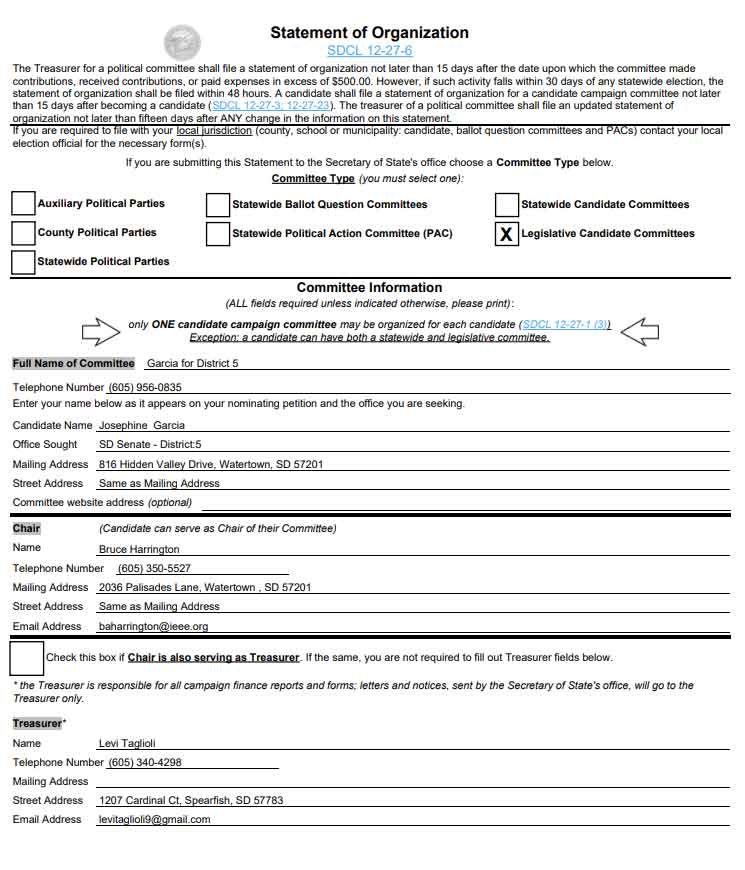
Maybe to further emphasize my point on why the addresses of legislators should not be hidden from the public; I tried sending this in an e-mail to committee members early this afternoon. None of them got it.
If the system rejects e-mail to legislators’ e-mail addresses, maybe – just maybe – they should have information available to assist people sending them an old-fashioned letter.
– pp
——————–
Good afternoon.
I wanted to send a note to you in opposition to House Bills 1083 and 1084 that you will be hearing tomorrow in House Judiciary Committee as these bills are deeply flawed in several different ways. Even if some problems can be addressed, there are portions that rise to the level of being offensive to the concepts of open government and transparency in South Dakota.
I had previously written an essay on some of the problems with this legislation..
The pitfalls of creating a protected class of elites. And what about all the elected officials they leave for the wolves?
..But to give you the highlights of why these bills are bad:
With House Bill 1083, We are creating yet another new crime in South Dakota – intentionally or not – directed against those in the media. I would draw your attention to the fact that the crime of stalking is proposed to include in it’s language in Section 1 of the bill:
(4) Knowingly disseminate, post, or publish, by electronic means, another person’s employment, home, or school address or location, or identifying information, as defined by § 22-40-9, without the other person’s consent, and with the intent to intimidate, harass, or cause substantial emotional distress to the other person or the other person’s immediate family, as defined by § 22-1-2.
Consider the result of this language. Under the passage of this law, it could become a criminal act for a newspaper to publish on-line that the subject of a story works at a certain business. And it goes farther than that. What happens when property transfers are posted publicly? That often will include names and addresses. Will 22-19A-1 now become a risk of criminality for the publisher after this very common disclosure of public information that is filed and available through county websites?
Whether it intends “to cause emotional distress” might be arguable. Intent may be in the eye of the beholder and a question of fact that will have to be drug through the courts. One person’s journalism might be triggering of another’s distress. I myself often report using the very tools made available to the public – the publicly available and accessible state voter list and corporate records – all currently public documents available from the state of South Dakota. All containing addresses.
Will disclosing the contents of public documents now run the risk of an arrest, investigation and felony prosecution? Because I would venture prosecutors and law enforcement will then be spending resources trying to determine where that line is drawn.
Further problematic is Section 3 of House Bill 1083, as it creates and carves out special protection for certain elected officials, yet leaves off others. Under this bill, Statewide officeholders are granted special protections. So are Legislators.
But County Commissioners, County Auditors, County Register of Deeds, County Finance Officers, Mayors, City Councilmen/Commissioners and School Board members are among the many others left out. This seems to be very inconsistent, and makes little sense.
Regarding the rest of this section of the proposed measure, by all means, protect law enforcement officers and members of the justice system who are charged with investigating and prosecuting criminal acts. But to create felony level penalties for the media or public citizens pointing out conflicts of interest for elected officials is an extreme measure, and more than chilling for free speech.
House Bill 1084 is also problematic and inconsistent. As noted under Section 4 with the proposed addition to laws:
Any home address, home or personal telephone number, or the personal e-mail address contained in the historical archive of the statewide voter registration file is not open to public inspection if the information is for:
(1) An individual elected or appointed to statewide or legislative office;
(2) An individual elected or appointed to a federal office;
The proposal to redact the home address of legislators from the public record is against the public interest, as it takes away the ability of the public to verify whether the declared residence of the legislator is factual in terms of their qualifications for the office they are currently serving in. A legislator or other elected official might send a postcard with an address of their choosing. But with the passage of this law, how can the public verify that this person sending them correspondence is actually their neighbor?
As a participant in the American experiment, the public’s right to know is a fundamental principle that citizens should have access to government information and records to ensure transparency, accountability, and informed participation in democracy. This legislative package is the opposite of this. It is contrary to and attacks the public’s right to know. It creates a privileged class of elected officials who under these measures do not owe any duty of transparency to the voters, and weaponizes the law against voters to attempt to independently review the claims of politicians.
Ronald Reagan famously quipped “trust, but verify.” With House Bills 1083 and 1084, that principle is wiped away because there is no trust. And the measure will erase any ability to verify.
Thank you for your consideration of my request. Please reject House Bills 1083 and 1084.