Interesting bill that popped up in the South Dakota State Legislature this week. As noted in the Dakota Scout:
Sen. Tim Reed, R-Brookings, supported the bill on the Senate floor Wednesday. Reed said he currently serves as president of his HOA and keeps track of bylaws and covenants. Five people sit on the HOA board out of 92 total members.
“Five people could do this,” he said. “That’s why I think this bill is so important.”
Sen. Reynold Nesiba, D-Sioux Falls, said the issue pits two values against each other: property rights and gun rights.
Led by Senate Democrat Leader Reynold Nesiba, a majority of the Democrats in the State Senate voted against limiting the power of HOA’s to stop the second amendment at the entrance to South Dakota’s gated communities.
Voting to allow HOA’s to give themselves the ability to grab guns were three of the four Democrats in the State Senate, Senators Nesiba, Liz Larson, and Shawn Bordeaux. Democrat Red Dawn Foster voted with the Republican Majority to prevent any such overreach.
Rounds, King Introduce Bipartisan Legislation to Fast-Track Combat Veterans’ Access to Health Care Benefits
WASHINGTON – U.S. Senators Mike Rounds (R-S.D.) and Angus King (I-Maine), members of the Senate Veterans’ Affairs Committee, introduced bipartisan legislation to allow combat veterans to enroll in their health care benefits program before officially transitioning out of active duty in order to make certain that service members don’t experience a lag in coverage.
The Combat Veterans Pre-Enrollment Act would create an opt-in program allowing transitioning service members to access VA health care services on their first day as a civilian. Currently, transitioning service members must wait until they have left the military and received their official separation paperwork, which can take months, to apply for Veterans Health Administration health care and other services, creating a period where veterans do not have access to the health care benefits they have earned.
Rounds and King are joined by Senators Joe Manchin (D-W.Va.) and Kevin Cramer (R-N.D.).
“Veterans represent the best of our country. Our men and women in uniform have made incredible sacrifices so that we can be free, and we have a responsibility to fulfill our commitment to them once their service is complete,” said Rounds. “The Combat Veterans Pre-Enrollment Act would eliminate the lapse in care that many service members face when transitioning from the military to civilian life, and make certain that service members have timely access to the health care services they need upon separation from the military.”
“Our combat veterans continually put their lives on the line to protect our freedoms and they deserve our utmost support and care, they have retired the uniform,” said King. “The Combat Veterans Pre-Enrollment Act is another way in which we can guarantee our servicemembers experience a warm handoff in their transition to civilian life. By eliminating this bureaucratic lag, we can deliver VA benefits to our men and women who served, the moment they return to civilian status.”
“The Combat Veterans Pre-Enrollment Act, S. 3560, is essential to the type of service and support our Service Members immediately need when they transition from the military,” said Marty Pennock, Disabled American Veterans Department of South Dakota Adjutant. “It clearly focuses in on one of the most important areas that arise upon discharge from their Service, and that is in their health. This legislation clearly is founded by those that understand the needs of our military and the importance of getting to the resources and linking our Service Members to VA as early as possible.”
“As Service members make the transition to civilian life it can be a very stressful time,” said Rick Williamson, Department of South Dakota Veterans of Foreign Wars Legislative Chairman. “Making sure that they have healthcare, medications, and benefits is a great start to assuring them the stability they deserve as they enter the next chapter of their life. The Department of South Dakota, Veterans of Foreign Wars of the United States proudly supports this legislation and congratulates Senators Rounds and King for doing the right thing.”
“Transitioning service members face challenges post separation. Making sure these veterans enroll in the healthcare and benefits they have earned will help ease that transition,” said Pat Murray, Legislative Director for Veterans of Foreign Wars. “VFW supports theCombat Veterans Pre-Enrollment Act of 2023in order to make transition easier for the men and women who served our country.”
State Senate hopeful Jordan Youngberg has long given his notice of his intent to run for the District 25 seat currently occupied by State Senator Tom Pischke.
And today it is no longer intent, as Youngberg has filed his petitions with the Secretary of State to be placed on the ballot for that office.
Rounds, Sinema Introduce Legislation to Increase Transparency and Accountability for Financial Regulators
WASHINGTON – U.S. Senators Mike Rounds (R-S.D.), a member of the Senate Committee on Banking, Housing, and Urban Affairs, and Kyrsten Sinema (I-Ariz.) introduced legislation to increase transparency and accountability within the Financial Stability Oversight Council (FSOC). The FSOC Improvement Act would enhance transparency and procedural fairness of the systemically important financial institutions (SIFI) designation process.
Specifically, this legislation would codify 2019 guidance that requires FSOC to determine whether systemic risks could be better addressed through means other than designating a financial institution as a SIFI. It would also require them to consult with the primary regulator and the company on other means to address potential threats to financial stability. Finally, the legislation enhances transparency at the FSOC by requiring the council and its member agencies to report on crisis planning activities and potential threats.
“I believe the FSOC Improvement Act is a crucial step towards enhancing the effectiveness and transparency of our financial regulatory system,” said Rounds. “SIFI designation is a blunt tool that comes with a significant increase in regulatory burden for individual companies. By allowing an affected institution to modify its business, structure or operations prior to the SIFI designation, we are creating a more resilient financial environment for the American people, fostering economic growth and stability.”
“We’re fueling growth and creating careers for Arizonans while increasing transparency,” said Sinema.
Rounds first introduced the FSOC Improvement Act in 2018 during the 115th Congress. Rounds reintroduced this legislation to the 116th Congress in 2019, with Sinema as an original cosponsor.
SIOUX FALLS–District 14 State Senator Larry Zikmund announced his intent to seek reelection for the Legislature today. A respected leader in the Capitol and Sioux Falls, Larry is an experienced and effective public servant advocating for the people of District 14.
“District 14 voters have honored me with the support over the years, and I’ll work hard to earn their support again in 2024,” said Zikmund. “South Dakota is moving forward in the right direction, but we need to keep working on the issues impacting Sioux Falls’ growth and prosperity. Experience matters, and that’s what I’m offering District 14.”
Zikmund was first elected to the South Dakota House of Representatives in 2014, where he served until winning the vacant Senate seat in 2020. He is a member of the state budget setting Appropriations Committee, the Vice-Chair of the Military and Veterans Affairs Committee, and member of the Retirement Laws. A veteran himself, Zikmund is especially proud of his work to support active service members, veterans and their families including his leadership to help build the new South Dakota Veterans Cemetery in Sioux Falls.
District 14 encompasses southeast Sioux Falls in Minnehaha County between Cliff Avenue and Veterans Parkway. Election Day is Nov. 5, 2024.
A measure to ask South Dakota voters to choose for themselves whether they would like the same opportunity to choose their Attorney General and other offices in a primary election as they have to select their Governor or legislators failed in committee after sponsors could not convince the House State Affairs Committee to send the resolution on to the floor.
House Joint Resolution 5001, a measure proposing and submitting to the voters at the next general election an amendment to the Constitution of the State of South Dakota, requiring all non-judicial offices elected by a statewide vote to be nominated at a primary election failed to gather sufficient votes in committee to move the measure to the floor after testimony from several interested parties, including South Dakota Republican Chairman and Senator John Wiik.
The discussion over moving offices out of the convention process has arisen after a trend has emerged at State Republican Conventions of groups of activists registering as precinct people showing up only to vote, and not otherwise participating in any Republican Party activities. Controversy over these activists grew after the last Republican convention after many of the agitators forced a vote to make the convention free, which would have bankrupted the Republican Party. The measure narrowly lost by 5 votes.
It remains to be seen if the proposal will come back in another form during this legislative session, but this remains a problem which the Republican Party will have to face in the months to come.
Had an observant reader catch this and sent it over..
“Interesting campaign finance tidbit is that Keintz terminated her Lt. Account and transferred $3,352.56 to her Keintz for House.”
Sending a bigger pot of money over to an equally dormant account that had $133 in it… why would this be? The speculation is whether Jennifer is going to join her running mate Jamie Smith with both attempting a return to the legislature in 2024.
Proponents of House Joint Resolution 5001 to propose a vote to choose whether to switch South Dakota to a primary voting system for all statewide offices just dropped a huge bombshell in their pursuit of legislative success.
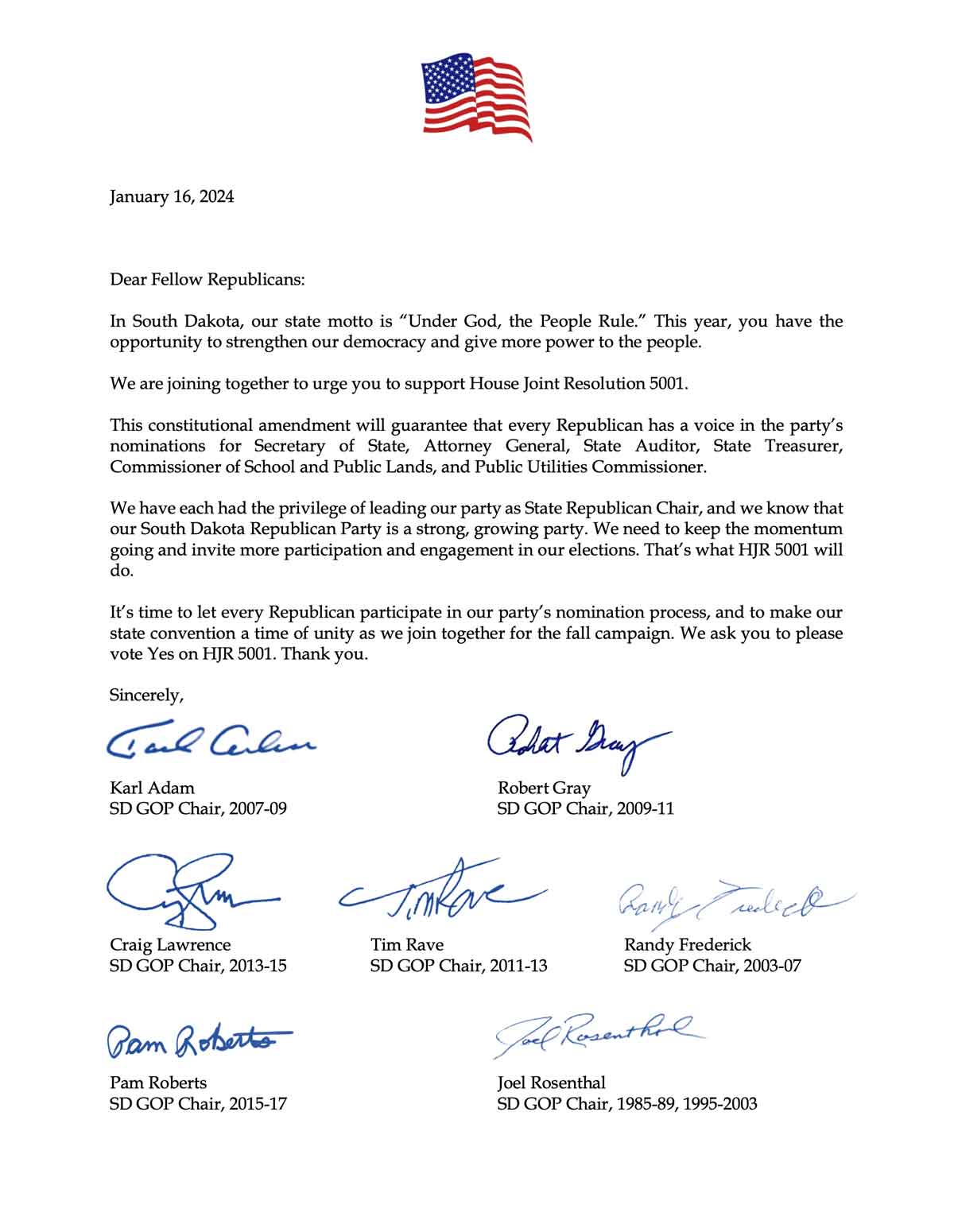
This afternoon HJR 5001 prime sponsor Rep. Tyler Tordsen released a letter of support from 7 of the 89 living past South Dakota Republican Party chairmen, representing over a quarter century of GOP leadership, urging passage of the measure:
The only ones missing from this list, the 8th living past State Republican Party chair and immediate past Chairman Dan Lederman, currently sits on the State Republican Party’s Executive Board and also serves as chairman of the Union County Republican Party. The 9th, also not signing the letter is former GOP Chair Arlene Ham. (My bad, I missed Arlene when I wrote this, who served as party chair in the late 70’s. Arlene is 88 years old, and I hope she is with us for many more years to come – she’s a great lady!)
The letter is an open letter to all Republicans noting in part:
This constitutional amendment will guarantee that every Republican has a voice in the party’s nominations for Secretary of State, Attorney General, State Auditor, State Treasurer, Commissioner of School and Public Lands, and Public Utilities Commissioner.
We have each had the privilege of leading our party as State Republican Chair, and we know that our South Dakota Republican Party is a strong, growing party. We need to keep the momentum going and invite more participation and engagement in our elections. That’s what HJR 5001 will do.
It’s time to let every Republican participate in our party’s nomination process, and to make our state convention a time of unity as we join together for the fall campaign. We ask you to please vote Yes on HJR 5001.
Pulled up a couple of posts I did this last year during the debate over SB40 which both contain information which continues to be valid during the debates being held in the legislature beginning tomorrow over House Joint Resolution 5001, which proposes to put it to a decision of voters whether or not they want to continue allowing political parties to nominating several statewide candidates at a convention, or to allow all Republicans to weigh in. First, from a post I made on Feb 14, 2023..
..It would be interesting to look at the public offices in South Dakota where we select the partisan candidates in a primary election process to represent those parties in the November election, and those we select at the Republican or Democrat State Conventions.
US Senate – Primary
US House – Primary
Governor – Primary
Lt. Gov – Convention
Atty General – Convention
Secretary of State – Convention
State Auditor – Convention
State Treasurer – Convention
School & Lands – Convention
Public Utilities Commission – Convention
State Senate – Primary
State House – Primary
Circuit Court Judge – Primary (if more than 2 for each seat)
County Commissioners – Primary
State’s Attorney – Primary
Sheriff – Primary
County Auditor – Primary (and/or county finance officer)
County Treasurer – Primary
Register of Deeds – Primary
PrimaryCoroner – Primary (or appointment after 2023 per HB 1057)
and.. If you think about it, the argument against the constitutional offices being decided by the voters in a primary is largely being made by precinct people.. who themselves are chosen in a primary. I imagine they would be the first people against precinct committee positions being chosen and filled by a small group of party insiders.
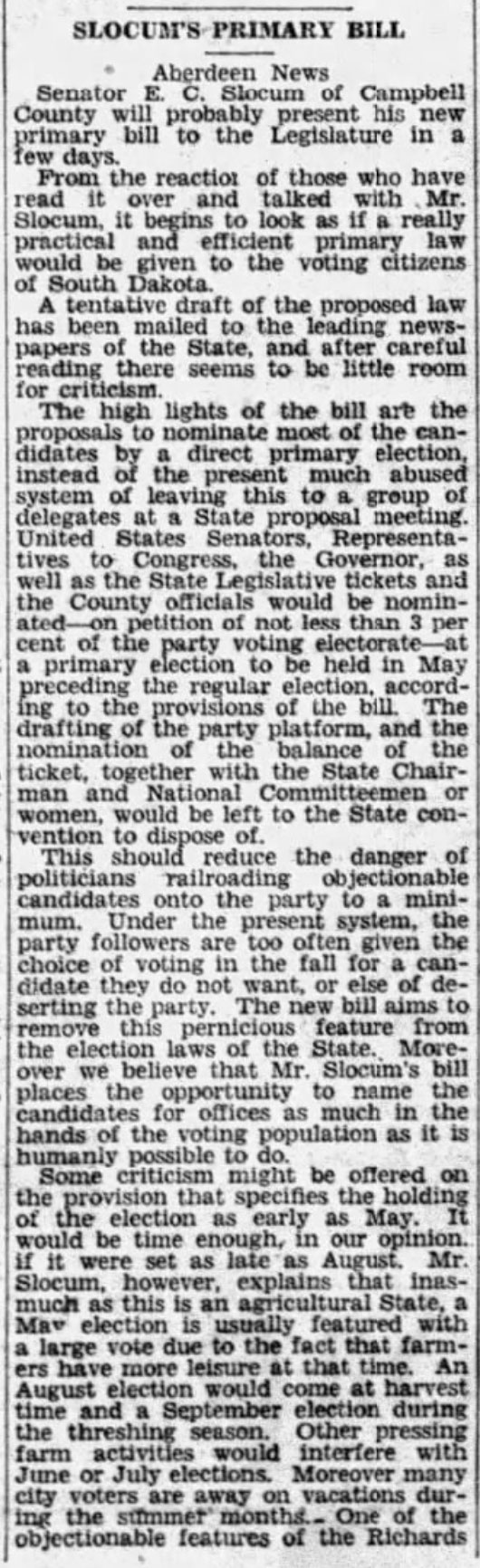
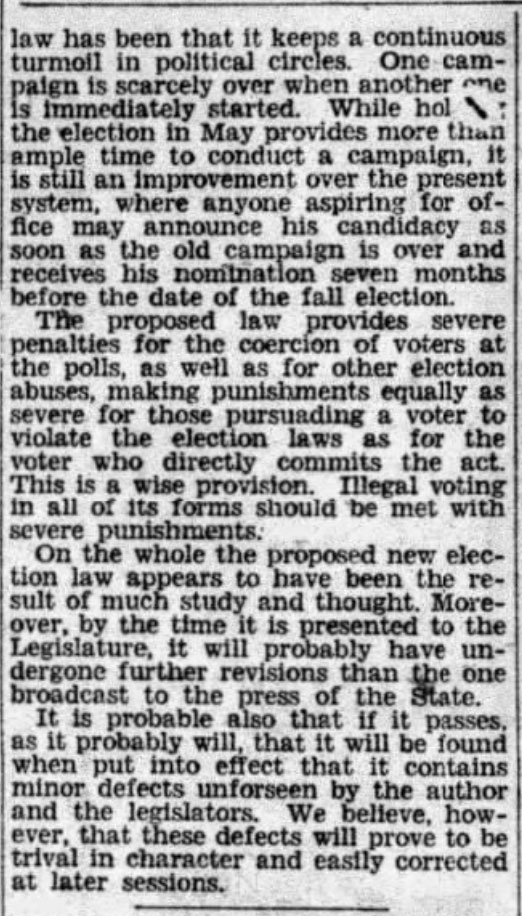
Next, a post that goes back further in state history, to the last time the legislature had a debate of this nature, when it was decided to move several offices at the top of the ticket away from party conventions to a statewide primary:
Apparently, up until that time, those candidates had been vetted exclusively by party nominating committees, and by 1929, legislators had had enough complaints that they had to do something to change the system.
From the Aberdeen American News, via Argus Leader, 22 Jan 1929, Tue · Page 6
It appears that the problem before was that the choices that ended up in front of them were not great via that party system of vetting, and “party followers are too often given the choice of voting in the fall for a candidate they do not want.”
So far, I think I’ve read it a couple of times today on how South Dakota Republicans have had precinct people since about 1917. And the people claiming this are woefully misinformed.
If someone is going to talk about the issue, they at least owe everyone the duty of honesty and accuracy. I wrote about this last year during the debate over SB40, and it remains true.. Precinct people were not part of the process until 1990:
In the 1990 GOP convention when GOP Chair Dwight Adams (Doing double duty as Mickelson re-election chair) threw the doors open to bring more people into the process in exchange for precinct peoples labor, it was lauded as an expansion of the process. In fact, I wrote about it in Dakotawarcollege’s early days waaaaay back in 2005:
Dwight took the party representation for the State Party convention and blew it wide open. He went from having county representation comprised of only a few select individuals on a county wide basis to opening it up to dozens or more per county. He opened up participation and guaranteed that precinct level representatives would be part of county delegations at the state convention. What he did was in effect a molding of the command structure of the party to a military model. It was an organized and well defined structure from the state chairman at the top down the precinct level.
The system was transformed! The “carrot” was that the precinct level people could vote for the candidate of their choice and on issues at convention. But in turn, they also had to be active in precinct level activities, such as poll watching, etc. This in turn gives the party a literally endless pool of volunteers and activists – activists, many of whom someday might be candidates.
With the simple change of a set of rules, the number of people who attended conventions exploded. While the loyal opposition still might be pushing 100 or so for their convention, in some years the GOP has had numbers exceeding 800 or more. (Why do you think Frank Kloucek sometimes makes an appearance at our convention? It’s where the people are). County GOP meetings have people attending simply because they identify themselves as precinct people – another positive effect.
I would make the argument that no other single factor has helped ensure the party’s continued electoral success than making it more participatory. It’s not that people didn’t identify before – party registration numbers illustrated that – but more people than ever could dig into the nuts and bolts work that happens behind the scenes with the party.
The issue that has come about since I wrote that piece in 2005 is that there’s a lot of the precinct process that has changed in the years since 1990. Technology has made precinct watchers obsolete. The phone tree has been replaced with auto dialers and call centers, and a lot of their job has gone away. But, while the call to action for working together has gone away, it’s been replaced in some cases by those who have no interest in being representative of their communities for the GOP, and are more interested in weaponizing the process. These are the people who are recruited for one candidate, only to vote and never be seen again. These are the same people who complain incessantly that when a convention is held, it should all be a free lunch, as a number attempted to do in 2022.