Biden’s Border Crisis Continues By Sen. John Thune
From the day the president took office, our nation has been experiencing an unprecedented surge of individuals who want to enter the United States illegally through the southern border. There have been 2 million illegal border crossing attempts since President Biden was sworn in, yet his administration refuses to implement policies that would deter illegal immigrants from coming into our country. Now the administration has announced that Title 42 border restrictions, which have provided for the immediate deportation for many of those who have crossed the border illegally, will end in May. Once Title 42 restrictions are officially lifted, the flood of illegal immigration across our southern border is expected to become a tsunami.
The Department of Homeland Security expects as many as 18,000 migrants per day to attempt to cross our southern border after the policy is lifted, which adds up to more than half a million migrants per month. To put those numbers in perspective, in fiscal year 2021, the Border Patrol encountered more than 1.7 million individuals attempting to cross our southern border, which was the highest number ever recorded in a single year.
Title 42 restrictions were never intended to be a permanent border solution, but the problem with the Biden administration abruptly lifting them is that its doing it without any type of a coherent plan in place to handle the flood of likely illegal immigration to follow. The administration’s approach amounts to an invitation for this current security and humanitarian crisis to get exponentially worse.
This isn’t just a Republican concern. I recently introduced legislation with five Republican senators and five Democrat senators that would block the administration’s rollback of Title 42 border policies until the administration presents Congress with a plan to stem the crisis. Asking for a plan shouldn’t be too much to ask. Even several of my Democrat colleagues agree that rescinding this policy would send a clear and dangerous signal to anyone who wishes to illegally cross the southern border.
The obvious policy contradiction by the administration can’t be overlooked here either. By ending Title 42, the administration is saying that the pandemic is over at the border. That’s an ironic position because President Biden is still pressing for more COVID funding in Washington. His administration is still extending the pause on student loan repayments, presumably for pandemic-related reasons. And most shocking to me, the Biden administration is still requiring some toddlers in the Head Start program – as young as two years old – to wear masks, even on the playground. When you boil it down, President Biden is essentially declaring that the pandemic is over at the border, but it’s overwhelming on the playground.
We can’t keep COVID policies in place forever, obviously, but there’s no sign that the administration has any substantive plan for how to deal with the resulting surge or the enhanced criminal activity that would accompany rescinding this border policy. The decision to lift Title 42 without a legitimate plan in place to handle a mass surge of illegal immigrants is irresponsible, dangerous, and reckless. I hope the president will get serious about developing a plan to secure our southern border.
Tourism is a Reminder of Why Policies Matter By Rep. Dusty Johnson April 8, 2022
Travel is coming back. After nearly two years of pleas, Speaker Pelosi finally reopened the Capitol building to visitors and tours. South Dakotans wasted no time in coming to their nation’s capital. This week, I had the opportunity to meet with members of the South Dakota Department of Tourism, including their Secretary Jim Hagen.
Fortunately, South Dakota policies throughout the pandemic have offered our tourism industry an easier bounce-back than many other states and communities. But the tourism industry across America is still hurting.
Policies like extended shutdowns, mask mandates, restaurant closures, capacity limits, vaccine mandates, and international travel restrictions, have cost the travel industry more than $755 billion over the past two years.
States like California, who implemented prolonged strict COVID-19 policies, have seen the toll it can take on the industry. Tourism spending in California during 2021 dropped to 67.2% of the 2019 amount. The last time it was this low was 2010. In 2021, the number of visitors to New York City was 32.9 million, down from 66.7 million in 2019—nearly a 50% decrease. Comparatively, in Florida—a state famous for low COVID-19 restrictions—the number of 2021 visitors were only down 9% from 2019 numbers.
In 2021, there were one million fewer visitors in South Dakota than the 2019 numbers – that’s a small decrease of 6.9%. Visitor spending and GDP of the South Dakota tourism industry throughout 2021 has even outpaced 2019 levels. It’s not perfect though, our hospitality industry is facing a workforce shortage – too many open jobs, not enough people. Without the tourism industry, each South Dakota household would pay an additional $980 in taxes. A thriving tourism industry is beneficial for all South Dakotans, not just those with skin in the game.
While everyone took a hit at the start of the pandemic, the COVID-19 policies put into effect thereafter made all the difference when it comes to the reopening of economies. Policies matter, and the COVID-19 responses between states is a clear way to see the impact state and local economies have on our lives. Common-sense policies protect and create jobs – they allow businesses to thrive on their own. Federalism works.
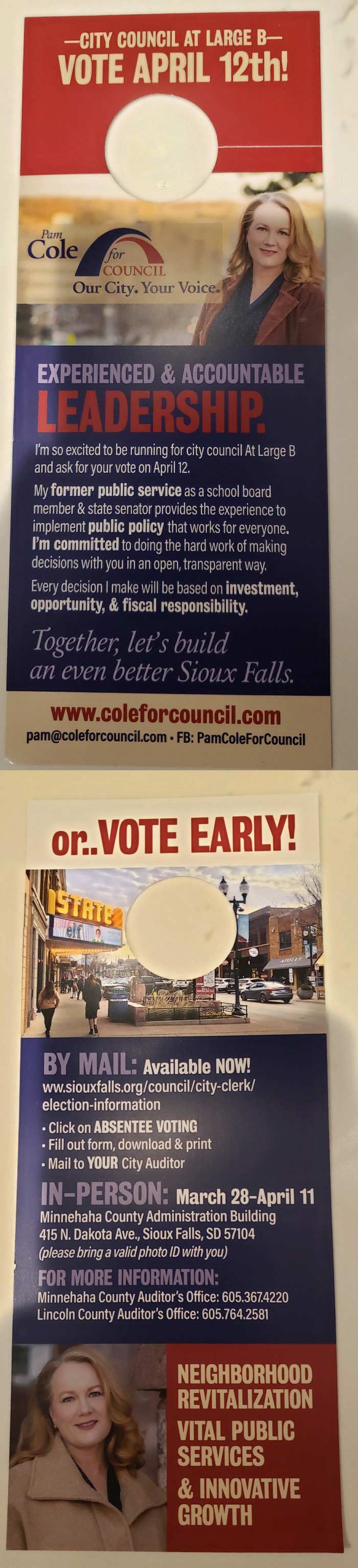
For someone who was the Executive Director for the State Democrat Party, you’d think Pam Cole would remember that political advertisements are supposed to have a disclaimer.
Because I sure don’t see one on this piece.
Nevermind that her name might be the smallest piece of text on the piece. I mean, seriously. Tiny name, no disclaimer. But a couple of pictures. It’s what we might call an ego piece. Nobody ever bothered to try to realize what they should communicate, as opposed to their assuming people know who the lady is on the flyer.
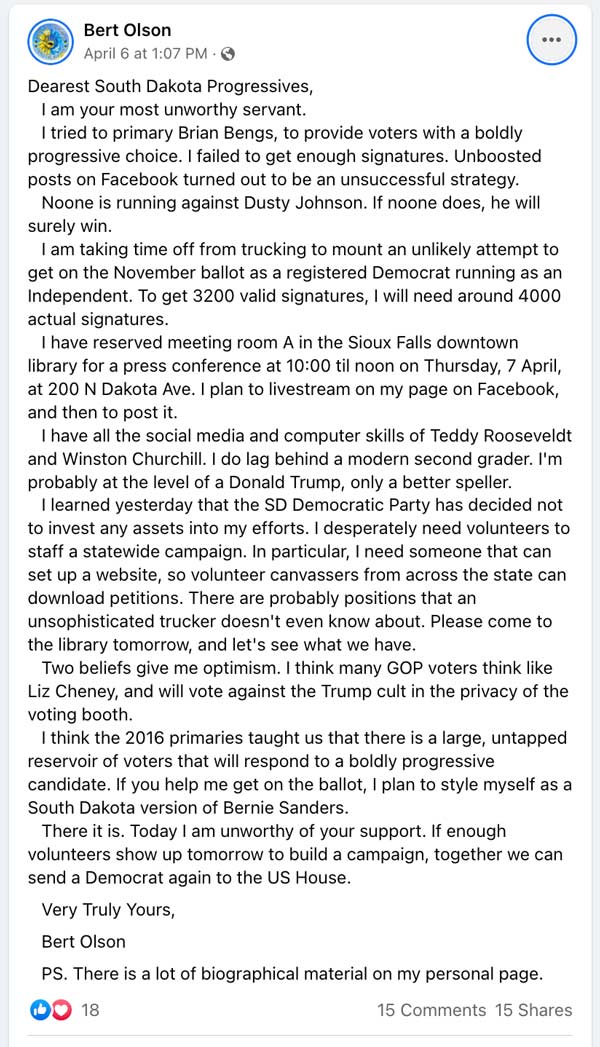
From Facebook, Independent wannabee congressional candidate Bert Olson is on facebook complaining that he doesn’t seem to be getting a lot of love from South Dakota Democrats, who apparently are refusing to invest any assets into his campaign:
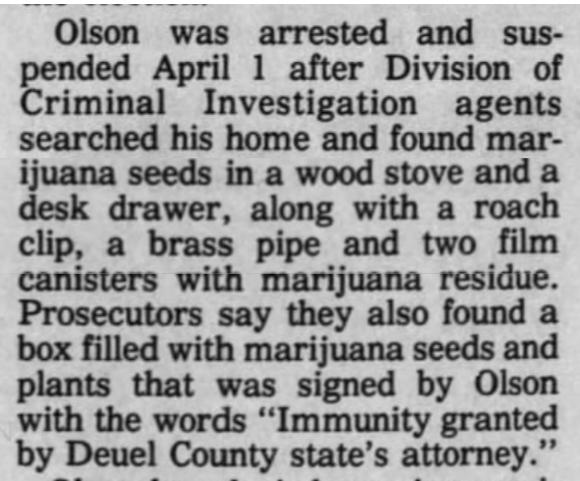
I will say though, at least last time he was in office, he seemed to have a sense of humor (Argus, May 4, 1993)..
..such as when as Deuel County State’s Attorney, he granted himself immunity for possession of illegal drugs. By writing it on the box of illegal drugs. (He resigned after his arrest).
We’ll have to stay tuned to see if this self-styled “South Dakota version of Bernie Sanders” gets any traction.
The Lessons of History By Governor Kristi Noem April 8, 2022
I love learning about history. When I see the granite faces on Mount Rushmore, I always want to learn more about the men enshrined there. When I walk through downtown Rapid City and see the bronze statues of our presidents, I want to learn more about each of their successes and failures. I love the stories — and we can learn powerful lessons from those stories.
At times, history can be a refreshing reminder that the difficulties that we face are not wholly unique. There are often corollaries in the past, lessons to be learned from situations that mirror the present challenges that we face.
America’s history is unique when compared to every other nation on the planet. To this day, we are the only nation founded on an idea — and a transformational idea at that. It’s an idea that has inspired nations the world over, one that even inspires the people of Ukraine today: “that all men are created equal, that they are endowed by their Creator with certain unalienable rights.”
Unfortunately, our nation’s appreciation for that founding idea has slipped over time. This isn’t a new phenomenon; President Reagan warned us of it in his farewell address: “We’ve got to do a better job of getting across that America is freedom — freedom of speech, freedom of religion, freedom of enterprise — and freedom is special and rare.” We need to remind our children about those freedoms and why they were instituted in the first place.
In particular, our children should learn the struggles our nation faced to implement those freedoms and the triumphs that were made in advancing them to folks who had not enjoyed them previously. Sometimes that history is tough, but it must be told for future generations to understand why this country is worth fighting for.
In the process of teaching that history, we should not compel our children to adhere to the false narrative that they are responsible for those previous shortcomings — not on the basis of their race, color, or sex. Such a philosophy is not in keeping with Dr. Martin Luther King Jr.’s powerful dream, “that (his) four little children will one day live in a nation where they will not be judged by the color of their skin but by the content of their character.” That is the America that I was raised in, and that is the America that I am proud to pass on to my children and to my granddaughter.
This week, I signed an executive order to restrict the teaching of divisive ideologies like Critical Race Theory in our K-12 classrooms. These ideologies reject America’s founding idea and instead teach that America was founded on racism — and that is not true.
At various times in our history, America fell short of the founding belief that all men are created equal. And together, our nation overcame those shortcomings. It is on us as a society — and on each elected leader — to commit to defending American liberty for every person in this country. That is my commitment to you as Governor.
Our children should learn America’s true and honest history. I hope that it will inspire them to accomplish incredible things with their lives and to always recognize that all of their peers are just as valuable as they are — no better and no worse. We all have incredible opportunities in this Land of the Free. The lessons from our past should inspire us to reach for those opportunities and teach us the mistakes to avoid along the way.
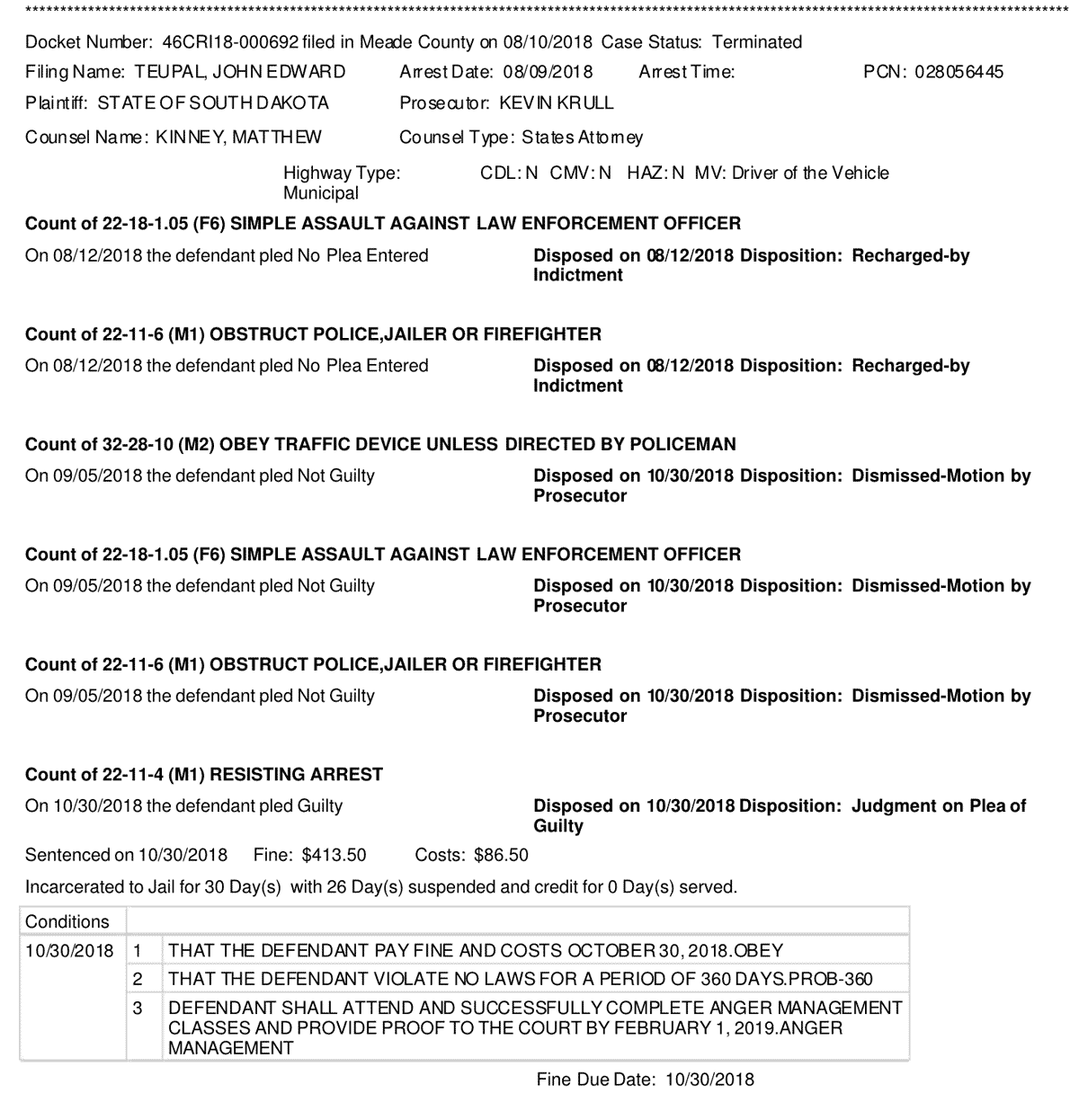
If you remember the election of 2020, I had done a post regarding former State Representative John Teupel, who was running for the State Senate at the time, noting that he was not someone I could support for the legislature. And a lot of that was geared towards the fact that in 2018, I considered it poor judgement to when he decided to raise hands against law enforcement:
Former State Representative John Teupel had previously served in the State House of Representatives from 2001-2004.. and had been a Majority Whip for the House from 2003-2004.
So, as took place in August 2018, how does a former State Legislator get arrested, charged with assault against a law enforcement officer, and it does not seem to make the news in any way, shape or form?
This took place in August of 2018 – Literally less than two months after Teupel was giving a nominating speech at the end of June in front of the Republican State Convention for Attorney General Candidate John Fitzgerald, this same person was arrested for assault against a law enforcement officer.
As you can see, the charge of assaulting a police officer (a felony) was disposed of and pled down with a guilty plea of resisting arrest, and in October of 2018, Teupel received 4 days in jail, being required to successfully complete anger management classes, a year of probation, etc.
Not exactly a resume builder that makes me want to get behind him for State Senate. If you find yourself fighting with law enforcement as a 56 year old man.. you might want to re-evaluate your decision making process. And the legislature is not the place you want to do that.
But there was another interesting contest in 2020, where a number of people were competing within the confines of the Republican party to be delegates to the State Convention. I was running, and gained a slot (only to have COVID cut that short), and John had similarly, but unsuccessfully, offered himself up as a candidate.
Quite a while later, I was speaking with a former board member about the process, and was told how there was also some vetting from those with Trump campaign who wanted to avoid any preventable embarrassments and that might have contributed to Teupel not being selected as a delegate. Being ever inquisitive, and just kind of nosy, I asked “So, did that have anything to do with the assault charge?”
And they replied, “No, it was all about when he made a floor speech about bestiality.” You can imagine a record needle being drug across a record here. Wait, what?
So, I actually went and looked it up. And there was a long ago speech on the floor of the State House I think we had all forgotten about. But, in case you need a reminder..
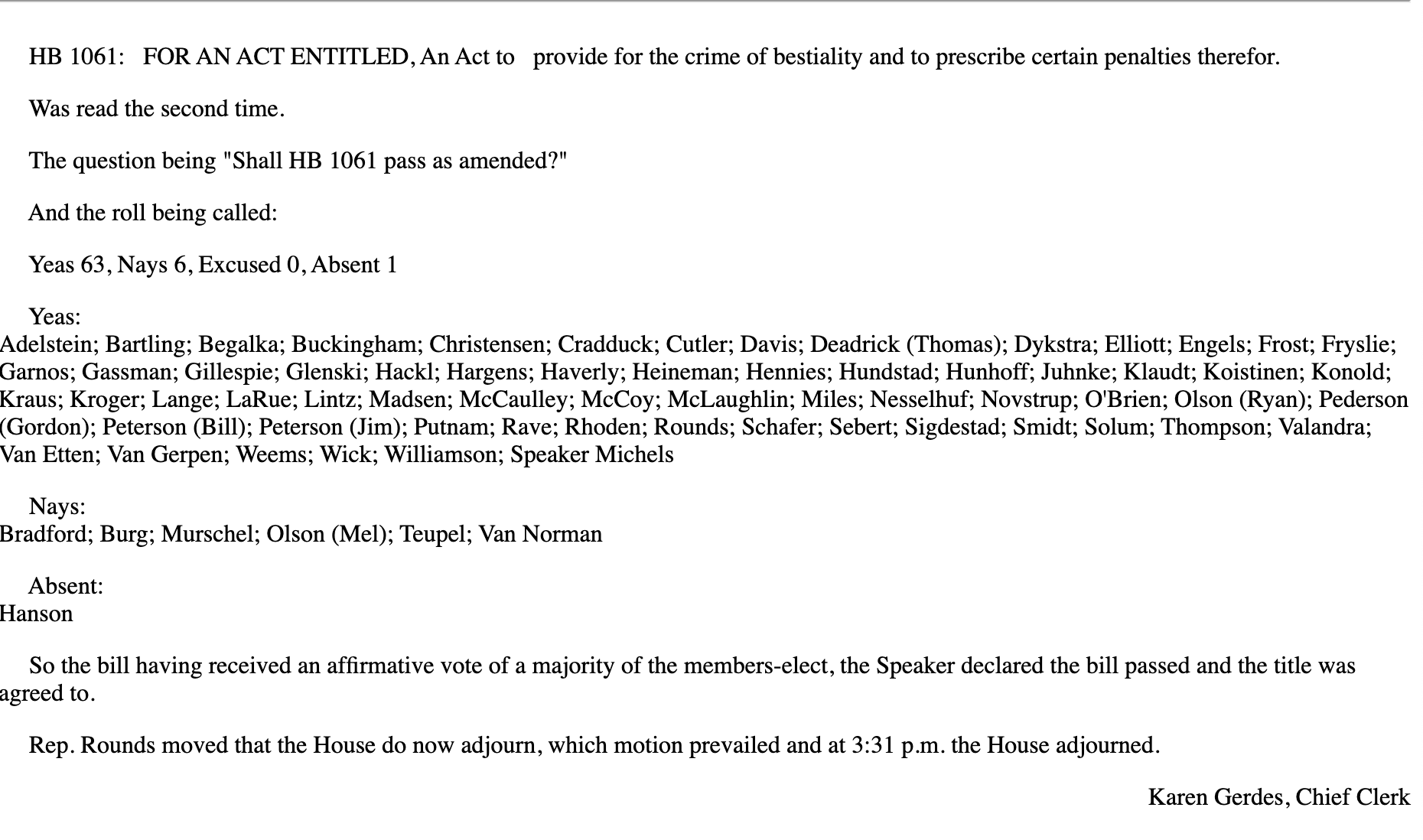
In 2003, a measure was proposed to the South Dakota State Legislature, House Bill 1061, to provide for the crime of bestiality. Basically South Dakota has done away with it as a law at one time, but was finally getting back around to a bill to say it was ok to like your horse..but it needed to draw the line at the relationship being strictly platonic.
But there was surprisingly some opposition to it. And the most vocal was State Representative John Teupel.
Legislators didn’t like talking about the measure at all on the floor because of the topic dealing with some of the worst sexual deviants, but Representative Teupel got up and gave his speech. While he claimed he “wasn’t rising in opposition of the bill,” he did have a very detailed three point notation of his “concerns.” #1, “With a class 6 felony, they usually have an identified victim of the crime.” #2 “With the prosecution of a crime like this, there’s not really a plaintiff you can put on a witness stand.” And there was also concern #3..
Concern #3 was the concern that kids who were “sexually experimenting” would be caught in something like this as a young age, and be labeled permanently as a sex offender, when it might have “been a phase that they would have outgrown.”
Teupel went on declare that he’s not “opposed to the measure” but “has concerns about the legislation.” And despite his concerns, he actually was an opponent, and went on to be one of the votes against making bestiality a crime.
Obviously, with people still remembering it in 2020, it hasn’t been forgotten.
So, looking at my previous story, while I think the fighting with police constituency is pretty small in District 31, I tend to think the constituency against bestiality being a crime is probably even smaller.
And that’s why I’m still not going to support former State Representative John Teupel for State Senate in D31.
Thune Questions IRS’ Handling of Private Taxpayer Information, Calls for Better Customer Service for South Dakotans
“I hear from a lot of South Dakotans who are frustrated with the IRS. Many are reaching out to my office as their returns are over six months behind. Not only are they frustrated with the delay, but with the lack of assistance as it feels impossible sometimes to reach an IRS representative.”
Click here or on the picture above to watch the video.
WASHINGTON — U.S. Sen. John Thune (R-S.D.), ranking member of the Subcommittee on Taxation and IRS Oversight, which has jurisdiction over tax and other revenue measures, today questioned Internal Revenue Service (IRS) Commissioner Charles Rettig at a hearing on President Biden’s fiscal year 2023 budget and the 2022 tax filing season. Thune questioned Commissioner Rettig on the administration’s poor response to the IRS’ recent data breach or leak, which led to private taxpayer information being published by ProPublica, a left-leaning media organization. Thune also called out the IRS for its notoriously poor customer service
Thune spoke on the Senate floor last week and criticized the IRS’ failure to deliver basic customer services and the negative effect it has on South Dakota taxpayers. Last September, Thune led a letter to Senate Majority Leader Chuck Schumer (D-N.Y.) urging him to abandon the Biden administration’s unprecedented proposal to expand the reporting of the private, confidential financial data of law-abiding Americans from financial institutions to the IRS. Thune’s letter was signed by every Republican member of the Senate Committee on Finance and the Senate Committee on Banking, Housing, and Urban Affairs
On ProPublica’s 2021 leak or breach of private taxpayer information (excerpt):
“Since last year’s IRS data breach or leak of private taxpayer information, which the left-leaning ProPublica went out on to publicize confidential taxpayer details, there has been no meaningful follow-up from the administration. In your March 8 response letter to Finance Republicans, you pointed to Secretary Yellen’s testimony that said the Department of Treasury, the Office of the Inspector General, the FBI, and the Department of Justice are conducting independent investigations into this matter. This apparent leak or hack of private taxpayer information is a serious breach of trust between taxpayers and their government. And it is simply inexcusable that the administration hasn’t provided any accountability.
On the IRS’ customer service shortfalls (excerpt)
“I hear from a lot of South Dakotans who are frustrated with the IRS. Many are reaching out to my office as their returns are over six months behind. Not only are they frustrated with the delay, but with the lack of assistance as it feels impossible sometimes to reach an IRS representative.”
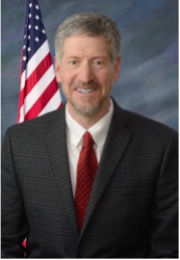
Gary Schuster announces his candidacy for the 12th District South Dakota State House
“I’ve been interested in politics from an early age,” said Gary, “and decided that now is the time to take action. South Dakota is a great state and has largely avoided the political craziness that has taken hold in many of our nation’s large cities and states.
Nevertheless, we need to be aware that even in South Dakota our liberties will slowly erode if we don’t actively defend them.”
Gary is a retired metallurgical engineer. He has a Bachelor’s degree in Physics from Iowa State Univ. A PhD in Metallurgical Engineering from the Univ. of Illinois and an MBA from the Univ. of South Carolina. He was raised on a farm near Pleasantville Iowa. He’s lived all across the United States and his jobs have taken him to many countries. Even so he’s never forgotten his early life on the farm and has respect for anyone that is honest and hard working. He sincerely believes that government should strive to create an environment that gives people the most opportunities to succeed and minimizes what is taken from them in the form of taxes and fees. He’s a fiscal conservative and constitutional originalist.
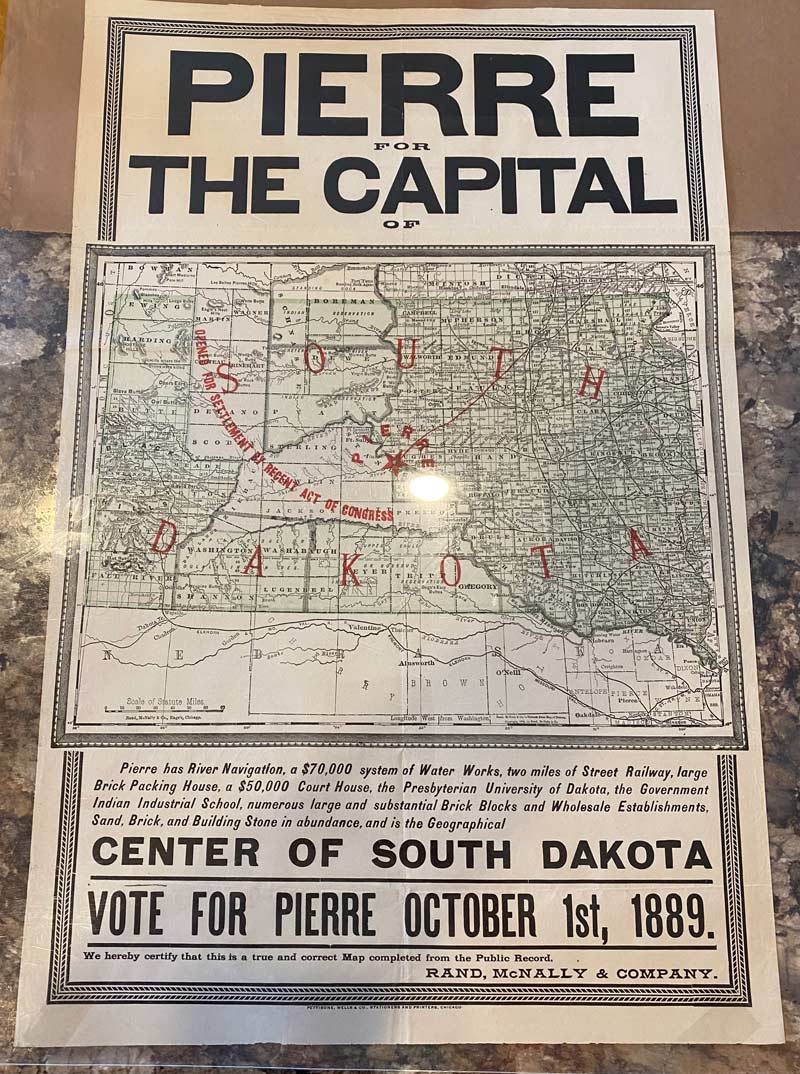
My longing and waiting are over. My 1889 Pierre for Capital Map/Broadside finally arrived!
And as hoped, it is in mint condition, as much as anything from 1889 could be hoped to be. It’s in much better shape than the one from the State archives. It’s sandwiched in plastic sheeting (hence the glare) for transport, and they did a masterful job of getting it to me in one piece.
Already planning to get it, and a map of South Dakota I bought many years ago with the first 5 governors at the top, matted and framed. Until then, I’ve got it squirreled away until I can get them to Sioux Falls where I’ll have them done.



 Gary Schuster announces his candidacy for the 12th District South Dakota State House