Sen. @LeeSchoenbeck released the names the House members who signed petition supporting special session on impeachment, despite efforts by Speaker @SpencerGosch to keep them secret. 49 House members signed.
An article from Christopher Vondracek this morning in the Forum News Service/Grand Forks Herald doesn’t exactly paint a bright portrait of how things are progressing in the House Select Committee for Impeachment in the case where they’re attempting to bring action against the Attorney General:
“This is way beyond the scope of anything we’ve done,” said Jensen, who added he was just “trying to figure out how to get things done in a timely manner.”
And..
Moreover, the Legislature’s select committee hasn’t been keeping the most brisk of calendars. After meeting more than two weeks ago, they’ve yet to meet since. On Tuesday, Nov. 23, Gosch told Forum News Service that “likely next week” would be when the team next meets.
And..
On Wednesday, Nov. 24, the committee’s vice-chair, Rep. Mike Stevens, R-Yankton, also said he’d yet to hear a meeting for next week confirmed. Asked if they’d hired the special counsel yet, Stevens said, “You’d have to talk to the speaker about that.”
Considering the AG pled No Contest to minor traffic offenses (a lane change violation and using his phone while driving a few miles before the accident) this whole impeachment business might be a lot more complicated than people think.
The South Dakota Republican Party campaign school this morning with Leadership Institute has a great crowd, and a number of people that I’ve never seen before. That’s indicative of a high interest and very active campaign season!
This follows a recent Morning Consult from 10 das ago story showing that Noem’s approval among South Dakota Republicans is sky high at 86%:
This leaves Thune roughly matching Noem’s popularity among GOP voters in the state (86 percent approval), though they are less likely to strongly approve of their senior senator than they are their governor (33 percent to 53 percent).
During the Second Special Session of the week, there was an interesting vote from conservative corners of the State House against moving forward with the impeachment of Attorney General Jason Ravnsborg:
HR 7001 – Establishing a select committee to investigate whether articles of impeachment should issue against Jason Ravnsborg, Attorney General of the State of South Dakota, and draft any resulting articles.
The question being “Shall HR 7001 pass as amended?”
And the roll being called:
Yeas 58, Nays 10, Excused 2, Absent 0
Yeas:
Anderson, Aylward, Bartels, Barthel, Beal, Blare, Bordeaux, Chaffee, Chase, Cwach, Davis, Dennert, Derby, Deutsch, Drury, Duba, Finck, Fitzgerald, Goodwin, Lana Greenfield, Hansen, Healy, Hoffman, Jamison, Kevin Jensen, Chris Johnson, Keintz, Koth, Ladner, Lesmeister, May, Milstead, Miskimins, Mortenson, Mulally, Olson, Ernie Otten, Perry, Kent Peterson, Pischke, Randolph, Reed, Rehfeldt, Reimer, Schneider, Jamie Smith, St. John, Stevens, Thomason, Tidemann, Vasgaard, Weis, Weisgram, Wiese, Willadsen, Wink, York, and Speaker Gosch
Nays:
Gross, Haugaard, Howard, Phil Jensen, Karr, Marty, Mills, Odenbach, Overweg, and Soye
There were 10 “NAY” votes, mainly from strongly conservative quarters, with three of them Attorneys, and one outsider Congressional challenger in Taffy Howard.
What brought those Legislators to vote no on establishing a committee to review whether impeachment is warranted? A recent newspaper column from State Rep. Steve Haugaard in the Brandon Newspaper may shed some light on it:
What seems to be missing in all of this is any indication that there was any action on the part of the Attorney General that rises to the level of maliciousness, recklessness or even carelessness. That is why the ‘careless’ charge was dismissed in an effort to resolve the case. Anyone who has operated a motor vehicle knows that there are very brief moments when our eyes are not focused on the road ahead or something suddenly comes at us from the side, and that is apparently what happened that tragic night. If that happened to anyone else it would be found as tragic and the matter would be at an end.
Certainly, we should hold our elected leaders to a higher standard, but should one be forced to resign based upon an absolute accident? No one can seriously believe that the Attorney General sought to cause a death, or now, based upon the evidence, that the Attorney General was ‘reckless’ or even ‘careless?’ After an exhaustive review of the actual evidence, the State’s Attorney could not find ‘reckless’ behavior and willingly dismissed the ‘careless’ charge apparently due to the fact that the evidence would not ultimately be found sufficient.
When anyone reviews the work of AG Ravnsborg since his election, and especially since last September, it will be apparent that he has done an excellent job overseeing the Attorney General’s office and that he has continued to do his job, serve the state, accomplish victories for the State and developed relationships with the tribes that create a pathway for ongoing success.
Rep. Haugaard seems to tip his hand in the article, and gives the impression that he will be one of the chief forces arguing against impeachment of the Attorney General.
With popular opinion for impeachment inflamed by media coverage versus the minimal traffic violations the AG pled ‘No Contest’ to, it is interesting to see the degree of pushback on impeachment as well as where it’s originating from.
From the SoDak Governors Blog, Former Chief of Staff and member of the Board of Regents Tony Venhuizen eulogizes fellow former Chief of Staff Jim Soyer, who passed away yesterday:
Jim Soyer, a former chief of staff to Gov. Bill Janklow and longtime Governor’s Office staffer, has passed away.
Jim Soyer was, to my knowledge, the longest-tenured employee in the history of the South Dakota Governor’s Office. With only a couple of short interruptions, he served in the Governor’s Office in various capacities from 1979 to 2015.
and..
One rule in particular always stayed with me: “Always do the right thing, and don’t consider the politics. Once you’ve decided what to do, politics will help you decide how to explain it and achieve it. But never let politics stop you from doing the right thing.”
From an article in the Argus Leader, PUC Commissioner Gary Hanson has announced that his current term is his last:
Gary Hanson had been attending to the affairs of his father, as well as his duties on the PUC, this summer.
Next year will mark his 20th year on the PUC, having won a new six-year term in 2020. And when that term is over, Hanson said he is done with political office.
and..
All told, Hanson has run in 18 elections, including primaries, runoffs and general elections. He hasn’t lost one of them.
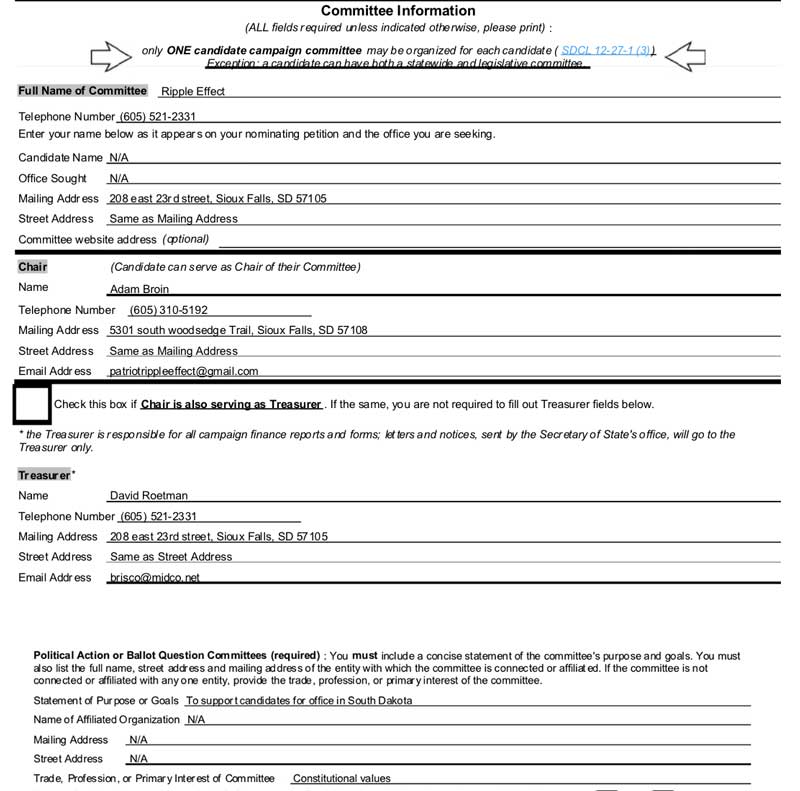
Had a lot of chatter and tips this week that seems to circle back to an organization I’ve recently written about, the Patriot Ripple Effect Group/Political Action Committee based out of Sioux Falls. The group is chaired by Adam Broin, with former Minnehaha GOP Chair Dave Roetman serving as treasurer and main contact for the committee.
I’m told that new Sioux Falls at-large city council candidate Bobbi Andera is a very politically conservative recruit of this group in one of their first forays into finding candidates. She is running to take on incumbent Janet Brekke for one of the at-large Sioux Falls City Council spots. (City Council race watchers should also be aware that word is also that a not-so-hard-right candidate with broad based support will also be getting in the race.)
But even more interesting, I’m also being told that this race was NOT Andera’s first choice. I was told last night that she was originally recruited to run in a primary election against State Representatives Sue Peterson and Richard Thomason in whatever ends up as the reconfigured District 13 legislative district. And that information was in the wild as much as 2-3 months ago, and the switch to City Council is only a very recent development.
The word is that the intent was to try to take out Thomason because there are those who view him as not being one of the hard right members of the Sioux Falls legislative delegation. And the group has eyes on replacing several incumbents they see as not following their dogma.
Now that brings me up to this afternoon. In conjunction with tracking down some calls being made by one of the leaders of this group in the race for AG, I’m told that the Patriot Ripple Effect group is ALSO recruiting for Republican Party precinct positions in hopes of influencing candidate selection.
While legislative races are selected in primaries among Republicans in the population at large, this push for precinct people is a very big deal for Constitutional office candidates; those offices from Lt. Governor down through Public Utilities Commission, as those delegates are the ones who directly select those offices at the State Republican Convention which will be in Watertown next June.
In recruiting for precinct slots, with enough people they could hold sway over who wins the contested races at the next Republican Convention. Which at the moment are currently Attorney General & Commissioner of School & Public Lands. But, there could be more in this environment of political conflict.
The number of precinct people I was given was that they may be hoping to recruit was around 250 precinct people statewide to help forward their agenda.
With precinct people, that group can also further influence races, as party committee precinct people are the ones who make the replacement selections if legislative candidates drop out of running during the election cycles. Of course, wielding that influence also continues in races in late 2022/early 2023 for county party officials.
It’s hard to guess whether the group is going to gain any traction or influence.
The Pandora Papers: Puff and Point
by Thomas E. Simmons
A tenured professor at the University of South Dakota School of Law, Thomas Simmons concentrates on trusts, estate administration, and the estate tax. Prior to joining the legal academy, he was a partner with the law firm of Gunderson, Palmer, Nelson & Ashmore, LLP
Since Monday, there has been a buzz – to put it mildly – relating to the trust administration industry in South Dakota. The leaking of 11.9 million private financial records was very big news and it’s reverberating around the globe.
Let me say that again: eleven-point-nine-million financial records. How much data is that?
Simmons is a professor at the University of South Dakota’s Knudson School of Law and concentrates on trusts, estate administration, and the estate tax. Prior to becoming an academic, he was a partner with the Rapid City law firm of Gunderson, Palmer, Nelson & Ashmore, LLP.
I think it’s fair to guess that some financial records are more than just one page long. Let’s say on average – conservatively – a financial record comprises three pages. (The records include a variety of documents; emails, spreadsheets, contracts, etc.) At three-pages each, that amounts to 35 million pages.
A full set of the Encyclopedia Britannica is about 32,000 pages. So, that’s 1,093 sets of encyclopedias worth of leaked documents.
I don’t know about you, but – despite my ambitions as a young person – I never finished reading our family’s encyclopedia set. (We had the World Books at our home, which are a slightly easier read than the Encyclopedia Britannica.)
I never completed even a single volume, although I made it partway through “L” if I recall correctly. If a person could finish reading a full set of the Encyclopedia Britannica at the near-maniac speed of six months, at that rate, it would still take over 500 years to sift through the entire Pandora Papers. Maybe you delegate the task to 100 persons; that way it would only take five years.
The project to bring the Pandora Papers to light reportedly engaged 150 news organizations, and you would need that kind of workforce to make even a small dent within a reasonable period of time – otherwise the information would be too stale to be newsworthy. And some of the information is too stale to be of much interest as it goes back to as early as the 1970s.
My point is this: It’s a lot of documents. An almost unmanageable volume of documents. The Washington Post refers to it as a “massive trove.” They’re not kidding.
Nevertheless, journalists have somehow managed to summarize them for the public. What do they show?
Thus far, the Pandora Papers journalism has identified several bad actors who have utilized trusts. There are, for example, indications that a Cambodian antiquities dealer named Douglas Latchford used trusts to traffic in looted cultural artifacts. The Department of Justice caught up to him and he hadn’t utilized a South Dakota trustee but rather a trust company in Jersey (one of the Channel Islands off the coast of France). Latchford died last August.
For trusts administered in South Dakota, there are accusations, too. The journalists list 30 South Dakota trusts holding shares in companies which have been accused of “corruption, human rights abuses or other wrongdoing.” That’s a concern, and one which should be taken seriously by professional trustees and government regulators of trust companies alike. But it’s also important to note what the allegation says – and what it doesn’t say.
The allegation is that some trusts administered in South Dakota hold shares in companies which have been accused of wrongdoing.
My friend owns shares in Volkswagen AG, a Germany company not just accused of wrongdoing, but guilty of violating the Clean Air Act by fraudulently manipulating emissions test results (the “diesel dupe”).
I personally used to hold some shares in Wells Fargo Bank, N.A., an American company not just accused of wrongdoing, but actually guilty of an account fraud scandal of such staggering proportions that it generated a $3 billion dollar fine. (That’s billion – with a “b.”)
Those are examples of some pretty serious corporate wrongdoing and not mere allegations. Now, I could just as well own some Wells Fargo shares in trust, let’s say a college-savings trust I’m managing for my children’s future college costs. I’m pretty sure that would not make the front-page news.
There are some points in the Pandora Papers journalism which are emerging as concerns that deserve attention and perhaps even regulatory reforms. But, at least so far, there’s also quite a bit of puff. With such an enormous stack of documents, perhaps there are more serious concerns to come.
Or perhaps not.
—
These are the views and opinions of the writer and not those of the University of South Dakota, its Knudson School of Law, or the South Dakota Board of Regents.