National Republicans are showing up to advance agricultural export policies…here in South Dakota.
by Luke Lindberg, South Dakota District Export Council
Tomorrow, the South Dakota District Export Council will host a Midwest Agricultural Export Summit for the first time. This regional event brings together agricultural leaders from six states, SD, ND, IA, MN, NE and KS, to coordinate on export policies that will help our farmers and ranchers feed the world. And the speaker list is top-notch.
As we put out requests for individuals to join this summit, the response was overwhelming, particularly from well-known, Republican leaders in agricultural policy. Currently, we have seven confirmed speakers who were appointed to government posts by President Donald J. Trump (myself included) and four confirmed Members of Congress. I’m also pleased that Governor Noem will welcome the attendees to South Dakota.
The speaking list includes:
Former Appointees
- Ambassador Terry Branstad, Former Ambassador to China and Governor of Iowa
- Ambassador Kip Tom, Former U.S. Ambassador to the United Nations Agencies for Food and Agriculture, and Chief of the U.S. Mission to the United Nations
- The Honorable Kimberly Reed, Former President and Chairman of the Export-Import Bank of the United States
- The Honorable Ted McKinney, CEO of NASDA and Former Undersecretary of Agriculture for Trade and Foreign Agricultural Affairs
- The Honorable Ken Barbic, Head of Policy and Government Relations at Farmer’s Business Network and Former Assistant Secretary of Congressional Relations at USDA
- The Honorable Michelle Bekkering, Director of National Engagement at the U.S. Global Leadership Coalition and Former Assistant Administrator at USAID
- Luke J. Lindberg, Former Chief of Staff and Chief Strategy Officer at the Export-Import Bank of the United States
Members of Congress
- The Honorable John Thune, Senate Minority Whip and U.S. Senator from South Dakota
- The Honorable Dusty Johnson, U.S. Representative from South Dakota
- The Honorable Randy Feenstra, U.S. Representative from Iowa
- The Honorable Michelle Fischbach, U.S. Representative from Minnesota
And our very own Governor, Kristi Noem!
Unfortunately, we were not able to secure any Democratic speakers, despite our best efforts.
The South Dakota District Export Council is hosting this event to ensure our farmers and ranchers are paid a fair price for their meats and grains. Today’s geopolitical environment is far too uncertain for us not to plan for the future, expand access to new markets, and develop the infrastructure needed to export our products.
Please join me in welcoming these great Republicans to South Dakota!


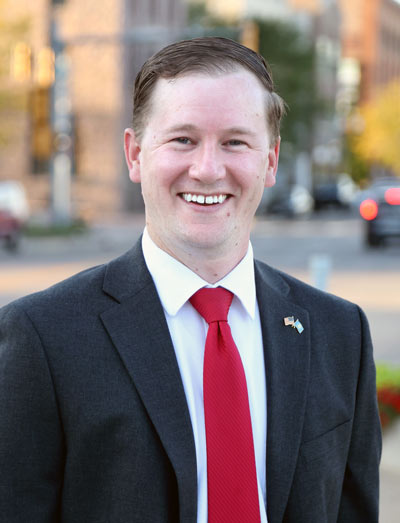 SIOUX FALLS, SD – Joe Kippley has filed to be a candidate for the Republican nomination for the Minnehaha County Commission. Kippley was born and raised in Brookings, SD. He has lived in Sioux Falls since 2016 and works at Sanford Health as an administrator within the Imagenetics program. Kippley is married to his wife, Amanda, and they have two children, Grace (3) and Rose (2).